
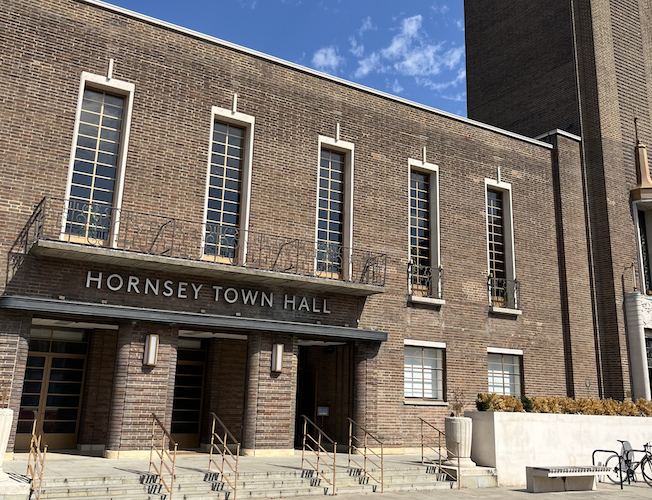
The reorganisation of London local government in 1965 left a crop of redundant town halls across the capital. Hornsey Town Hall was arguably the finest of them. Completed in 1935, it was declared the best new building in London by the Royal Institute of British Architects and later described by the 20th Century Society as the “quintessential English modern public building of the decade”. It was Grade II* listed in 1981.
But by 2000, its custodians, Haringey Council, had declared it surplus to requirements and for more than a quarter of a century it was a fixture of Historic England’s “Heritage at Risk” list.
When I first went inside it some 20 years ago, it was in a sorry state. There was severe water damage from leaking roofs and the asbestos-riddled council chamber was sealed off. The sprung floor and elegant wood panelling in its 1,000-seat assembly hall were in serious disrepair and a grand piano, already beyond saving, stood slowly rotting away on the stage.
It was a familiar story of a cash-strapped council, planning rows and political and community conflict as various rescue bids came and went – very different from the municipal optimism that saw the old Hornsey borough consciously embrace modernity when it invited proposals for a new headquarters in 1933.
Reginald Uren’s winning design was in striking contrast to Crouch End’s late Victorian and Edwardian townscape. Modelled on the much-praised Hilversum town hall in Holland, it was almost universally well-received, the “sort of building that is come upon with an exclamation of pleasure,” said the Times.
The assembly hall became one of the “main cultural and social centres for north London” according to the Hornsey Historical Society. In 1971, it hosted the rock band Queen’s first ever live show and before that some of the first performances by Ray Davies of the Kinks, as well as countless dances, pantomimes, community and political events and local school speech days still remembered by older Crouch Enders.
But the 1965 absorption of Hornsey into the new London Borough of Haringey, which chose Wood Green civic centre for its HQ, marked the beginning of a slow decline. The assembly hall, getting tired and deemed too costly to maintain, closed in 1987, and the whole complex, as John Boughton’s Municipal Dreams blog sets out in a comprehensive chronicle, was “essentially redundant” by 2004.


Schemes for a community trust and later a takeover bid by the nearby Mountview theatre school came to nothing, scuppered by a combination of the financial crash, lack of public or grant funding and the sheer cost of restoration. In 2017, this was estimated at £10 million just to get the building off the “at risk” list. When the council mooted a straight disposal, locals took to the streets in protest. Meanwhile the building continued to deteriorate.
This is a story with a happy ending, though. Haringey’s leadership took a risk, faced down the protestors – at some political cost – put the site on the market and concluded a deal with Hong Kong-based developers Far East Consortium (FEC), controversially trading affordable quotas on the proposed 135-home development to the rear of the town hall in order to prioritise the restoration.
Seven years and some £30 million later, the outcome is impressive, as I saw when I went back to the building on a London Society tour hosted by lead architect Katy Ghahremani from international practice Make. The assembly hall, committee rooms and council chamber are fully restored as community and event spaces. There’s a café and co-working spaces together with a 67-room hotel in the old office wing. A couple of the rooms are still labelled “director of education” and “borough engineer”. A cinema and a rooftop bar are to come.
For Ghahremani the task was a seven-year labour of love, restoring interiors where possible, hunting through a council warehouse to retrieve and then reupholster original furniture, repairing or replicating light fittings, rotted flooring and wall panels, uncovering and restoring the hall’s walnut proscenium arch, finding an 80-year-old clockmaker to repair the building’s 78 clocks, all of them controlled by a single synchronometer to make sure meetings started on time. As a restoration job, it is surely a success.
The new apartment blocks making that possible, despite prompting much criticism at the planning stage, fit well too, I think, with new public garden spaces and pedestrian routes linking the hall to the neighbouring Hornsey Library, itself a distinctive Grade II-listed 1960s building, recently sympathetically renovated, giving a calm campus feel to the complex.
There are some concerns that promises of a fully-fledged arts centre remain to be realised, with FEC recently selling the building on to new overseas owners AMTD. Commitments to community use and access remain in place, however. A programme including “baby salsa”, a children’s arts course and an upcoming jazz-reggae crossover night is underway, and there are hopes that Haringey’s term as London Borough of Culture in 2027 will be the catalyst for further activity, putting the venue on the map.
The Crouch End Neighbourhood Forum (CENF) website still features a picture of those local protestors with placards proclaiming “Hornsey Town Hall Not For Sale” and many, in an ideal world, might have preferred a less commercial solution.
But the CENF and, I would guess, many other locals also acknowledge that real world trade-offs were required after almost two decades of trying and failing to find an alternative. And the benefits of the council deal – full restoration and a sustainable future for the complex, with ongoing community use and access have been secured.
Crouch End has its Town Hall back and, as Ghahremani put it, “If the council hadn’t pushed this through it wouldn’t have happened. It would have stayed empty for another 30 years.”
Follow Charles Wright on Bluesky. Top photo by Charles, interior one from Make.
OnLondon.co.uk is funded by sales of publisher and editor Dave Hill’s twice-weekly newsletter On London Extra. To receive it, become a paying subscriber to Dave’s personal Substack. Thanks.