
The government announced in March that London would be getting two New Towns, one at Thamesmead in Greenwich and the other at Crews Hill and Chase Park in Enfield, where housebuilding is set to be “accelerated”.
The Thamesmead plan for 15,000 homes on brownfield land enjoys broad political support and is already being boosted by a major transport upgrade, with the Docklands Light Railway extension to Thamesmead now going ahead. But in Enfield, it’s a much more complicated story.
When the government’s New Towns Taskforce first recommended the Enfield location last September, it was fully supported by the council’s Labour administration, which – as I detailed in my last piece for OnLondon – was itself about to finalise a new Local Plan allocating 9,200 homes to Crews Hill and Chase Park.
The New Town, however, more than doubles that number to 21,000, while the government has also identified it as one of three sites where it wants to see “spades in the ground” by 2029.
Of course, the reason this New Town is far more controversial and complex than the one in Thamesmead is that it’s planned to be built entirely on Green Belt – the ring of protected land around the city that has limited urban sprawl since the post-war period.
Although the Labour government has pointed out that some of today’s Green Belt is not, in fact, very green and would be better described as “grey”, the likely area of the Enfield New Town will still chiefly comprise of greenfield land – a mix of farms, grazing pasture, equestrian centres and golf courses.
The parts that could be classified as “grey belt”, meanwhile, are mostly sites providing employment – the many garden centres and small businesses of Crews Hill, where around 1,000 people work at present.
Enfield Labour’s unwavering support – firstly for the Green Belt allocations in the council’s Local Plan, and then for the New Town which doubled the size of those developments – has now come at an extremely heavy political cost.
In May’s local elections, Labour lost control of Enfield Council for the first time in 16 years. The Civic Centre is now run by a minority Conservative administration which made “saving the Green Belt” its core campaign message.
Despite Labour and the Greens between them potentially having a “progressive” majority of seats, the borough’s five new Green Party councillors decided instead to abstain on the vote for a new council leader – prioritising their own pledge to protect the Green Belt.
In the immediate aftermath of the election, former council leader Ergin Erbil denied that the Green Belt and the New Town were key factors in his party’s defeat, but the electoral maths strongly suggest otherwise.
This year’s Enfield elections were not the first in which the Green Belt was considered a key issue. In 2022, a year after the council first proposed any kind of Green Belt development, Labour lost eight seats to the Conservatives at a time when the Tories nationally were enduring heavy electoral punishment for the “Partygate” scandal.
While Enfield Labour’s traditional support has always been centred in its eastern heartlands, in order to control the council the party has always needed to win at least a handful of wards in the west, where the local connection to the Green Belt is far stronger.
It should not therefore have been a surprise to see Enfield Labour losing its majority this year. But it did, seemingly, come as a surprise to the government, which had been counting on Labour to stay in control of Enfield to help deliver the New Town.
During the election campaign, Steve Reed – at that time the housing secretary – visited the borough and spoke to me for a piece in my paper Enfield Dispatch. He admitted to having no plans at that time to visit Crews Hill or for talking to the garden centre owners facing compulsory purchase, although he did acknowledge that businesses should be “supported” to relocate if necessary. On the prospect of the Tories taking power locally, Reed said: “I hope that won’t happen.”
Now that it has, the government faces a dilemma. Conservative council leader Alessandro Georgiou’s first act in charge was to “formally withdraw” the local authority from the New Towns process, a decision which sparked uproar in Labour circles and even drew a rebuke from the then Prime Minister, Sir Keir Starmer, who issued a statement in June slamming Enfield Council for being “naysayers” who were “blocking growth”.
While it has been easy for some to label opponents of the new town “Nimbys”, attacking people in such crude terms is unhelpful to the broader debate – and certainly doesn’t help win votes.
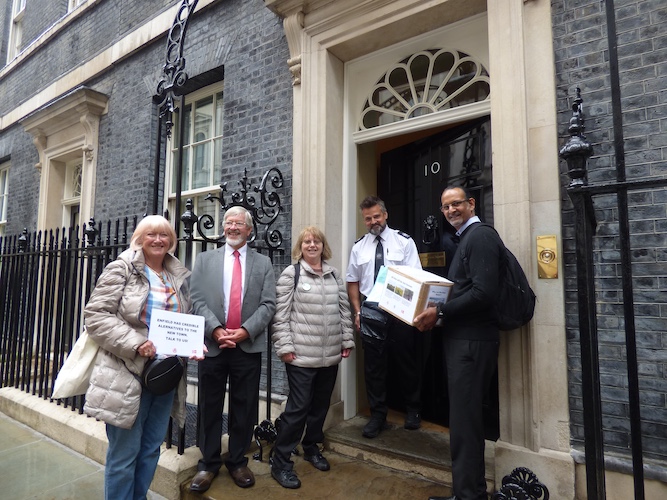
Contrary to such perceptions, from the conversations I’ve had with local people in Enfield there seems to be a general acceptance that building some homes at Crews Hill makes sense. It has a railway station, it has employment (as long as businesses are not forced out), and it’s clear the area has unfulfilled potential for residential expansion. The bigger debate is around what would or would not be an appropriate scale of development and what level of infrastructure would need to come with it. Alternatives to a New Town have been proposed (see main photo).
The so-called Chase Park site, on the other hand (below), is completely different in character: almost every part of it is greenfield of one kind or another and there’s no station within a 15-minute walking distance of it. At last year’s Local Plan hearings, even the council’s own representative admitted building homes there would cause “high harm” to the Green Belt.
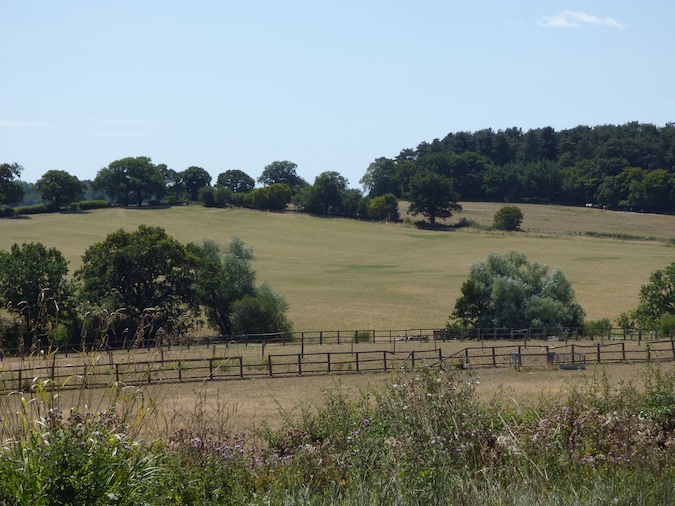

Among those now calling for Chase Park to be removed from the New Town plans is local Labour MP Feryal Clark, who served as a minister in the first year of the Starmer government.
In a recent comment piece for Enfield Dispatch, Clark wrote, “I believe the way forward must be guided by two equally important principles: addressing the genuine housing pressures facing local families, while ensuring that any development of this scale only proceeds with the infrastructure, environmental protections and community involvement that residents rightly expect.”
She added: “The current New Town proposal envisages around 21,000 homes. That level of development is excessive. By removing Chase Park and other areas of high-quality Green Belt, the number of homes could be reduced while still making a significant contribution to housing need and reducing the impact on valued green spaces.”
In Starmer’s statement on the “naysayers” last month, he strongly hinted at the creation of a Mayoral Development Corporation to push the Enfield New Town forward. Mayor of London Sir Sadiq Khan – perhaps as an enticement – could at the same time be handed control of the rail route through Crews Hill, something Transport for London has long coveted.
But if there’s any lesson to be learned from the way the New Town project has been handled so far – and the way Enfield Labour has been electorally punished – it surely has to be that ignoring local views does not pay dividends.
What happens next is now up to the pro-devolution government of new Prime Minister Andy Burnham, who promised upon taking office to “make politics more collaborative”.
Update, 27 July 2026. More Enfield Green Belt news has broken.
James Cracknell is the editor of Enfield Dispatch. Follow him on Bluesky.
OnLondon.co.uk is funded by sales of publisher and editor Dave Hill’s twice-weekly newsletter On London Extra. To start receiving it, become a paying subscriber to Dave’s personal Substack. Thanks.