
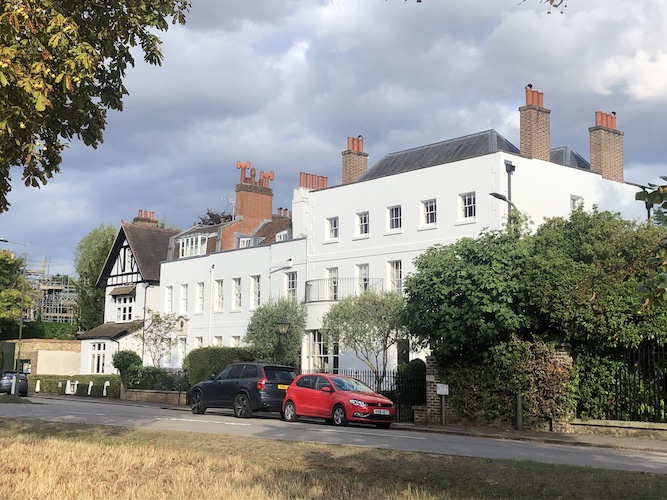
Approaching Monkenholt, a late 18th Century, Grade II listed house just north of Chipping Barnet, I tried to imagine the scene in January 1971 when two bombs were placed outside it.
Such details no doubt emerged during the ensuing criminal trial, but as I took in the scene more than half a century on, I confected a mental picture of a van pulling up at the edge of neighbouring Hadley Green and a pair of scrawny hippies bearing devices made at home tip-toeing through the front gate then scuttling off again before a local curtain twitcher could spot them.
But the episode was no comic caper. Monkenholt was the home of Secretary of State for Employment, Robert Carr. The attack on it was the work of the Angry Brigade, a radical Left-anarchist group. Both of the bombs ignited. Carr, his wife and the younger of their two daughters were in that evening. They were unhurt, but the damage to the house was considerable and the feeling that the country was going up in flames intensified. Carr’s comments at the scene (below and here) spoke to the era’s anxieties.
Monkenholt had previously been the home of Cicely Saunders, born in Barnet when it was part of Hertfordshire and revered for her role in the creation of the hospice movement. The Angry Brigade’s story, though, was still unfolding.
They had been blowing up things in London for a while, favouring banks and embassies, but the attack on Carr’s home was an assassination bid. The Met set up a squad to catch them, and in August of the same year raided a house at the Stoke Newington end of Amhurst Road in Hackney – coincidentally, just a five-minute walk from where, four years earlier, a Mr Reginald Kray stabbed a Mr Jack “The Hat” McVitie to death. They found a tidy cache of gelignite and weapons. Eight people faced charges as a result.
In November 1971, a different Angry Brigade member was convicted in connection with the Carr attack (for which he later apologised), and in 1982 the “Stoke Newington Eight”, as they came to be mythologised, went through a famously long Old Bailey trial. Four were acquitted, four were jailed.
Given their predicaments at the time, it perhaps wasn’t any of the above who – as well a man who introduced himself in a phone call to the Met as a member of the Irish Republican Army – claimed responsibility on the Angry Brigade’s behalf for planting the bomb that went off in October 1971, in a toilet in what was then known as the Post Office Tower.
No one was ever charged with causing that. But the Angry Brigade link – or the absence of one, as the case may be – is what prompted me last week to take a wander through N16 and then to travel to the High Barnet end of the Northern line to look at Monkenholt and try to conjure up a sense of the London of that period.
The genesis of the Angry Brigade can be traced back at least as far as the anti-Vietnam war protests of 1968. Those were focussed on the the US Embassy, then in Grosvenor Square and a part of Mayfair often known as “Little America”. I think that may be where I next pick up my random London history trail.
John Vane’s London novel, a political satire called Frightgeist, can be bought from this very website.
OnLondon.co.uk is funded by sales of publisher and editor Dave Hill’s twice-weekly newsletter On London Extra. To start receiving it, become a paying subscriber to Dave’s personal Substack. Thanks.