
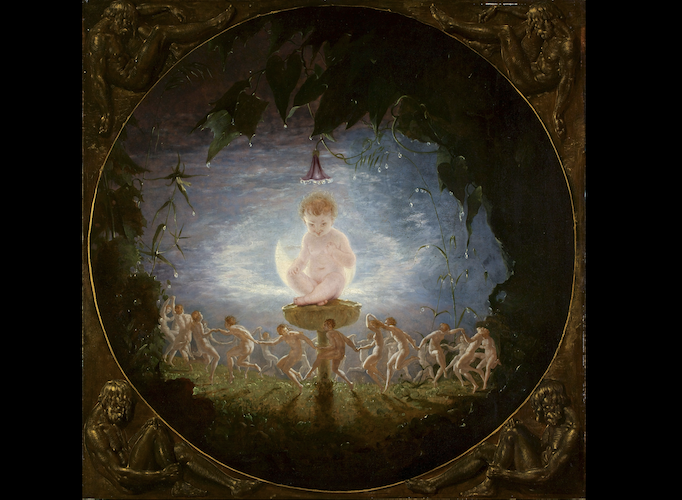
Richard Dadd produced some of the most extraordinary artwork of the Victorian era. His story is one of a hugely talented young man who, although afflicted by mental breakdown and tragedy, produced images from the depths of his illness and isolation that still fascinate us today.
A Royal Academy exhibition, which will run until 25 October, reflects growing interest in his work and is the most comprehensive since 1974. It brings together over 100 oil paintings, watercolours and drawings and takes you through the key phases of his life journey and artistic output.
Born in Chatham, Kent, in 1817, Dadd, came from a large, upwardly mobile family. Recognising the extraordinary talent revealed in his early drawings and paintings, Dadd’s father moved the family to London. He was ambitious for his son, and through his own work as a gilder developed a social network of artists and art lovers that would support the younger Dadd as he began to develop his career. He entered the Royal Academy School in 1837, and there pursued a conventional period of study, drawing and painting on themes from antiquity and Shakespeare.
The records show that he was the most conscientious student of his generation and was good – very good – and won prizes for his life drawing. Early on, he produced some very fine portraitures of friends and family. His 1839 portrait of his sister Maria Elizabeth, for example, is delightfully suggestive of her quiet beauty and sensitivity. But he found himself increasingly drawn to the uncanny and supernatural, particularly fairy creatures. His ability to paint in microscopic detail was already being refined and his work often displayed a disquieting strangeness in content and in the expressions of his subjects (see main image: Puck circa 1841).
In 1842, Dadd gained employment as an artist companion for the celebrated Welsh lawyer Thomas Phillips, who was about to set out on an ambitious tour of Egypt, the Holy Lands and Turkey. The pair were constantly on the move, rushing through different countries over an 11-month period. Dadd once wrote that half the time he didn’t actually know where he was. Without pause to stop and set up easel and paint, he crammed landscapes, faces and city views into tiny sketchbooks.
Unfortunately, it appears that over-stimulation by the sights and scenes of foreign lands began to affect his mental health. By the time of his return to London in the spring of 1843, he was unwell, suffering from delusions and paranoia and hearing voices. Friends and family became worried, but had no clear sense of how to help him. On the 28 of August, 1843 he killed his father and fled to France. There, after then trying to kill himself, he was detained and eventually repatriated then, in August 1844, sent to Bethlem Hospital, which at that time was in St George’s Fields in Southwark. He would spend the rest of his life in secure accommodation.
At the time of Dadd’s incarceration, Bethlem was based in a very grand building at St George’s Fields. Its central block is now part of the Imperial War Museum. The original hospital had been founded in medieval times as a religious charitable alms house in Bishopsgate. Records show that it was first referred to as a hospital for the “insane” in 1403, after which it has a continuous history of caring for people with mental distress. However, during the 18th Century, it gained a notorious reputation when Londoners were allowed to pay to visit and gawk at patients. Bethlem was often called “Bedlam”, and that word has long since entered the collective consciousness to describe unruly anarchy.
Dadd’s confinement appears to have been austere yet sympathetic to his condition. Few medical records were kept of his time there – after all he wasn’t being treated in the conventional sense, as he wasn’t going anywhere – but he was seen by staff as a complex character who could be both aggressive and threatening, but then completely charming.
Art therapy was not yet established as a discipline through which greater understanding of a patient’s condition could be appraised. and through which an easing of that condition could be achieved. But Dadd’s doctors encouraged him to find comfort in the skills of his youth, and he was allowed pencils, paints and paper. Dadd was happy to return to his work, and was soon producing portraits of his doctors and staff, and painting out some of the drawings in his traveller’s sketchbooks.
Dadd’s work was never exhibited during his lifetime and as most was given away to hospital staff, it vanished from public view. One of his most renowned pieces “An Artist’s Halt in the Desert” (1845), a dreamy nocturnal scene of the artist and Phillips making camp on their way to the Dead Sea, was only discovered through a chance visit to the Antiques Roadshow in 1986 by a couple curious about a picture they’d had in the family for a long time but kept in the loft.
Dadd’s most famous painting, The Fairy-Fellers Master-Stroke (below), was produced between 1855 and 1864. The critic Jonathan Jones has called it a “hypnotic vision of the microscopic secrets of the fairy realm at the bottom of every English garden”. It is unlike anything created anywhere else at that time – a masterpiece of minute, fantastical observation. The large crowds that gather round it in the gallery attest to its enduring popularity.

In response to the overcrowded conditions at Bethlem, the government built a new asylum near Reading. Set in the countryside, Broadmoor was purpose-built with terraces that overlooked the Berkshire fields and therefore more comfortable for patients. Dadd was moved there in 1864, and seems to have attained a more peaceful state of mind. His palette became more muted, with softer autumnal shades, and some of his work reflected his rural surrounds. Dadd died of tuberculosis in 1886 having spent more than 40 years in confinement.
Our understanding of Dadd’s life and work is largely down to the pioneering research of Patricia Allderidge, who became Bethlem’s first archivist in 1967. She systematically worked through the hospital’s archival records and collections to piece together a deeper, richer more complex assessment of Dadd’s life and work. Allderidge went on to produce a hugely influential catalogue to accompany the Tate’s 1974 exhibition. For many years, this was the only serious academic study of Dadd.
The fruits of her and others’ labours can be explored at the Bethlem Museum of the Mind, which was opened in 2015. More than just an account of the way treatment of psychiatric patients has changed, the museum records the lives and experiences and celebrates the achievements of people with mental health problems. And art can be central to those stories, shifting our perspective from art as recreation or art as evidence of states of mind to art made by people with lived experience of mental illness being valued in its own right – something the exhibition of Dadd’s work at the Royal Academy surely exemplifies.
Follow Richard Derecki on Instagram. Images of Dadd’s work from the Royal Academy.
OnLondon.co.uk is funded by sales of publisher and editor Dave Hill’s twice-weekly newsletter On London Extra. To start receiving it, become a paying subscriber to Dave’s personal Substack. Thanks.
You must be logged in to post a comment.