
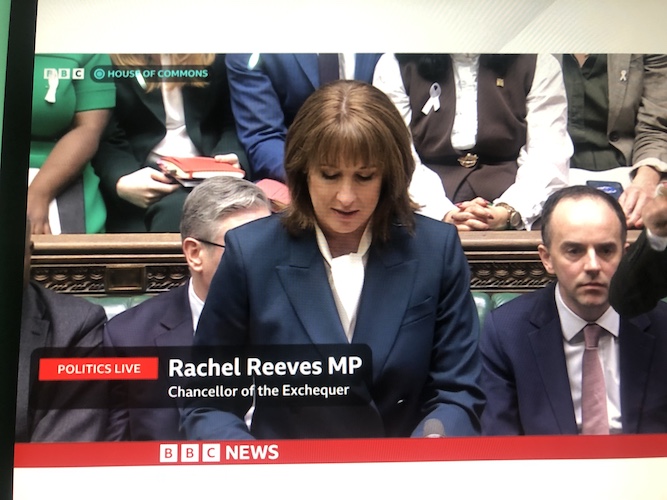
The decision by Rachel Reeves to end the so-called “two child limit” on benefit entitlements for families with low incomes has been warmly welcomed by those who’ve long campaigned for it. In the capital, however, even those rejoicing are also warning that another aspect of the system could blunt the good effects of the change, which will take effect from April.
Katherine Hill, director of the 4in10 child poverty network, described the scrapping of the two-child limit, introduced in 2017 by Conservative Chancellor George Osborne, as “extremely welcome” and its effect as meaning “healthier, happier children who do better at school, families under less stress and lower costs to society in the long run”. But she added: “We will continue to press for the further changes that are still urgently needed.”
She listed an end to people subject to immigration control having “no recrouse to public funds“, the lifting of the freeze on Local Housing Allowance – a form of housing benefit for private sector renters – and the removal of the overall benefit cap, all of which, Hill says, “disproportionately drive up child poverty rates in London”.
Precise numbers for the capital are still being crunched, but prior to the Chancellor giving her speech, The Standard reported official figures showing that 260,000 London children were expected to be less poor as a result of the two-child limit being scrapped. Newham, Hackney, Tower Hamlets and Brent were in line to be the boroughs with the largest numbers of winners from the change.
However, the effect in the capital of the benefit cap being retained had already been calculated too. A report by the charity Z2K included a case study of a London lone mother of three whose rent is £2,000 a month, while the overall benefit cap is £2,110 a month, leaving her dependent on borrowing from family and friends. If the two-child limit were lifted on its own, her overall income would not change at all because of the overall benefit cap, and “she and her children would remain in destitution,” the report says.
Last year, Trust for London urged the ending of both the two-child limit and the benefit cap, arguing that there was “no evidence that the policy incentivises people into work” and emphasising that, in any case, “a majority of households affected by the limit have at least one member in work”.
Its report found that 27,000 London households were affected by the benefit cap, with single parents, large families and families with young children most likely to be affected”, and calculated that if both the benefit cap and the two-child limit were scrapped, 55,000 Londoners would be lifted out of poverty entirely – 15,000 more than would be the case if the two-child limit alone were ended.
Follow Dave Hill on Bluesky.
OnLondon.co.uk provides unique coverage of the capital’s politics, development and culture with no paywall and no ads. It is funded by subscribers to publisher and editor Dave Hill’s twice-weekly newsletter On London Extra. To receive it, become a paying subscriber to Dave’s Substack or follow any Support link on this site.