
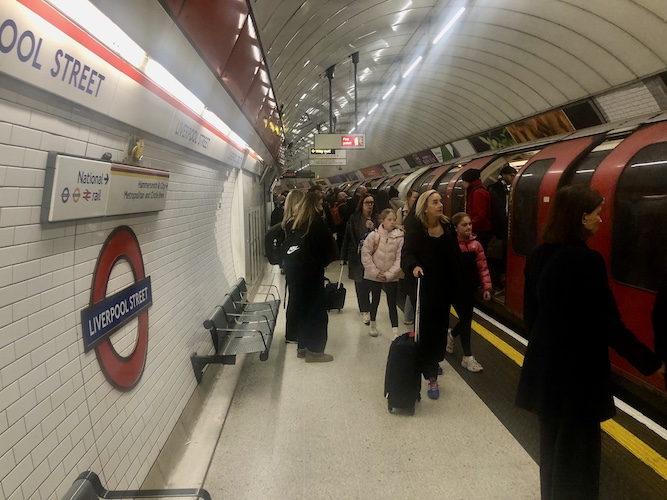
Will it be a Happy New Year for Transport for London? The network’s chiefs struck an optimistic note this week as they were grilled about their spending plans for next year at the London Assembly’s budget committee meeting, buoyed by continuing break-even forecasts, a four-year £2.2 billion capital funding deal with the government and the recent green light for the Docklands Light Railway (DLR) extension to Thamesmead.
The budget discussion was a reminder that TfL is a big business – a £9 billion operation providing almost nine million public transport trips a day generating £6 billion a year in fare income, and with a planned capital spend in the coming year of some £2 billion.
That made its forecast surpluses on operating costs – £26 million next year and rising to almost £500 million in 2028/29 – a major achievement, said Sir Sadiq Khan’s Deputy Mayor for Transport, Seb Dance. TfL was the only large-scale transport network “anywhere in the world” to break even, he said, with all surpluses reinvested in services. And that, he added, was despite receiving no government fares subsidy since 2015, when it was phased out.
The long-term £2.2 billion capital spending deal was also significant, he said. The largest allocation for a decade, it would pay for a new tram fleet, new trains on the Piccadilly and Bakerloo London Underground lines and the DLR, continuing upgrades to the 33-year-old Central line fleet and wider signalling and accessibility improvement, plus the Oxford Street pedestrianisation plan, initial work on the DLR extension and more.
All good news then? Not quite. Finance chief Rachel McLean had to reassure Assembly members (AMs) that the £900 million allocated annually for renewals was enough to keep the network in good shape. “There is always a gap between what is absolutely desirable and what we are able to afford, but I don’t believe this is insufficient to maintain the service,” she said.
Keeping one of the world’s largest public transport networks in shape is a long-term job too. Commissioner Andy Lord confirmed that new Piccadilly line trains are now expected “between July and December” next year, with new DLR trains also due by the end of next year at the earliest and the new tram fleet in the early 2030s. He also said there will be no money for repairing Hammersmith Bridge.
For the DLR extension, next year would be taken up finalising detailed business and funding plans as well as securing formal government approval under the Transport and Works Act 1992, before construction could begin in 2027, McLean added. Mayor Khan’s target of making half of the city’s Tube stations step-free by 2030 also posed “operational challenges”, the meeting heard.
And as the Mayor announced last week, rail fares overall will rise by some 5.8 per cent next year, in line with government expectations, although as an “emergency cost-of-living measure”, bus and tram fares will be frozen until July, with City Hall money plugging the gap. With the caps on the cost of multiple journeys and Travelcards also frozen through next year, and Tube increases limited to 20p, the package struck the “right balance” between maintaining the network and keeping it affordable, Dance said.
TfL is also currently spending up to £11 million a year on removing graffiti along with investigation and prevention work following a “spike” in incidents, particularly on the Bakerloo and Central lines, the meeting heard. The meeting heard that the cost of recent Tube strikes amounted to between £20 million and £25 million too, while fare evasion was costing some £130 million a year, though this was in the context of a £6 billion total farebox income. Plans were in place to reduce the evasion rate from its current 3.5 per cent to 1.5 per cent by 2030, McLean said.
The major risk remained the continuing decline in bus ridership, which is down by a quarter over the past 10 years, the meeting heard. Action was planned, on bus lanes, tackling roadworks hold-ups, improving the fleet, customer information and more, Lord said. But he concluded with a stark warning: “We have to increase ridership. If we don’t do anything the cost of the bus operation is going to grow significantly over the next four years, to the point that it will be unsustainable and we will have to reduce it.”
Consultation on the full City Hall draft budget will close on 4th January, with Assembly debates on Khan’s final figures, including his Council Tax proposals, scheduled in advance of final decisions by the end of February.
The London Assembly budget committee meeting can be viewed in full here.
OnLondon.co.uk is funded in full by subscribers to publisher and editor Dave Hill’s twice-weekly newsletter On London Extra. To receive it, become a paying subscriber to Dave’s Substack or pay £50 a year or £5 a month through Support links on this site.