
Handel Hendrix House, also known as numbers 23 and 25 Brook Street, London W1, is a heritage landmark for having previously accommodated two people who came from overseas and made the capital their home. Both of them made music, too.
Hendrix, as in Jimi, arrived from the USA late in 1966 and became famous as one of rock music’s greatest guitarists. He lived upstairs at Number 23. He probably didn’t release two parakeets from a cage while visiting Carnaby Street, thereby introducing them to every park in the city, but it’s fun to pretend he did. He definitely died in 1970 at St Mary Abbots Hospital in Kensington.
Handel, as in George Frideric, hung around town for much longer. Born in Germany in 1685, he moved to Italy in 1703 and to London in 1710. Like Hendrix, he arrived in the city while in his twenties. Also like Hendrix, he was a renter.
The composer was the first occupant of Number 25, moving in in 1723 and staying put until his death there in 1759. Almost all the work he produced during his Brook Street tenure is thought to have been written and rehearsed at that address, where, Wikipedia says, he kept harpsichords, a clavichord and even a small chamber organ. History does not record if neighbours complained.
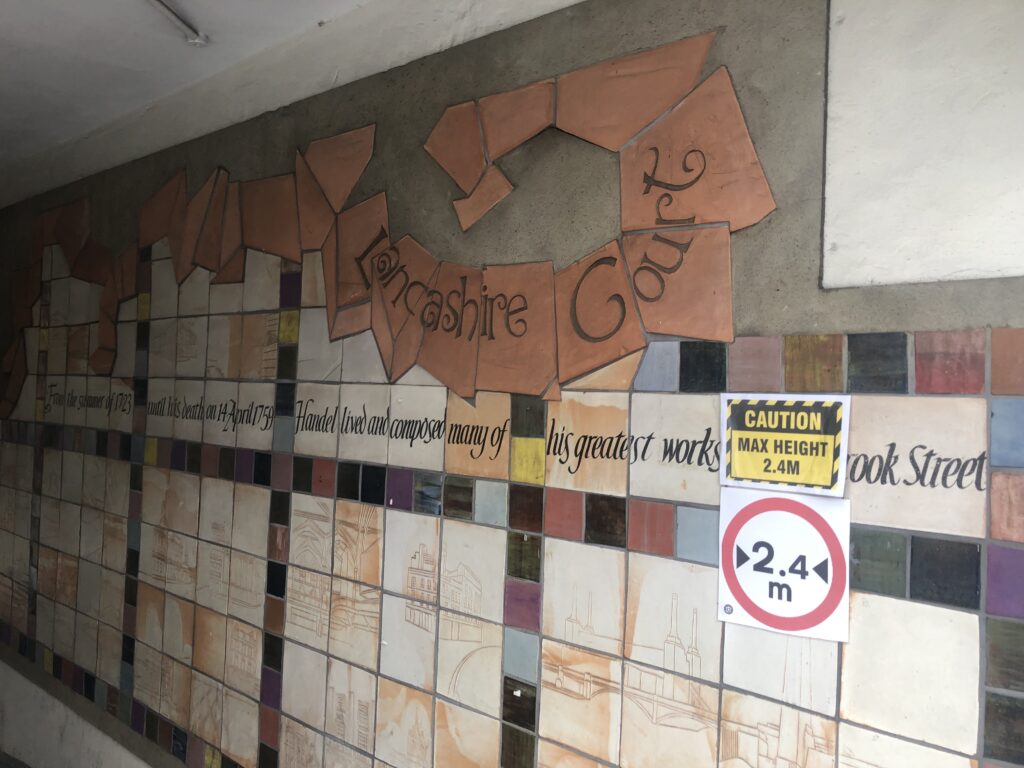
When I wandered past Handel Hendrix House the other week, I didn’t realise I was doing it. Not until my eye fell upon a tile mural on the wall of an adjacent alley did I work it out.
The alley is an entrance into Lancashire Court, a Mayfair mews you can also enter from New Bond Street. As you would expect of a mews in Mayfair, it is old, pricey and posh. As you would also expect, Ian Mansfield has had a proper look round. So let’s concentrate on the mural.
It is difficult to photograph, because they alley is narrow and dark. But, look, I did my best. The work is attributed to “M. Czerwinski” who seems to be this guy. I tried checking through LinkedIn. I didn’t get any reply, but everyone else who’s written about this lovely piece of tile work seems sure that the “M” stands for “Michael”.


His surname is Polish and therefore adds a further migration dimension of some kind to the Brook Street scene. The same may or may not apply to Ray Howell, who is credited in the mural for having done “additional work” on it. Around 60 per cent of Londoners were born outside the city, which means the odds are that he, like your correspondent, migrated in from somewhere. It would be fun to know more.
The mural is called London 2001, a year that feels both recent and long ago. As well as celebrating Handel’s local connection, it features images of London landmarks too, from Battersea Power Station to what I think must be the London Eye. There’s also something in the bottom right hand corner that looks like The Shard, though work didn’t even start on that until 2009. So is it Cleopatra’s Needle? Whose bright idea was it to stick a “caution” sign over the tip?
John Vane’s London novel Frightgeist can be bought here.
OnLondon.co.uk provides unique coverage of the capital’s politics, development and culture with no paywall and no ads. It is funded by subscribers to publisher and editor Dave Hill’s twice-weekly newsletter On London Extra at a cost of £5 a month or £50 a year. To receive it, become a paying subscriber to Dave’s Substack or follow any Support link on this site.