
Braybrook Street, W12, is a residential road that skirts the common land of Wormwood Scrubs and the Category B prison of the same name. Six decades ago, it wasn’t unknown for inmates to abscond from “The Scrubs” with the help of getaway cars lurking in the vicinity.
It was, then, perhaps unwise of three men who had committed a string of armed robberies to be sitting in a shabby blue van parked on the street in question in the middle of an August afternoon in 1966 with a bunch of firearms to hand and no tax disc displayed.
The trio were spotted by three passing officers of the Metropolitan Police, two of whom, their suspicions aroused, stopped to have a chat with them. A few minutes later, they and their colleague were murdered. Of the three, two were shot by 30-year-old Harry Maurice Roberts, the son of Wanstead publicans whose criminal career had begun during his childhood and was interrupted only by national service in Malaya, which may have refined his aptitude for violence.
The Shepherd’s Bush Murders as they continue to be known despite taking place in East Acton not far from the local tube station, happened a fortnight after England won the World Cup at nearby Wembley. They followed that event to the top of the Swinging Sixties’ newsroom hit parade.
Roberts went on the run for almost 100 days before having his collar felt on a farm near Bishop’s Stortford. Seemingly unrepentant and unreformable, he wasn’t freed until 2014 when he was 78 and died earlier this month. But he had long since been rehabilitated by some whose moral universe accommodates the proposition that shooting unarmed officers of the law in the face or head, as Roberts did, is inherently comedic or heroic.
Football terrace chanters eager to wind up constables during the peak hooligan era hymned the cop killer as their friend to the tune of London Bridge is Falling Down. Jake Arnott, whose novel He Kills Coppers, was largely inspired by the Roberts case, has described first hearing his name chanted by anarchists at demos in the 1980s. So ubiquitous was Roberts’s celebrity that a boy I was at school with in the early 1970s, a world away from the crime scene, was nicknamed Harry because he shared the murderer’s surname.
Of course, Roberts’s brutal, selfish and terrible misdeeds caused distress and concern as well as vindictive delight. A Shepherd’s Bush funeral procession for the police victims was attended by 600 officers and a memorial service was held for them at Westminster Abbey, which Prime Minister Harold Wilson attended. The precursor to the Met’s Specialist Firearms Command was established soon after.
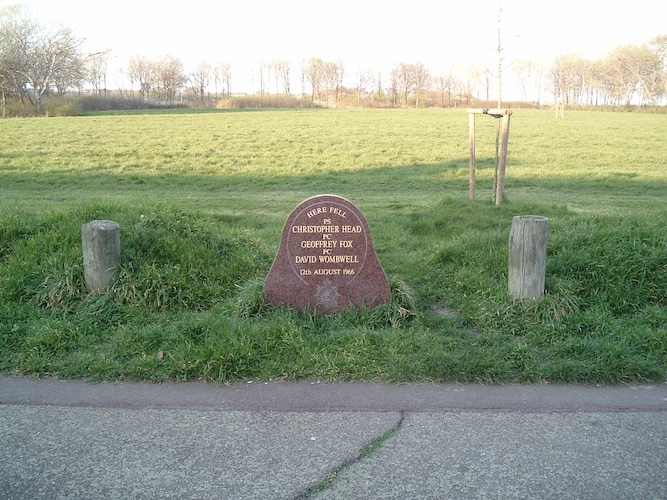
In 1988, the London-based Police Memorial Trust placed a remembrance stone in honour of the three officers murdered by Roberts and one of his accomplices beside Braybrook Street in the grass at the edge of Wormwood Scrubs, marking the spot where the killings took place. The victims’ names were Christopher Head, David Wombwell and Geoffrey Fox. But it is that of Harry Roberts that lives on in glorified infamy.
John Vane’s London novel Frightgeist in available here and only here. Photograph by Chrisfow, 2007.
