
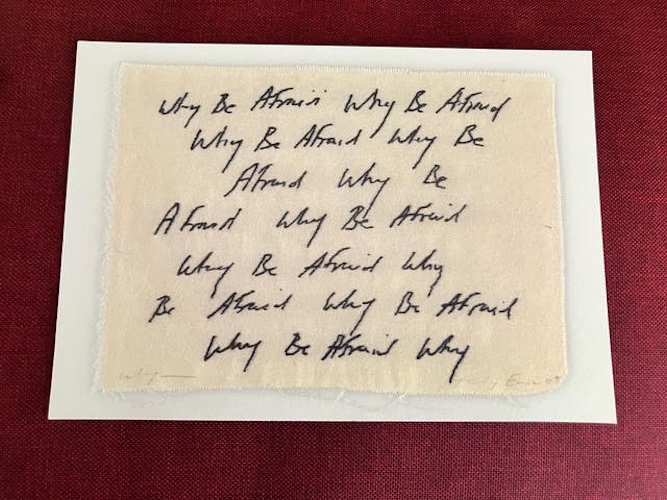
Recently, I attended the impressive Tracey Emin exhibition at Tate Modern. It’s confessional, brutal, upsetting and powerful. The handwritten words in her diaries displayed on the wall affected me most, and I found myself living her life with her, feeling her confusion and fear, and falling into her tears. It’s incredible how she has turned a history of abuse and pain into art. I left feeling such admiration for her bravery. I bought a set of her prints. One of them, in her distinctive handwriting, stitched onto fabric, simply asks: “Why be afraid?”
The words repeat over and over again, making me really think about the question, and how it shifts from comfort and reassurance towards vulnerability, trauma and the haunting reality of fear. At home, I put it on my desk and looked at it for long periods. It made me think of the fear I feel when I’m out alone late at night in London. All of my evenings begin with the same question: What’s my plan for getting home?
London has a fantastic public transport system. I use it constantly. But I won’t travel on it alone after ten or eleven at night. And that is just an arbitrary line I’ve drawn – it’s not as though the city suddenly becomes unsafe only after those hours.
Back in April, I went to see The Damned play at Wembley Arena. I was determined not to miss them, even though there was a Tube strike on. My night out was to continue with heading for The Dublin Castle in Camden with my friend Tony, who was due to DJ there. All went according to plan and it was excellent fun, but by midnight I was exhausted and decided to leave early while Tony carried on spinning til 2am.
I intended my journey home to be by Uber, but my order was rejected three times due to a shortage of drivers caused by the strike. I hadn’t expected it to be that busy. I tried other cab apps with no luck. The Northern line, serving Camden Town station, wasn’t working at all and there wasn’t a black cab in sight, so I headed for the bus stop on Camden High Street. My idea was to catch a bus to Swiss Cottage station, because some Jubilee line trains were running and I would be able to get home from there.
I told myself to be brave. There were plenty of people about. All would be fine. Why be afraid?
I waited at The Black Cap bus stop for 15 minutes before the bus arrived. I jumped on and settled in, but stupidly got distracted by my phone. Looking up, I saw Swiss Cottage station disappearing into the distance behind me. I’d missed my stop, and the bus then swung down an unfamiliar road and continued for what felt like ages all the way down a long hill. It was approaching 1am. The street lighting was sparse and there was barely another person in sight.
I asked a fellow woman in a seat near mine if it was safe to walk back up the hill to Finchley Road alone.
“Just walk as quickly as you can,” she said. She knew why I was asking. I was the only person to get off at the next stop. I started back up the hill as fast as I could. I thought of my friend Marie, who has a “don’t let them beat us” attitude and will happily walk through an unlit public park at night to get home. That idea fills me with absolute terror. I makes me think of Sarah Everard, and how she too cut through a park when walking home.
Women have every right to move freely through London. Yet the possibility of harassment or attack leaves many of us on high alert. I do have, and am thankful for, many wonderful male friends who, when I’m out with them, will wait until I’m safely in a taxi or text me to check that I’ve got home. Sadly, there are other kinds of men too, and the possibility of something happening makes me follow my little rituals of self-protection:
- If there’s no traffic, I walk in the middle of the road. It keeps me away from dark entrances, alleyways and garden walls, while giving me room to move in either direction if I need to.
- If a man is walking close behind me, I cross the road. I might then pretend to be on the phone saying things like, “I’m just around the corner” or “I’ll be there in a minute”.
- I wave into the distance, as though someone I know is waiting for me up ahead.
- I walk close to groups that include women.
- If I’m on the Tube, I look for a carriage with a woman in it and sit near her.
London gives me so much. Galleries, gigs, pubs, theatre, friends, chance encounters and tons to explore. I love living here. But after dark, the city can feel entirely different and I, like many other women, carry the fear around with me like an extra bag.
Continuing my journey with anxiety and adrenalin for company, I hurried back up the dark road, constantly checking behind me and scanning the shadows. When I got to Swiss Cottage station, it was deserted. The stairs down to the platform looked really creepy. By then, my imagination had taken over.
I clocked the CCTV camera and immediately thought of its footage being used on telly as part of a “last seen” reconstruction. When a train came, every carriage was empty apart from two or three men. I risked it and got on. I kept an eye to see if the men were getting off at my stop and as it approached I hesitated, not wanting to rise from my seat first. Leaving the station, I ran across the road and sped along the middle of two dead streets, feeling as if I would never get home.
I closed my front door behind me at 1.35am and immediately blamed myself for being frightened: I shouldn’t have gone out, the Tube strike, I should have planned better, never again.
“Why be afraid?” asks my Tracey Emin print. Nothing happened to me that night. I got home safely. But I don’t carry fear because something is happening, I carry it because something could happen, as I have learned from Sarah, Tracey and other women before me. Being afraid is part of being a woman. We never quite know which night, if any, will be different.
Follow Julie Hamill on Instagram. Image shows print by Tracey Emin.
OnLondon.co.uk is funded by sales of publisher and editor Dave Hill’s twice-weekly newsletter On London Extra. To start receiving it, become a paying subscriber to Dave’s personal Substack. Thanks.