
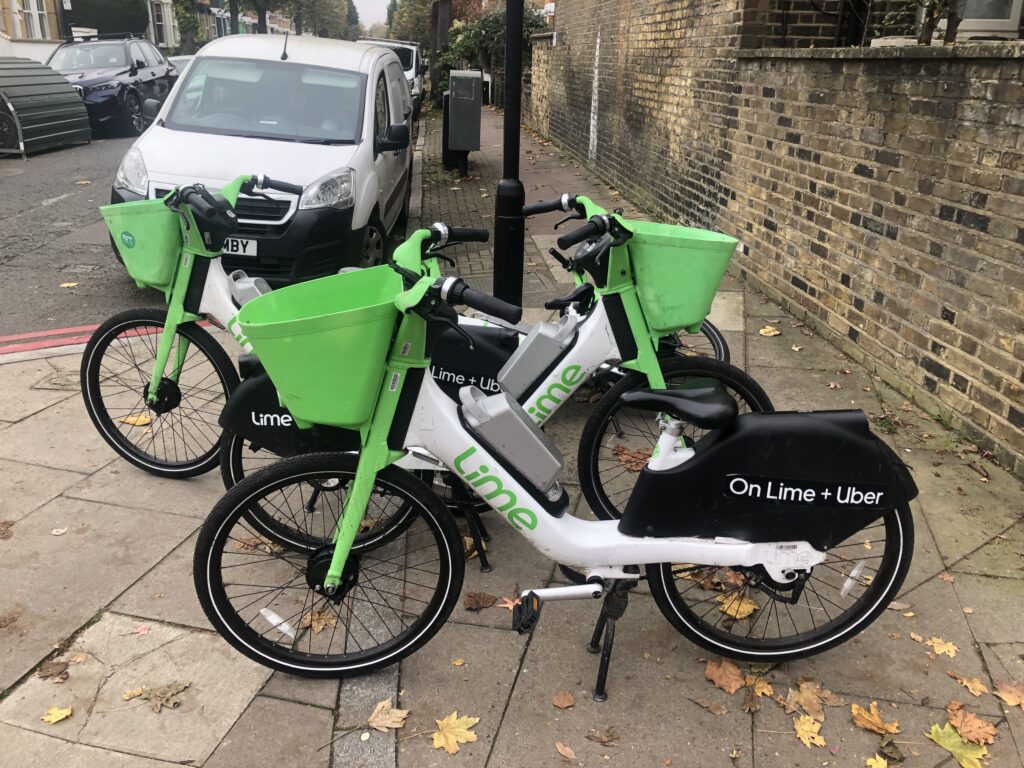
It is often said that death and taxes are the only two certainties in life. Most Londoners would add a third – that e-bike riders will run red lights, and worse.
Even so, perhaps given a further nudge by September’s Tube strikes, this form of bike hire looks to set to stay and grow in London – and it’s clear that our built environment, planning rules and political leaders need to respond accordingly.
In today’s economic climate it is increasingly convenient to use an electric bike rather than to save up for, buy, and then store a new pedal bicycle, especially for young people. On top of that, the forthcoming budget may see the end of the government’s Cycle to Work scheme, and bike theft in London is 186 per cent higher than the national average.
It is therefore clear that the capital’s future is bike-led – but with Lime, Forest, Voi and also “Boris Bikes” to the fore.
What needs to be done to make this work well? For one thing, there must be better London-wide cooperation. Currently, places such as Chiswick Bridge act as 21st century versions of the Berlin Wall, because Hounslow priorities Forest and Voi, while Richmond has a license with Lime. Comedian Dara Ó Briain has called it ‘Checkpoint Charlie’ after the east-west crossing in Berlin during the Cold War, and there’s a risk of this proliferating along the Thames, which forms a boundary between many London boroughs.
The design of buildings and streets needs to change too. On-street parking bays are the storage space of tomorrow. Current London Plan guidance is for homes in highly sustainable locations to aspire to being ‘car free’. This forces developers to make space within often constrained urban locations for hundreds – and in some cases thousands – of storage spaces for conventional bikes and those who own them.
The proposed changes to these regulations, recently announced, include more flexibility around this rule to facilitate the viability of schemes – a sensible move, given that housing delivery in London is under unprecedented pressure and every square metre needs to be used. And boroughs should also consider allowing developments to ‘pool’ their cycle spaces and make it possible for spaces left unused to later be converted to additional homes.
With such provisions and freedoms must come a greater sense of responsibility. There need to be more penalties for riders and operators for bad behaviour. More dedicated parking spaces must come with better parking practices, more self-policing from operators and greater geo-fencing – virtual perimeters placed around specific areas – to ensure slower e-bike speeds in some of London’s most famous and special locations. The rise of so-called Lime Bike Leg breaks show that accidents are putting additional pressure on the NHS.
There is a growing need for City Hall, Transport for London and the boroughs to coordinate these processes. It has proven difficult to do this, even with a single political party, Labour, dominant in London government. It won’t get any easier after May’s borough elections, which opinion polls suggest could see a much more mixed set of Town Hall administrations. The e-bike revolution is underway and the clock is ticking.
Michael Stanworth is a director at Cavendish Consulting.
OnLondon.co.uk provides unique coverage of the capital’s politics, development and culture with no paywall and no ads. It is funded by subscribers to publisher and editor Dave Hill’s twice-weekly newsletter On London Extra. To receive it, become a paying subscriber to Dave’s Substack or follow any Support link on this site.