Blog

Charles Wright: Is London warming to more congestion charging?

Sir Sadiq Khan’s announcement of a £3 hike in the London congestion charge to £18 a day from 2 January 2, coupled with reduced discounts for cleaner vehicles – unwelcome to some, while, for others, not going far enough – has brought a new focus on the continuing problems of congestion and traffic management in the city.

The charge was famously introduced by the capital’s first Mayor, Ken Livingstone, in 2003 to better manage central London’s clogged streets, which were increasingly damaging the city economy, delaying buses and deterring walking and cycling. It was controversial, opposed even by the Blair government, which had included the power to charge road users when it set up the new mayoralty.

But the measure had an immediate impact. After 12 months, traffic speeds were up, congestion was down by 30 per cent, and bus ridership in the zone, boosted by service improvements, was up by a third. Importantly, as transport charity Sustrans said on the charge’s 20th anniversary, it showed “we don’t just need to accept congestion, pollution, and roads dominated by traffic as the inevitable consequence of modern life”.

That impact has diminished over time. Traffic speeds are down, eroding the benefit for those paying the charge as well as for bus users. Despite there being fewer vehicles in the zone, congestion is increasing – to the extent that, in last year’s “Global Traffic scorecard” produced by traffic analysts INRIX, London was named the most congested city in Europe, at an estimated cost to the capital’s economy of £3.85 billion.

There are a number of causes. As vehicle numbers have reduced, the road space allocated to them has also been reduced, in favour of bus lanes, cycleways and pedestrians. There are more traffic lights, more roadworks and more private hire vehicles. Larger SUV-style cars having difficulties negotiating the central streets are also in the frame.

That’s the context for the Mayor’s latest intervention, to ensure the charge “stays fit for purpose”. Doing nothing, he said, would see around 2,200 more vehicles in the congestion charging zone on an average weekday next year.

The growth in the number of electric vehicles (EVs), currently exempt from the charge, is a significant factor. There were some 20,000 EVs in the zone when the discount was introduced in 2019. Now, there are more than 116,000, close to 20 per cent of the total – an increase threatening to undermine the scheme’s main objective of tackling congestion.

It’s a tricky balancing act, encouraging the switch to cleaner vehicles while restraining overall numbers. The current discount was flagged from the start as lasting only to the end of 2025, and last year the Mayor remained bullish – retaining it would simply encourage more vehicles into the zone, “contributing to worsening traffic and congestion”, he told the London Assembly.

But a vocal backlash during the consultation on the new scheme seems to have prompted a climb-down. Khan will now phase out the discount rather than axing it in one go, initially to 25 per cent for cars and 50 per cent for vans and lorries, with a further 50 per cent reduction in 2030.

Business groups wanted it retained, while some green campaigners wanted it gone, but Khan may, for now, have found a sweet spot: the consultation showed 66 per cent of respondents supporting action to reduce traffic and congestion in central London, and 58 per cent backing steps to encourage the use of zero emission vehicles in the zone.

Where does this leave Khan’s sustainable transport target of 80 per cent of all trips in London to be made on foot, by cycle or by public transport by 2041? And his net zero by 2030 target, requiring a 27 per cent reduction in car vehicle kilometres travelled by that date?

The impact of the new charging regime looks as if it will be a relatively small 2,200 fewer vehicles a day in 2026, a two per cent reduction, going up to 2,600 when the second cut in the cleaner vehicle discount kicks in, but declining to approximately 1,700 fewer by 2035, as the number of EVs goes up.

Experts quizzed recently at the London Assembly transport committee suggested it was time to go beyond the central zone, where intervention might be approaching its peak, and look to the wider city, where car numbers are actually increasing. So is it time to extend road user charging?

It’s not a new idea of course. It can be traced at least as far back as the government’s Smeed Report in 1964, with various schemes proposed since then, in the capital and more widely. But Livingstone’s congestion charge has to date been the only significant scheme to surmount the hurdle of public opposition.

Recent polling for the Centre for London think tank suggests the mood may be changing, with almost half of Londoners saying they would choose public transport over driving if fares were lower, a fifth saying increased road charges would encourage them to switch, and some 36 per cent now backing a “pay per mile” charge.

“It is well time to get this sort of discussion underway,” professor David Metz for University College London told the assembly. “It is all politically quite difficult but that is, I think, where you have to go if you are talking seriously about demand management.”

As with the original congestion charge, which was accompanied by major improvements to bus services, expanding public transport networks across the city might seal the deal. All eyes on the upcoming budget then, with government support for the Bakerloo Line extension, the Docklands Light Railway extension and the West London Orbital rail like high on the capital’s wish list.

Follow Charles Wright on Bluesky.

OnLondon.co.uk provides unique coverage of the capital’s politics, development and culture with no paywall and no ads. It is funded by subscribers to publisher and editor Dave Hill’s twice-weekly newsletter On London Extra at a cost of £5 a month or £50 a year. To receive it, become a paying subscriber to Dave’s Substack or follow any Support link on this site.

Categories: News

HollyShorts London: Cinema creatives and the capital’s global allure

The HollyShorts film festival didn’t have to extend its reach to London – it’s been doing very nicely in its United States birthplace since it began in 2005. But Steven Adams, festival strategist and advisory board chair, says that doing so made perfect sense.

“It’s been clear for something like the past 15 years that the second biggest demographic at HollyShorts was British,” he said at Sunday’s closing evening of the three-day event, held at Vue West End, just off Leicester Square, which was also attended by HollyShorts co-founder and director, Theo Dumont.

Not only had British filmmakers been entering the Hollywood original in significant numbers, they had, Adams says, been winning awards too: “We started celebrating those filmmakers with parties here in London. And then we thought, let’s just step it up a bit. Let’s have a British edition”.

The first of those took place last year, and HollyShorts London has returned in 2025 to showcase nearly 80 short movies, selected to further its mission of celebrating “innovative storytelling and emerging talent on a global stage”.

The global dimension was very apparent from a gathering I joined at Lisle Street’s Imperial China restaurant prior to the evening’s screenings.

Dining there were members of the team behind The Secret Assistants, a shrewd and subtle study of unequal power relationships in the film industry, written, directed and co-produced by Katey Lee Carson.

A cosmopolitan bunch, several of them are based in Berlin, where the film was shot, while others live in Paris (where it was edited), London and other bits of Britain.

Like Adams, they expressed no doubt that London remains a pivotal location in the wide world of film-making, and not only because of Soho, the British industry’s historic central London hub.

Other parts of the capital, including outer boroughs, have seen new film and TV facilities open in recent years, for example in Enfield and Barking & Dagenham. A 2024 report commissioned by Hounslow Council found west London’s film and TV sector to be booming, post-pandemic. Meanwhile, in Camden, Yoo Capital has plans to build a new Kentish Town film quarter.

The Secret Assistants, whose lead roles were played by the excellent Camille Rutherford and one of Britain’s most distinguished actors, Richard Hope, was not among those to win a HollyShorts London award, but the competition was formidable. The grand prize went to British-German director Franz Böhm for Rock, Paper, Scissors, which tells a harrowing story of the war in Ukraine.

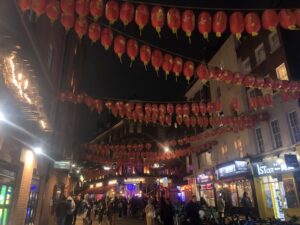
It was good to again be out in Chinatown and among the West End’s Christmas lights, seeing, hearing and feeling the capital’s creative sector retaining its international allure, despite challenges and hostilities from many directions. As far as Steven Adams is concerned, that will continue: “We will definitely be back next year.”

OnLondon.co.uk provides unique coverage of the capital’s politics, development and culture with no paywall and no ads. It is funded by subscribers to publisher and editor Dave Hill’s twice-weekly newsletter On London Extra at a cost of £5 a month or £50 a year. To receive it, become a paying subscriber to Dave’s Substack or follow any Support link on this site.

Categories: News

John Vane: Drinks and teams

There was a throwback quality about him. It wasn’t the jacket, which had a badge on it with a word that might have been “veteran”, though maybe that was part of it.

More redolent, though, was the industrious way he was doing a crossword, solving clue after clue as the train trundled towards Liverpool Street. He was wiry and grey, and his manner took me back to the days when men of that sort of age filled in their football pool coupons with the same brisk concentration.

I could imagine him of a Saturday teatime, poring in hope or exasperation over his Green ‘Un as he headed for a post-match pale ale.

At Hackney Downs some more passengers got on. One of them, a teenager or young man, had an innocent look about him. I’m not sure if he was being accompanied. My companion later wondered if he had Downs. He sat on the other side of the crossword man from me, and began chatting to him instantly.

“What’s your team?”

“Spurs,” replied the older man. Then he saw what his interlocutor was wearing – an Arsenal shirt. “Oh, that’s unfortunate.”

Not really, though. Soon, they were discussing how best to travel to Highbury, the connections needed by younger party to take him to the game.

“You’ve got yourself there before, then?”

“Yes. What’s your favourite drink?’

“Oh, that’s a difficult one…” He had a think. Looking back, I’d have liked it if he’d answered “hot Bovril”. But his actual reply was: “Rakia. It’s an east European brandy.”

“Mine’s Fosters.”

“Oh yeah?”

“And cider and blackcurrant.”

We arrived at Bethnal Green. Crossword man jumped off. I think he’d reached his destination, though maybe he’d concluded that the conversation had come to its natural end. I thought he’d been kind, though. Rakia sounds good, too.

John Vane’s London novel Frightgeist can be bought here.

OnLondon.co.uk provides unique coverage of the capital’s politics, development and culture with no paywall and no ads. It is funded by subscribers to publisher and editor Dave Hill’s twice-weekly newsletter On London Extra at a cost of £5 a month or £50 a year. To receive it, become a paying subscriber to Dave’s Substack or follow any Support link on this site.
 

Categories: Culture, John Vane's London Stories

Dave Hill: Jewish London – how has life changed since 7 October 2023?

On the evening of 10 October, 2023, I boarded an eastbound London Overground train at Stratford station. I found myself sitting next to an Orthodox Jewish woman. Opposite sat her two Orthodox Jewish woman companions. There were a few minutes to go before the train’s departure time. As the carriage filled up, the women chatted to each other in what I, not being a speaker of it – or, as it happens, Jewish – assume was Yiddish.

The carriage was otherwise fairly quiet, and as the seconds ticked by I experienced a blend of anxieties and emotions. They arose from a wish to protect, one whose implications for the inside of my head included:

  • A mental debate about the possible unintended outcomes of instigating a well-meaning social interaction with the women.
  • Imagined scenarios in which a fellow passenger instigated an interaction with them of an unpleasant kind, prompting me to nobly but perhaps self-righteously and disastrously intervene.
  • A more general speculation about how the women might be feeling a few days after fellow Jewish people in a far-off land had been the victims of murder, injury, kidnap and rape, these acts committed with premeditated savagery and, in some quarters, celebrated with great glee, including in parts of London.

I refer, of course, to the incursions of 7 October 2023 by Hamas attackers and kindred spirits from Gaza into southern Israel during a Jewish holiday and their killing of around 1,200 people, more than 800 of them civilians, including children, their kidnapping of 251 people, again mostly civilians, and their acts of torture and sexual violence against others. Not all of these victims were Jews, but the great majority were.

Two years later, Israel’s sustained military response to that attack has officially ended with a fragile ceasefire, but only after it resulted in the deaths of close to 70,000 people in Gaza, according to the Hamas-run health ministry.

Throughout those two years, London has been the scene of widespread and conspicuous demonstrations, with protesters proclaiming their support for Gaza and the wider Palestinian cause, some of them large marches through the heart of the capital, some of them smaller local rallies outside government and cultural institutions, some of them displays of flags on lampposts or in the windows of shops and homes.

These public alignments in favour of Gaza and against Israel have become routine and ubiquitous – part of the London scene. Debates about their meanings, motivations and legality have been loud and rancorous. There has been less reporting of the everyday experiences of Jewish Londoners during this time as they have led their London lives among the city’s multitudes and in the privacy of their homes and minds.

How have Jewish Londoners been feeling all this time? How have their fellow Londoners been feeling about them?

***

A short walk north from where I live in Hackney lies the borough’s Cazenove electoral ward. It forms part of a neighbourhood containing a strictly Orthodox Jewish community of around 15,000 people. Most are Hasidic Jews, adherents to a movement with 18th Century origins in what is today western Ukraine. This is the largest such Orthodox grouping in Europe and is famously synonymous with the Stamford Hill area.

One of Cazenove ward’s three councillors is Ian Sharer, whose remarkable career in Hackney politics has seen him represent three different parties over three decades, starting with Labour in 1994, continuing with the Liberal Democrats, and now with the Conservatives, for whom, in January 2024, after a spell out of the Town Hall, he won in serene style an otherwise fraught by-election, having narrowly missed out on a Cazenove seat when running as a Lib Dem in May 2022.

He is very much at home in the ward, and not only because he has lived there for a long time. Invited to his house and there provided with a stupendous cup of coffee and five neat slices of delicious honey cake, I asked him my very simple question about a complicated situation – had his London life changed since 7 October, 2023?

“To a certain extent, yes,” Sharer replied. “I am very wary of going outside my own area.” He explained that he and his wife, both of them still working full-time despite having a combined age of 159, go shopping every Sunday in nearby Wood Green, across the borough boundary in Haringey. “I do not go wearing a kippah,” he said. “I always wear a cap. But that doesn’t really disguise me. We still look pretty Jewish, my wife and I. To the credit of Wood Green, if you like, I’ve never had a problem there. But I’m always very aware of what’s going on around me.”

Other types of excursion have sometimes led to other types of experience. “I have been shouted at while driving in various parts of London,” Sharer said. “People being nasty to me. It’s always happened, but it’s happening more than it used to.” He revealed, too, a still sharper difference between his London life before the Hamas-Israel war began and since: “I would not go out at night, now, outside of this area.”

It is an area some might imagine cannot possibly exist. Yet Cazenove has long been noted for the good relations between its Jews and its Muslims, who between them make up around 40 per cent of its 15,000 or so residents. At the last Census count there were around 3,700 Jews and 2,308 Muslims there. “For the last 30 years, I’ve been working with the Muslim community,” Sharer said. “They are really good friends of mine.”

He had a wealth of stories of interfaith solidarity, ranging from local mosques and synagogues backing each other’s planning applications for extensions, to the local Shomrim patrols – Hebrew for “watchers” or “guards”, a kind of Jewish Neighbourhood Watch with a hotline to the Met – embracing mosques as well.

The recent terror attack on Heaton Park synagogue in Manchester was followed by WhatsApp messages to Sharer’s phone from Muslim locals, saying, as he put it, “this is totally out of order and we stand with you on this”. And when out on the street, on his way to pray, he was stopped by Muslim passers-by, wanting to tell him how sorry they were about what had occurred.

As a councillor, he is on call for local Muslim institutions and individuals, some of whom pop by to talk through this or that local matter, and it is heartening to imagine their conversations taking place in the same pleasant parlour where I sat with my coffee and cake. When he dines at local mosques, Sharer is provided with kosher food. When a Jewish school was daubed with antisemitic graffiti a few years ago, local Muslims sent its pupils a delivery of kosher cakes.

There is, though, no escaping the rise in antisemitic incidents over the past two years. And Jews in this part of London have been subjected to attacks in their own backyard.

In September, arrests were made after video footage emerged of a 77-year-old rabbi being pelted with food and subjected to abuse outside the Stamford Hill branch of Boots, and after a man on an e-scooter rode into two Orthodox Jewish women, reportedly shouting “fucking Jews”. In December 2023, two teenagers, both of them girls, were sentenced after being found guilty of four separate attacks on Jews in the neighbourhood, most of them children, in the space of half an hour. One recent attacker travelled from afar. In 2022, a man from Dewsbury came to Stamford Hill and assaulted three Jews, one of them a child, punching another of his victims unconscious.

Sharer spoke of his life as a Jewish Londoner with a mixture of positivity and realism. “All my life, I’ve been made aware by people that I’m Jewish,” he said. As a youth, he’d been a good cricketer, yet his form master at a non-religious secondary school in Leyton never picked him for the school team. There was, he said, one other Jewish boy in his class. Both of them noticed how often they were punished for misbehaving compared with the other kids. He recalled a Labour Party meeting held many years ago when a latecomer decided against taking the last remaining seat, which happened to be next to Sharer’s.

That would not happen, he said, with today’s Hackney Labour, even though he has become a Tory. He went out of his way to praise Caroline Woodley, the borough’s Labour Mayor, for taking matters he raises with her seriously. Sharer is firmly of the view that what some on the Right call “hate marches” in support of Palestine and against Israel should not be banned – “you’ve got to allow freedom of speech,” he said – and he accepts in the same spirit the Gaza protest events that have taken place both outside Hackney Town Hall and in its public gallery.

There is a lot of such activity in Hackney. A few days after I visited Sharer, the borough’s Green Party councillors, who include London Assembly member and Hackney mayoral candidate Zoë Garbett, and their Hackney Independent Socialist allies, had the full council debate a motion demanding that it cut all “ties” with “Israel’s genocide in Gaza”. The other day, a leaflet fell on to my doormat from a campaign called Hackney Votes Palestine 2026, urging me to vote Green in the borough elections next May.

Sharer’s experiences and reflections provide both comfort and hope for the future and a window on to a larger landscape of anger, misunderstanding and prejudice. Sharer regards himself as thoroughly English, and spoke with pride of family members with impressive records of service to the British armed forces, going back to World War II and beyond.

Like many British Jews – though not a majority of them – he feels no attachment to Israel, and has never been there. He described what it has done in Gaza as “appalling” and condemned its government’s inviting a British far-Right activist, the so-called Tommy Robinson, to visit the country as its guest as “making him mainstream, and I don’t think that’s right”.

It is, perhaps, a sign of the times that views like as Sharer’s are infrequently heard, not least because too many don’t wish to hear them. And, being Jewish and visibly so, nothing he does or believes can exempt him from the enmity of bearers of the oldest hatred. He remarked as we talked on the saying that antisemitism is a light sleeper. Even in Cazenove’s safe haven, it is awake.

***

The increase in antisemitic incidents in London that followed the Hamas atrocities has raised sobering questions about the capital’s preferred – and largely justified – image of itself as a city at home with its vast human variety, one that renders laughable the claims of cranks and provocateurs that “real” Londoners have been “pushed out” by immigrants or that it is full of “no-go zones” controlled by Islamists imposing Sharia Law.

The heightened caution of Ian Sharer made me think again about the “existential weight” felt by the Newbury Park rabbi I interviewed last year, as he described how the mass appearance of Palestinian flags on local lampposts had made his congregants feel.

It also brought to mind the observation of a Jewish woman from north London I met for coffee early in 2024, who said that even though her Jewishness might not be obvious from her appearance, the thought of visiting Whitechapel, where flags of Palestine were at that time everywhere, did not appeal.

She spoke also of noticing that she had, almost unconsciously, begun spending more of her time with fellow Jews, doing a bit more talking about old, familiar worries and frustrations: about threats, security and the chilling absurdity that out there on the streets or maybe festering and fantasising in internet bubbles in their homes, were persons as yet unknown for whom every Jew in the world was somehow responsible for every act of military retribution approved by Benjamin Netanyahu in a different country 3,000 miles away.

Hearing such stories illuminates a particular precariousness, a necessary kind of watchfulness, that, for many of London’s roughly 145,000 Jews is an ingrained part of their London lives among nine million others. It also serves as a reminder that this state of affairs is far from new.

Other kinds of Londoners go about their London lives conscious of potential dangers of one or another kind, not least Muslims from self-styled “patriots”. But none has felt so routine a need to have security guards outside its community centres, places of worship or schools – and felt that need, not just for the past couple of years, but for decades.

***

A few days after visiting Ian Sharer but still before the Gaza-Israel ceasefire was declared, I spoke to Esther Levy – not her real name – a Jewish woman who lives in a part of the north west of the city not noted for its Jewish population and characterised by a more typical London ethnic and cultural mosaic. Esther called it “a very mixed area,” whose Muslim residents, unlike its Jewish ones, tend to be visibly so, primarily because of women wearing hijabs. It’s very different from Cazenove ward in many ways. Yet an equivalent good neighbourliness has long been a feature of life there.

Esther recalled when, pre-Covid, a local mosque would, every year, build a sukkah in its grounds – a temporary hut commemorating the wilderness shelters scripture says were used by Jews after they were freed from slavery in Egypt. Members of the local synagogue would accept the mosque’s invitation to join local Muslims there, and friendly links were built.

The pandemic put paid to that, though, and Esther described a “fracturing” since the onset of the distant war that, to her, “felt wrong”. Attempts to put that right have included “peace walks” in local parks and other events, primarily involving Jewish and Muslim women. “We’re just trying to feel like we’re all part of the same community,” Esther explained.

This rebuilding has followed a period of sudden anxiety following the 7 October attacks and the reaction to them in London. On Kilburn High Road, for example, flags and stickers appeared. There were people wearing “Free Palestine” badges. “Initially, I felt very threatened,” Esther said. That was despite her, unlike Ian Sharer, not standing out as Jewish and, like him, being “British through and through” and having next to no feeling of connection with Israel, which she has spent a total of eight days in all her life.

Esther mentioned the long-established pattern of antisemitic incidents increasing in London following outbreaks of violence in the Middle East, “but nothing like this”. Her daily habits didn’t change, although she emphasised that had she had wished to go into the centre of London, there was no way she would have done so on a weekend when a pro-Palestine demo was taking place there (she still feels the same way).

What did change, though, was the expectation of others that she, being Jewish, would be an authority on Israel: “Suddenly, we all have to be experts. And you get the feeling from people that they think you must be slightly responsible for what that country is doing. And that’s what led to what happened in Manchester.” She elaborated, referring to the killer: “He didn’t check first to see if people supported Netanyahu. He just wanted to kill Jews.”

She said, as have many others, that the Manchester attack, though, horrifying, came as no surprise. And she noted: “We have heard loudly the silence of people we thought were our friends, who haven’t contacted us. People don’t seem to get it.” She remarked, too, on a recurring difficulty with having conversations with people about the beginnings of the war. “There’s always a ‘but’. Every time anyone mentions the 7th of October, they then say ‘but’. No! Twelve hundred people were killed, in cold blood, including babies.” Esther concluded: “It’s very odd. And it’s been very destructive.”

***

I think I recognise what Esther means about that use of “but”, how it ushers in a contextualisation that can sound like a justification. Six days after the Hamas-led attacks, on the morning of 13 October 2023, I sent out an edition of my newsletter, On London Extra, with the headline A Jewish Voice. Israel’s military response, though clearly gearing up, had barely begun. Yet the Palestinian Solidarity Campaign had already mobilised, holding its first big central London demo, complete with chants of “from the river to the sea”, on 9 October, just two days after the attacks and the day before my chance sharing of an Overground carriage with those three Jewish women.

I don’t write about the politics and conflicts of the Middle East and never have. The reason for that is simple – it’s not my subject and I know very little about it. But I do write about London, I knew that Jewish Londoners would be worried about the implications for them of the terrible events overseas, and I wanted to express some sort of empathy. My solution was a sort of appreciation of the part Jews had played in my life since my early childhood – a part my London life had helped me to see.

It concerned Helen Shapiro, born in 1946 in Bethnal Green and raised and schooled in Clapton, where I have lived since 1992. The granddaughter of Russian Jewish immigrants, she became, in the 1960s, one of Britain’s most successful pop singers.

As a very small child growing up far from London, I would often hear her records on the radio or played at home by my big sister. I had no idea that Shapiro was Jewish, or what a Jew was. At my primary school, I came to know the word “Jew” as something other children called you if you wouldn’t let them have one of your crisps.

My reminiscence about Shapiro and its connection with the London outside my front door was written as a personal way of showing my appreciation for Jewish Londoners, for whom the Hamas attacks and the delight with which some had greeted them were so obviously distressing. This modest offering did not impress one On London supporter, who responded to it with an email tirade, complete with gory pictures, about the iniquities of Israel and its treatment of Palestinians, and the immediate withdrawal of their £5 a week.

Here was a taste of the venomous polarisation Gaza continues to inspire. My correspondent (and ex-supporter) even allowed that what Hamas had done was terrible – terrible “but”.

***

Jewish Londoners are diverse, not least in their perspectives on Israel, its attitude to Palestinians, and the way feelings about the Israel-Gaza war have been expressed in their home city.

Dan (not his real name) was born in London and has lived here for many years, but, in between, had an Israeli childhood and young adulthood. He came back to London because, as he puts it, he “had a sense that Israel would be extremely lucky to avoid ending up essentially where it is now”. He continues: “I would totally define myself as a Zionist, but in a very minimalist sense that I think there should be a Jewish homeland”. One of his children, he adds, currently lives in Israel, without being  Zionist in the slightest.

Dan says his London life has been little affected by the war. Working in the tech sector “it’s so multinational that it’s taken for granted that people have backstories that occasionally become awkward”. Describing his Jewishness as “not conspicuous,” he reports having faced “no street aggro” or, unlike some fellow Jews, any hostility when travelling on the tube.

Neither does he feel “threatened by Palestinian flags”, something he links to his view that there should be a Palestinian state and that “illegal Jewish settlements on the West Bank are an absolute disaster”.

However, Dan says he would feel “very uncomfortable going on any of the pro-Palestine marches”. He doesn’t care for those chants of “from the river to the sea, Palestine will be free”. If the word “Palestinians” was used instead of “Palestine”, that would be fine with him. But the meaning of “Palestine” in that context is, for him, to imply that between the Mediterranean to the west of Israel and the River Jordan at its eastern border, “there’s to be a place called Palestine, and nothing but. With that, I’m not comfortable, at all”.

He regrets “the tone deafness of some of the supporters of the Palestinian cause” which can lead to their becoming “inadvertently antisemitic”, along with “a refusal to engage with Jewish concerns around that”. He detects a reluctance on the part of the UK Palestine Solidarity Campaign to accept the two state solution long accepted by two actual Palestinian bodies, the Palestinian Authority and the Palestinian Liberation Organisation. It is a reluctance that he finds “menacing”.

It is also, Dan observes, “nothing new”, and notes a “lack of clarity” on the Left about “what it actually thinks about the Jewish state”. He can see reasons for that failure: “Any ethnic state needs to work extremely hard not to become discriminatory, let alone one which has been holding millions of people under military occupation for decades”. He thinks there is a heavy onus on such a state to “protect minorities, proactively”.

Amid the complications and contradictions, Dan is sad but unsurprised “that the argument goes simplistic very quickly”. He sees a reflection of that in the refusal of the organisers of a London protest against the banning of the Palestine Action group to call it off in the wake of the Manchester attack. Dan characterises that stance as one of “aggressive self-righteousness”.

Through it all, though, he remains positive about London. “I think London’s wonderful,” he says, underlining that conversations and collaborations with Muslim Londoners have continued and endured, albeit sometimes, in some cases, with regretful caveats and new constraints. “I may be naïve, but I don’t feel at risk walking in any part of London,” he says, though he adds that if he wore a kippah, he might not want to walk in “some parts of Tower Hamlets on a Friday afternoon when people are coming out of mosques”.

He offers a broader perspective, too – a feeling that both the Jewish and Muslim communities of London and the rest of Britain are “becoming playthings” in types of politics that aren’t very much about those communities or the issues that affect them at all.

***

From my safe middle distance of a London life that daily encounters the symbols and stridency of Gaza activism – the flags, posters and badges, the marches and demos that have, at times, seemed to be around every street corner – without being directly touched by them, I think I recognise the types of politics in question.

Where the Left is concerned, they are nothing new. In February 2003, I joined the march against the war against Iraq – not out of any very considered analysis, but because Tony Blair struck me as being too eager to follow where George W Bush led and because I had an uneasy feeling the whole business would not end well.

It was the biggest protest march in London’s history. I got there rather late, in the company of my wife and two of our young children. Harold Pinter, the great east London Jewish playwright, who grew up in a house very close to mine, had already declaimed from the stage in Hyde Park as we brought up the rear of the procession.

Pinter’s involvement contributes to my strongest memory of that day being exposure to the most explicit and virulent display of antisemitism I had yet encountered: a little group of young Muslim men and women up ahead, gathered behind a banner bearing a crude cartoon depiction of Albert Einstein, and chanting the words “Jew, Jew, Jew S A”. In their minds, it appeared, US  power and Judaism were indivisible evils, joint authors of all that was most wicked in the world.

I recall speaking to one of the march’s stewards. Had he noticed what those marchers were doing? What they were chanting? Was there anything he could do to stop them? He shrugged and shook his head. And while I can see that there wasn’t much he (or I) could do at that moment, even had he (or I) had the will and the courage to try, the clanging incongruity of such sentiments being so uninhibitedly expressed on an occasion extolling the virtues of peace confirmed doubts I already had about the part of the Left that organised the march.

Twenty years on, the same part of the Left has been to the fore in the campaigning about Gaza. It retains the same willingness to accommodate or turn a deaf ear and blind eye to antisemitism, sometimes explicit, sometimes subtler, among its activists and followers.

I am happy to accept that most people who go on Gaza marches do not harbour a hatred of Jews. I know that, as some defenders of the marches are eager to point out, Jewish people take part in them. I question the characterisation of those events as “hate marches”, especially when done so by people whose motives are, I suspect, more hateful than what lies in the hearts of most of the marchers.

But as we’ve seen from some of those prosecuted, the sometimes blurry line separating disagreement with “the Jewish state” from antipathy towards Jews, all Jews, is too often crossed. I went to the one in central London on 9 October, 2023, as a writer, to observe. I found the mood among the hardcore near the speakers’ stage and the messages delivered from it pitiless, ghoulish and chillingly devoid of qualifications or misgivings.

We can debate all day the meaning of the chant “from the river to the sea”, how that meaning can be shaped by context, how it means different things in the mouths and ears of different people. But I’m with Sir Sadiq Khan on this one. Addressing the issue at the Jewish community hustings during last year’s mayoral election campaign, he said: “If you know that it causes distress, anxiety and upsets your Jewish friends and neighbours, don’t chant it – it’s as simple as that.”

Meanwhile, some of the noisiest in their professions of support for Jews are also some of the most destructive and extreme right-wingers in the country.

In November 2023, I went for a walk with a friend through central London. It ended at the Royal Courts of Justice, which was the starting point for a march against antisemitism.

My friend, a Labour Party person, joined it, as planned. I thought that rather noble, given that Boris Johnson and Robert Jenrick were also in attendance and that so-called Tommy Robinson would have been too – despite the organisers not wanting him there – had the Met not detained him. I felt a bit ashamed of being glad I had to rush off somewhere else.

It would be unfair to impute ignoble motives to every figure on the Right who is conspicuous in their support for Jews. As well as being a crude and wrong, it would ignore the fact that, for example, the crude and wrong Jenrick’s wife is Jewish.

At the same time, would it be mistaken to suspect that the fervour with which some Tories and members of Reform UK – not to mention “Tommy Robinson” – protest their outrage about antisemitism is not unconnected to a dislike of Muslims? Maybe, even a veiled way of endorsing such a dislike among others? Maybe a way of deflecting and defusing wider accusations of racism and xenophobia as they rage against asylum-seekers, immigrants and immigration?

***

I have dealt with my reservations about the most publicly prominent Gaza-related and anti-antisemitism campaigning by steering clear of both while helping both causes in a different way – by giving money every month to the Community Security Trust (CST), which protects Jewish communities in Britain, and to the Red Cross Gaza Crisis Appeal. That’s my stance and I’m sticking to it.

The predicament of Jewish Londoners – and, by extension, Jews anywhere in Britain and beyond – is, to put it mildly, less neatly resolved, especially at a time when political and social polarisation drives a troubling absence of empathy and an increased default preference for venting rage over seeing complicated pictures more clearly.

I will end this article with excerpts from two others, each of them by London-based Jewish writers. The first is from Jonathan Freedland of The Guardian, writing last year in response to the latest CST figures about antisemitic incidents:

An arresting fact about the latest numbers is that the biggest surge in anti-Jewish activity came immediately after the 7 October attacks, when Israelis were still reeling – still counting their dead and missing – and had scarcely responded at all.

As the CST put it: “In the week following 7 October, CST recorded 416 anti-Jewish hate incidents, higher than any subsequent week. It indicates that it was celebration of Hamas’ attack, rather than anger towards Israel’s military response in Gaza, that prompted the unprecedented levels of antisemitism across the country.”

Viewed this way, when Israel is in the news – whether as villain or victim – it acts as a kind of bat signal, summoning either the antisemites from their caves or, more subtly, the antisemitic feelings that lurk even in the most seemingly blameless hearts.

The second, also published by The Guardian, is from the CST’s director of policy, Dave Rich. It appeared soon after the Manchester synagogue attack:

When Jews are attacked by the far right, solidarity and sympathy flows easily from the anti-racist ecosystem that exists to protest and campaign against prejudice and hatred. But when Jews are murdered by jihadists? Not so much.

There are plenty of reasons for this, but they all amount to the reality that large swathes of the anti-racist movement that stood alongside Jews when they faced neo-Nazis in the 1960s abandoned Britain’s Jewish community a generation ago.

The instinctive support that progressives show for other minorities, the sense that they are naturally on their side, has evaporated when it comes to Jews. This has to change. 

If London is to fully be the multicultural success story it mostly is, that change cannot come too soon.

OnLondon.co.uk provides unique coverage of the capital’s politics, development and culture with no paywall and no ads. It is funded by subscribers to publisher and editor Dave Hill’s twice-weekly newsletter On London Extra at a cost of £5 a month or £50 a year. To receive it, become a paying subscriber to Dave’s Substack or follow any Support link on this site.

Categories: Analysis

Reform’s Zia Yusuf claimed that foreigners receive “the majority” of London social housing. The facts say otherwise

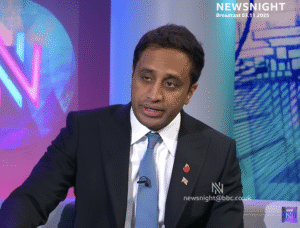
Appearing on the BBC’s Newsnight show on 3 November, Reform UK’s head of policy, Zia Yusuf, made the following statement:

“The majority of social housing in London goes to foreign nationals.”

It appears 6 minutes and 51 seconds into the BBC Sounds archive of the interview and 6 minutes and 17 seconds into its posting on YouTube

It was a dramatic claim to make, particularly in view of the chronic social housing shortage that forms part of London’s housing emergency. According to government figures, there were more than 330,000 households on London local authority waiting lists for social housing in 2024, the highest since 2013.

The allocation of social housing when it becomes available is, therefore, a difficult and delicate matter for London’s social housing landlords – its local councils and housing associations. Who should be at the front of the queue for this scarce resource? If more foreigners than British Londoners are being given these precious tenancies, as Yusuf said they are, that would, to say the least, be very odd. It would also make some people very angry.

I asked Reform UK to provide me with Yusuf’s evidence for his claim. I received no reply. I ask them five more times. Still no reply. I asked Yusuf and Reform chairman David Bull directly on X/Twitter. No response.

Meanwhile, I’ve been asking London’s social landlords if it is the case that “the majority of social housing in London goes to foreign nationals”. And I’ve been looking at the very latest government figures about social housing tenancies in England, which were published yesterday. These inquires have revealed that the claim Yusuf made on Newsnight was wrong. Very wrong indeed.

Those new government figures show that during the financial year 2024/25 across England as a whole, 502,000 people in 263,000 households received a new social letting. Of the “lead tenants” of these households – the person whose name goes on the contract – 89 per cent were to UK nationals.

Could it really be that in London the situation was so radically different during that period that, despite only 11 per cent of new lettings in all of England – which includes London, of course – going to foreign nationals, in London itself a “the majority” of them did?

The government’s statistical release doesn’t include a regional breakdown. However, the Ministry of Housing, Communities and Local Government maintains a sub-national social housing lettings data dashboard.

This provides insights into a range of characteristics of lead tenants, including their nationalities. Number crunchers at the G15 group, which represents the largest housing associations operating in the capital, dug into it for me. They found that just 17 per cent of new social housing lets in London during 2024/25 went to foreign national lead tenants – significantly fewer than a majority.

Where did Yusuf get the completely wrong idea that “the majority of social housing in London goes to foreign nationals”?

Perhaps he was remembering – in fact, misremembering – a similar sort of claim made earlier this year by a leading figure in a rival political party Reform has pledged to replace – the Conservatives.

In March, shadow home secretary and London MP Chris Philp took to X/Twitter to claim that “48% of London’s social housing is occupied by people who are foreign”. This assertion was different from Yusuf’s in that it referred to all current social housing tenancies, some of which go back decades, rather than to recent allocations, as Yusuf’s appeared to. But it was the same in being highly inaccurate.

Philp made his claim on the basis of a map compiled by a far-Right online agitator whose definition of a foreigner includes British people who were not born in the United Kingdom – an extraordinary source for a senior figure in a supposedly respectable political party to rely on. The map also misrepresented the data it drew on. That data refers only to the “household reference person” – a new term for head of household, effectively the single individual whose name is on the rental contract, not all the people who live in the property.

I looked into Philp’s claim at the time and demonstrated that the true figure for the number of people living in London social housing is not 48 per cent, but about 15 per cent. Reuters and The Standard later did the same.

In the absence of any enlightenment from Reform, I have again searched in vain for any factual basis for Yusuf’s (or Philp’s) claims about foreigners and London social housing.

For example, in March 2024, answering a question from London Assembly member Sem Moema, Sir Sadiq Khan said that in 2021/22, 84 per cent of new social home lettings in London had been to UK nationals. And in December of last year, research by Oxford University’s Migration Observatory, based on the 2021 Census findings, showed that 11 per cent of London social housing was occupied by foreign nationals.

False and misleading allegations about foreign nationals and social housing are nothing new, but they have gathered fresh momentum in the past couple of years, facilitated, of course, by Elon Musk’s social media platform. They form part of a wider populist-Right propaganda agenda which focusses much of its attention on London. The capital, despite its vital importance to the UK and the admiration it enjoys around the world, exemplifies everything people in such circles most dislike.

Newsnight’s Victoria Derbyshire did not pick up on Yusuf’s remark, but no criticism of her is implied here – if you watch or listen to her interview, you will see or hear that he slipped in his dubious claim at a point when she was trying to get him to give a proper answer to a question she had asked him earlier.

But if Reform or the Conservatives try advancing such claims again, fellow journalists in Big Media need to be ready for them. As one of the London social housing experts I spoke to put it, what Zia Yusuf said on Newsnight was “grossly misleading and factually untrue”.

OnLondon.co.uk provides unique coverage of the capital’s politics, development and culture with no paywall and no ads. It is funded by subscribers to publisher and editor Dave Hill’s twice-weekly newsletter On London Extra at a cost of £5 a month or £50 a year. To receive it, become a paying subscriber to Dave’s Substack or follow any Support link on this site.
Categories: Analysis

Alexander Jan: London’s Mayors would love to have the powers of New York’s

In scenes reminiscent of Ken Livingstone’s victory in London in May 2000, New York City last week elected its very own firebrand left-wing Mayor –  Zohran Mamdani, a 34-year-old New York state assemblyman from Queens. Voter turnout was up by nearly a fifth on the previous election, making it the highest for a quarter of a century.

Mamdani has been elected on a platform of progressive commitments. His raft of high-profile policies includes, among other things, fast and free buses, rent freezes and a major social house building programme. As official at New York’s City Hall (pictured) turn their attention to implementing his manifesto, opponents and supporters alike are asking how many of his promises can be delivered by the machinery of government at his disposal and how they might be paid for.

For London, meanwhile, the same questions bring into focus yet again how much more power Mayors of New York wield compared with their London counterparts.

Mayor-elect Mamdani will soon be running everything from policing to health, from schools to public housing, from roads to water supply, waste and sanitation. His office will be responsible for an annual operating budget of some $115 billion (£87 billion) and a capital budget of $17.5 billion (£13 billion) along with a workforce of some 300,000 people. That is five to six times more than the £20 billion budget of the Mayor of London and the 50,000 workers of the Greater London Authority’s and its “functional bodies”. Furthermore, control of some of these services, including policing and transport, are shared with national government and London boroughs.

New York State government approval is required for varying some of the taxes Mamdani has talked about raising. Nonetheless, New York’s Mayors tap into a much broader tax base than is available to London’s. This includes property taxes, personal income tax, a sales tax and a general corporation tax. The Mayor can change property taxes, amounting to around $39 billion (£30 billion) and representing about 44 per cent of the city’s revenue, without state permission.

In contrast, the London Mayor’s tax-raising powers are limited to bits of Business Rates and a Council Tax precept. National government is the first and last arbiter of how much financial firepower he or she really has. It would be unthinkable for the Mayor of a major American city to have over half of their income determined by central government, but that’s a (generous) assessment of the situation in London today.

Perhaps only in the area of mass transport does the Mayor of London enjoy more direct control than his opposite number in New York. Largely for historical reasons, Transport for London (and its predecessors) evolved from being city-centric rather than regional (or statewide) bodies. As chair of TfL, the London Mayor enjoys direct control of the Tube, buses and other forms of mass transport. In New York, it is state government working through the Metropolitan Transportation Authority (MTA) which provides nearly all public transport serving the city.

Mamdani may be able to deliver more bus lanes to speed services on his city roads, but the situation is much more tricky with bus fares. Leaving aside debate about the wisdom of his giving away the $500 million (£390 million) a year farebox, he will need the co-operation of the powerful MTA, New York state legislature and its governor in order to keep his promise. The MTA’s institutional culture means it may well demand that state lawmakers force it to make buses free, even if the City of New York is prepared to underwrite the cost.

In London, too, such a policy would face a major financial hurdle. Here, free buses could easily cost TfL £700 million ($920 million) a year in revenue from fares. With zero prospect of central government or the boroughs paying for such a move, the Council Tax precept would most likely need to increase. This might be by as much as 50 per cent. And even before being implemented, central government approval would be needed as well as a “yes” vote in a London-wide referendum.

In New York, roughly a quarter of the city’s population lives in rent-stabilised apartments in the private sector. Mamdani has pledged to freeze thise rents. The New York Mayor appoints members of the Rent Guidelines Board (RGB) that determines increases for this class of property. Assuming he can find a way of having individuals sympathetic to a rent freeze on the RGB – and avoid being sued – Mamdani might be able to deliver on this policy. But in London, the Mayor has no such authority. The power to administer such rent controls was one of the key election asks of Sir Sadiq Khan, but there appears to be no appetite for changing national legislation to allow this to happen.

Finally, with respect to house building, Mamdani wants to deliver 200,000 units of affordable housing over the next ten years. This could cost as much as $100 billion (£76 billion). Unless the city can hike taxes dramatically (property taxes would need to rise by a quarter), or access federal or state grants, expenditure at this sort of level would result in city debt limits being breached – as set out under the state constitution. In London the Mayor is largely at the mercy of central government for housing investment. At about 15 per cent of the value of Mamdani’s targeted spend, his sums are very modest.

Within weeks of taking office on New Year’s day, Mamdani is likely to face battles with an array of institutions as he tries to deliver his more radical and higher cost policies. At times, he will no doubt feel frustrated that he lacks the powers and resources to “cut through” and to implement change. Pity him not too much, though. London’s Mayor can but dream of having the powers and resources available to his New York equivalent.

Follow Alex Jan on X/Twitter.

OnLondon.co.uk provides unique coverage of the capital’s politics, development and culture with no paywall and no ads. It is funded by subscribers to publisher and editor Dave Hill’s twice-weekly newsletter On London Extra at a cost of £5 a month or £50 a year. To receive it, become a paying subscriber to Dave’s Substack or follow any Support link on this site.
Categories: Comment

Sadiq Khan sticking to his net zero target, says his deputy for business

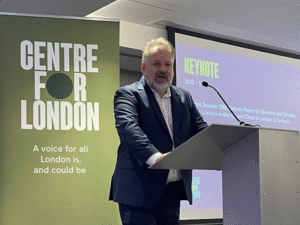
Sir Sadiq Khan will not be deflected from his “net zero by 2030” target for the capital, despite recent shifts in the politics of climate change. That was the message from City Hall’s deputy mayor for business Howard Dawber to the Centre for London think tank’s annual conference held earlier this week.

The conference focused on the city’s “ecosystem”, the infrastructure required for supporting a growing but sustainable city, and the adaptations needed to build the capital’s resilience in the face of continuing climate pressures – all in the context of just five years to achieve the Mayor’s challenging target.

“We stick to the target,” Dawber (pictured) said. London’s green economy, now worth some £55 billion a year, was already the “biggest driver of investment” in the city, he added, with the benefits in growth and jobs already apparent. Despite political scepticism, he said, a “tipping point”  was approaching, when it would be “more advantageous for business to be green than not to be”.

Londoners were backing the Mayor too, he said, recalling that while many, including Labour politicians, had urged Khan to “tone down the green stuff” ahead of last year’s mayoral election, Khan’s vote share had actually increased in outer London constituencies following his expansion of the Ultra-Low Emission Zone (ULEZ) to cover the whole of Greater London.

New polling presented to the conference supported the claim: three in four Londoners were concerned about climate change and more than half felt “personally impacted”, expressing worries about air quality, pollution, extreme heat and flooding. And 65 per cent of Londoners said it was important both to them and their communities that London achieved its net zero goal.

Will that happen? Progress was being made, the conference heard. The Thames, once declared “biologically dead”, now supported 115 species of fish. City Hall policies, including the ULEZ, had brought the capital within air pollution legal limits for the first time. And with significant green space and almost 20 per cent tree cover – some 8.4 million trees – London is effectively an urban forest.

But the climate emergency continued to put pressure on the city, delegates were warned. Temperatures were rising, coupled with more extreme weather – a hotter, wetter London, bringing more floods and fires. Last summer, London’s firefighters experienced their busiest day since World War II, battling a “ring of fire” round the city, said Emma Howard Boyd, chair of the Mayor’s 2024 climate resilience review.

While deaths from extreme heat were increasing – and forecast to triple by 2050 – some 47 per cent of homes were still energy-inefficient. More than one in five Londoners had struggled to keep their home warm, even with the heating on, over the past 12 months, the polling showed. “Retrofit” to upgrade the city’s housing stock – old, leaky, too often overheated in summer – remained London’s “biggest sustainability challenge”.

Car dependency was increasing too, particularly in the outer boroughs, while public transport schemes such as the Bakerloo and Docklands Light Railway extensions remained stalled. And it remained London’s poorest and most disadvantaged who were least protected from pollution and the wider costs of climate change.

Mitigation through continued decarbonisation was both an “imperative, to protect and conserve the habitat we rely on to survive, and an opportunity to create a healthier and more equal city”, said the Centre’s research, director Rob Anderson. But adaptation to build resilience to current as well as future challenges was also needed.

“London faces rising heat, flooding and water stress that already threaten homes, health and infrastructure,” said the Centre’s chief executive Antonia Jennings. “How the city adapts will determine whether it remains liveable and equitable. With hotter summers, more intense rainfall and growing pressure on water supplies ahead, the next decade will be decisive for London’s resilience.”

That would mean both retrofit and cooling for vulnerable homes, protecting and expanding “nature-based” defences – including tree cover, wetlands, floodplains and sustainable drainage systems for managing surface water – and more powers and funding for action at borough level, she said. “We really need to drill down on climate resilience,” added Boyd. “We desperately need a joined-up policy approach.”

Action is underway. The conference saw London Councils leader Claire Holland launch a new pitch for government backing to unlock £400 million of private finance to retrofit 20,000 homes of all tenures, neighbourhood by neighbourhood, with no upfront costs for residents. An updated London infrastructure framework setting out sustainable and climate-resilient investment priorities is due from City Hall and the boroughs, and the Mayor’s London heat plan to tackle rising temperatures and extreme heat will be ready next year. Transport for London is hoping for good news on its Bakerloo and DLR plans.

But the vital element, said Jennings, remained “consensus building – bringing communities on the adaptation journey”. The point was echoed in a keynote speech from energy minister Michael Shanks. In the face of growing fractures in what till now had been broad political agreement around climate action, that government would, he said, “double down”. But he added that that would need more voices speaking out more loudly: “We can’t win if it’s just the government making the argument”. Friends of the Earth chief executive Asad Rehman put it more bluntly: “We need a ground war.”

Follow Charles Wright on Bluesky. Photo of Howard Dawber from Centre for London.

OnLondon.co.uk provides unique coverage of the capital’s politics, development and culture with no paywall and no ads. It is funded by subscribers to publisher and editor Dave Hill’s twice-weekly newsletter On London Extra at a cost of £5 a month or £50 a year. To receive it, become a paying subscriber to Dave’s Substack or follow any Support link on this site.

Categories: News

Transport for London contractors face threats when removing unauthorised flags

Transport for London has pledged to continue removing flags attached to its lighting columns and other infrastructure despite contractors hired to do the job facing “abuse and aggression” when carrying out their duties.

Replying to a letter about the issue from Liberal Democrat London Assembly member Hina Bokhari, TfL Commissioner Andy Lord said: “We understand the concern these unauthorised displays have caused. London’s streets must be safe and welcoming for everyone, and TfL will not tolerate behaviour that undermines that principle.”

Bokhari (pictured), who is also a Merton councillor, wrote to Lord on 29 September to raise “serious concerns” about Union Jack flags being hung on TfL-managed roads outside Merton Council’s headquarters. Though acknowledging that the union flag “is, in many contexts, a proud national symbol of unity,” Bokhari argued that “its unlawful placement across our neighbourhoods is part of a growing pattern of activity that is being used, not to celebrate but too intimidate” with “far-right groups deliberately misusing the national flag to spread fear amongst minority communities”.

In response, Lord assured her that, “It is our long-standing policy to remove all unauthorised displays from our infrastructure – this includes unauthorised flags, a range of graffiti, posters and other materials. It is important that we apply this principle fairly and consistently.”

In addition, Lord stated that TfL is “working closely with our contractors and the Metropolitan Police to establish safe ways to remove unauthorised objects across our network,” emphasising that TfL takes “very seriously” the “abuse and aggression” directed at contractors, and promising to “investigate” any individuals who target them.

A guide published by the last Conservative national government says the flying of flags from local authority or highway authority property is illegal unless permission for it has been given. TfL meets both descriptions.

Tower Hamlets Council, which tolerated the flying of flags of Palestine after the outbreak of the Israel-Gaza war, eventually removed them from all its buildings and infrastructure after the group UK Lawyers for Israel threatened a legal challenge, saying permitting it was in breach of the Town and Country Planning Act 1990.

In a recent True London podcast, Bokhari spoke of “rising hate crime” in London, making particular mention of its effects on her fellow Muslim Londoners. She said, “It reminds me of the time when I was growing up in the Seventies and Eighties and seeing NF [for National Front] signs,” and went to describe her local mosque having red crosses daubed on it in style signifying both the flag of St George and a Christian crucifix.

The organisation Hope Not Hate has reported that some of those behind the raising of flags an lampposts across the country are long-standing far-Right extremists.

OnLondon.co.uk provides unique coverage of the capital’s politics, development and culture with no paywall and no ads. It is funded by subscribers to publisher and editor Dave Hill’s twice-weekly newsletter On London Extra at a cost of £5 a month or £50 a year. To receive it, become a paying subscriber to Dave’s Substack or follow any Support link on this site.
Categories: News