Blog

Rob Blackie: Panorama showed that the Met needs a London re-set

The Metropolitan Police needs to be changed urgently. This week’s Panorama programme, showing officers’ racism and hatred of women at Charing Cross police station, is just the latest exposure of its failings.

Over two years ago, Sir Sadiq Khan said he had “already acted to put the Met on a path of far-reaching systematic and cultural reform”. Yet we keep seeing unacceptable behaviour. And on everything from recruiting more woman officers to screening new recruits better, the Met is failing to improve fast enough.

Baroness Louise Casey suggested in her 2023 report into the Met that it would need to be restructured if it couldn’t make progress within two years. That time is up.

If we’re going to get the Met that London deserves, we need it to focus exclusively on London’s priorities. That means relieving the service of its various national responsibilities, leaving its leaders free to concentrate on bringing about the major reforms of culture and attitudes Casey called for.

At present, senior Met officers have an almost impossible job, juggling different roles. They have high-risk national tasks. They protect the royal family and diplomats. They also work to stop terrorism across the country. At the same time is fulfilling these specialist duties, they are expected to tackle crime of every type in the capital.

No other major country has this structure. The US has the FBI for national crimes. Its secret service protects diplomats and the President. State and local police handle everything else. But in London, our police chiefs are forced to split their attention between terrorists and phone snatchers.

Here’s a simple solution: reset the Met by focusing it entirely on policing London, investigating and solving crime in communities across the city.  As the Met’s national functions are moved to national bodies, greater powers over crime and policing should be devolved to London’s mayoralty.

This could be done quickly, with only simple legislative measures needed to cement the following changes:

  1. Transfer national and international police duties from the Met to the National Crime Agency.
  2. Allow the National Crime Agency to fulfil new duties and give it arresting powers. This could be as simple as a statement saying that the NCA would have the same powers in the areas it was to assume responsibility for as the Met has at present.
  3. Move management responsibility for the Metropolitan Commissioner from the Home Secretary to the Mayor of London, replacing the current system where the Commissioner has two bosses.
  4. Move Parliamentary and Diplomatic Protection and Royal and Special Protection out of the Met into independent groups reporting to the Home Secretary.

These types of change already have wide support, including from the Police Foundation, my Liberal Democrat colleague and former police officer, Wendy Chamberlain MP, and serving police officers I talked to while running for Mayor last year.

Inevitably, people would argue against this for the sorts of reasons often given for not implementing change.

We would hear that it would be costly. It won’t be, though, because only existing duties would need to be funded. Instead, there would be more focused management by people who would know what their job was.

We would hear that the Met would lose funding, a claim made by people who either cynically misunderstand the plan or are unable to add up.

We would hear that such changes would be a distraction from reform. But we’ve seen the Mayor’s current reforms of the Met fail.

Finally, we would hear that the proposal were too radical and need more consideration. Yet we already know that our system is failing, and that if we don’t reform it the people of London will continue to suffer.

Another benefit of bringing the Met back to its core London functions might be inspiring the next generation of police officers. The reforms I’m proposing could again make good, old-fashioned community policing a job young people dream of having, and help fix the Met’s recruitment crisis.

We owe it to the people of London to have an effective police service. We owe it to the many hard working police officers who are trying to protect Londoners every day. It’s time to get going and reset the Met.

Rob Blackie was the Liberal Democrat candidate for Mayor of London in 2024. Follow him on Bluesky. Image from the Panorama investigation, which can be watched in full here.

OnLondon.co.uk provides unique coverage of the capital’s politics, development and culture with no paywall and no ads. Nearly all its income comes from individual supporters. For £5 a month or £50 a year they receive in-depth newsletters and London event offers. Pay via any Support link on the website or by becoming a paying subscriber to publisher and editor Dave Hill’s Substack.

Categories: Comment

Richard Derecki: London must act to reduce youth unemployment

The labour market situation for young people in London today is among the toughest since the fallout from the 2008 financial crisis.

There are just over 900,000 16-24 year-olds in London. Many are in education, some on apprenticeships, some working part or full-time. But increasing numbers are struggling to establish themselves in the labour market, piling financial pressure on them and their families and undermining their sense of self-worth.

Long-standing difficulties with the Office for National Statistics (ONS) labour force survey have affected analysts’ attempts to get a clear picture of what is going on in the labour market. However, various data sources make it apparent that conditions for young people trying to find work have worsened.

Nationally, the unemployment rate has risen from 10.7 per cent in 2022 to 14.0 per cent in 2024. There has been a slight easing of this in the past couple of quarters, but the 2024 annual youth unemployment rate was the highest for ten years. And in London it is significantly higher.

Unhelpfully, there is a paucity of granular London data. However, Trust for London quotes a youth unemployment figure of 14.6 per cent at the end of 2023 and the NOMIS dataset from the ONS has a figure from pooled date for April 2024-March 2025 of 17 per cent.

These unemployment figures are worrying, and a further labour market indicator, that of inactivity rates, compounds the concern. ONS data show that, nationally, the economic inactivity rate for young people (that is, those not able to work or not seeking it ) is running at over 30 per cent and has been on a rising trend for many years.

Economic inactivity reflects certain choices – for example, if a young person chooses to stay in education. But since 2023, this measure has been rising for young people out of full-time education. The current number is around the highest level recored since the current series began in 1992.

A recent House of Commons briefing paper on youth unemployment notes how, since the start of the pandemic, there has been an increase in the number of 16-to-24-year-olds who are economically inactive due to long-term illness. This has been driven largely by an increase in the number of young people with a mental health condition.

There is a well-worn narrative that seeks to explain London’s high youth unemployment rate: employers are looking for ever higher skill levels; there’s a misalignment between the school curriculum and labour market needs; there’s insufficient investment in further education and a paucity of apprenticeship schemes.

A post-2022 twist comes from the rapid and speculative adoption of AI tools by many firms. This is cutting entry-level jobs in administration, customer services and even software development, and wiping out swathes of graduate entry jobs.

The recruitment site Adzuna reports that entry-level jobs now only account for 25 per cent of the market in the UK — down from 28.9 per cent three years ago – and that the number of job vacancies has declined by 32 per cent since 2022. It also reported Dario Amodei, chief executive of AI company Anthropic, warning that the technology could wipe out half of entry-level jobs in the next five years.

This is in line with research about the US. A recent paper from Stanford University shows how employment has declined for young workers in AI-exposed occupations (they highlight software engineers and customer service agents). Growth in employment as a whole continues, but for young people it has stagnated.

Those with no toehold in the labour market of any kind are caught in a terrible bind, as entry-level jobs both for those with GCSEs and those with A levels and degrees vanish. These qualification pathways were traditional routes into well-paid and stable careers. But it is not like that anymore.

Chatting to a Sainsbury delivery driver, who is self-funding a coding degree because everyone assured him coding was a gateway skill to a well-paid software developer job, I wondered what he should do. Crack on, double-down and try for a Masters? Take on more debt in the vague hope of landing, eventually, a high paid role or grind out the hours in his current role on a just above minimum wage?

The rapid adoption of AI is changing our labour market in ways we still don’t really understand – and far more quickly than policy can respond. There will be winners as well as losers, but if we do not want to further entrench employment inequalities we need to be braver about finding a way to recycle some of the staggering profits the tech firms are making into specific support for those whose labours they are making redundant.

The recent UK-US tech agreement goes big on new data centres, but these do not, of themselves, generate many jobs beyond the construction phase. They are capital-intensive, not labour-intensive. A temporary one-percent windfall tax on AI-excess profits earned in the UK could provide a ring-fenced fund to support thousands of paid apprenticeships in not just AI and digital sectors, but also those where there are long standing shortages, such as nursing or childcare. In this way, the AI transition can be made more inclusive.

Meanwhile, in the real world, the government’s policy response is to establish a Youth Guarantee so that every young person aged 18 to 21 has access to further learning and help with getting a job or an apprenticeship. Youth guarantee trailblazers have been launched in eight mayoral authorities in England, and London has been awarded £30 million for 2025-26 to invest in locally-led employment support programmes.

London government – the Mayor and London Councils – has long highlighted how youth unemployment disproportionately affects black Londoners, disabled youth, and those with mental health challenges. Its response has tended to focus on tackling the fragmented nature of employment services provision.

As the most recent London Councils report, Breaking Barriers, argued, “there are many bodies operating at the national, London, sub-regional, and borough levels which offer employment and skills services to young Londoners, but the lack of integration and collaboration among them hinders effective support.”

As part of the London response, the Mayor set-up the No Wrong Door programme, which seeks to ensure that whichever route a Londoner chooses, they get directed to the appropriate guidance or training to help them gain employment and boost their skills. This objective is delivered through four sub-regional partnerships, which are the recipients of the trailblazer funding.

One of those partnerships, the Local London integration hub, focuses specifically on adults (19+) with special educational needs or disabilities and on young people with few qualifications, especially those without Level 2 English or maths.

Local London covers nine outer-London boroughs across the eastern side of London. It focuses on support for schools through their career hubs, which provide self-development and career management skills for students and meaningful exchanges with employers.

It also looks to support young people by capturing their voices through youth summits, so that interventions are more closely aligned to young people’s concerns. The team is helping to develop a core offer that all young people in London should be able to access through interactions with their own dedicated youth frontline advisor, though future funding for this resource-heavy initiative is not yet secured.

Through its engagement with local businesses, Local London found that many SMEs can be overwhelmed with applications when they advertise a vacant role. Without the resources to efficiently manage the process, they can come to rely on word of mouth and people they know when choosing who to take on. This compounds the problems of those with low levels of social capital.

Caroline Kandaya, who leads on the integration hub at Local London, would like to see more direct intervention to support firms with taking initial steps to create and recruit young people for new roles.

Kickstart, the Covid-era employment support scheme for young people, was widely criticised for being overly bureaucratic and inflexible, but Caroline argues that the level of financial support – paying 100 per cent of the age-relevant National Minimum Wage, National Insurance and pension contributions for a 25-hour week for six months – was crucial in mitigating the costs of employing someone in a situation where margins are tight across the firm.

The integration hubs have the potential to address long-standing failings in the functioning of London’s labour market. But they need much bolder levels of investment and less prescription. London government has long argued for greater flexibility over the use of the apprenticeship levy and for some control over the underspends, so that resources can be brought together.

Moves to provide London with an integrated funding settlement, which will include adult skills and employment support and be multi-year, should be the catalyst for amplifying the work of the hubs.

There is momentum behind them. But to really push on, they need the finances to develop their tech infrastructure, to employ well-resourced youth advisors and –  wouldn’t this be something? – to have the ability to pilot a Kickstart-like programme of financial support for local small and medium enterprises. to take on a youngster who needs a helping hand into the labour market.

All the ingredients are there to allow the hubs to make decisive interventions. It is time to bring them all together.

Follow Richard Derecki on Bluesky. Photo from Local London.

OnLondon.co.uk provides unique coverage of the capital’s politics, development and culture with no paywall and no ads. Nearly all its income comes from individual supporters. For £5 a month or £50 a year they receive in-depth newsletters and London event offers. Pay via any Support link on the website or by becoming a paying subscriber to publisher and editor Dave Hill’s Substack.

Categories: Comment

Government confirms Crews Hill in Enfield and Thamesmead riverside picked as New Town locations

Two locations in London have been officially recommended for the building of New Towns, with the potential to provide more than 35,000 new homes between them. The newly-released findings of the government’s New Towns Taskforce confirm that the Crews Hill area in Enfield and riverside land at Thamesmead in Greenwich are among 12 sites thought suitable for New Towns across England, as first reported by On London earlier this month.

The taskforce report says the Crews Hill site has the potential to provide around 21,000 new homes, bearing out suggestions in recent days that it was being earmarked for significantly more the the government’s goal of at least 10,000 for each New Town. The Thamesmead site too, has been judged able to substantially exceed the minimum target, with the report saying 15,000 homes could be built there.

The report’s definition of the Crews Hill location also encompasses the adjacent area collectively dubbed Chase Park in what it calls a “green” and “expanded development” with “an ambition for 50% of those homes to be affordable, helping to address London’s acute housing need”. This effectively combines the two Green Belt sites Enfield Council has long had ambitions to build on and has included in its new Local Plan proposals, which have been undergoing their statutory examination in public.

As Enfield Dispatch editor James Cracknell has documented for On London, Enfield envisaged only 5,500 homes for the Crews Hill area itself (top picture) and 3,700 for Chase Park, a total of only 9,200. The taskforce report say it would bring together and expand the two sites and that “without new town designation it is unlikely that development will be brought forward at such a scale” or with the speed the government seeks.

The much smaller, 100 hectare (247 acre) Thamesmead Waterfront location (pictured below) is described in the report as “an opportunity which has gone unrealised for decades” to renew the original promise of the mid-1960s Thamesmead development, which is undergoing a long term regeneration. It notes a “long-standing desire to connect the Waterfront site to the London transport network” and says New Town status “could be an opportunity to finally realise this historic vision”.

Bafkreicn2o2gtl4sojuefdzaehg3awfftuh23euidiqokpsfjdhzdl2roa

It identifies as a “key challenge” Transport for London securing “confirmed government support” for its proposed extension of the Docklands Light Railway to the south side of the Thames through Beckton to its north. Sir Sadiq Khan made known his disappointment with the exclusion of commitment government funding for the project from Chancellor Rachel Reeves’s spending review in June. However, transport secretary Heidi Alexander later noted that “substantial work” had been done on the plans and would continue to work with TfL and City Hall to finalise a business case by the autumn.

Follow Dave Hill on Bluesky

OnLondon.co.uk provides unique coverage of the capital’s politics, development and culture with no paywall and no ads. Nearly all its income comes from individual supporters. For £5 a month or £50 a year they receive in-depth newsletters and London event offers. Pay via any Support link on the website or by becoming a paying subscriber to publisher and editor Dave Hill’s Substack.

Categories: News

Sadiq Khan deputy hints at major policy shift to increase homebuilding

As London’s housing crisis deepens, pressure is mounting on Sir Sadiq Khan to reduce his 35 per cent affordable housing requirement for new private developments to help revive home building in the capital, now at a record low.

Could a dramatic City Hall announcement be imminent? That was certainly the expectation among development professionals at the Shaping London’s Future conference held by leading planning chambers Landmark last week “Everyone is waiting for the GLA (Greater London Authority) announcement,” said one attendee as the session began.

That made Jules Pipe, Sir Sadiq’s deputy for planning and overseer of the London Plan, the Mayor’s long-term blueprint for development in the capital, something of a star attraction. And while participants may have been disappointed not to hear specific pledges from him, Pipe suggested there isn’t long to wait. There was an “increasing sense of urgency” as development ground to a halt, he said, with City Hall working with government on “immediate measures”.

Speakers set out the now familiar cocktail of challenges which, according to Tom Dobson of planning consultancy Quod, meant that in the coming period “most developers aren’t going to be building very much”. Soaring costs, high inflation and interest rates and falling sales, coupled with the pressures of new building safety rules and the demand to provide high levels of affordable housing, new infrastructure and other public provision, were all making schemes increasingly unviable.

Two recent schemes were highlighted, the 1,000 home Stag Brewery development in Mortlake and the 52-storey, 434 home Cuba Street scheme at Canary Wharf, where developers had successfully argued for large reductions in an initial 30 per cent affordable home provision, to enable works to proceed. Meanwhile, as Pipe himself pointed out, no work has begun on thousands of potential homes in the capital for which there is planning permission because of similar viability concerns.

With homelessness increasing, the situation is all the more acute because affordable housing built by private developers under “Section 106” agreements with boroughs, in return for planning permission, makes up more than half of the total affordable supply in the city.

More homes in London were also critical for UK economic growth, said Landmark KC Rupert Warren, while his colleague Zack Simons KC pointed out that with the capital allocated almost one in four of new homes in government plans, there would be “no hope” of reaching that target “unless London does its bit”. The Mayor’s London Plan, added fellow KC Russell Harris, must “become a delivery machine…because if it doesn’t, no-one else will”.

“I’m very alive to the reality of development in the current climate,” said Pipe. “We recognise the viability challenge, and the Mayor is serious about kick-starting development in London.” Short-term measures that might initially focus on helping unlock stalled sites and “make those permissions a reality” were in train, he said.

Pipe added that viability challenges were not all due to City Hall and borough planning rules and other regulations. Wider economic pressures were in play, and more investment in transport – particularly City Hall’s top three proposals, for the Bakerloo line and Docklands Light Railway extensions and the new West London orbital line – was vital for meeting the city’s 10-year 880,000 home target.

But he also accepted that for potential new development what had been a flagship, and initially successful, Khan policy, offering a “fast track” through the planning process in return for 35 per cent affordable housing, was no longer delivering. And changes brought in by City Hall at the end of last year, designed to speed up delivery by allowing more flexibility on the type of affordable housing provided, had “not been enough”.

The Mayor would now be “increasingly active” in exercising his power to “call in” major planning applications and take over decision-making from the borough in order to push schemes through, Pipe promised. But beyond that, what could the emergency City Hall guidance, which is now clearly expected – perhaps in the next few days, according to some observers – look like?

Pushing that 35 per cent threshold down is the main demand, with viability expert James Brierley, from the Newmark consultancy putting his money on a reduction to 20 per cent. “Developers want to build, and schemes should provide what they can and maximise the amount of affordable housing, recognising that affordable delivery is the government focus,” he said. “But we need a bit of pragmatism and realism.”

Simons highlighted what he said was the “biggest constraint” on housebuilding in London, its extensive Green Belt, covering 22 per cent of the city’s land area. The government’s changes to planning rules allowing some release of Green Belt land, alongside strict affordable quotas, was a “once in a generation” opportunity to get building, he said, and urged developers to “strike while the iron is hot”.

Follow Charles Wright on Bluesky. Photo: New homes at Brent Cross Town.

OnLondon.co.uk provides unique coverage of the capital’s politics, development and culture with no paywall and no ads. Nearly all its income comes from individual supporters. For £5 a month or £50 a year they receive in-depth newsletters and London event offers. Pay via any Support link on the website or by becoming a paying subscriber to publisher and editor Dave Hill’s Substack.

Categories: News

Arise, Sir Keir of Camden

If Sir Keir’s aides have a moment, they are invited to run their eyes over the below.

Why do our most extreme opponents – Britain’s enemies within, often funded from abroad, who pose as patriots but peddle lies, incite violence and stir up hate  – so often denigrate their own capital city?

Our capital city – London.

Why do they falsely claim that it is “fallen” or “lost” when, in so many ways, and despite Brexit, the pandemic and the sidelining it suffered under the Conservatives, it is still growing and thriving?

They do it because they cannot bear to recognise that London, with its energy, creativity and vast human variety, represents one of things – one of the very many, very different things – our country can be proud of.

London, let us remember, is the mighty engine room of our country’s economy. Almost a quarter of all UK economic output comes from it. Every year, tens of billions of pounds in taxes raised in London are spent in other parts of the country – north and south, east and west – on public services and on funding infrastructure.

I would like to see less of that dependency on London. I want all of our other great cities to become more successful, more independent, more attractive to business, more able to provide great opportunities for their people and draw others from around the country and the world.

But we cannot achieve that if London is made weaker – precisely because the stronger London and its economy is, the better able the government – this Labour government – is to fund the skills training and new transport and revived industrial power that Birmingham and Leeds and Cardiff and Manchester and Bristol and Glasgow and Liverpool and many other cities need.

My friend Sadiq Khan is right when he insists that when London does well, the whole country does well. And just because Boris Johnson used to say the same thing, doesn’t mean it isn’t true.

To help London grow stronger – and grow better – and to help our other cities and regions at the same time, we are now finalising plans, worked out with Sadiq, to give away more powers to London’s City Hall so that London can take care of its own affairs better – and, as a result, do more for the rest of the country too.

We will build further on the historic devolution of power to the capital made by the last Labour government at the start of this century to put London and Londoners more in charge of their own destiny, and become even more of an asset to our country than they already are.

Those powers will include more freedom for London government to raise more taxes at London level and spend those taxes the way its Mayor and its local councils, rather than Whitehall and the Treasury, thinks best.

That won’t mean the rest of the country gets less. Quite the opposite – by giving London more freedom and control over taxes raised in London, London will generate more for us all.

Conference, we must not fall into the trap of blaming one part of our country for the problems of others. It is true that some parts of Britain have, for many decades – indeed, for centuries – been wealthier than others.

But even the wealthiest have also contained stubbornly high rates of poverty and disadvantage. My job as Prime Minister and leader of a Labour government is to recognise that truth and to work relentlessly with every part of England, Scotland, Northern Ireland and Wales, to create opportunity, spread wealth and bring those rates of poverty down.

We will never do that by pretending that favouring some parts of the UK at the expense of others will end inequality. In the Britain I want to build, no one would be left behind, whether they live in Aberdeen or Anglesey, Blackpool or Birmingham, Carlisle or Camden, where my constituency is.

The dead end, regional politics of the so-called “north-south divide” are not progressive, not patriotic and not prepared to deal with reality. They are though, as their name suggests, divisive.

The different regions and nations of our United Kingdom have long had precious and profitable relationships with each other. We need to strengthen those good relationships, so that all concerned get more out of them, not encourage destructive resentments and rivalries.

We need all of our cities to grow stronger economically, and build stronger relationships – with other cites, including cities overseas, and, of course, with the towns and villages that surround them, so that as prosperity increases, it is also shared.

Conference, our country does not need any more voices of grievance and division, seeking to blame honest, hard-working migrants or supposed “metropolitan elites” – who include, I am told, north London lawyers – for difficulties whose true roots and causes could not be more different.

Instead, the regions and nations – the cities and towns and villages – of the United Kingdom need unity – unity in their dazzling diversity – to work together for national renewal.

All reasonable suggestions for re-writes considered, but don’t push your luck. Follow Dave Hill on Bluesky.

OnLondon.co.uk provides unique coverage of the capital’s politics, development and culture with no paywall and no ads. Nearly all its income comes from individual supporters. For £5 a month or £50 a year they receive in-depth newsletters and London event offers. Pay via any Support link on the website or by becoming a paying subscriber to publisher and editor Dave Hill’s Substack.

Categories: Comment

Lewis Baston: Trouble grows for Newham Labour with landslide by-election loss

The Newham Independents, a local political party, made a landslide gain in a by-election held last Thursday in the ward of Plaistow South. The Plaistow area has fallen within Labour-run councils’ domains since 1919, initially as part of the County Borough of West Ham and since 1965 as part of the London Borough of Newham*. Could this change in the borough elections of 2026?

Labour’s defeat in Plaistow South was just the latest bit of damage inflicted on its Newham fortress. The party won every seat on the council in three successive elections between 2010 and 2018 and has provided the borough’s directly elected mayor since the post’s creation in 2002.

But the 2022 elections were preceded by internal Labour strife in the council chamber, leading to the party’s National Executive Committee (NEC) administering the re-selection of mayoral incumbent Rokhsana Fiaz, who had won for a first time in 2018. The election results showed some slippage from the 2018 high point. Although Labour won another massive majority, winning 64 seats, the Greens took two, both of them in the new Stratford Olympic Park ward, and support for Fiaz fell from 53,214 votes (73.4 per cent) in 2018 to 35,696 (56.2 per cent).

Since then, a sense of crisis has gripped the borough, with a financial difficulties leading to an above-normal nine per cent rise in Council Tax, emergency funding from central government and looming “tough decisions” about spending in the light of a £40.6 million overspend, largely the result of demand for temporary housing.

Newham’s housing services received a damning C4 rating from the Regulator of Social Housing indicating “very serious failings” requiring “fundamental change”. There have been frequent changes of chief executive, with three permanent and three interim appointments in post since 2018. The borough has fallen a long way since it was held up as a role model by a sympathetic central government when it was led by the its first Mayor, Sir Robin Wales.

In May 2025 the government issued a “best value” notice to Newham expressing concern about its governance and culture. Paul Martin, the latest chief executive, who was appointed in July, warned councillors that the government imposing commissioners to take charge of Newham over the head of the local executive was a “plausible outcome”.

A row rumbled about the terms of departure of Martin’s predecessor, Abi Gbago, who left with a £230,000 payoff and a non-disclosure agreement. In July 2025, Mayor Fiaz announced that she would be standing down. The Labour NEC panel selected her successor as Labour candidate. Newham may not have a tradition of organised political opposition to Labour, but it has a lively and critical local media including Newham Voices and Open Newham, which receive a steady stream of Town Hall news and gossip.

Labour’s response to the Israeli attack on Gaza after October 2023 added to the party’s problems in Newham. The borough’s population is 35 per cent Muslim and many of the rest are young and have left-wing and pro-Palestine values. In the general election, the Newham Independents polled a significant 20 per cent in West Ham & Beckton and a Gaza Independent polled 18 per cent in East Ham, as Labour’s vote fell by 26 percentage points compared with 2019.

But Newham Labour started losing by-elections even before Gaza became the major issue in UK domestic politics it is now. A Boleyn ward seat was lost to Mehmood Mirza, now leader of the Newham Independents, in July 2023. The independents won again the following November, in Plaistow North. And now comes Plaistow South. In addition, Labour has lost four Newham councillors through defections or suspensions. There are now nine Newham councillors not taking the Labour whip, which the largest since the council term of 1974-78.

The Plaistow South by-election was caused by the death of Labour councillor Neil Wilson, who had represented this ward and its predecessor, Hudsons, since 1994. Wilson’s long service made him “father of the council”. He played a mentoring role for successive intakes of new councillors, which will be much-missed. He was cabinet member for health and adult social care under Mayor Fiaz, and for equalities under her predecessor, Mayor Wales. His Cabinet colleague Sarah Ruiz paid tribute to him:

“Neil was a very dear friend and colleague. His beliefs shaped him and his values, and his life of public service – as a teacher, and as a councillor.  Neil was loved and respected by Member colleagues across the chamber, and by all the Council officers he worked with, for his experience, dedication and commitment to the borough and people he loved – and his sense of joy and fun.”

Plaistow South is more or less in the geographical centre of the borough of Newham. The ward is well-defined on the map. Its boundary to the south is the A13 Newham Way. The line follows New Barn Street and Barking Road to the west and north, and then Boundary Road to the west. Boundary Road defines the border between the former boroughs of West Ham and East Ham.

It is divided by the elevated Greenway, which follows the course of Joseph Bazalgette’s Northern Outfall Sewer, one of London’s great Victorian public works. The ward includes Newham Hospital. It contains no stations, but a very high 25 per cent of its working population travels to work on the Underground, mostly from Upton Park or via a bus connection to Canning Town.

Like most of Newham, Plaistow South is a multi-ethnic, predominantly working-class area, but its demographics are a bit distinctive. For an inner London ward, a high proportion of people (76 per cent) live in houses rather than flats, and 41 per cent (above the 33 per cent Newham average) own, rather than rent, their homes.

Fewer people are educated to degree level (35 per cent) than is usual for Newham (40 per cent) or for London (47 per cent). It has a larger white population (35 per cent) than Newham as a whole (31 per cent) and not as many people of Asian heritage (35 per cent rather than 42 per cent). It has a smaller proportion of Muslims (32 per cent) than either of the other two wards previously gained by the Newham Independents (Boleyn has 46 per cent, Plaistow North 43 per cent).

Plaistow South was won by Labour by a large majority over the Conservatives in the 2022 elections, but it was clear from the outset that, although six candidates came forward the by-election, the contest was between Labour’s Asheem Singh and Md Nazrul Islam** for the Newham Independents, both of whom ran proper campaigns with leafleting and canvassing while the other parties were less active.

Islam (pictured) gained the seat with 913 votes (44.7 per cent) – more than twice as many as Singh’s 436 votes (21.3 per cent). Labour’s vote share was down 34 percentage points, its worst London result since the general election except for Redbridge Mayfield in March.

In third place was Lazar Monu for Reform UK, whose 16.1 per cent (329 votes) was a creditable showing. The other three contenders – Nic Motte for the Greens (152 votes), Rois Miah for the Conservatives (123) and Sheree Miller for the Liberal Democrats (90) – all lost vote share. It was the fourth-worst Conservative by-election performance in London since the general election by this measure. Turnout was poor, at 23.1 per cent.

The by-election issues, according to Islam speaking to Newham Voices directly after his win, were housing plus the Council Tax rise, emission-related charges for parking permits (the “parking tax”, as he dubbed it) and charges for bulky waste. In the background were Gaza, the national government and the general state of Newham governance, but most of Islam’s priorities could have come from a pro-motorist, low-tax Conservative.

The perception that groups like the Newham Independents are left-wing relies heavily on their stand on Palestine. Look more closely, and a more complex picture emerges. The local party is a catch-all. It has not had to make the sort of choices that being in government involves.

Labour’s candidate for Mayor of Newham next May is Forhad Hussain, who was a councillor for Plaistow North in 2010-18 and served in Wales’s cabinet. He will face determined competition from the Newham Independents, surely in the form of party leader Mehmood Mirza. The Plaistow South by-election is a sign that Labour’s mighty fortress is perilously besieged from without, and at risk of collapse from within.

Newham is one to watch in the May 2026 elections. Despite its century-long history of Labour municipal control, it is one of the party’s more likely losses.

*Labour won only 30 seats out of 60 in the 1968 elections, but retained an overall majority thanks to indirectly elected Aldermen.

**Md or MD is a common abbreviation among Bangladeshi Muslims for Mohammed when used as a personal name.

Follow Lewis Baston on Bluesky and read all his writing for On London here. Photo from Newham Independents x/Twitter feed.

OnLondon.co.uk provides unique coverage of the capital’s politics, development and culture with no paywall and no ads. Nearly all its income comes from individual supporters. For £5 a month or £50 a year they receive in-depth newsletters and London event offers. Pay via any Support link on the website or by becoming a paying subscriber to publisher and editor Dave Hill’s Substack.

Categories: Analysis

How is the local government Fair Funding Review unfair to London?

Last month, the Institute for Fiscal Studies (IFS) released its calculation that inner London borough councils were lined up to be the biggest losers from the Fair Funding Review 2.0, the government’s process for changing how money for local government will be allocated across England from next year.

Alarmingly, it estimated that some of the capital’s boroughs would “see funding fall by over a quarter if the reforms were introduced immediately”. Even if they increased their Council Tax levels by the highest amounts permitted over the next three years they would still, the IFS said, “face a real terms cut of 11-12%” despite a floor to limit losses.

As a region, Greater London would be hit harder than any other, with the East Midlands and Yorkshire & The Humber doing best, though that wouldn’t be the whole London story. Further analysis has taken place, including by London Councils, the cross-party body representing all of the capital’s local authorities. These efforts indicate that some boroughs would fare relatively well under the proposed new formula, all of them in outer London, as the London Councils graphs below show.
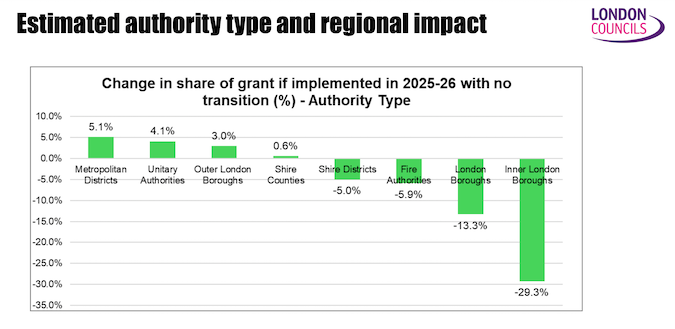
Screenshot 2025 09 20 at 11.10.56

Among the winners would be Hillingdon, Havering, Hounslow, Enfield and Croydon. But more than 20 of the 32 boroughs would be worse off, with Camden, Hammersmith & Fulham, Kensington & Chelsea, Westminster and Wandsworth the most heavily clobbered.
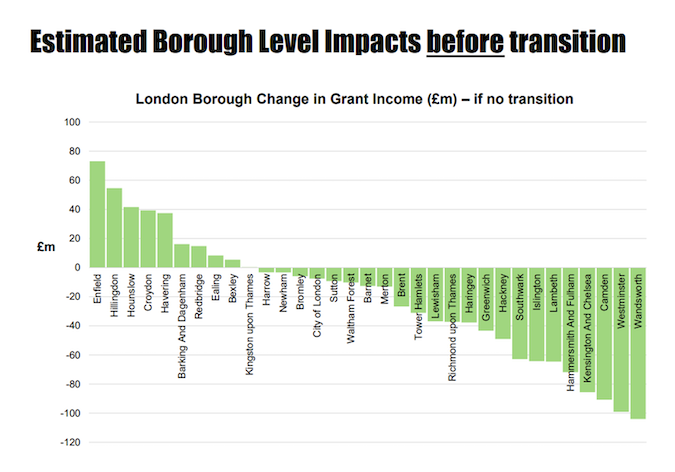
Screenshot 2025 09 20 at 12.50.31

London Councils warned the government a year ago that many boroughs were facing a funding crisis. In June, it stressed the importance of the funding reforms recognising London’s pressing social problems, and last month produced a briefing arguing that the review proposals “will fail to produce a robust, long-term funding system that genuinely matches resource to need” and land more boroughs in deep financial trouble. Already, seven of them have had to seek extra financial support.

How has the government, specifically the Ministry of Housing, Communities and Local Government, come up with its new Fair Funding formula? Is it fair to London? And what could it mean for Londoners?

*  

The main purpose of the Fair Funding Review is to allocate a bunch of grants to local government in a new way, essentially by simplifying them and distributing them according to new set of formulae the government regards as being fairer. London Councils thinks that, as things stands, the boroughs would collectively receive £700 million less than they do at present.

It is, perhaps, not widely known that the largest proportions of local authority spending go on adult and children’s social care, which are among the services councils must provide by law. The more visible to most of us are things like rubbish collection, road repairs and street cleaning. The Fair Funding proposals as first set out envisage redistributing existing total funding for England to help poorer areas more. The worry is that its calculations fail to recognise the levels of poverty and need in London.

Councils also raise funds locally, of course. An Institute for Government explainer from five years ago said just over half the funding for local government in England comes from Council Tax and just over a quarter from the portion of Business Rates they are allowed to retain. That left 22 per cent from government grants. The government’s proposals raise the possibility of many Londoners having to pay more in Council Tax and see cuts in services too, as boroughs struggle to balance their budgets.

Another part of the national context is that local authority revenues as a whole fell substantially under the austerity policies of the Conservative-Liberal Democrat coalition government before partially recovering from 2017/18. Between 2009/10 and 2019/20, the government grant element was cut by an astounding 40 per cent in real terms, the Institute’s explainer says, before recovering a bit during the pandemic. Throughout, the proportion accounted for by Council Tax has risen.

The austerity period hit inner London boroughs particularly hard. In 2019, Centre for London analysis put Westminster, Newham, Tower Hamlets, Hackney, Camden and Wandsworth at the top of the list. The then chair of London Councils, Peter John, said government funding for the boroughs had dropped by 63 per cent since 2010. And now, under Labour, the axe is out for London again.

The government’s approach, which dates back to pre-Covid, has been to make a calculation about the amount of need that exists in each local authority area compared with all the others, and another one about the resources at that local authority’s disposal, which largely comes down to the amount of Council Tax it can raise. The difference between the two is the basis for deciding how much grant the government should bestow.

London’s beef is with the way the “relative needs” assessment has been calculated. This has involved boiling down about 15 different formulae for each local authority into seven main ones and, rather than ring-fencing the different grants as before, pouring them all into one pot. The seven areas covered are adult social care (the largest), children’s services (the second largest), a “foundation formula” element derived from population and deprivation figures, homelessness, road maintenance, fire and rescue provision and home-to-school transport.

It’s a mathematical equation for working out who gets what that generates bad results for most of London. It’s also very complicated – the document explaining how it’s done is around 120 pages long plus ten annexes. A lot of is drawn from its now rather outdated Indices of Deprivation, which haven’t been revised since 2019 and were based on the findings of the 2011 Census. The formula for children’s services has its own deprivation index, which also comes into the calculation.

Because these reforms have been a long time coming, London government has been able to anticipate some of what is proposed. That is just as well, because national government has not attached any figures of its own to the impacts of its changes. That makes it much harder to respond to them with precision. Doing so has entailed working with specialist consultants and modelling the impacts as well as possible. No one has a definitive answer. The broad direction of travel, though, seems pretty clear.

*

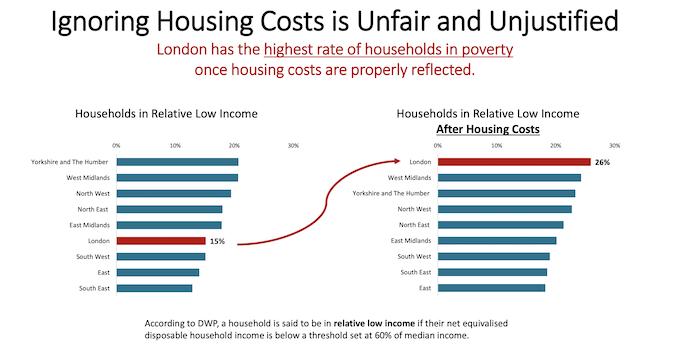
What will happen next? London government, which includes Sir Sadiq Khan, has been arguing for adjustments. There has been, it’s fair to say, some amazement that housing costs were not factored in. As the London Councils chart below shows, it is these that push Londoners whose incomes might be quite good compared with counterparts elsewhere into the “in poverty” category, which in London is very large – the city’s poverty rates are the country’s highest. The word is that there might be some movement on the housing front, but nothing has yet been confirmed.
Screenshot 2025 09 20 at 11.13.01

The children’s services formula is causing particular concern and seen as the most consequential change in the Fair Funding Review as a whole. It leaves every London borough except one worse off in that department, and the exception only just.

A multi-level regression model has been assembled. Devised by the Department for Education under the last government, it uses a number of socioeconomic datasets to predict the needs of local school students. Its final evaluation report is 200 pages long and enough to make the most accomplished number cruncher weep. Long story short, a top drawer team assembled to divine its meaning concluded that this “whole new approach” wasn’t very good.

Overtures have had a hearing, a ministry technical working group has been formed and, again, progress is being made with recognising some of London’s distinctive social characteristics. These again include housing and also the free school meals situation which, in London, already has a universal element, thanks to Mayor Khan’s high-profile Londonwide initiative. Eligibility for Universal Credit has been suggested as a better metric.

Measuring children’s health was identified as another tricky area, and not only in terms of what it meant for London. The review relied on responses to the 2021 Census, in which a question asked parents only if their child was in general good health or not. Hardly any – about two per cent nationally – ticked the “bad health” box.Then there are the effects of household overcrowding. Past studies have demonstrated a link between it and the likelihood of children ending up in care. Yet somehow the new model points to the opposite.

Among the vaguer elements is a “remoteness factor” which was presented in the review as an adjustment based purely on theory, together with a request for supporting evidence. It supposes that access to any kind of service, product or amenity will be easier and cheaper if you live in an urban area than a remote one, solely on the basis of proximity. This has induced significant annoyance, not least because other government research has shown that the theory doesn’t hold up.

Does the Fair Funding model work properly? Are its mechanisms muddled? Are its ingredients sound? Are its potential outcomes actually fair at all?

*

The process continues. There is lot at stake. It has been estimated that the children’s services formula alone, if left in its initial form, would see £1.5 billion go out of London. The deprivation measures, the free school meals and the omission of housing costs in their own right also seem to have the potential to leave Londoners in need of local council support worse off. London is also pushing back on the overall population numbers the review relies on. These are drawn from the last Census, which was conducted when many Londoners left the city temporarily because of the pandemic and could therefore be artificially low.

There’s acknowledgment that the outgoing funding mechanism has in some ways, favoured London: for example, it factors in ethnicity, especially of black groups, as a proxy for higher need, and has historically enabled Westminster, Wandsworth and Kensington & Chelsea, all of them Tory strongholds until two turned Labour in 2022, to set very low Council Tax rates.

At the same time, the new formulae overall seem to effect London as a whole so negatively that there is an urgent need to understand them better and figure out why that might be. The government’s consultation period is over, but that work is still ongoing with London concentrating particularly hard on children’s services and housing costs. In the midst of this uncertainty, boroughs are trying to plan their budgets. the uncertainty isn’t helping.

A formal government response to the feedback to its consultation is expected to be published next month and a policy statement from the department, now headed by Steve Reed, at around the same time, perhaps the same day. The final outcome of the Fair Funding Review 2.0 will not be known until the provisional local government finance settlement comes out in December, following the budget late the preceding month. Fingers crossed.

Follow Dave Hill on Bluesky. Photo from Greater London Authority.

OnLondon.co.uk provides unique coverage of the capital’s politics, development and culture with no paywall and no ads. Nearly all its income comes from individual supporters. For £5 a month or £50 a year they receive in-depth newsletters and London event offers. Pay via any Support link on the website or by becoming a paying subscriber to publisher and editor Dave Hill’s Substack.

Categories: Analysis

Nick Bowes: Sub prime Lime

On Tuesday 12 August at around 6:30 pm, my left wrist was shattered in an accident as I cycled on a quiet residential street near Elephant and Castle. At point blank range, directly ahead of me, a group of boys aged no more than 11 or 12 on Lime bikes shot straight into the road at speed without looking. With no time to brake, I slammed into the side of one of them. The impact crushed my front wheel and threw me over my handlebars.

The group of lads, none of whom were injured, stayed around for five minutes or so, more amused than remorseful, before leaving the scene. One kind fellow cyclist stayed with me, tying up the remains of my bike before waiting until my taxi arrived. At the hospital, an x-ray confirmed a bad fracture. A fortnight later, I had a metal plate and screws inserted during surgery. Months of recovery and interruptions to my normal routines lie ahead.

Being a good citizen, I filed a police report and contacted Lime. The police opened and closed the case (no CCTV, no hope of tracing the kids) and Lime launched an investigation. Their insurers have been in touch, but a top personal injury lawyer warned me not to get my hopes up.

Hire a Lime bike through the app and your journey is insured, covering the rider, the bike and any third parties. Lime policy is that only over-18s can rent one of its bikes. But I collided with a child who was either riding a Lime without paying (in effect, stealing it) or had an account (or was using someone else’s) contrary to Lime’s rules. Either way, he was uninsured.

There’s little reason why you’d have heard of the Motor Insurers’ Bureau (MIB). Funded from everyone’s car insurance premiums and backed by section 95 of the Road Traffic Act 1988, if you are in an accident caused by an uninsured motor vehicle, the MIB steps in. Effectively, it is the insurer of last resort. But be in an accident with a stolen Lime bike and you’re on your own – the MIB does not cover uninsured rental e-bikes – nor is there an equivalent for micromobility.

Let’s be clear – I have no grudge against e-bikes. I have had a Lime account in the past. E-bikes have obvious positives (adding to transport options) and widely acknowledged negatives (dumping of bikes, reckless cycling). The drawbacks do not solely lie with Lime to fix – e-bike users also must take some responsibility. But Lime could do more to address areas where it is falling short.

Take the ease with which Lime bikes can be stolen. It would seem simple to prevent people pedalling off on one without paying. Yet Lime repeatedly seems incapable of stopping it, always one step behind those who’ve worked out another way to hack them. Ever wondered what that “clack, clack, clack” sound you sometimes hear on the street is? It’s someone on a stolen Lime bike.

Take Lime’s policy of renting bikes only to those over the age of 18. When setting up an account, you are asked to tick a box accepting Lime’s user agreement. Only if you click on this and scroll down quite some way do you come to a mention of the minimum age rule. And when hiring, no proof of ID to verify a user’s age is asked for. How many Lime bike users on London’s streets either lied about their age or didn’t read the user agreement and so are unaware that they are too young to be riding one? 

Then there’s the question of those underage users “borrowing” an adult’s account. We already know from my recent experience that a child on a stolen Lime bike causing an accident isn’t insured. But what if it’s a child using an adult’s account or an account that includes false information? Is Lime’s insurance null-and-void? The kids I encountered didn’t hang around, and even if they’d volunteered names and addresses, the chances are they would have been be false.

Washing its hands of responsibility, Lime claimed that what happened to me was a police issue, as the theft of the bike was a criminal offence. But the company’s failure to get the details of those who steal its bikes makes it impossible to do anything.

The messiness surrounding what is and isn’t insured makes the case for universal insurance cover, whenever Lime bikes are in use and regardless of who is in the saddle. If this was the case, it would focus minds at Lime – overnight, I bet they’d triple efforts to prevent theft and dramatically tighten up age checks. Reducing theft would also help with the problem of dumped Lime bikes – Lime’s policy of fining users who recklessly leave bikes strewn across pavements is toothless for perpetrators that don’t have an account!

The problem is that without being dragged kicking and screaming, Lime won’t voluntarily take such steps. They will need to be mandated by an appropriate regulatory body. Alas, none of the obvious authorities have the required powers. Certainly not London’s 32 local authorities, left to make do the best they can with by-laws and enforcement regulations that were never intended for e-bikes. Neither does Transport for London. It has jurisdiction over black cabs, private hire vehicles, a trial of e-scooter trials and, coming soon, pedicabs, but it is powerless when it comes to e-bikes.

The law, as is often the case, is a decade behind. There is a glimmer of hope on the horizon – the English Devolution and Community Empowerment Bill working its way through parliament includes new clauses (Part 2, clauses 23-29) designed to strengthen and simplify the regulation of micro-mobility providers. Credit where it’s due to TfL and London Councils for their constant lobbying.

Alas, this becoming law, let alone put into action, is some years away. No doubt Lime will fight a rearguard action. But if parliament does its job, e-bike providers will be licensed, subject to stricter rules on safety and usage, liable to penalties for failures and could even lose their licences. Hopefully, as part of this, the insurance gap my accident exposed will be closed.

In the meantime, until laws are passed more people will be injured and maybe even killed. While some journalists (such as Jim Waterson) have dug away at Lime’s failings, it’s sad to say that only a horrific fatality might force the pace of change that is desperately needed. But these aren’t risks we should be taking with the safety of Londoners. I’m a cyclist and pro-cycling, but until sufficient regulations are in place, I’m not convinced rental e-bikes should be on our streets.

Follow Nick Bowes on Bluesky.

OnLondon.co.uk provides unique coverage of the capital’s politics, development and culture with no paywall and no ads. Nearly all its income comes from individual supporters. For £5 a month or £50 a year they receive in-depth newsletters and London event offers. Pay via any Donate link on the website or by becoming a paying subscriber to publisher and editor Dave Hill’s Substack.

Categories: Comment