Blog

Enfield: Local Green Belt housing event hears polite but firmly-opposed views

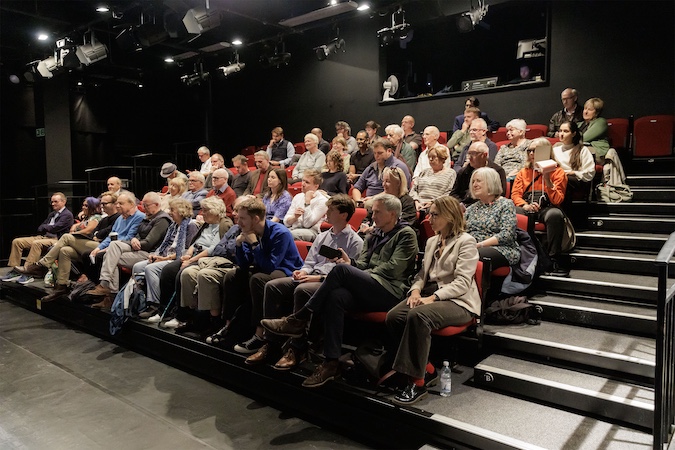
London desperately needs more homes, but where should they be built? Should some of them be on the previously sacrosanct Green Belt, prompting conflict in the suburbs? That was the thorny subject addressed this week at an event held at the Dugdale arts centre in Enfield Town, hosted by The London Society with the local community newspaper, Enfield Dispatch, and chaired by On London publisher and editor Dave Hill.

It was an appropriate location. Green Belt land makes up 37 per cent of the borough of Enfield, whose council has led the way in London in identifying development sites within that protected zone. Its new Local Plan, now at its public examination stage overseen by a government planning inspector, proposes some 9,200 new homes on the Green Belt at Chase Park and Crews Hill.

Meanwhile, Sir Sadiq Khan Khan is conducting his own Green Belt review, Transport for London has made an “illustrative” proposal for Enfield to accommodate up to 12,000 new homes on alternative Green Belt land nearer to public transport, and there are strong suggestions too that the government’s New Towns taskforce will soon recommend Crews Hill for one of these settlements, aiming for at least 10,000 homes there.

Following an overview of London Green Belt history by Dr Jack Brown, senior lecturer in government studies at King’s College, and a summary of the local situation by Enfield Dispatch editor James Cracknell, debate was polite but revealed firmly-held opposing views.

“Families need homes, no more excuses,” said London YIMBY representative John Murphy. “Young people” unable to get on the property ladder were now in their 40s, he added. “I want more affordable homes, so people can have more children and live better lives, not so pressured financially.” The Green Belt, he said, was now “strangling London”.

He said the deposit for first-time buyers in Enfield is now £85,000 while private sector rents are higher than ever, making it harder to save such a sum: “If you’re a couple and you’ve done everything right but you can’t afford a house you therefore can’t afford to have a child.”

Addressing the council’s objectives for Crews Hill, Murphy said it was “a good plan” and that although he felt sorry for people employed by the area’s many garden centres who might lose their jobs if the area was cleared for housing, he asked why they couldn’t be relocated somewhere further north. “Nobody has to lose,” he said.

Murphy was also critical of the council, though, over its handling of a major brownfield site, Meridian Water, in Upper Edmonton in the south-east of the borough. Enfield owns nearly two-thirds of the developable land within the site, and a new railway station opened there in 2019, but progress has been slow.

“It’s a good plan, I’m in favour of it,” Murphy said, but while local were residents were having to help meet the cost of the scheme, it had been blighted by “delay, delay, delay”. He concluded: “Families need homes, builders want to build and nobody needs any more excuses from politicians.”

Opposing the council’s plans, Andrew Lack from the Enfield Society said one of the sites it had chosen was a significant remnant of the historically important ”Enfield Chase”, a Royal hunting ground from medieval times and “part of the character of the borough” akin to Richmond Park or Hampstead Heath. He argued that it should remain protected and the council should instead be prioritising brownfield sites, which a society survey suggested could accommodate 38,000 homes.
Chair@londonsociety.org.uk

“There is land and it’s not being developed,” he said, citing stalled progress on sites including Meridian Water, where 10,000 homes are promised, but also on a 1,800 home scheme in Southbury, which was abandoned when planning permission expired last year.

Lack set out a nuanced position, saying the society had backed development on the Arnos Grove station car park in the south of the borough and also supported Tottenham Hotspur FC’s recent controversial plans for a women’s training centre in the Green Belt. “The society does accept some development may be needed,” he said. “The critical factor is that it must be sympathetic.”

That also meant no “tower blocks” in locations such as Enfield Town, he added, when pressed on the need for building in well-connected areas. It still had the “character of a small market town,” he said, as well as being a conservation area with a significant number of listed buildings where new tall buildings were inappropriate, though the society “would accept up to seven storeys”.

However, a member of the audience said the housing crisis was now at such a level that Green Belt development was needed alongside “densification” in town centres and around transport hubs. Other points included the need to “go back to council housing” to guarantee affordability, as well as building sustainably “where the buses and trains already are” and to a higher standard as well.

A local property developer highlighted soaring building costs increasingly rendering brownfield sites unviable, while architect Russell Curtis recalled that development around railway stations was not new in Enfield. Another audience member asked how to counter well-organised “NIMBY” campaigns – get lobbying your councillors, was the answer –  and another called for consultation to engage more with people who actually needed homes, as well as hearing from opponents.

Can Enfield’s Green Belt defenders hold their position? London Society trustee and experienced town planner Heather Cheesbrough set out the council’s legal duty to prepare a Local Plan that broadly complies with all mayoral and national planning policies as well as being designed to meet housing need.

That inevitably meant finding more land to meet Enfield’s share of London’s new 88,000 homes a year target, taking into account recent dramatic falls in brownfield site supply, the “human and financial” costs of homelessness for families and the council alike, and the impact on the wider economy of failing to provide enough homes. “That’s the dilemma for the council, identifying those sites,” she said. “But we can’t put our heads in the sand and say we don’t want development.”

Where that development takes place will be largely determined over the coming months. The examination of the Enfield plan resumes on 21 October, followed by further consultation before ministerial sign-off. Meanwhile, the findings of the New Towns Taskforce are expected within weeks.

Follow Charles Wright on Bluesky. Photos by Simon O’Connor. Main pic L-R: Jack Brown, Andrew Lack, Dave Hill, James Cracknell, John Murphy, Heather Cheesbrough. Comprehensive coverage of Enfield’s Local Plan by Enfield Dispatch here. The next London Society housing event will take place on 25 October in the City of London. Details here.

OnLondon.co.uk provides unique coverage of the capital’s politics, development and culture with no paywall and no ads. Nearly all its income comes from individual supporters. For £5 a month or £50 a year they receive in-depth newsletters and London event offers. Pay via any Donate link on the website or by becoming a paying subscriber to publisher and editor Dave Hill’s Substack.

Categories: News

Julie Hamill: Bowie overshadowed

“Don’t let me hear you say life’s taking you nowhere…”

David Bowie is playing on Greatest Hits Radio (the Ken Bruce show) as I do up my top button and think about a jacket for the weather, which has suddenly turned dismal. Soon, I’m heading to Brondesbury Park station to take the eastbound Mildmay line to the David Bowie Centre at the V&A East Storehouse for press day.

The Tube strike explains why I’m going by Overground – which, ironically, makes me start humming Bowie’s Underground – so I’m expecting the train to be busy. It is, in fact, quiet, with plenty of empty seats. Only the big corrugated rubber-joiny bits of the train squeak and stretch as we whirr along to Hackney Wick. A woman a few seats away smiles as she breastfeeds her baby.

With the rain pelting outside, it’s cosy in the carriage, and I can see why people like travelling on the big trains. I hit “play” on Moonage Daydream, looking forward to feeding my five senses with the great musical inventor and all the little wonders of a new collection from his personal estate.

The V&A has been gifted Bowie’s personal archive, which contains over 90,000 items: costumes, handwritten notes, lyrics, instruments, props and a vast number of photos. The collection will be permanent, but with so many objects only 200 can be displayed at any one time, to be refreshed every six months. For something specific, visitors can book an “order an object” session and view it in a smaller room under close supervision.

As I head into the Storehouse at Here East on the Queen Elizabeth Olympic Park, I’m surprised to see no signage or posters in the window, not even a single Aladdin Sane lightning bolt. I’m not the only one checking if this is the right door. I hear others asking, “Am I in the right place for the Bowie Cent…?”

“Yes, you are! Right this way,” the two door staff reply, as if they’ve been saying it all morning.

Brollies down and wet things in a locker, I get my wristband and we’re led upstairs along a corridor into the exhibition room. Bowie videos roll on a big screen. I desperately want to hear his music, any of it, but it’s turned down very low on a not-great sound system. My ears sink. Where is he now? I need his voice to heat the air and dry my trousers. Alas, it’s held at a careful volume.

Then it’s turned off completely as the curator gives a talk about the items in this vault from Bowie’s career: his favourite Little Richard photo, the rejection letter from Apple Records, the glass ball from the movie Labyrinth, the iconic Yamamoto designs, right up to the notes he made on a musical set in 18th Century London called The Spectator, which was writing just before his death.

It’s an intimate space, and I hear others asking, “Is it just these two rooms?”. In the smaller one, some “order an object” items are on display: Ziggy’s guitar, one of Bowie’s kimonos, the palm tree heels. I imagine, despite the limits, there’s excitement in the constant rotation, so repeat visitors won’t be seeing the same pair of Pelican platforms twice.

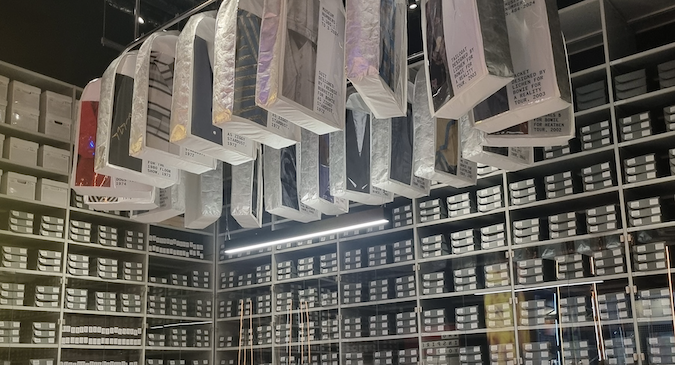
Back in the main room, I look up to notice some of his costumes are hanging from the ceiling in white suit bags with a small viewing section and some writing and order numbers on each one, but it’s not big enough to see what’s inside. I wonder what delights are hidden, and why they couldn’t have made the bags entirely transparent or, better, displayed the clothes from the ceiling in a more creative or experimental way – something more befitting the artist’s vibrancy.

Unnamed

Box upon box of grey archive files are stacked neatly along one wall, labelled. A few duplicates are open on a table to provide a taste of contents. I open one and read about Labyrinth, a classic movie in our house. There are stories and handwritten lyrics to Magic Dance from the movie tucked inside plastic covers, hole-punched and indexed. It feels very much like a library: quiet, hushed, low mumbling in the background. A staff member puts the music back on, even lower. I imagine Bowie walking in and saying “Shh!”, like in China Girl.

I move over to the glass cases holding handwritten lyrics for Win and Heroes. There’s a section for Gail Ann Dorsey, his bassist and friend for over 18 years, and notes on his drum-and-bass work with Goldie. The Nile Rodgers and Last Dinner Party guest curations showcase their chosen objects: photos and lyric notes. There are many costumes, including the Let’s Dance suit and Ziggy/Yamamoto outfits, displayed on headless mannequins…which feels a bit faceless and department store.

The “Bowieness” of this whole thing is missing. He is not here, literally or metaphorically. His things are, yes, but there’s no flavour of him in how they’re displayed, no sense of his unique sparkle, very little of his face. I suppose you could ask, what was I expecting? This is a museum with a huge vault of his stuff. It’s a challenge to choose and display. True. But if the boxes have to be stacked, must they be grey? If the costumes have to hang in suit bags, can’t we see them? This is the most inventive artist in history, so where’s the flamboyance? Perhaps I wasn’t expecting to see, but to feel. And I didn’t.

I did love discovering that Bowie treasured all his fan art, sent from around the world. Only three small items are on display, but knowing he kept and catalogued every piece gave me the closest glimpse of David Jones himself. That alone could make a powerful exhibition.

The stretch of Bowie’s musical influence is well covered, from Charli XCX to The Last Dinner Party, Chappell Roan and many others, all citing Bowie as their pathway to individuality. This feels more suited to a music magazine or talking-head documentary. That wall might have been better used to showcase his beautiful paintings, or a commissioned painting of his face.

Afterwards in the foyer, I hear other press visitors marvelling at how wonderful it all is, to see Bowie’s personal life and legend in one place. No doubt the reviews will be five stars across the board. And maybe they’re right, and I’m a brat. This is his collection, after all, gifted with his blessing. But for me, it’s a stack of stuff, much of it paper, pictures, and notes, all filed away, with only glimpses on display. It’s hidden bits of Bowie in boxes. It didn’t fill my heart, so I run for the shadows.

Follow Julie Hamill on Instagram. Centre photo from V&A East Instagram.

OnLondon.co.uk provides unique coverage of the capital’s politics, development and culture with no paywall and no ads. Nearly all its income comes from individual supporters. For £5 a month or £50 a year they receive in-depth newsletters and London event offers. Pay via any Support link on the website or by becoming a paying subscriber to publisher and editor Dave Hill’s Substack.
Categories: Culture

Sadiq Khan calls for government rethink on ‘fair funding’ for London boroughs

Sir Sadiq Khan has warned the government that new plans to reform borough council funding would be a “false economy”, undermining the capital and hampering efforts to promote economic growth.

The government’s Fair Funding proposals, due to come into effect next year, would update the formulas used to fund councils all over England, which have remained unchanged for a decade, aiming for a system where “allocations are made based on the latest and best available data and recognise the areas where demand for council services is greatest”.

But the proposed new arrangements would create “big winners and losers”, according to the Institute for Fiscal Studies (IFS), with London, and inner London in particular, losing out most – prompting the all-party London Councils group to accuse the government of ignoring deprivation in the capital, where poverty levels after taking housing costs into account are the highest in the country.

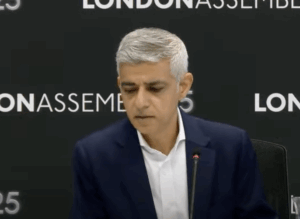
The group has already warned the government that “after more than a decade of structural underfunding, rising demand and skyrocketing costs”, the change could have “devastating consequences” for London boroughs and their residents. The Mayor (pictured) told the London Assembly yesterday that he backs its call for a rethink.

“If London is to continue driving the national economy, we can’t risk repeating the mistakes of the past,” he said at Mayor’s Question Time. “Our city has suffered under the weight of austerity for too long. Now is the time for investment, not further cuts, which would only suppress growth and stifle our potential.”

The old formula needed to change, he agreed, but the new arrangements needed to take more account of the “disproportionately high housing and living costs in the capital” as well as appropriate deprivation indicators. “Otherwise we risk support being taken away from those who need it most. We all believe in those with the broadest shoulders carrying the greatest burden, but civil servants are in danger of not recognising that London councils in particular are carrying a huge burden already.”

Cutting allocations to London was also a “false economy, doing London down,” Khan said, responding to a question from Conservative Assembly member Thomas Turrell’s, in which he referred to a Labour MP in the north of England celebrating funding moving northwards.

“I welcome a fairer funding formula,” the Mayor continued, “but what I wouldn’t want is money taken away from London, not just because inequalities in London are huge, but because with the right support we can contribute even more to the Treasury, which can then support people across the country.”

The capital’s unique position, making an outsized 25 per cent contribution to the UK economy, needed to be recognised, but the continuing perception that the streets of London “are paved with gold,” also needed countering, he added. “They really aren’t, and the way the proposed formula works doesn’t take into account the needs of our city.”

City Hall would continue to make the case for fairer funding, alongside London Councils, Khan said, and Assembly chair Len Duvall suggested that the Assembly itself could also support that effort, with a further joint cross-party call on ministers. The Mayor agreed; “That would demonstrate a real coming together of ‘Team London’,” he said.

Watch the September Mayor’s Question Time here. The fair funding discussion begins at 2hrs, 36mins. Follow Charles Wright on Bluesky.

OnLondon.co.uk provides unique coverage of the capital’s politics, development and culture with no paywall and no ads. Nearly all its income comes from individual supporters. For £5 a month or £50 a year they receive in-depth newsletters and London event offers. Pay via any Donate link on the website or by becoming a paying subscriber to publisher and editor Dave Hill’s Substack.
Categories: News

Vincent Stops: Are London’s bus services really getting ‘brighter’?

When bus passengers are asked about their priorities, reliability always comes top. The reasons are obvious: commuting time to work, parenting commitments, meeting friends, hospital appointments or getting to school. Knowing a bus will arrive regularly and that you will reach your destination in a reasonable time is fundamental to travel choice, if you have one.

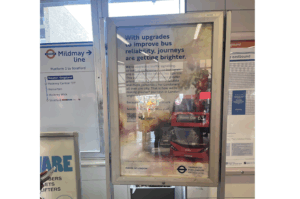
So when I read a Transport for London poster at Dalston Kingsland station recently, with its message about bus journeys “getting brighter”, it angered me enough to refer it to the Advertising Standards Authority. The poster may be cleverly worded, but it isn’t truthful. You have to go back to the early years of this century to find bus reliability figures as bad as they are now.

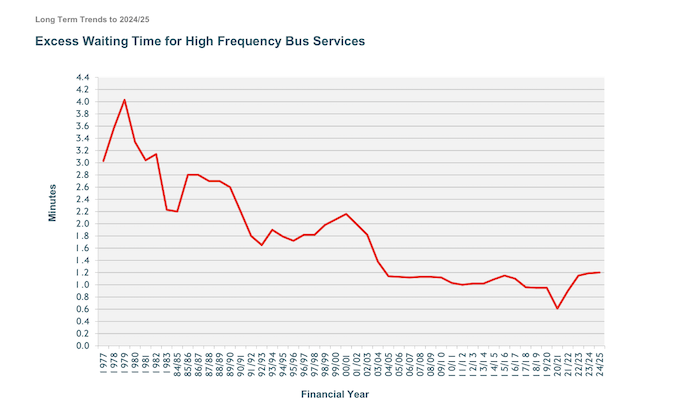
Transport for London was established in 2000 and very soon was incredibly proud of what it achieved for bus passengers in a remarkably short space of time. The chart below of “excess waiting time” dramatically demonstrates the improvements in reliability between the late 1990s and early 2000s. This was delivered initially by an active Government Office for London and then by TfL itself. The average amount of time London bus passengers had to wait beyond the scheduled period was halved.

Screenshot 2025 09 11 at 19.55.55

The first Mayor of London, Ken Livingstone, understood what mattered to bus passengers and focussed TfL’s attention accordingly. He used a mix of measures to achieve this aim, both physical and financial. At the heart of his policies was the so called “quality incentive contract”, a combination of bonuses and penalties for bus operators to run their contracted bus mileage, and to do so reliably.

Primary amongst the other measures was the London bus initiative, which introduced over 200 bus priority lanes across the city and, crucially, enforced them with cameras. Oyster ticketing reduced boarding times. And, of course, congestion charging was the most effective area-wide method for increasing bus priority. The funding from scheme was directed towards new and better services.

The improvement continued in the early years of Boris Johnson’s time as Mayor, maintaining a golden era for bus passengers, with more frequent services, more routes and route extensions. Passenger levels rose rapidly to 6.5 million journeys a day.

But his good work didn’t last. A second round of bus priority and a second new contract regime to incentivise quality of service were abandoned and the western extension of the congestion charge zone was removed. And in his second term, from 2012, Johnson appointed Andrew Gilligan, a journalist friend and fanatical cyclist, as his “cycling czar”.

The focus of London streets policy turned dramatically from tackling congestion and further enhancing London’s most important passenger service, the bus, to London’s smallest private transport mode, the bicycle. Cycle Superhighways and mini-Hollands consumed much of TfL’s energy and eye-watering sums of money for the next four years. Bus lanes were converted to cycle tracks and motor vehicle capacity was reduced in favour of cycle priority.

With massive amounts of disruption due to road works, the loss of bus lanes and overall motor vehicle capacity at key junctions across inner London, the inevitable occurred – bus journey times got longer. TfL and the bus operators did their bit to maintain performance by adjusting traffic lights to favour buses, shortening bus routes and improving their control of services. TfL officers undertook a lot of work to establish that a decline in passenger numbers was linked to slower bus speeds.

Sir Sadiq Khan’s mayoralty carried on where Johnson’s left off. A new cycling and walking commissioner, Will Norman, continued Gilligan’s focus on bicycles, this time under the cover of a “healthy streets” agenda. There has lately been some recognition of the damage being done to the bus service – hence the poster. But there are inherent contradictions: part of TfL is putting in bus lanes and other bus priority measures, while another part is taking out bus priority and removing motor capacity from bus routes in favour of cyclists.

As a result, bus service performance is the worst it has been since Livingstone’s first term. Reliability is worsening, as shown in the chart. Bus speeds are the slowest they have since the reporting mechanisms of TfL’s I bus system were introduced in 2013. TfL have missed their bus journey time target for the last three years, despite that target being slackened. And what of the actions the poster describes for making bus journeys “brighter”?

A plan published in 2022 promised to adjust traffic signal timings, add bus lanes and increase the hours of operation. These are good things to be doing. However, the root of the problem is that whilst there may be policies supporting buses, London government has been, and continues to, be far too casual about bus performance. The scale of the effort to turn around the decline is woefully inadequate. There are neither the policies nor the commitment to do more. Bus journeys aren’t about to get brighter anytime soon.

Vincent Stops is a former Hackney councillor and lead member for transport who worked on streets policy for London Travelwatch, the capital’s official transport users’ watchdog, for over 20 years. Follow him on X/Twitter.

Categories: Comment

Charles Wright: London’s affordable housing supply looks likely to recover. But how strongly?

Are things beginning to look up for affordable housing in London? Sir Sadiq Khan’s housing deputy Tom Copley sounded optimistic about the progress of City Hall’s government-funded affordable homes grant programmes when he appeared before the London Assembly housing committee earlier this week.

It’s a mixed picture, though. The Mayor’s initial affordable homes programme (AHP), which saw an allocation of £4.8 billion for the period for 2016 to 2023, met its target of 116,000 homes started. However, a second programme, running from 2021 to 2026 with £4 billion to invest, has seen just 5,500 “starts” to date. That’s well short of its target of between 17,700 and 19,000 affordable homes got underway by next year.

The housing associations delivering the bulk of the programme, along with councils taking forward their own schemes, had been hit by the same problems affecting the wider housebuilding sector, Copley said: the now familiar cocktail of high interest rates, spiralling building costs, labour shortage, hold-ups over post-Grenfell safety rules, the continuing impact of Brexit and inadequate past government funding, all pushing construction in the city to the brink.

But “green shoots” of recovery were now evident, Copley said. Last year, affordable housing starts were up 70 per cent, alongside renewed confidence in the social housing sector, putting the Mayor’s challenging targets within reach. “Starts will ramp up and we will be able to achieve the 2021 to 2026 target range,” he asserted.

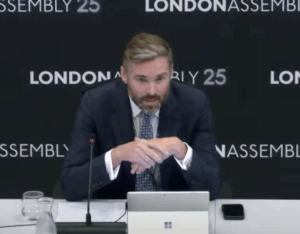
What’s behind the optimism? Government action, said Copley (pictured), including the new £11.7 billion ten-year AHP funding deal from 2026, hailed by Khan as the “biggest and longest funding settlement that the capital has ever received for affordable and social housebuilding”. In addition, there is a long-term rent deal that will boost housing association balance sheets, easier ways for councils to recycle Right to Buy receipts into new housing, and more cash for vital post-Grenfell fire safety improvements. Initial bids for the next round of AHP funding will be invited next month, with overall delivery targets to be confirmed next year.

Good news, then. But City Hall funding is just one part of the affordable homes story. On the other side, where private developers build affordable homes under “Section 106” agreements with boroughs in return for planning permission, there’s far less optimism.

Just 2,158 private homes were started on schemes of more than 20 homes in the first half of this year. There are 200,000 permitted but unbuilt homes on “stalled” sites in the London Plan’s 47 “opportunity areas” alone, with developers arguing that they are now “unviable”. That’s a big concern, given that the Section 106 deals on sites like these have generally provided up to half the affordable homes in the capital in recent years

Berkeley’s 637-home Camden Goods Yard scheme is just one example, with the housebuilder saying that rising costs mean it can no longer provide the affordable housing it originally promised. The builder now wants to slash that commitment by almost half. Without that concession, it warns, the site would “stall altogether, like so many others”. Councillors are so far resisting, but calls are growing for Khan to relax his “35 per cent affordable” homes threshold for larger developments.

It’s a particular issue on brownfield sites that are expensive to develop, including the opportunity areas. Consultant and former councillor Rhys Williams warned last month that the threshold is now squeezing developers “beyond breaking point”, resulting in brownfield development collapsing “exactly where we need housing most urgently”.

City Hall is listening, it seems. “We’ve been hearing the message from the sector about how challenging viability is, and we intend to respond to that,” Copley told the committee. The 35 per cent threshold would be reviewed as Khan gets to work on the next London Plan, to run from 2027, he confirmed.

But Khan is also looking to identify development opportunities in the capital’s extensive Green Belt – land which had “substantial potential” and was cheaper to develop, Copley said. “We can’t meet our targets without Green Belt development.” That set alarm bells ringing. “We are worried we will get to a situation in a few years where we will still have brownfield sites that are empty and the Green Belt being built on,” said committee chair Zoe Garbett.

Will the new London Plan meet developers’ demands, or might Khan act sooner to get brownfield sites going, as some are urging? “The industry cannot wait for a new London Plan. There is a mountain of stuck consents that are working off yesterday’s assumptions. They can be unlocked before we go to the Green Belt,” says Nick Cuff, experienced in local government and now managing director of real estate advisers Urban Sketch. He proposes immediately reducing affordable housing requirements in opportunity areas to 15 per cent and reinstating “fast track” processes to review now outdated affordable home agreements on existing schemes.

Battle lines are being drawn. The capital’s housing associations argue that “in the face of acute affordable housing need, maximum delivery must remain the expectation…Viability concern should not become a route for reducing affordable provision.” City Hall, too, recently told MPs the threshold had successfully boosted affordable supply and helped “embed affordable housing requirements into land values”.

The key intervention, Copley said, would be the proposed City Hall developer investment fund, providing “different types of financing that will help to get some of those stalled sites moving again”. The government has supported the proposal, though details are still awaited. Meanwhile separate government funding has just been announced to unblock almost 4,000 new homes on currently stalled sites at High Road West in Tottenham and Billet Road in Redbridge.

Arguments about where to set the balance between public and private funding are not new. There’s hard bargaining on both sides, and current problems are not all down to planning rules, either. But the coming months could be critical, for all parts of the housing system.

Follow Charles Wright on Bluesky. Watch the London Assembly housing committee meeting here.

OnLondon.co.uk provides unique coverage of the capital’s politics, development and culture with no paywall and no ads. Nearly all its income comes from individual supporters. For £5 a month or £50 a year they receive in-depth newsletters and London event offers. Pay via any Donate link on the website or by becoming a paying subscriber to publisher and editor Dave Hill’s Substack.
Categories: News

Elin Morgan: Reviving London’s historic drinking fountains

In her novel There are Rivers in the Sky, Elif Shafak traces the life of a single drop of water from ancient Mesopotamia, through centuries and across continents to the present day. Following the life of water is an appealing idea, though on the long journey of that drop we encounter water that is anything but vital: in London in 1854 water infected with the comma-shaped bacteria known as Vibrio cholerae is estimated to have killed 10,000 people.

Cholera outbreaks were not uncommon in Victorian London and were often caused by unsanitary conditions at the public water pumps upon which many relied. Investigations at the time found that water supplied by unscrupulous private companies was often the cause.

It was in response to this public health crisis that in 1859, a group of philanthropists set up the Metropolitan Free Drinking Fountain Association. It unveiled the first clean public drinking fountain outside St Sepulchre-without-Newgate Church in the City of London. The use of innovative in-built filters ensured that the water supplied was safer to drink. In the years that followed, the association opened several more clean water sources across London, and were joined in their mission by other philanthropic associations and individuals.

There was often a moral bent to the intentions of the first fountain donors. Many were Quakers or otherwise involved in the Temperance movement and were, in part, motivated by the desire to stop the working classes drinking beer as a safer alternative to water. In 21st Century London, we don’t have to worry about the cleanliness of water from our taps (or resort to beer unless we want to), but a conversation about private ownership of water and the morals and standards of those who provide it is again taking place.

It’s also true to say that hydration on the move is very much part of contemporary life, much more so that when I was young, when barely anyone carried the now-ubiquitous portable bottles. Combine that with concerns about plastic waste from disposables and it’s no surprise that public water fountains are becoming a feature of London town planning again. Six years ago, Sir Sadiq Khan installed 100 new fonts at locations around the capital.

What, then, of London’s original Victorian water fountains, many of which were decommissioned and fell into disrepair? I can remember seeing them as a child in parks and outside stations, their marble sinks more likely to be stuffed with litter than splashed with drops of fresh water.

With that in mind, I was interested to hear about the work that the Heritage of London Trust (HOLT) is doing to restore London’s historic drinking fountains – 16 so far, and eight coming up. HOLT’s director, Dr Nicola Stacey, told me that they “involve local communities in all our projects from beginning to end, so they have a chance to see the conservation work up close. In the case of fountains, many local people remember drinking from them as children, but have seen them switched off and neglected for decades. There’s a brilliant ‘switching-on’ moment, which brings a huge uplift for the community and a sense of delight across the generations.”

Guilford place fountain, camden after

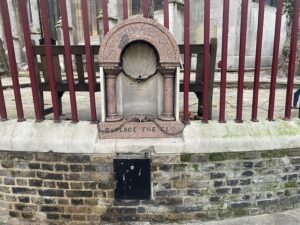
That sense of ownership echoes the intentions of the Victorian philanthropists who set up the first drinking fountains. I went to visit the one at St Sepulchre early on a summer evening (pictured, top). The crossroads where it sits was busy with people rushing in and out of pubs and restaurants and home from work.

The Old Bailey loomed large to my right, though when the fountain was first unveiled, it wasn’t there.  It was then the site of the infamous Newgate Prison. With Smithfield Market and several City guilds based nearby, this would have been an ideal site for footfall. It’s no wonder that at its peak St Sepulchre was used by 7000 people a day.

Today, the fountain sits humbly against the railings. Pink granite pillars topped by an arch enclose the marble shell from which water once flowed. Underneath, a dedication to its founders. At the base, an exhortation to users to “Replace the cups”. No plastic water bottles back then, though the cups, which I’ve seen chained to the font in photographs, aren’t there today and the fountain isn’t operational. HOLT have plans to restore it soon, but it’s not yet possible to fill my bottle.

Keen to find a water fountain I could use, so I headed east along the A40. On my way, I took a detour to Red Lion Square, known for its association with Bertrand Russell, among others, but also notable for being one of the 70 or so London gardens laid out by Fanny Wilkinson, a Suffragist and pioneering landscape gardener, who has recently been commemorated in the form of a statue attached to a water fountain in Southfields.

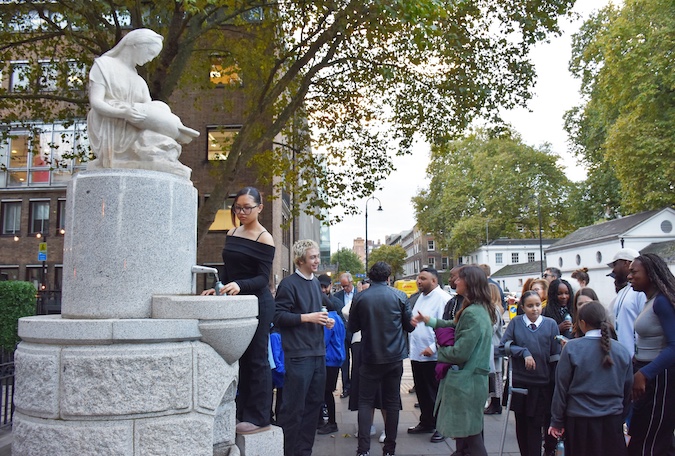
My final destination was Guilford Place, at the end of Lamb’s Conduit Street, just by Great Ormond Street Hospital. Walking through that part of town, busy with legal chambers and the bars that draw their employees after hours, I almost missed the fountain (pictured above) until I turned and saw it, with my back to Coram’s Fields. Built in 1870 in gentle white stone, it depicts the Woman of Samaria, who according to the Bible, Jesus accepted water from, although she was considered a social outcast.

It’s another echo of the religious intentions of many early fountain donors, but it also brings my thoughts back to Shafak’s novel and the idea that water, wherever we find it, completes its cycle over and over again, with the molecules in a single drop lasting through centuries. In London, as we once again look at who owns our drinking water, it’s an idea worth a few minutes’ contemplation. That is what I gave it, as I took out my bottle and prepared to fill it.

Elin Morgan is a writer and communications professional from East London. Follow her on Bluesky

OnLondon.co.uk provides unique coverage of the capital’s politics, development and culture with no paywall and no ads. Nearly all its income comes from individual supporters. For £5 a month or £50 a year they receive in-depth newsletters and London event offers. Pay via any Donate link on the website or by becoming a paying subscriber to publisher and editor Dave Hill’s Substack.
Categories: Culture

Where in London will government New Towns go? Two places are getting mentioned

It is a year since the government’s New Towns Taskforce began figuring out where such settlements should be built, and six months have passed since it was announced that more than 100 sites had been submitted for consideration, including several from London.

In London planning circles there is an expectation that the decisions of the taskforce will be revealed soon, perhaps some time this month. Which parts of the capital will be named? I’ve been in touch with several well-connected sources. Two places have been mentioned by them all.

  • One of them is Thamesmead, where a big regeneration programme is already underway.
  • The other is in Enfield, specifically a place at its northern edge called Crews Hill.

If these are confirmed as London’s recommended New Town locations, they will excite interest of different kinds. Thamesmead would probably produce the least surprise or opposition – maybe none at all, given that the area is already undergoing a major transformation – and make irresistible the case for government approval for extending the Docklands Light Railway from Gallions Reach in Newham to a new station at Beckton Riverside, and then south of the river to Thamesmead itself.

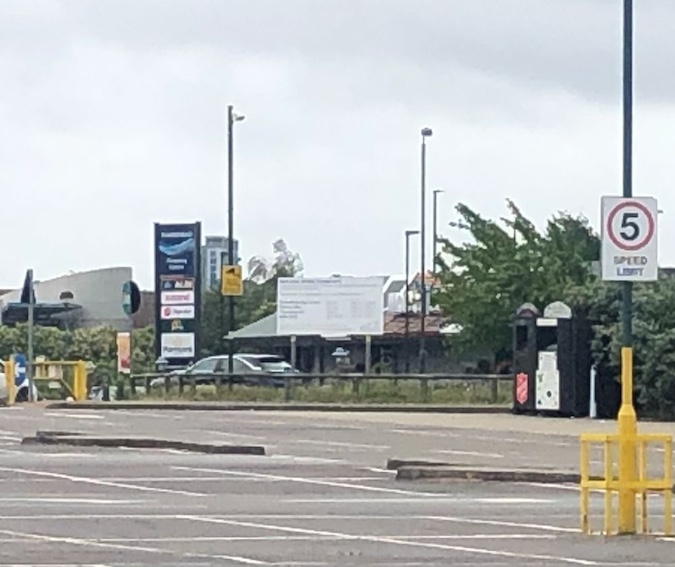
On a recent site visit with the developer, Peabody, I was shown the very spot (big white sign in blurry photo below) where a Thamesmead DLR station would go, right next to an unexceptional drive-to shopping centre served by a large car park a mere spit from the Thames.

Bafkreicn2o2gtl4sojuefdzaehg3awfftuh23euidiqokpsfjdhzdl2roa

The government said its New Towns, which can take the form of “urban extensions” of existing areas, will each provide a minimum of 10,000 homes. Transport for London has long made the case that 25,000 to 30,000 homes could be built along the route of the DLR extension as a whole.

There was annoyance and disappointment in the capital when Rachel Reeves didn’t back the extension in her spending review in June, preferring to make a performance of funding projects in the north of England instead, seemingly in the hope of appeasing voters attracted by Reform UK.

However, transport secretary Heidi Alexander soon after noted that “substantial work” had been done on the DLR scheme and pledged to “continue to work closely with the Greater London Authority and TfL” so that a “full business case and funding plan” could be finalised by the autumn of this year. A further TfL consultation was launched within days. Autumn has arrived. The stars have long looked very aligned.

By contrast, If Crews Hill in Enfield is indeed lined up to be the site for a London New Town, if will add a further dimension to the intense and already long-running local debate about housebuilding on Green Belt land in the borough.

Writing for On London, James Cracknell, editor of Enfield Dispatch, has documented the latest stages in that debate as they have been unfolding during the examination in public (EiP) of Labour-run Enfield Council’s new Local Plan, its master planning blueprint.

It is almost seven years since James reported that at an early stage in the plan’s evolution, Sir Sadiq Khan, when asked about Enfield’s intentions, confirmed his opposition to any building on the Green Belt within Greater London.

That had been the Mayor’s consistent stance on Green Belt land, and it remained so until after the Labour national government was elected. But even though his top planning officer told the EiP in January that Khan had concluded that building on the Green Belt was now necessary – a change of policy Khan himself confirmed in May – there was, as James wrote, a large caveat:

Even with the U-turn, the Enfield Local Plan was proposing homes on Green Belt sites that City Hall deemed “unsustainable”, thanks to their lack of existing public transport links. For that reason, the Mayor would still be objecting to them.

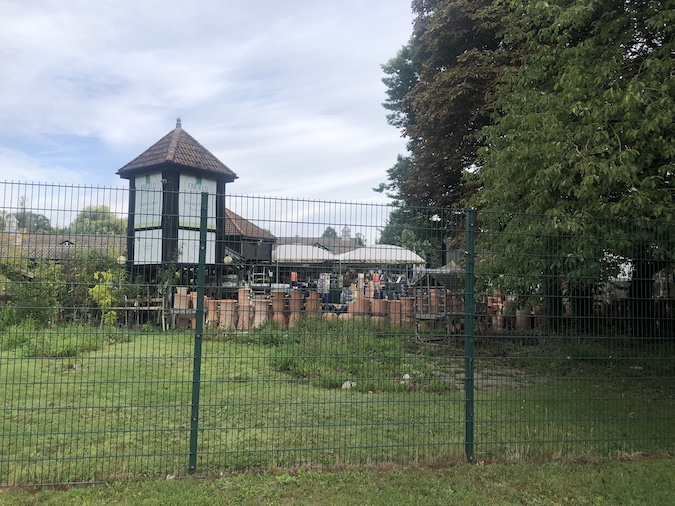
I went to Crews Hill this morning, arriving at its little railway station, courtesy of Great Northern, at about 8:30 and taking a short walk down the road to photograph some of its string of garden centres, once described as “Britain’s horticultural mile”. There is also a residential community of about 550 people, a large pub and a nearby golf course.

Img 6523

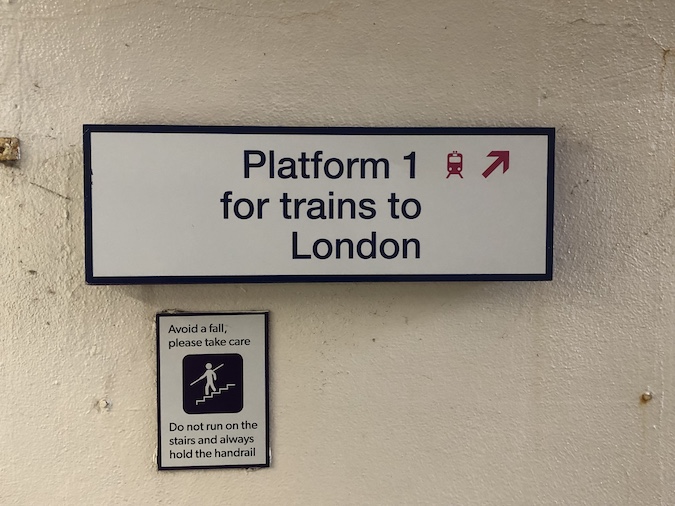
Crews Hill is right at the northern edge of Enfield and, therefore, of Greater London. The next stop on the line to Stevenage, a flagship post-war New Town, is Cuffley, a village in Hertfordshire. A sign within the station directs passengers to trains to London, perhaps suggesting that the area itself might not see itself as part of the capital.

Enfield Council’s plan is for the Crews Hill area to accommodate 5,500 homes – only about half the figure the government wants each of its New Towns to provide. The council envisages the redevelopment of many of those garden centre sites, the golf course (which it owns) and some adjacent farmland. Any New Town at Crews Hill would seemingly be more extensive, and public transport provision would need to be hugely increased.

If local arguments about Green Belt and housing need any further stimulation, a New Town designation for Crews Hill would provide it. The issue is already at the heart of Enfield’s political battleground, with the Conservatives firmly opposing Green Belt development and hoping this will help them secure control of the council in May’s borough elections.

Img 6525

How confident should we be that Thamesmead and Crews Hill are indeed to be named London New Town locations? As confident as my sources, I suggest. None wishes to be identified – in one case, our interaction amusingly parodied a famous scene in All The President’s Men – but all were very clear in their convictions that those are the two names in the taskforce’s frame.

If confirmation is to come, it might be delayed by the resignation from the government of Angela Rayner, who was the minister in charge of the New Towns programme. But it still might come pretty soon.

Dave Hill will be chairing a London Society discussion event about Enfield, housing and the Green Belt on 15 September, with James Cracknell bringing his local expertise to the panel. Buy tickets here

Categories: News

Dave Hill: The Right’s ‘lawless London’ slur is under challenge

Sir Sadiq Khan’s fightback against the monstering of London by Britain’s Outer Right of Faragists, fascists and the fouler kind of Conservative has received a boost in the form of figures showing there were fewer homicides – a term covering murder, manslaughter and infanticide – over the summer months of 2025 than in any year since 2018.

Throughout August in particular, the “due impartiality” and pitchfork nationalist media alike have lavished coverage on ludicrous claims such as the Reform UK leader’s that no one dares wear jewellery in the West End after dark and the mendacious repeat slur that “Sadiq Khan’s London” is “lawless”.

These portrayals of London leading a national descent into rampant criminality, all of them linked with varying degrees of slyness to immigration, are at odds with even the police statistics Nigel Farage says he relies on (he dismissed the Crime Survey for England and Wales, held by crime trend experts to be the most reliable, as “based on completely false data”, but didn’t elaborate).

But now the capital has emerged from June, July and August, the period when homicides are often most frequent, with a tally of such grim deaths numbering 27 compared with, for example, 41 in 2021 and in the low or middle 30s for the three years after that.

The distinctive characteristic of homicide stats is that, unlike every other form of law-breaking, they aren’t open to concerns about routine under-reporting or unreliable gathering and processing that can be raised about police figures for other kinds of offence. When someone has been killed by someone else, that stark fact tends to be clear and undisputed.

The Mayor and the Met have also emphasised a reduction in the number of homicides for the whole of this year so far compared to this stage of last year, and falls over longer periods in the numbers of young victims. Add to these, drops in cases of theft from the person and personal robbery reported to the Met and a Notting Hill Carnival that failed to provide the carnage some had ghoulishly hoped for, and a sturdy counter narrative is underway.

Naturally, Susan Hall, the Donald Trump and Rupert Lowe-supporter chosen by the London Assembly Conservatives to be their leader, has dismissed the better news on homicides, preferring to talk up “knife crime”. This is statistical category includes offences where the assailant threatens to use a knife but might not even have one. It is, though, linked closely in the public mind with stabbings. Hall and her like are less interested in reality and remedies than in ramping up fear. Promiscuous use of the term “knife crime” serves that purpose well.

But what explains the fall in London homicides and, according to Met stats, other types of offence that cause anxiety as well as harm? How much of it can be credited to mayoral policies and Met policing, and how much to good luck that might not hold?

When crime figures are discouraging and the Mayor is held to blame – often, sad to say, by some or other twit scribbling for the Standard – it is important to point out that no Mayor of London has the ability to turn the crime tap off at will, whoever that Mayor may be.

Certain types of offending may increase or decrease for reasons beyond the immediate control of City Hall or the Met, sometimes linked to ebbs and flows in drug market competition, specific, highly local factors and so on. A rise in the numbers for a particular type of offence can indicate a greater public willingness to report them, or better Met success with detection. In any case, Mayors don’t sit in equivalents of Churchill War Rooms ordering battalions of bobbies around, and just as well – if they did, it would do more harm than good.

So, just as we should challenge political opportunists when the figures get worse, we need to pause before awarding plaudits when they are more encouraging.

Responding to the homicide stats, Sir Mark Rowley has said a “sustained crackdown on violent crime” has got results. Lib Peck, director of London’s Violence Reduction Unit (VRU), set up under Khan, has highlighted early intervention with the young. And certainly, a combination of relentless, tightly-targeted enforcement and the prevention efforts of Peck’s department and its neighbourhood partners seems more likely to produce good outcomes than the evangelical, often devious, authoritarianism craved by the “lawless London” mob.

The longer positive trends continue, the stronger the arguments made for the Met’s tactics and the VRU strategy will look. In the meantime, social attitudes and conditions that nurture violence, including by men against women, are still present in the capital. As any serious crime-fighting mission understands, they need tackling too.

Follow Dave Hill on Bluesky. Photo from Greater London Authority.

OnLondon.co.uk provides unique coverage of the capital’s politics, development and culture with no paywall and no ads. Nearly all its income comes from individual supporters. For £5 a month or £50 a year they receive in-depth newsletters and London event offers. Pay via any Donate link on the website or by becoming a paying subscriber to publisher and editor Dave Hill’s Substack.
Categories: Comment