
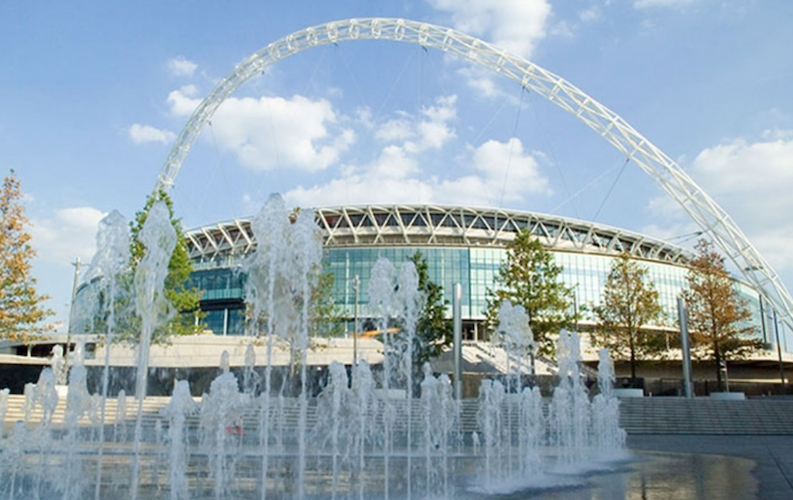
London is one of the most exciting cities on the planet. People travel thousands of miles just to spend a weekend here, whether it’s to see a West End show, a football match at Stamford Bridge, a gig at the O2, or England’s cricketers at the Oval. Wembley Stadium (pictured) and Wembley Arena are on my doorstep in Brent.
In 2023, over 20 million overnight visitors came to London. That’s more than half of all UK overnight tourism, pumping £27 billion into the economy and supporting 700,000 jobs. Last summer alone saw Brent proudly welcome 1.5 million Oasis and Coldplay fans to Wembley. It’s a great success story and something I am deeply proud of as someone born and bred in the Wembley area.
But there is another side to it. Hosting the world comes at a cost, and right now it is being paid by Londoners locally. Big events mean more rubbish to collect, more streets to clean, more enforcement to keep things safe. It’s our bin lorries, our street sweepers and our community safety teams who make sure London looks its best – and all of that is paid for out of already overstretched council budgets.
Other global cities have found a fair solution: a visitor levy. It’s a small, locally-set charge on hotel rooms or short stays, with the money ringfenced for local services. In Rome and Paris it is the norm – and it is becoming so in Edinburgh and Cardiff, too.
Some fear that these modest levies put off tourists, but the evidence is clear – they don’t. Recent research by Centre for Cities shows that visitors are not deterred by them and that London is an outlier as the only major G7 city that doesn’t have one. Bloomberg analysis has estimated that a levy for London could raise around £500 million a year – money that could go straight back into local services providing for visitors and residents alike.
When you went on a city break in Europe or further afield, did a charge of a euro or a dollar a night charge stop you? These small charges don’t scare off tourists and they give local communities a fair return for hosting them.
The problem? In England, local councils can’t introduce one without a change in the law. Meanwhile, Wales and Scotland already have or are introducing the powers needed. Manchester and Liverpool have come up with lengthy workarounds involving Business Improvement Districts, but local leaders would like to introduce a local authority one.
That’s why I, along with 10 other London leaders representing over three million Londoners, wrote to the government calling for a rethink. Now is the time to amend the English Devolution Bill and finally give local authorities the power to introduce a visitor levy, in consultation with their residents and businesses.
We are encouraged by local government secretary Steve Reed’s early steps with helping councils restore “pride in place”. But this can only be truly achieved if councils are given the fiscal and policy autonomy they desperately need. Other global cities have shown a different path, where such schemes are designed locally and the benefits flow directly back into their communities.
Crucially, I strongly believe that any visitor levy must be flexible, designed by London boroughs, and its proceeds spent on the priorities of local people – no differently to the new Pride in Place programme, where a neighbourhood board calls the shots on the way the funding should be spent.
London’s visitor economy is incredibly diverse – what works in Brent won’t necessarily work in Bexley or Bromley. And local leaders are best placed to balance the benefits of a levy against any risks to local tourism, adjusting the approach if needed. As the Institute for Government articulates, if a high visitor levy diverts tourists away from one borough to another, the policy can be recalibrated. But if it allows reinvestment into improved local transport and a more attractive public realm, it may benefit local residents and attract more visitors at the same time.
With Rachel Reeves now reportedly considering how such powers might work in London, it’s worth being clear about what genuine, local devolution really looks like. I’ve always backed stronger local powers.
But true devolution should benefit both London’s boroughs and the Mayor of London. If councils are the ones who’ll explain, run and collect this levy, then we must be around the table when it comes to shaping the design and the priorities for its use. London works best when its strategic and local tiers move in lockstep, each bringing their own strengths to the table.
A well-designed visitor levy is a simple yet meaningful idea – fair and proven to work elsewhere. Small change from visitors could mean cleaner streets, greener parks, and more funding to help us address the cost-of-living crisis in this city.
London will always roll out the red carpet for the world. But if we want to keep the ball rolling and the music playing for the rest of the world to enjoy, it’s time Londoners saw a slice of that success too.
I am therefore urging the Chancellor to give councils the powers to introduce a locally-led visitor levy and ensuring that those who’ll be delivering it on the ground are placed front and centre of any arrangements, so we can safeguard essential services and ensure our residents see a fair return from the millions who benefit from our city every year.
Muhammed Butt is leader of Brent Council. Photo from Wembley Stadium.
OnLondon.co.uk provides unique coverage of the capital’s politics, development and culture with no paywall and no ads. It is funded by subscribers to publisher and editor Dave Hill’s twice-weekly newsletter On London Extra at a cost of £5 a month or £50 a year. To receive it, become a paying subscriber to Dave’s Substack or follow any Support link on this site.
It always irritates me when I have to pay large sums to visit foreign museums and art galleries while tourists visit our galleries and museums free. We should make visitors pay if they cannot produce a British passport or similar ID proving British nationality. An excellent reason for requiring British Identity cards
What really nauseates me is the continued drumbeat from Labour politicians to keep raising taxes. In LBHF, the council has come up with the idea a charging drivers from outside the borough for driving through the backstreets… what a great wheeze… tax people who come to visit and don’t have a say in voting you out of office!
Now it’s a tourist tax, yuck!
When it comes to tourism, the most important tax change we need is to bring back the VAT refund for foreign visitors shopping.
Why?
It’s the easiest and fastest way to drive growth and exports.
Better still, doing so fixes a massive marketing mistake by the previous government and it would capture the biggest Brexit benefit, by making Britain the shopping capital of Europe.
If you revive the VAT refund, research confirms that foreign tourists will stay longer and spend more in our shops… but also more in our hotels, restaurants, theatres, taxis and wider visitor economy.
The VAT revenue not collected will be far outweighed by revenue that is collected on income tax, national insurance, corporation tax and VAT on other things. Furthermore, money will be saved from the benefits bill because tens of thousands of jobs will be created incredibly rapidly.
Even better still, such a measure would likely give confidence to the bond markets, exerting downward pressure on interest rates, which is incredibly important when the UK’s interest rate bill is larger than the defence budget.
While all the data shows that tourists divert to Milan, Paris and Rome to go shopping, don’t forget that Brits go there too, so our retailers are missing out twice over.
Mischaracterising this measure as a “tax break for tourists” deliberately misses three vital points: First, all our major competitor destinations offer VAT refunds on shopping, so failing to match them guarantees we don’t get business we should get. Second, voters understand that if the price is too high, customers leave without spending. Third, thanks to VAT free shopping, competitor destinations lure away our high spenders to shop there, so they can’t complain if we do the same.
This month’s budget is the moment for Rachel Reeves to demonstrate she is on the side of our retailers, our hospitality industry and our visitor economy by implementing a small measure that will have a disproportionately big impact.
And, if you don’t believe me, have a look at this: https://lnkd.in/e3bSacvJ.
I recommend you listen to this podcast, which addresses visitor levies and VAT-free shopping.