
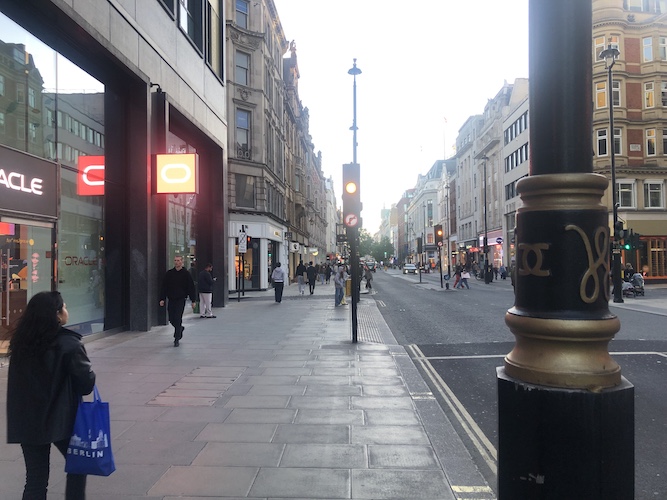
In the headlines, rows, rage and vows to resist. In the real world, continuing progress towards the realisation of Sir Sadiq Khan’s plans for pedestrianisation on Oxford Street – and a bit more besides.
As On London has reported, the new leader of Westminster Council, Paul Swaddle, has had to abandon seeking a judicial review of the decision to go ahead with converting the section of the street between Great Portland Street and Orchard Street into a pedestrianised area. Apart from anything else, that course of action had always looked difficult because of the short period of time available.
Swaddle has said he will continue to “explore every legal avenue” that might (or might not) exist for impeding the scheme’s progress, and media organisations have obligingly reported his disparagements and accusations aimed at City Hall. But while this fighting talk keeps the “row” story going, behind the headlines Westminster is co-operating as Transport for London sets about closing what it calls the “Oxford Street West” stretch of Oxford Street to traffic by the end of the summer.
The Oxford Street Development Corporation (OSDC), the mayoral body set up to take control of the street and its immediate surrounding area, is pleased to have received the council’s approval for “enabling works” to go ahead, allowing it to make “changes to a number of streets in the area surrounding the extents of the TfL Oxford Street West proposals”. In other words, to undertake alterations to such as signage, road markings, kerbs and so on to facilitate the pedestrianisation on roads still under Westminster’s control.
That “enabling works” permission, granted on 5 June, followed February’s decision by Westminster, in that case made prior to the change of council administration from Labour to Conservative on 7 May, to approve TfL “undertaking works comprising changes to bus stops and supporting infrastructure in the area surrounding the extents of the TfL Oxford Street West (OSW) proposals”. This was described as being in anticipation of TfL formally approving those proposals, which it did.
The board of the OSDC is due meet on Thursday afternoon. It will be “invited to note” that its membership has changed to reflect the borough elections outcomes in both Westminster and next door Camden, which is also affected, in a much smaller way, by the project. Swaddle has been appointed to the board by Mayor Khan to represent Westminster, as has Swaddle’s Camden counterpart Sagal Abdi-Wali, who has taken the helm at Camden. It will be interesting to see who attends.
The main item of business on the agenda at this point is the approval of members of the corporation’s planning committee, which is to be chaired by board member Margaret Casely-Hayford. The property sector has been anticipating the big change coming to “the nation’s high street”, including in the form of a seminar held earlier this month by the Westminster Property Association. It began with an address by OSDC chair Scott Parsons.
Meanwhile, progress is being made in another part of the OSDC’s domain further west, at Marble Arch. No one is breathing a word in public, but there is considerable confidence behind the scenes that the go-ahead will be given to a long-gestating plan for rescuing the historic monument from the worst of the roundabout environment to which it has been subjected since Park Lane was turned into a dual carriageway in the early 1960s.
In 2019, public realm designers Publica produced proposals for, in its words, “repositioning Marble Arch as a safe, inclusive and democratic public space”. Backed by Portman Estate and the Marble Arch business improvement district, it envisaged reclaiming and enlarging the rather scruffy square in which the monument stands as “an expansive civic space” that would effectively lop the top end off Park Lane to make way for a public realm peninsula connecting to the south side of Oxford Street. Getting into Hyde Park on foot would mean crossing just one road instead of several.
The Marble Arch itself has recently been released from a protective box while cleaning and restoration took place. Designed by John Nash in 1827 and originally positioned in front of Buckingham Palace, it was moved to its current site in 1851. At that time it formed a grand entrance to Hyde Park, but was later severed from it. The Publica proposals aim to salvage and breathe new life into a part of the West End that has been degraded and neglected for decades. Work on the details is understood to be continuing.
For more on the story of Marble Arch and the vision for improving it, listen to the Marble Arch episode of The London Society’s London Explained series from 2024, which was researched, written and presented by Dave Hill.
OnLondon.co.uk is funded by sales of publisher and editor Dave Hill’s twice-weekly newsletter On London Extra. To start receiving it, become a paying subscriber to Dave’s personal Substack. Thanks.