Blog

John Vane: Up West, Way Back When

Covid traces seem almost erased from Oxford Street, with builders’ hoardings rather than boarded-up frontages breaking the retail line on each side. Amid its Christmas lights, the dead and deserted West End, that freak feature of the pandemic, is fading further into a surreal and troubled backroom of memory as shoppers and visitors return. Consumer business as usual is being restored. It wasn’t always usual, though.

Walking down “the nation’s high street” you can spoil your day by recalling the two centuries during which what was then called Tyburn Road formed part of the route along which prisoners were conveyed from Newgate prison to the hanging tree just yards from where Marble Arch now stands, drawing vast crowds of ghouls from near and far.

Back then, though, it was all but in the countryside. The West End as we now know it, though its roots lie in the aftermath of the Great Fire, wasn’t really formed until the early 19th Century, when the term was coined. It described affluent neighbourhoods west of Charing Cross lying conveniently close to power in Westminster and agreeably distant from the pong of the poor and industry in the east.

Culture, parks, hotels, places of entertainment and more followed the money. There were huge redevelopment schemes: for example, Regent Street went through radical alterations that saw colonnades put up by none other than John Nash pulled down and today’s sweeping grand design completed between the two world wars following government approval. The profitable churn of demolition and rebuild is not new.

Exploitation, street crime and that moral category labelled vice followed too. In his monumental London In The 20th Century, Jerry White describes a gleaming, glittering Edwardian West End that was “a playground for every class” and “the world’s largest flesh market” with its streets after dark “almost entirely given over to sexual commerce”. And Graham Greene in his 1936 short story Jubilee captures beautifully the man and the mood of Mayfair of the time with his character Mr Chalfont, an ageing gigolo who lived in a bedsit off Shepherd Market and “looked distinguished even in his pants”.

After the Second World War, Oxford Street revived its tradition for elaborate window displays, including, in 1953, a giant Father Christmas welcoming all and looking down from above the entrance to Selfridges, where tinselled pedicabs now gather in search of tourist trade. But the West End has gone on offering the ultimate, unique mixed bag of London experience. Some ever-varying blend of commerce, culture and criminality has continued to shape its character, from theatre-goers to luxury shoppers, from phone-snatchers to bad cops.

In my novel Frightgeist, set in an imagined London of the recent past, Alev, an undercover cop, gets off the Tube at Bond Street station, where she “rose up into the gloam of Oxford Street” recalling that “as a child she had loved its grand old department stores, now a wounded and perhaps dying breed”. But perhaps not.

Buy John Vane’s London novel Frightgeist here and only here.

Categories: Culture, John Vane's London Stories

Julie Hamill: Sparkling steps into a London Christmas

Have you ever been to the hidden restaurant at Selfridges? Alto by San Carlo is only accessible via a particular lift on the ground floor. You rise to the top and arrive at the restaurant reception via a corridor of multicoloured, shiny baubles. My friends Sharon and Sue and I treated ourselves to an end of year lunch there, preceded by a good look at the Christmas windows on Oxford Street.

The Selfridges displays are Disney-themed with Lady And The Tramp, that cute, lively crockery from Sleeping Beauty (below) and the mirror-obsessed vain witch (I know her) from Snow White being the stand-outs. In the corner window, poor Cinderella was very much a cardboard let down. I fear the designers got to the end of the street, ran out of budget and set to work with polyboard, spray mount and scissors. Cinders got a raw deal. Maybe that was the idea.

Inside, after passing through the food hall and seeing a bag of truffle crisps for £5, some discounted shortbread in a tin (£25) and Disney princess biscuits without a price tag, we moved swiftly on to the make-up section, to be guided through the benefits of Victoria Beckham eyeliners. Two of us (mugs) made unnecessary “It’s- Christmas-so-I-can-treat-myself” purchases, and with our improved eyes found the elevator to the rooftop.

Unnamed 5

Alto provides its “chic Italian dining experience” in a really lovely setting. I had two courses: the artichoke hearts in mint sauce (delicious) followed by a very nice spaghetti puttanesca, washed down with a refreshing icy mocktail. The service has great – the staff make you feel special by taking your coats and, well, by just looking happy. Sharon and Sue shared a bottle of rosé and afterwards we used the corridor of baubles as a catwalk. It’s all about the confidence.

Back outside it was getting dark. The Oxford Street lights shone above us: a canopy of thousands of stars lighting the sky; a magical scene fit for we three princesses.

***

And so to my favourite, the Brent Cross Shopping Centre. Visiting there for Christmas shopping last week, I went to Wenzel’s bakery for lunch – where the vegan sausage rolls are better than any you can buy on the high street – and decided to try my luck paying for it using a rogue Scottish tenner I found in my pocket from a recent trip.

As past experience has shown, trying to using Scottish banknotes in London is a gamble. They should be accepted, but will they be? I approached the counter bravely. Two assistants of eastern European descent smiled.

“Yes please?” said one of them.

“Can I have a vegan sausage roll?”

“That will be £2.35.”

“Do you take Scottish notes?” I asked, feeling a need to even as I handed mine over. “It’s perfectly legal.”

“I prefer not to,” answered the first assistant, bluntly.

Feeling her English wasn’t great, and I thought, “I prefer not to” probably meant, “The boss says we can’t.”

“Sometimes we can take, sometimes we can’t,” said her colleague.

“I prefer not to,” the first assistant explained, “because I have to call head office, and then I talk to someone, and they talk to someone, and you are waiting here…”

“Listen, don’t worry about it, it’s not your fault”, I said, presenting my debit card instead, with a smile.

“It’s not fair,” said the second assistant. “I think it’s racist.”

The three of us half-laugh at her comment, and I head off with a bite.

My new system with Scottish money in London is to use the notes in supermarket self-service tills. They swallow them like hungry hippos.

***

My Christmas really began with celebrations of my birthday (13 December) and the music quiz at the Lexington, near the Angel. It was, as always, a silly blast.

I arrived to a greeting of candles on a cake and my usual team members, Martin, Greg and Andrew, singing happy birthday. Our wonderful – and always very late – host, Paul Guided Missile, arrived, said hello and was gone. Then, suddenly, Santa  appeared and announced he would be asking the questions.

There was £60 for the winner, booze for the runner-up and, the most coveted prize, crisps for the best team name. During a short interval, Santa handed out mince pies and I bumped into Lennon Gallagher, who I DJ’d for at a party last year. He told me his brother’s band was playing upstairs. He really is a lovely fella.

Screenshot 2025 12 21 at 17.32.09

Back at the table, I was delighted to identify my favourite Christmas hit, Pipes of Peace by Paul McCartney, being butchered on Santa’s Bontempi in the “guess the song” round.

Scores were totted up and prizes awarded. Our team name, All the Jingle Ladies, did not take the crisps, losing out to Sleigh Another Day (robbed). We did, however, score a very respectable 98 points to finish joint fourth and close behind the winners who, with 99.5, emerged victorious after a tie-breaker to which I knew the answer.

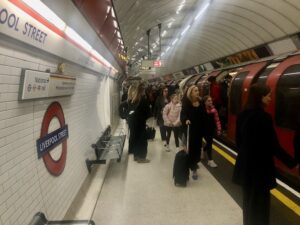
We walked back to the Angel – surely the right Tube station for a London step into Christmas.

Follow Julie Hamill on Instagram. All photos by Julie.

OnLondon.co.uk is funded by subscribers to publisher and editor Dave Hill’s twice-weekly newsletter On London Extra. To start receiving at a discount rate, become a paying subscriber to Dave’s Substack. Offer applies until the end of 2025. 

Categories: Culture

Camden knowledge, old and new

Libraries are full of stories, none more so than the British Library. Not all of them are in books. There is a room there where residents of Camden meet to discuss matters of transport, housing, health, wealth and happiness. A varied group, they have all sorts of tales to tell. The big thing they have in common is being a lot older than the average Londoner.

Late in the summer I was invited to speak at one of their gatherings. Most of those present were women, one of whom revealed, in an American accent, that she was originally from Panama, but has lived in London for something like 50 years. She is also a member of Team London, the mayoral volunteer scheme that began with the 2012 Olympics. Another, in her late eighties, has lived in the borough since she was a teenager – that is to say, as she did herself, she has lived in what became the borough of Camden in 1965. She’d been around the place for some time before that.

There was also a more recent arrival. She had lived for most of her life in and around the Home Counties, eventually settling by the sea. Then, 12 years ago, she asked herself a question: “What do you do on the Essex coast, when you’re getting a bit old and its raining or snowing and the buses don’t work? You might live in an absolutely delightful town, but the number of things going on, particularly if you’re not an arch Conservative, are pretty limited. There are only so many pantomimes you can go to at the amateur dramatics society. So we moved up to London.”

***

And why wouldn’t you want to live here when you’re old? Why not reside in a place where you are within easy reach of scores of theatres that put on hundreds of plays? A place where buses run constantly? A place where all sorts of things go on, and do so endlessly? Why not spend your retirement days in what many consider the greatest city on Earth if you can?

There are grounds for believing that more and more older people are answering such questions with a “yes”. Greater London’s population is younger than that of the UK as a whole, with an average age of around 35 compared to 40. Yet its profile has been changing. Both the proportion and the number of Londoners in the older categories are growing.

The 2011 Census estimated that there were 874,000 Londoners aged 65 or older out of a total of 8.17 million, or 10.69 per cent. Ten years later, the figure for over-65s had risen to just over a million and the percentage to about 12.

The 2021 Census is thought to have been affected by many younger Londoners, notably students, leaving the city to stay with parents during the pandemic. Furthermore, the widely-documented fall in London’s birthrate, dramatically illustrated by reductions in demand for primary school places, is contributing to changing balance between the higher and the lower ends of the age range. Even so, no one doubts that older Londoners are on the rise or that this trend is set to continue.

Their distribution across the 32 boroughs has been altering too. The 2011 Census showed the expected larger concentrations of older people in outer London than in inner: Bromley and Bexley had the highest percentages at 16.8 and 16.0 respectively. By contrast, the figure for Camden was 10.8 per cent. But by 2023, this had risen to 12 per cent and is projected to reach 15 per cent by 2041, representing about 33,500 people.

This is part of a large inner London trend. Analysing early results from the last Census for On London, Richard Brown highlighted some of the highest growth rates in England among the middle-aged in Southwark, Lewisham and Lambeth, where there were increases of around 60 per cent in people in the second half of their fifties.

“Some of this probably has its roots in London’s rapid growth of 35 to 39-year-olds in the 1990s,” Richard wrote, and continued: “It is interesting to consider why this generation may have chosen to stay in the city – and in inner London in particular – a rather than moving to the suburbs or a Home Counties village.”

Whatever the mix of reasons, this shift will form part of a London-wide evolution that, according to The London Plan, City Hall’s blueprint for the capital’s long-term development, will result in around 1.5 million Londoners being of or approaching Old Age Pensioner status in ten years’ time out of a projected possible Greater London population of between 9.6 and ten million

But if that rising tide reflects the growing attractiveness of the capital as a place to live for people in their 60s, 70s and 80s, it also means the city will need to become better at meeting their needs. And it won’t all be grey hair amid bright lights.

A report by the Resolution Foundation, published at the start of this year, identified London as the only major city in Britain that is getting older and concluded that these trends “will have profound implications for the local provision of public services, from education to health care”. What is a future, older London going to look like? And what can London learn from it?

***

That British Library gathering was a meeting of the advisory group of Age UK Camden, an independent charity that provides a range of activities and services for older people in the borough, from coffee mornings, to digital support to a book club. Among those present who didn’t speak was Costas Louis. He didn’t need to, because he and I had already had a long and fruitful conversation a few weeks earlier, in the British Library’s terrace café.

Costas (pictured) has led a remarkable London life. It began in 1958, when he arrived in the city from north Africa, alone and aged 16. “I wanted to become a wireless operator,” he said. “I thought I could get a job on a liner and travel the world.”

Costas’s parents were Greek, but he was born in Egypt, in the hospital of a British military base, just outside Alexandria. In the multi-national, post-war community he grew up in there, French was the lingua franca and he also learned Arabic, Greek and English as well as picking up some Polish and Italian. As a Boy Scout, he was taught Morse Code. This knowledge, he was told by one of his peers, would be his passport to global seafaring – if he came to London and acquired the right skills.

He rented a room on Clapham Road for 17 shillings and sixpence a week. There was no bath or shower. “I had to go to the public baths,” Costas said “That’s how it was in those days.” And when he applied to a local college, his dream fell apart. “You’re wasting your time, lad,” the administrator said. There was this new invention – teleprinting. It meant wireless operating was dead.

Crestfallen, Costas went to the pub. A mock number plate above the bar inquired “RU18?” Costas avoided the question. Instead, he ordered a Guinness and got drunk. He kept on getting drunk for a month. This was, perhaps, unwise, but it helped him settle in. What did he think of the London of the late 1950s, still scarred by the Blitz and only just free of post-war rationing?

“I loved it,” he says, “because there was so much life. People were happy when they went to the pub. They dressed up as if they were going to the theatre. There was always a piano. People got up and danced.” Londoners were good to him, too: “They treated me nice because I was only a young boy, and because I became part of the community. They liked people to come and drink and join in the singing. I knew all the songs.”

With his savings running out, he got a job in a factory that made gripe water and Roboleine, a vitamin and mineral supplement primarily consumed by children and convalescents. The wages were poor – eight pounds, two shillings and sixpence a week – but the canteen was cheap and the rice pudding, superb. Then he was employed in a distribution centre in Vauxhall, which served the earliest supermarkets. After that, he worked for a fashion trader and did a few other things, including marrying, in a London registry office, a nurse from what in England is called Salonica.

They had a son together, born in Clapham. Then, they moved to Greece. There, Costas studied, became qualified in child psychology, had second son, and was a teacher for a good dozen years. He did well and he had friends. There was a problem, though. From 1967 until 1974, Greece was under military rule. Costas, with his British passport, was sometimes an object of suspicion.

He returned to London in 1973, this time to stay. He’s lived in Camden since 1980. And he loves the British Library, which he can get to on foot in five minutes. “It’s a beautiful building. It’s marvellous. I’m not an architect, but I can look at it and think, yes, this is an institution that makes me feel happy. My idea of the British Library is that it is a gift. It’s a privilege having it in my area.”

***

Costas, 85, is not only a member of Age UK Camden’s advisory board, but one of its most energetic volunteers, helping to provide its array of activities and services in the borough. Like many other charities for older people in the capital, it works in partnership with Age UK London, an organisation that campaigns on behalf of older people throughout the city.

There are many issues to address. The Care Quality Commission (CQC) noted earlier this year that there are large differences in “healthy life expectancy” between those who live in the most affluent parts of Camden and those who live in its most deprived – remarkably, a gap of 20 years. Happily, the CQC assessment of the council’s adult social care provision rated it “outstanding”.

The report also serves as a reminder that delivering such services forms a huge part of the responsibilities of London’s local councils. It says that in the financial year 2023/24, Camden devoted 19 per cent its budget to it – just under £114 million out of its total expenditure for that year of £608.5 million. Approximately 1,425 people received long-term adult social care support and around 3,420, short-term. The CQC stressed that every care package is different, tailored to individual needs.

For other boroughs, the figures are smaller, but the percentage higher. Bromley Council, for example, serving a less expensive but proportionately older borough with around 19 per cent of its residents being over 65, anticipated spending around £99 million on adult social care in the current financial year (2025/26) out of a total budget of about £284 million. That’s roughly 35 per cent of it, almost twice as big a slice as Camden’s.

For London’s boroughs as a whole, adult social care is their largest area of spending, higher even than on children’s social care and homelessness. And although London Councils, representing the capital’s 33 local authorities, is taking some quiet satisfaction from concessions it has secured from the government’s initial – and for most boroughs, pretty alarming – Fair Funding Review proposals, increased financial pressure will continue.

An Institute for Government report has found that the proportion of older adults accessing care was significantly higher in Greater London than in other areas, partly reflecting the capital’s poverty levels. Twenty-two per cent of Londoners above state pension age are in poverty after housing costs are accounted for, a rise of four per cent over the past ten years and a higher rate than the rest of England’s. Almost half of those living in social rented homes fall into this category.

What is to be done? A London Councils report last year made the point that “adult social care plays a crucial role in preventing, reducing and delaying the need for more formal care and support” as the National Health Service in London copes with its own pressures. Research by University College London, conducted partly in the capital and published in February, found that home visits to older people assessed as having “mild frailty” could help them to stay well and remain independent.

Meanwhile, Age UK London continues to seek recognition of the needs of London’s poorer older people, and to call for action to address them. In May, it published qualitative research exploring the experiences of older Londoners on low incomes facing financial insecurity, the anxiety these bring and the sacrifices they make to keep their heads above water, including selling possessions and switching off their heating. It contained three individual case studies. One of them was of Costas.

***  

In the British Library café, Costas told me about the work he does for Age UK Camden. Much of it involves visiting people with dementia, many of them lonely: “I take a book with me, full of old songs and I try to make them happy. We sing Maybe It’s Because I’m a Londoner or The Old Bull And Bush and they come alive. All of a sudden, you see a smile on their face.” These outings are nostalgic for him, too: “It’s like visiting my mum and dad. People with memory loss, Dave, they are so lovely. All they want to know is about the past – about shillings and farthings and Max Bygraves. Things they find they can still recall.”

Costas also described how, until quite recently, he worked with young adults too, as a mentor to local university students. One group was mainly from overseas and, typically, homesick. For example, “they didn’t know what to do during Christmas”. Separately, he helped undergraduates coping with autism in various forms. “My job was to make sure these kids stayed on, did not drop out in year one, graduated and stood on their own two feet,” he said.

He was paid for doing the latter work and the money was very helpful. It ended, though, when he was 78 and he has felt the loss of income. That is largely because it has limited what he can do for his two sons.

Both need specialist help that he can’t give: the older one, Costas explained, sustained brain damage through a medical error when very small. Today, aged 60, he lives in a care home in Kent. The younger one suffers with what Costas called “psychological problems” and resides in sheltered accommodation in south London. Their mother, Costas revealed, “died a long time ago”.

When he was earning, Costas and his present wife, to whom he became married near the start of this century, were able to take “my boys” on holidays in places where they could be at ease and and was able to visit them often. Now, that isn’t possible. He and his wife live in a one-bedroom Camden Council flat south of Euston Road. It’s in a nice area, but there are some problems with the flat and Costas’s wife has lately been unwell. “I was her butler for a long time because she couldn’t do anything,” Costas joked. He adds that the flat is too small for his sons to come and stay.

His age, too, limits what he can do for them. And now that he and his wife depend for income entirely on the state, there isn’t much to spare for meeting the costs of travel. He puts down some of his affection for the students he used to help to his own children having been unable to go to university: “So those kids were my kids,” he said.

He and his wife have made economies: rather than renew their TV licence, they sold their television; they’ve got rid of their telephone landline; Costas described how they’ve economised on food: “We know that if we buy a packet of rice we can make ten meals with it. In the past, we would have bought two steaks, now we buy one and cut it in half.” They take shorter showers than they used to and they use their oven less.

For all this, Costas remains extremely busy. He has a record of community involvements as long as your arm, including some advisory input into the British Library’s earliest days. Along with caring for others, he writes and has just completed his sixth play. It is called The Befriender and its purpose is to encourage more people to volunteer to help those with dementia. He has long been involved with the world of theatre, including Camden’s Theatro Technis in Crowndale Road, which he has helped in the past with raising funds from the National Lottery. “I try to be involved with the community,” he said, “because if we lose track of it, then we all become lonely people.”

***

Today’s Camden is known as a centre of knowledge, principal borough home of London’s Knowledge Quarter, a cluster of research and educational institutions of which the British Library is a part. Although some of its members have been around for two centuries, others are very new and the grouping as a whole tends to be associated with innovation and with youth.

It is, then, encouraging to see Age UK Camden listed as a Knowledge Quarter partner, denoting, perhaps, an acknowledgment that age can bring insight and wisdom as well as infirmity and decline. And in a city where change, often rapid, is a given, older and long-time residents can be a necessary, binding force of continuity, a repository of lived history at a time when London’s past has become contested ideological territory.

London’s future as a city of endless possibility may substantially depend on how it values and cares for those whose tomorrows are mostly gone.

Follow Dave Hill on Bluesky.

OnLondon.co.uk is funded by subscribers to publisher and editor Dave Hill’s twice-weekly newsletter On London Extra. To start receiving at a discount rate, become a paying subscriber to Dave’s Substack. Offer applies until the end of 2025. 
Categories: Analysis

Lewis Baston: What if the London Ringways had been built?

“Soon after three o’clock on the afternoon of April 22nd, 1973, a 35-year-old architect named Robert Maitland was driving down the high-speed exit lane of the Westway interchange in central London. Six hundred yards from the junction with the newly built spur of the M4 motorway, when the Jaguar had already passed the 70 m.p.h. speed limit, a blow-out collapsed the front nearside tyre.”

***

This how J.G. Ballard introduces us to the London of Concrete Island (1974), a novel in which principal character Robert Maitland is stranded on an island created by intersecting motorways. Maitland’s concrete island does not exist in our timeline, but something like it might have done had politics turned out differently in the 1970s [1].

Ten days before Maitland’s fictional crash, Labour won the election for the Greater London Council (GLC) on a manifesto promising the cancellation of the London Ringways project that threatened to carve the metropolis into an archipelago of Concrete Islands.

I have always been intrigued by the idea of the Ringways, and the Ballardian alternative London that they might have brought into existence. I was therefore pleased about the publication this year of the SABRE might-have-been map of what London’s road network would have looked like had the full project been implemented.

The map is a transgressive work of art that dreams of a different city. It involved an awful lot of work for its authors. Behind the lines on the map lies a great deal of archival research, because the Ringway plan was not contained in a single detailed document until now. There was not even a single organisation in charge: the outer rings were the responsibility of central government while the inner two were GLC projects.

The Ringway plan was a product of the 1960s [2]. Ringway 1, also called the Motorway Box, would have been the innermost, the compass points on its route being Camden Town, Blackwall, Brixton and West Kensington. Much of it would have run above ground level “on stilts”. Ringway 2 would have run largely where the North Circular is now, but significantly further out than the laughable South Circular, running for instance through Thornton Heath and Earlsfield.

Ringway 3 would be the heavy-duty principal route around the city for non-London traffic, running from Enfield in the north to Purley and Jim Ballard’s Shepperton in the South before looping back through Hayes and Bushey. Ringway 4 was further out, in line with the present M25 in the south and west but a gentler parkway-style road through Hertfordshire in the north. They would have spurs and radials connecting them, but the Ringway plan was less extreme than the motorway plans of the 1950s that envisaged the M1 starting at Marble Arch.

The consensus on building the inner Ringways collapsed surprisingly rapidly, reflected in London Labour’s about-turn between 1970 and 1973. The brutal look of the Westway, London’s innermost urban motorway, did not make public opinion warm to the larger Ringways.

Michael Heseltine opened this Wilson-era project in July 1970, just after Edward Heath’s government took office. It ran for the most part as an elevated highway alongside railways, following an existing seam in the city as most of the Ringways would have, but it still created a bleak barrier at street level. Residents of Acklam Road in North Kensington looked out onto the flyover from their first-floor windows, the noise and pollution inescapable. The residents were rehoused in 1971 but their protest in 1970 had a lasting impact in focusing attention away from the shiny futurism of the car city towards the human and environmental cost.

Contemporary authors, before the planners and London politicians rejected the Ringways, found something inherently dark and dystopian in the image of an urban motorway. J. G. Ballard made it his territory in Crash (1973) where the North London Radial, one of the more speculative add-ons to the Ringways, features. He did it again in Concrete Island, a world of the roar of depersonalised traffic, direction signs lit by sickly sodium lighting and the ruined spaces in between.

Yet there is a strange allure about the Ballardian urban motorway for the author, his characters and I think ourselves. Maitland never leaves the island although he clearly could, and this perverse love is made all too literal in Crash. Will Self, influenced by Ballard, is one of the few to be open about his affection for the Westway. I remember watching a hallucinatory short film about Self driving along the little elevated highway back in the day when it was legal to do it at 70 mph.

In Martin Amis’s Dead Babies (1975) the jaded characters visit a theatre – implicitly the Gaumont State in Kilburn – hemmed in by a flyover. They see violent entertainment on a theme of steely art-terrorists attacking a vaudeville performance – a metaphor for the motorway’s bulldozing of the tired urban fabric and the wider attack of the new upon the old.

There is another important piece of dystopian 1970s motorway writing. I wonder if the collective imagination, at least among people who are involved in writing about this sort of thing and making policy, is influenced by Robert Caro’s magnificent book The Power Broker (1975). It is a biography of Robert Moses, who, without being elected to anything, navigated through the maze of organisations that made up New York government and shaped the physical landscape of the city.

Moses was, in Caro’s persuasive account, almost obsessive in his belief that cars were the future. He sliced the city with highways. There is a particularly vivid chapter, The Meat Ax, which describes how the Cross Bronx Expressway was rammed through a densely populated urban area, its straight-line course refusing any attempt to mitigate the impact on the surrounding neighbourhoods. It directly displaced 40-60,000 people.

Caro describes how crime and blight spread in the area south of the Cross Bronx, and even without knowing about the toxic effects of the lead fumes billowing from the highway he identified it as a cause as well as a marker of the geographical extent of the collapse of the South Bronx.

***

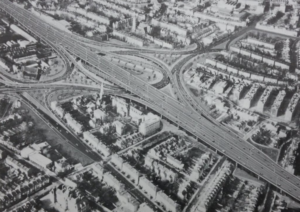
The Ringways are usually seen now as a bullet, or a meat axe, that London dodged. But I’m not so sure. I’m not going to defend them, of course. The models for Brixton town centre were deranged, and the massive interchange that would have destroyed Dalston is a nasty-looking thing (main photo). There is open space in London where I have wandered happily that would not exist in the Ringways timeline – the fields along the Wandle between Earlsfield and Wandsworth, a chunk of Victoria Park.

The complete programme would have demolished around 30,000 houses, although cutting out the South Cross Route and its access roads would have reduced that toll considerably. We now know more than we did in the 1960s about how urban highways generate more traffic. My knee twitches in opposition when I hear about London road plans now, and I don’t drive – but then again, neither could Robert Moses.

If London had built the Ringways, my heretical opinion is that we would have got used to them. London would still be London. Our mental maps of the capital would incorporate them without thinking about the planning decisions that had created them. They would just be there.

They would not have been the first body modifications to London either, or the most disruptive. The mid-19th Century construction of the great railway termini and their approach lines involved a larger number of people being displaced than the Ringways, in a city with a smaller population. The impact of displacement was much worse. Who admires St Pancras and King’s Cross and thinks about the long-ago cost in homelessness and misery when they were built and the locals were pushed out without compensation to live in squalor?

Even smaller projects involved what now seem colossal amounts of displacement. Holborn Viaduct alone threw 2,000 people out of their homes in the 1860s. Ramming Kingsway and Aldwych through a densely populated section of central London at the end of the 19th and beginning of the 20th Centuries cost 3,700 people their homes, although – a sign of social change and the progressive aspirations of the London County Council – they were mostly rehoused elsewhere.

The Ringway plans reveal one of the eternal features of urban infrastructure – there is more solicitude over wealthy areas than there is for places where poorer people live. Ringway 1 would have run in a tunnel under Belsize Park. The planners agonised over the idea of ploughing Ringway 2 through Blackheath and wondered about putting it in a tunnel instead. By contrast, Brixton and Camden Town received no such consideration.

I once lived not far from the Westway. I realise with a shudder that next year my arrival there in 1998 will be on the halfway point of the Westway’s life, slightly longer than my own. The road did not impinge much and most of the time, a bit like tinnitus, you could forget it was there. The mitigation of the Westway’s impact was a long story, involving a lot of hard work led by the Westway Trust (formerly North Kensington Amenity Trust) whose origins are in the protest movement against the Westway.

I now live not far from a cancelled stretch of the northern section of the Motorway Box, and even closer to the Camden Town Bypass, one of its access routes. I’m glad, of course, that neither was built, but I still wonder what might have been.

The Camden section was one of the most complex parts of the Ringway. The main course of the planned road would have swept along the north of Camden Town just where the market is today, forming the top deck of a double-deck flyover with criss-crossing access ramps between the decks and the surface streets.

It would certainly have altered the course of local history, but would it have prevented the Camden we know from existing? Camden Market was founded in 1974, but surely the groundswell for a craft market would have surfaced somewhere in north London. Perhaps the cheap and blighted land produced by the roads’ creation would have hastened its arrival, the stalls finding spaces between the concrete pillars and growing organically like a Ballardian underworld? After all, the Camden Market we have is formed amid transport infrastructure, just of different kinds – railway lines, canals, horse tunnels.

I think my end of Camden might actually have benefited from taking out the through traffic. Part of the grand roads plan was to create car-free zones in what was left. We would have got our Low Traffic Neighbourhood 40 years earlier, and with fewer motorists complaining.

***

London’s twin and rival, Paris, has its own highway stories. Mayor Anne Hidalgo’s city has accomplished amazing things in becoming more pedestrian and cycle-friendly, but the secret is that the core of Paris is girdled by autoroutes that look an awful lot like London’s Ringways would have done. The French capital is small but very dense and had a ring of dead land around the demolished city walls where you could put a major road without too much disruption.

The resulting Périphérique, completed in 1973, would fit inside London’s Ringway 1. All the main autoroutes radiating from Paris plug into it. The A86, Paris’s rough equivalent of Ringway 2, orbiting through the inner suburbs about as far out as the North and South Circular Roads, was completed in 2011. It goes through St Denis, Bobigny and the grimy eastern banlieue at grade or as an overpass, but sidles further out and dives into a long duplex tunnel to spare the feelings of the wealthy residents of Versailles and Rueil-Malmaison.

There was not much fuss over its construction, something not guaranteed for infrastructure projects in France. The outer rings – the Francilienne (Paris’s M25 equivalent), and a vague diversionary set of roads further out – have ended up incomplete and in planning limbo while the inner rings have been built, the opposite of what has happened in London.

The Périphérique is a barrier, but it merely reinforces the central city-versus-suburban status gap that exists in style-conscious cities like London and Paris. As the Métro sends out new tentacles below the barrier to the inner suburbs, the line is starting to blur and be replaced by Métro v RER users. Paris did not cease to be Paris because it built highways while London, mostly, didn’t.

***

There are a few scraps of London’s Ringway 1 that made it into our timeline: highways each side of the Blackwall Tunnel (opened in 1973) and a spur from the Westway to Shepherd’s Bush whose length is now mostly commandeered by a junction for the Westfield car park. The A12 radial from the north east corner of Ringway 1 at Hackney Wick to the Woodford Interchange on Ringway 2 was built in the 1990s. Large chunks of Ringway 2 exist north of the Thames in the form of the upgraded North Circular.

There are numerous other places where there are subtle signs of the Ringways. The “barrier block” by Coldharbour Lane looks forbidding, but its blank wall with tiny windows was designed to angle the living accommodation in the flats away from the anticipated motorway. The corridor along the West London railway line through West Kensington and Earl’s Court was reserved for decades in case that section of the Motorway Box was revived, as it briefly was under the cunningly benign-sounding name of the Western Environmental Improvement Route in 1989.

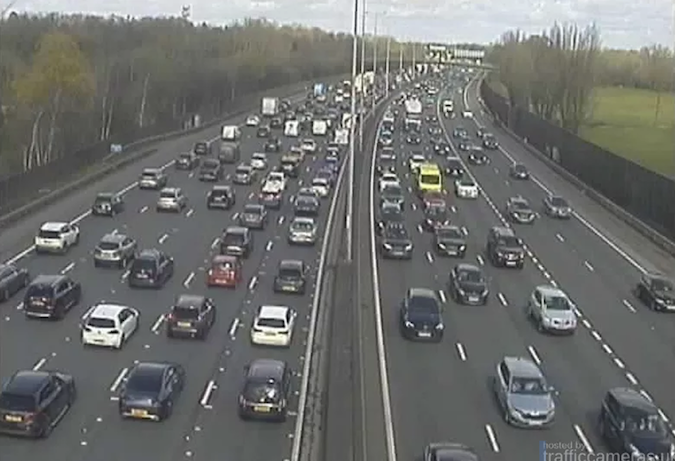
The big bit of the Actually Existing Ringways takes the form of the M25, whose circuit was completed when Margaret Thatcher opened the last stretch between London Colney and South Mimms in Hertfordshire in 1986. Ben Elton called it “Thatcher’s Berlin Wall”. It was a sort of bodge-job compromise between Ringway 3 and Ringway 4. You can see the joins in a couple of places where the motorway changes the distance of its orbit [3].

Screenshot 2025 12 20 at 07.58.31

Sections of it became swamped with traffic soon after opening. The planners had underestimated the number of local journeys that would be made on what was supposed to be a long-distance motorway. The section near Heathrow has subsequently been built out to six lanes in each direction, hardly better than distributing the traffic around a few more purpose-built roads.

Ringway 3-and-a-half, the M25, has become part of London’s identity, one of the accepted ways of defining the capital: hello and welcome, Watford and Walton-on-Thames. When we cross it, even inner Londoners like me have a feeling of “nearly home”. The world beyond it can feel strange and hostile in this age of political polarisation. London is a concrete island within the M25 and, like Robert Maitland, we kind of like it that way.

Follow Lewis Baston on Bluesky. Main image (Dalston) from The London Archives. M25 photo from National Highways via Berkshire Live.

***

Footnote [1]: Robert Maitland’s timeline had already diverged from our own several years before 1973; Ringway construction had advanced further. The pedant may note that the Ringway project would not have created a junction exactly like the one described in Concrete Island. What I think Ballard has done is imagine an M4 spur starting near the Chiswick Roundabout, following the course of the North London Line through Acton and then smashing westwards through East Acton or Shepherd’s Bush to meet the Westway near where it intersects with Ringway 1, the West Cross Route.

Footnote [2]: The idea of building major roads including concentric urban motorways was an accepted feature of London’s planning ever since the 1944 Abercrombie Report. The growth of car ownership, projected forwards, would have brought central London to a complete halt unless something was done. Postwar London was a different and sparser city than our own; its population was falling, land was cheaper and there were bomb sites, slums and belts of decaying industry where new roads could be built.

Footnote [3]: One is at South Mimms where the carriageways to the east (Ringway 3) run separate from each other, anticipating Ringway 3 continuing round to Bushey and Northwood. The other is in the other corner, where the road billows out from Swanley to Sevenoaks. Junction 5 is peculiarly aligned where in both directions continuing round the M25 involves turning off to stay on (TOTSO in road-people parlance).

OnLondon.co.uk is funded in full by subscribers to publisher and editor Dave Hill’s twice-weekly newsletter On London Extra. To receive it, become a paying subscriber to Dave’s Substack or pay £50 a year or £5 a month through Support links on this site.

Categories: Culture

Transport for London chiefs strike positive financial note

Will it be a Happy New Year for Transport for London? The network’s chiefs struck an optimistic note this week as they were grilled about their spending plans for next year at the London Assembly’s budget committee meeting, buoyed by continuing break-even forecasts, a four-year £2.2 billion capital funding deal with the government and the recent green light for the Docklands Light Railway (DLR) extension to Thamesmead.

The budget discussion was a reminder that TfL is a big business – a £9 billion operation providing almost nine million public transport trips a day generating £6 billion a year in fare income, and with a planned capital spend in the coming year of some £2 billion.

That made its forecast surpluses on operating costs – £26 million next year and rising to almost £500 million in 2028/29 – a major achievement, said Sir Sadiq Khan’s Deputy Mayor for Transport, Seb Dance. TfL was the only large-scale transport network “anywhere in the world” to break even, he said, with all surpluses reinvested in services. And that, he added, was despite receiving no government fares subsidy since 2015, when it was phased out.

The long-term £2.2 billion capital spending deal was also significant, he said. The largest allocation for a decade, it would pay for a new tram fleet, new trains on the Piccadilly and Bakerloo London Underground lines and the DLR, continuing upgrades to the 33-year-old Central line fleet and wider signalling and accessibility improvement, plus the Oxford Street pedestrianisation plan, initial work on the DLR extension and more.

All good news then? Not quite. Finance chief Rachel McLean had to reassure Assembly members (AMs) that the £900 million allocated annually for renewals was enough to keep the network in good shape. “There is always a gap between what is absolutely desirable and what we are able to afford, but I don’t believe this is insufficient to maintain the service,” she said.

Keeping one of the world’s largest public transport networks in shape is a long-term job too. Commissioner Andy Lord confirmed that new Piccadilly line trains are now expected “between July and December” next year, with new DLR trains also due by the end of next year at the earliest and the new tram fleet in the early 2030s. He also said there will be no money for repairing Hammersmith Bridge.

For the DLR extension, next year would be taken up finalising detailed business and funding plans as well as securing formal government approval under the Transport and Works Act 1992, before construction could begin in 2027, McLean added. Mayor Khan’s target of making half of the city’s Tube stations step-free by 2030 also posed “operational challenges”, the meeting heard.

And as the Mayor announced last week, rail fares overall will rise by some 5.8 per cent next year, in line with government expectations, although as an “emergency cost-of-living measure”, bus and tram fares will be frozen until July, with City Hall money plugging the gap. With the caps on the cost of multiple journeys and Travelcards also frozen through next year, and Tube increases limited to 20p, the package struck the “right balance” between maintaining the network and keeping it affordable, Dance said.

TfL is also currently spending up to £11 million a year on removing graffiti along with investigation and prevention work following a “spike” in incidents, particularly on the Bakerloo and Central lines, the meeting heard. The meeting heard that the cost of recent Tube strikes amounted to between £20 million and £25 million too, while fare evasion was costing some £130 million a year, though this was in the context of a £6 billion total farebox income. Plans were in place to reduce the evasion rate from its current 3.5 per cent to 1.5 per cent by 2030, McLean said.

The major risk remained the continuing decline in bus ridership, which is down by a quarter over the past 10 years, the meeting heard. Action was planned, on bus lanes, tackling roadworks hold-ups, improving the fleet, customer information and more, Lord said. But he concluded with a stark warning: “We have to increase ridership. If we don’t do anything the cost of the bus operation is going to grow significantly over the next four years, to the point that it will be unsustainable and we will have to reduce it.”

Consultation on the full City Hall draft budget will close on 4th January, with Assembly debates on Khan’s final figures, including his Council Tax proposals, scheduled in advance of final decisions by the end of February.

The London Assembly budget committee meeting can be viewed in full here.

OnLondon.co.uk is funded in full by subscribers to publisher and editor Dave Hill’s twice-weekly newsletter On London Extra. To receive it, become a paying subscriber to Dave’s Substack or pay £50 a year or £5 a month through Support links on this site.

Categories: News

Sadiq Khan’s 2025 Christmas Carol Service brings London comfort and joy

Ludicrous false claims that celebrations of Christmas have somehow been outlawed in London seem to start sooner every year. Or have they simply become louder due to the growing viciousness, weirdness and audacity of the Far(age) Right, a spectrum of dark belief encompassing violent racism, seething ethno-nationalism, Nigel Farage’s own political party and its Conservative kindred spirits?

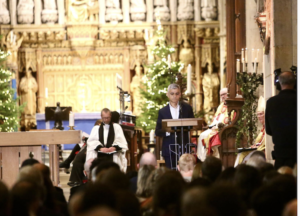
Such people and those led by them from the path of righteousness would have been amazed by the grace and enthusiasm for the Christian celebration demonstrated last night at Southwark Cathedral, where Sir Sadiq Khan once again led the Mayor’s Christmas Carol Service before a full house of London congregants.

Khan himself read from the gospel according to St Luke, the section where shepherds are “keeping watch over their flock by night” when “an angel of the Lord stood before them and the glory of the Lord shone around them”. They brought good news, the Mayor reminded us, of a baby “born this day in the city of David, a saviour who is the Messiah”.

Later, he delivered his Christmas message, which contained humour along with a warning about “forces of division” trying to erode harmony and peaceful co-existence among different faiths and communities. “We will stand up and defend London,” the Mayor said.

Referring with sadness to the antisemitic terror attack in Australia, he urged his audience to draw hope from Jesus Christ – who, he pointed out, knew about marginalisation – imploring people to “love thy neighbour”. Khan wondered, gently rhetorically, if London’s comfort with its human diversity explains why “some people don’t like us”.

Photo 2025 12 16 11 16 42

The sentiments of the Mayor, a Muslim, of course, chimed precisely with those expressed by the Dean of Southwark, Doctor Mark Oakley, in his welcome and bidding prayer, in the final blessing of the Bishop of Southwark, Christopher Chessun, who has just announced he’ll be retiring in August, and in the pulpit address of Doctor Rosemarie Mallett, the Bishop of Croydon.

The three clerics each warned against the rise of what Oakley termed a “so-called Christian nationalism”, which Mallett said “is not our message”. She applauded the Mayor’s campaigning against division and the aims of City Hall’s Loved and Wanted Fund, which supports civil society organisations that promote community cohesion across the city. Chessun paid tribute to Khan, who has had close links with the cathedral since he was first elected Mayor, in 2016. His formal signing in took place there within a multi-faith ceremony. There were other speeches, a selection of carols were sung and the famous London Community Gospel Choir performed.

The service took place just a few days after Farage, hoping to move on from offering a diversity of non-denials of allegations of years of public schoolboy antisemitic and other forms of racist bullying, said on television: “We have a Mayor of London who is happy to celebrate every other religious festival around the world, but just not Christmas.”

This untruth, uttered on the barely-regulated infotainment television channel GB News, came a good fortnight after Khan had presided over the annual light-up of giant Christmas tree in Trafalgar Square, maintaining a tradition dating back to 1947 when Norway presented one of its giant firs to the capital to thank Britain for its support during the World War II with defeating Nazism.

As Khan said of Jesus’s message about neighbours, the light shines on.

Follow Dave Hill on Bluesky. Photos courtesy of City Hall.

OnLondon.co.uk provides unique coverage of the capital’s politics, development and culture with no paywall and no ads. It is funded by subscribers to publisher and editor Dave Hill’s twice-weekly newsletter On London Extra. To receive it, become a paying subscriber to Dave’s Substack or follow any Support link on this site.


Categories: Comment

Youth unemployment is rising in London. Why?

The unemployment rate among young Londoners has long been higher than in the rest of the country. Reasons for that include a significant number coming out of school with fewer than five good GCSEs (even though London’s schools are very successful) and intense competition for work due to the large number of incomers from the rest of the UK and elsewhere looking for jobs.

But lately matters have got worse. Previously, youth unemployment levels varied in line with those for older groups except at times of economic crisis, such as the 2008 global financial crash or during the pandemic. They were, in general, higher than but in parallel with them.

Now, youth unemployment all over England has gone up more sharply than unemployment in general. In London it has risen as high as 17 per cent. Three years ago, it was 14.2 per cent. The problem is especially acute in outer east and parts of outer west London.

Trust for London has been searching for the causes of this. Drawing on Office for National Statistics job vacancy data, it found a “significant drop” in the number of jobs of all kinds advertised online nationally. London saw the largest falls across the board, but particularly among the sorts of job the youngest group of working age Londoners are most likely to apply for.

For example, entry level shop assistant and customer service roles are in far shorter supply than they were three years ago – the number has fallen by more than half. There has been a huge reduction, too, in web and multimedia roles, also popular with younger people. By contrast, Trust for London says, vacancies for skilled trade occupations, caring and leisure services, hairdressing and other “hands-on” roles that need “in person” skills have held up much better.

A big difference is that the former group are types of employment likely to have been affected by the wider use of Artificial Intelligence. The Trust for London analysis is careful not to jump to firm conclusions about this, stressing that “it’s impossible to separate the impact of AI from other factors”. But it notes, as did Richard Derecki when looking into AI’s impact in September, that other studies have found links between the adoption of AI and employers taking on fewer people.

The Trust for London work also points to wider economic uncertainty and high costs making employers cautious, poorly-paid or insecure employment making a lot of jobs almost literally unaffordable, and a lack of the particular skills firms are looking for.

It welcomes the budget confirming that small and medium-sized firms will no longer have to pay for apprenticeships for under-25s, its reforms to the Apprenticeship Levy from April and its improvement to the minimum wage. And its conclusions include the following:

“Rather than letting AI simply displace young workers from entry-level roles, we need proactive policies to ensure young people can benefit from technological change. This means investing in skills training that prepares young people for the jobs of tomorrow, not just yesterday.

Without action, too many young Londoners will be locked out of good work – and inequality in the capital will deepen even further. The evidence is clear: we know what works to support young people into employment. Now we need the political will and investment to make it happen at scale.”

Read the Trust for London research in full here.

Follow Dave Hill on Bluesky.

OnLondon.co.uk provides unique coverage of the capital’s politics, development and culture with no paywall and no ads. It is funded by subscribers to publisher and editor Dave Hill’s twice-weekly newsletter On London Extra. To receive it, become a paying subscriber to Dave’s Substack or follow any Support link on this site.

Categories: Analysis

The 2025 On London Christmas Party!

If there is a better example of the capital’s ability to combine a global character with neighbourhood intimacy than the Palm 2 shop beside Clapton Pond in Hackney I have yet to find it.

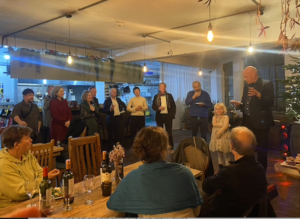
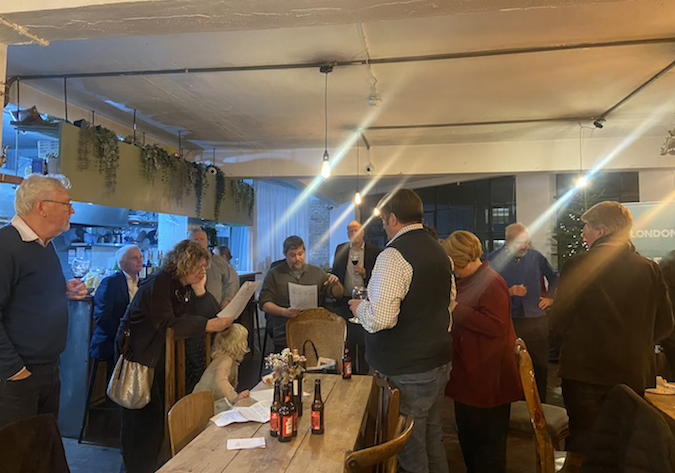
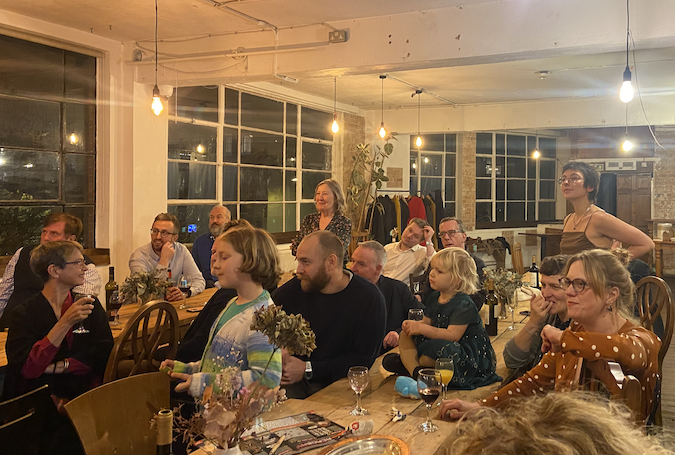
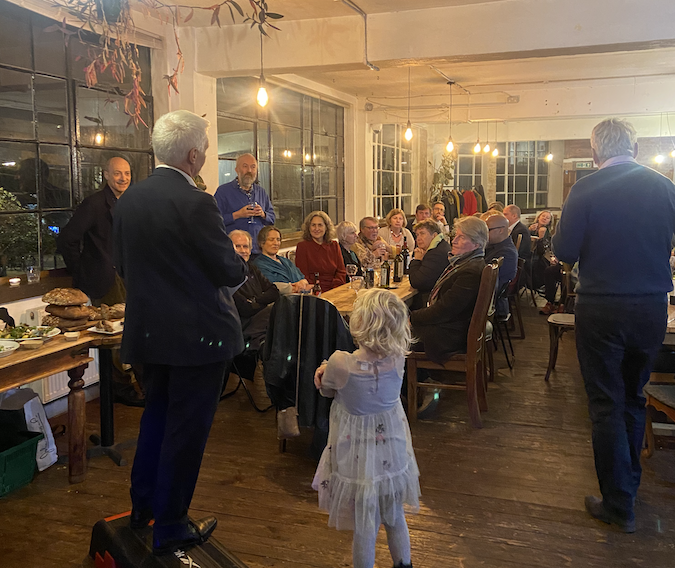
Palm 2 has been there for almost as long as I have lived in the area, which is well over 30 years. And for the second year in a row its first floor function room was the venue for the On London Christmas Party, featuring food, drink, a little speech by me and a brilliant London quiz.

Those present included a City Hall deputy Mayor, a borough Mayor, other eminent London political and governance figures, assorted influential consultants, advisers, journalists, historians, civic society leaders and academics, a lovely bunch of On London supporters and several members of my family, including grandchildren and their whippet.

Screenshot 2025 12 11 at 15.14.21

Quizmasters Robert Gordon Clark of LCA and PlayGC Theatre Company and Professor Tony Travers from the London School of Economics, provided a magnificent test of guests’ London knowledge, with questions covering everything from the original colour of Tower Bridge to the distance between Catford Bus Garage and the Greenwich Meridian, to the relative population densities of London boroughs and Leeds, to the longevity of London bus routes.

There were also two “connections” rounds involving names associated with the London Underground. These had me totally baffled despite seeing them in advance, but their mysteries were solved by James Cracknell, editor of Enfield Dispatch, and Sheila Fitzsimons, who as well as being my very fabulous wife, does On London the great service of fixing everyday tech issues I am too dim, intimidated and generally useless to cope with on my own.

Screenshot 2025 12 11 at 15.16.08

In my little speech I was pleased to report that during 2025 On London has become wholly financially self-sufficient from its income from my now twice-weekly On London Extra newsletter. That happened partly because I became an OAP, meaning I could afford a pay cut, partly due to a (very limited) trimming of outgoings, and partly because there are now more subscribers to On London Extra supporting this no-ads, no-paywall website and its writers than ever before.

I would like to thank every single one of those supporters and encourage others to join them. The easiest and best way to subscribe to On London Extra is to do so through my personal Substack. Do that, and you too will be able to come to On London Christmas Parties!

Screenshot 2025 12 11 at 13.48.35

Finally, special thank yous to Patricia Brown for saying some lovely words about On London after I’d finished saying mine, to Matilda, age six, for handing out the chocolate coin quiz prizes, and to Orla Hill, currently appearing as Deborah Mitford in Outrageous, for taking the photos.

Follow Dave Hill on Bluesky.

Categories: Culture