The history of this guiding force in the city's evolution, chaired for much of its time by the late Nicky Gavron, can now be explored in rich detail for the first time
In between Margaret Thatcher’s abolition of the Greater London Council (GLC) in 1986 and the creation by the first Tony Blair government of the Greater London Authority (GLA) in 1999, with its directly-elected Mayor, a range of organisations were set up to try to fill the gap.
Perhaps the most important was the London Planning Advisory Committee (LPAC), a statutory, cross-party body formed in the year of the GLC’s dissolution as ministers acknowledged that without some pan-London collaboration, the capital, already in the grip of its long, post-war decline, would struggle even more.
There was a danger that the work of LPAC would be overlooked, almost forgotten by history, despite its playing a vital strategic part in keeping Greater London’s development coherent and, indeed, innovative and alive to new possibilities once its recovery began in the 1990s.
That danger has been averted thanks to the commitment and great work of Richard Derecki, a contributor to On London and a hugely experienced economist and governance expert who has worked for the 10 Downing Street strategy unit and the GLA.
Richard, along with a group of former LPAC stalwarts, has organised a huge volume of material held in The London Archives to create an online story of LPAC, hosted by The London Society.
The new LPAC site also contains a wealth of documents and papers that belonged to the late and greatly missed Nicky Gavron, who after an extraordinary career in London government, died in August 2024.
Nicky became a member of LPAC in 1988, its lead Labour member in 1989 and its chair in 1994. She devoted a great deal of time in her latter years to piecing together and highlighting LPAC’s work.
Richard and his team have done a fantastic job. Enjoy Re-inventing The City: The Story of LPAC here.
OnLondon.co.uk provides unique coverage of the capital’s politics, development and culture with no paywall and no ads. It is funded by subscribers to publisher and editor Dave Hill’s twice-weekly newsletter On London Extra. To receive it, become a paying subscriber to Dave’s Substack or followany Support link on this site.
Amid persistent talk of the demise of the high street, the capital’s suburban shopping centres are bucking the trend – not only surviving but actually performing relatively well. That’s the message from a new study of 545 London high streets from the Centre for Cities think tank.
Analysing three years’ worth of debit and credit card transactions – millions of payments in all – alongside other data on empty shops and rateable values, the report finds high street vacancy rates outside the city centre running at between eight and 10 per cent. That’s well below even city centre vacancy rates outside London, with almost 80 per cent of the capital’s suburban shopping streets having a lower vacancy rate than the UK’s city centre average.
Very few empty shops then. That’s the case, the report shows, in all parts of the city, despite London’s “stark divides between different neighbourhoods”, and whether a high street is classified as primary, secondary or local. And there’s no correlation either between vacancy rates and the capital’s Business Rate burden, which is generally significantly higher than in the rest of the country.
London’s suburban high street vacancy rates are “not the sign of distress that they are in other parts of the country”, the report concludes. Instead, they “typically represent a healthy surplus of high street space that can be quickly occupied by new businesses if demand changes…London’s suburbs seem to be in a healthy balance”.
The key factor behind London’s success story, the report says, is strong demand across the city, shaped by relatively high average incomes and more people in high street “catchment” areas, as well as the number of international visitors in particular places. And that’s the case even for the city’s “weakest” shopping streets, where rateable values, which determine Business Rate demands and reflect rent levels, are lower.
Outside London, as previous Centre for Cities research has shown, low rateable values go hand in hand with higher vacancy levels, reflecting low demand for space. But in the capital, even those high streets with the lowest rateable values do not consistently experience high vacancies, the new report finds: “Demand across London’s high streets is so consistently strong that even its weaker high streets can keep units filled and vacancy rates low.”
It’s not an entirely rosy picture: Business Rates and the rise of online shopping do put pressure on the bottom line of suburban London’s high street retailers, the report says. Recent tinkering, such as the plan to shift more of the Business Rate burden to premises with rateable values of £500,000 or more, disproportionately affecting London and the south east, will add to that pressure. There are also a small number of London high streets, including “primary” centres such as Ilford and Croydon, where vacancy rates are relatively high by national standards.
But while some shopping streets may require specific interventions, perhaps to “reduce the amount of excess retail space”, the report says that the general approach to safeguarding the city’s high streets should be to focus on “strengthening the wider local economy”, putting more money into Londoners’ pockets.
For the capital, that means pushing housing costs down by building more homes, including through Green Belt release, boosting higher-paid job creation by supporting “Grade A” office development in the city centre, and using new “tourist tax” revenue to attract more visitors, growing a sector which already contributes significantly across the city. As report co-author Oscar Selby says, it is “supporting spending power and demand” that can fend off “the death of the high street”.
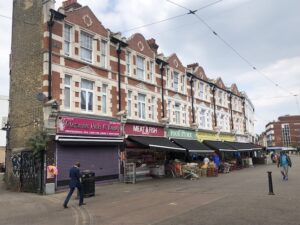
Follow Charles Wright on Bluesky. Read the Centre for Cities report in full. Photo: East Street, Barking.
OnLondon.co.uk provides unique coverage of the capital’s politics, development and culture with no paywall and no ads. It is funded by subscribers to publisher and editor Dave Hill’s twice-weekly newsletter On London Extra. To receive it, become a paying subscriber to Dave’s Substack or followany Support link on this site.
The denigration of council housing has long been commonplace, as is contempt directed at its tenants. Yet in the post-war decades, Labour and Conservative national governments seemed almost to compete to build more of it.
That attitude began to change in earnest after the election of the Conservatives under Margaret Thatcher in 1979, bringing with it the Right to Buy and an ideological belief that such homes were undesirable and best sold off.
Westminster Council, led from 1983 by firm Thatcherite Shirley Porter – Hackney-born daughter of Jack Cohen, the man who founded Tesco – was very much of that view. Porter’s administrations became notorious for many things, most of all for a policy called “building stable communities”.
Introduced following the Tories’ narrow re-election in 1986, it was really a covert strategy for selling council homes in marginal electoral wards with the aim of increasing the number of Conservative voters living in them. It became known as the “homes for votes” scandal. The policy was found to be illegal.
One of those in the thick of exposing Porter’s secret activities was Jonathan Rosenberg, who was already involved in battling the sell-off of two north Westminster housing estates, Walterton and Elgin.
Tenants were mobilised, put the council under pressure and – enabled, ironically, by Conservative legislation designed for selling council dwellings to private landlords – eventually secured ownership of the estates through the vehicle of Walterton and Elgin Community Homes, a community land trust and housing association. Today, it manages 673 homes with over 1,500 residents.
The 40th anniversary of the start of the campaign is now being marked, including with a commemorative calendar. Jonathan was my guest of my latest True London podcast. So was his cat.
More on the story of WECH from me here. More on “homes for votes” here. The Westminster Tories’ graveyard sell-off scandal, to which Jonathan alluded, is documented here.
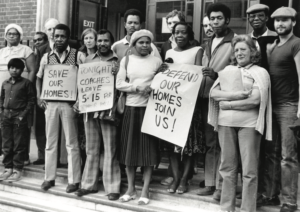
Follow Dave Hill on Bluesky. Photo from the WECH calendar by David Ingham, originally published in the Paddington Mercury newspaper.
OnLondon.co.uk provides unique coverage of the capital’s politics, development and culture with no paywall and no ads. It is funded by subscribers to publisher and editor Dave Hill’s twice-weekly newsletter On London Extra. To receive it, become a paying subscriber to Dave’s Substack or followany Support link on this site.
The nation’s shopkeepers have been having a rough time. Consumers have been moving online and the pandemic made matters worse. But in one town at least the Great British High Street is surviving – perhaps even thriving – in spite of everything.
Welcome to Hayes in west London and its valiant retail frontline, where a pharmacist describes a small business life that involves much more than customer service and sales.
“Every day, I give people food,” he says. “Every day.” Asked why, his answer is simple. “Because they ask me for it. What can I do?” He speaks of one man in particular who seeks sustenance, “daily, religiously”. The pharmacist dispenses a little of what he provides for his staff or, if none is left, “a couple of pounds”.
With others, his philanthropy is involuntary. Recently, a man came in, picked up two packets of Pampers and told the pharmacist straight that he wouldn’t be paying for them: “He said to me, ‘I can’t afford it’.” Less candid but still overt was the case the week before of a woman who picked up something from a shelf on her way in, held it as she queued for a prescription, then left the shop still carrying the item without handing over any money.
Most shoplifting, though, is of the less transparent kind. The pharmacist describes it, with regret, as coming with a shopkeeper’s territory. He doesn’t bother calling the police: “For a business, there’s profits and losses. I account for shoplifting as part of my losses.” He says theft of goods adds an average of £100 to his outgoings per day.
As we stand in an aisle, the shop door pinging with customers coming in and out, he speculates about the reasons for it: “Is it because people in the area are poor? Or they don’t know where to get help?”
His scariest incident happened a few years ago. Around 8:30 one morning, when he was in the shop alone, a man with blood coming from a wound walked in, craving help. He then produced a knife and told the pharmacist that if he didn’t give him what he wanted, he would stab him. The pharmacist, wisely, obliged.
He has been careful not to make the same mistake again. Yet his feeling is that street crime in the location, specifically violence, theft and drug-dealing along with disorderly drunkenness, has reduced of late. He lives near the station with his wife and their six children and has no qualms about the walk home.
Joint top of his list of issues as a shopkeeper is car-parking, saying it has become harder for drivers to find spaces, resulting in less trade than there would otherwise have been. That said, he sees the problem as partly arising from increased demand, with “more people coming to town” and a growing local population.
“A third of the people coming in, we don’t recognise,” the pharmacist says. “They are new people, with local addresses”. Some are staying in Hayes hotels, a mixture of visitors and asylum-seekers. Being close to Heathrow, Hillingdon as a whole accommodates plenty of foreign visitors and contains more so-called “asylum hotels” than most boroughs. Both types of guests are customers. Despite the shoplifting and parking, the pharmacist is pretty cheerful: “Otherwise fine, the business is doing well.”
The pharmacist’s name is Mohamed Abdi. He came to London from Kenya to study pharmacy at King’s College, arriving 20 years ago. He has been running his shop for the past 13. He says he likes living in Hayes: “It’s the people. It’s multicultural!”
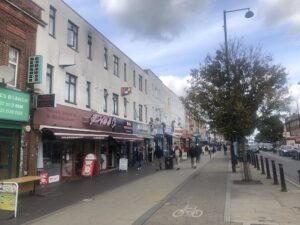
Indeed, Hayes, at the edge of the metropolis, is in some ways as cosmopolitan as many of the capital’s inner city areas, if not more so. Half of the residents of the Hayes Town electoral ward are Asian, a quarter of them Muslim, 15 per cent of them Sikh. And in the backroom of another shop in Hayes, I find myself admiring a little Hindu altar positioned directly beneath a multi-screen CCTV monitor.
This is a shop that sells clothes. There I meet Munish Thapar, who came to Hayes from India 20 years ago. He first lived in the town with an aunt while studying engineering in Portsmouth, commuting two or three times a week. He had other relatives in the north of England – shopkeepers in Barnsley, Doncaster and elsewhere. He met his wife, Poonam, in Sheffield at a social gathering. Their respective families were acquainted, a marriage was arranged and, happily, “we liked each other”.
Their Hayes shop is very much a family business, with two teenage sons and, sometimes, a grandfather helping out. It has been going for 15 years. The last few have been the hardest. The pandemic was, of course, very tough. “It would have been easy for us to give up,” Mr Thapar says, “but we carried on, we managed to pull through somehow.”
The post-Covid period has been difficult too. He is, on the whole, less sanguine than his pharmacist counterpart about the general social environment on his street a few minutes’ walk away, mentioning drug-related goings-on in an alley behind his block, which one of his security cameras surveils. And shoplifting is now a much bigger problem than it was when he and his wife started out, and before Covid: “People just picking things up and running away. It’s very, very disheartening.”
Often, the culprits are known to Mr and Mrs Thapar, familiar through repetition. If they spot them outside, they won’t let them in. But sometimes they sneak through. The police advice is not to intervene in case things turn violent, “but we confront them”. Usually, they leave without any trouble, though there was an occasion when one said he was carrying a knife. Mr Thapar invited him to show it. No knife appeared.
He thinks a gang operates in Hayes, quite small, but persistent. There will be periods when they aren’t seen and others when they are, perhaps related to police visibility or dispersal orders. Mr Thapar suspects they have drug habits to feed: “They are thin. You can tell by their faces, the way they behave.”
He gives an example of how badly the business can be hit be single thieving raid: a pile of T-shirts, each on sale for £60, all gone in single swoop, costing the shop £400-£500. Now, the most expensive garments are kept in locked cabinets.
All this is angering and sometimes frightening. Yet Mr Thapar is dauntless. He has a lot of loyal, good customers. “They don’t want us to go. They tell us to keep going until we’re old!” He points out that were he not a shopkeeper he wouldn’t see, day in, day out, some of the ongoing local problems, “which are sometimes under control, sometimes not”. Still living locally, he describes the town as “a very mixed community place, brilliant to live in”. He adds: “Running a business anywhere is hard, but this town is OK.”
***
I met the shopkeepers during my second autumn visit to Hayes. For my first, I had a guide, David Brough, a public servant of the most admirable kind.
David’s civic involvement began in 1969, when he became a trainee committee clerk with the then newly-formed Hillingdon Council. He ended up as the borough’s Head of Democratic Services and Returning Officer. Since 2013, he has chaired the Hayes Town Partnership, which represents businesses in Hayes.
We met at Hayes and Harlington station, which has long been a minor stop on the Great Western main line from Paddington and now serves the very major Elizabeth line, the busiest in the entire UK and a definite boon to Hayes. When I got there, a little shop on Station Road was being energetically refitted. A man outside gave me a business card. Coffee and pastries would be on sale there soon. In reply to his inquiry, I told him I was from Hackney.
“Pretty different there, yeah?” he said.
Well, yes and no.
My walk with David was educational in a various ways, not least about the esteem in which David is held. Several times, as I stopped to watch or inspect more closely some significant feature of the town street scene, such as an Irish funeral procession emerging from a residential side street or a commercial building that had been turned into an unauthorised dwelling of multiple occupation, or a Superloop bus passing the Methodist church, I would turn to speak to him and find him gone.
Gone where? Not very far. He might have been waylaid by a retailer or hailed by a passer-by, each of them eager to convey some matter of concern or piece of neighbourhood intelligence for David to pass on to the council, the police or any one of the array of local organisations with which he has some contact or influence. Just about everyone seemed to know him. Mr Thapar had spoken of him fondly: “I once said to David, ‘sometimes I feel like giving up’. He said ‘don’t – don’t give up’. He never does.”
We admired the stretch of the Grand Union Canal that cuts through Hayes. David, of course, is on the London and South East advisory board of the Canal and River Trust and has been a canal boater since 1967. Then we went to the place for which Hayes, in the memories of many Britons, is most famous, most embedded in national folklore – the former site of the EMI record factory.
EMI, which stands for Electric and Musical Industries, was once synonymous with Hayes, thanks largely to the packaging of the factory’s vinyl products. The sleeve of every album or single that came off its production line, including millions by The Beatles and The Rolling Stones, asserted its origin as “Hayes, Middlesex”. The latter, as younger readers might not know, was an English county abolished by the local government reorganisation of 1965 that saw the creation of Greater London, which absorbed most of it.
The EMI company was founded in 1931 through the merger of two gramophone firms. One of them, founded in Britain by a German American, owned the label His Master’s Voice, later shortened to HMV, which featured a dog listening earnestly to a phonograph horn. The dog was Nipper, a Bristolian canine who, in 1898, albeit three years after his death, was immortalised by his second owner, the London painter Francis Barraud, whose Huguenot ancestors came to Britain to escape persecution in the France of Louis XIV.
Barraud’s image of Nipper, who was laid to rest in Kingston in 1895, became one of the most celebrated commercial logos in the world, also adorning HMV record shops. The massive impact of this small pet is represented on the ex-EMI complex by a gigantic statue of him.
Now known as The Old Vinyl Factory, the site passed into the hands of developer U+I in 2011, and has been fitfully evolving into a mixed-use area. Behind its B-Town Café, a large artwork celebrates Beatlemania. Inside, David gave me his long view of Hayes and its fortunes down the decades.
EMI was just the biggest and best known of the local hives of industry, he explained. There was also the Fairey Aviation Company, founded in 1915 by an Englishman and a Belgian. From Switzerland, Nestlé had an instant coffee factory (“if you’re from Hayes, you call it ‘Nestles’”.) From Scotland came a Callard and Bowser confectionary plant. There was also, David said, “quite a lot of light engineering”.
One by one, the factories closed down. For David, this was all of a piece with the decline of British industry in the 1980s. “The town centre lost its hinterland,” he said: “You had this downward spiral of loss of purchasing power, declining shops, and an increasing number of betting shops and charity shops.” This, in David’s view, was “the story of Britain’s high streets” more generally. Drive-in shopping centres didn’t help. There’s one nearby, on Uxbridge Road.
Road traffic management measures have had big effects. A Hayes by-pass road, a survivor portion of the fiercely-contested and mostly abandoned London Ringways project, opened in 1992 with the aim of alleviating congestion related to nearby Heathrow airport.
The town centre was pedestrianised, but shopkeepers, already dismayed by a reduction in custom conveyed to them by car, thought this the last nail in the coffin. And David acknowledges that the place was sometimes deserted and forbidding. “If you were a woman on your own, you wouldn’t have walked through the Town Centre at night.”
The Hayes Town Partnership was formed by the council to aid the town centre’s revival. Soon after, with the help of £4.5 million from Transport for London, through-traffic was reintroduced. David had mixed feelings about this: “I think the car dominates too much.” He was happier about the addition of cycle lanes and improvements to the canal. During his time working for it, David often felt there was a disdainful attitude towards Hayes at the council. His and the partnership’s mission has been to challenge any such thinking and make the case for valuing and supporting the town as it battles against the odds.
“It’s a poor area,” he said, candidly. “That is reflected by the town centre shops.” There are branches of Boots, Iceland, Greggs and WH Smiths, but most of the retailers are independents. “All of them are from immigrant backgrounds,” David said, “and that is fine by me. Those shops meet the needs of the community.”
He also pointed out that very few retail units are empty. He looks back a dozen years to a “defeatist attitude” among local councillors of that time and “a kind of self-hating mode” he thinks contributed to forces of decline. But he takes heart from today’s Hayes shopkeepers’ refusal to cave in to them.
***
I hadn’t visited Hayes since January 2009, when Boris Johnson, then in his first year as Mayor of London, turned a People’s Question Time held at its Beck Theatre into a bit of a rally against Heathrow expansion. Before that, I had known it mostly as part of a parliamentary seat represented by the late Terry Dicks, a gobby working-class Tory from Bristol (like Nipper) who wanted to bring back hanging, deemed Nelson Mandela a terrorist and was casually racist in a way that, until recently, we might have thought we’d seen the last of.
First elected for Hayes & Harlington in 1983, Dicks represented the seat until 1997, when he stood down. His successor, McDonnell, personified a large swing in political outlook from extremely Hard Right to unbendingly Hard Left and has been there ever since. During that time, the area has undergone substantial demographic change. For example, the 2011 Census found that almost as many of its residents were Asian (38.9 per cent) as were white (40.3 per cent) and 12.3 per cent were black, and that 23 per cent had been born in Asia or the Middle East.
Hayes and its environs now form a Labour redoubt in the south of a resiliently Conservative borough. Tory-run since 1998, for most of that time it was led by Ray Puddifoot, a heroically moustachioed chartered accountant who stood down in 2020 after 20 years in the job. In 2022, the Conservatives won 30 seats to Labour’s 23 with only three changing hands, securing their fifth win in a row.
Labour hasn’t controlled Hillingdon or won the largest number of seats there since 1994. Labour’s Danny Beales gained the Uxbridge & South Ruislip parliamentary seat last year, but not by very much and only after the seat vacated by the by then disgraced ex-Prime Minister Johnson had stayed Tory against the odds in the infamous “ULEZ referendum” by-election of July 2023.
But although Hillingdon has differed from other outer London boroughs in resisting the advance of Labour in recent times, it has had financial struggles on a similar scale to several others and recently joined the list of those seeking exceptional financial support from the government. In July, Tory leader Kemi Badenoch, hitching a ride on the summer’s populist bandwagon, blamed a £17 million deficit on Labour’s “fast track” route for asylum seekers being given leave to stay in the UK. “There’s nowhere to put them,” she said. “A lot of people are worried about that, especially when some of those people go on to commit crimes.”
In fact, the financial demands of migrants were only part of Hillingdon’s difficult financial picture. A report to the cabinet of the council, led for the past five years by Ian Edwards, highlighted “additional costs” resulting from being close to Heathrow and “the surrounding hotels commissioned by the Home Office during the pandemic” – when, of course, the Conservatives were in power nationally – topped up by the arrival of Chagos Islanders.
But it also cited “demand pressures from adult social care, children’s social care and homelessness support” and central government underfunding stemming from 2013-14, when the Conservative-led coalition government reduced Hillingdon’s allocation in order to help councils elsewhere. This, the report said, “should not have led to under-funding of services to Hillingdon residents for the following thirteen years”.
The borough is one those that is hopeful of getting a better deal under the current government’s Fair Funding Review, whose outcomes are expected near Christmas. Local Tories may be less confident about their prospects in next May’s elections.
A new poll has confirmed that support for Labour across London has fallen, but the party still has a good lead. The Tories, meanwhile have been overtaken by Reform UK. Support for the populist Right party will be far greater in some boroughs than in others, and Hillingdon might be one of its stronger ones.
It was one of the five London boroughs to vote Leave in the 2016 EU referendum. In 2014, when UKIP was at its strongest, the party led at that time by Nigel Farage won no Hillingdon seats, but took 18 per cent of the popular vote. Reform will hope to do better than that in 2026.
As for Labour, it has its local problems too – problems focussed on Hayes. In 2022, the party strolled to a full-house win in Hayes Town ward, but two of its trio of winners, Peter Curling and Janet Gardner, have been deselected. They now sit as members of the five-strong Hayes Independent group. The other three, each representing a nearby ward, were also elected as Labour candidates. The split has been rancorous and dramatic. Curling was the Labour group’s leader.
For all, that, though, and despite the coming elections being unpredictable, you might think twice before betting against Labour repeating its Hayes Town ward clean sweep, especially if the right-wing vote is split. McDonnell, whose seat encompasses all the wards represented by the Independents, increased his majority last year. The spirit of Terry Dicks has been reviving elsewhere, but seems unlikely to catch on in today’s Hayes.
***
Back to David Brough. He sends out a free newsletter called Hayes Town News on behalf of the Hayes Town Partnership. It provides community information and as much optimism as possible. The latest edition leads with an account of him and colleague, Mr A. S. Puar – chair of the separate Hayes Town Business Forum, wearing pinstripes and a turban – presenting prizes to children at a local primary school.
The kids had been top performers in the annual Hayes Town Treasure Hunt, in which more than 20 schools had taken part, with 30 shops donating prizes. David is hugely enthusiastic about all the schools in Hayes: “They’ve got lots of really able kids who are doing really well. There’s fantastic talent in this town that needs celebrating.”
His newsletter contains a wealth of insights into Hayes, from its Muslim Centre and its Methodist Church opening their doors to provide warm spaces for people struggling to heat their homes, to praise for the Met’s Safer Neighbourhood Team and the work it does “that most people never hear about”, to a “Migration Menu” session at the Guru Nanak Sikh Academy, where Brunel University academics speak to locals about South Asian heritage and food, to the St Mary the Virgin church Christmas Bazaar.
“I’m pissed off with this attitude that everything is Hell,” David said, as we sat in the café, pondering the state of the world. He is a strong defender of Hayes’s cultural and ethnic mix and thinks others keeping their heads down “is fuelling Farage and his mob”. He’s not much impressed by the government’s handling of immigration and asylum: “Disgusting” is the word he used for Sir Keir Starmer’s “island of strangers” speech made back in May.
And, after all, it is thanks to residents of Hayes like Mr Abdi and Mr Thapar, who came to London from other lands, that the town centre streets of Hayes are keeping going against the odds, despite all the troubles they and the community they serve have faced.
We completed our round trip back near the station, where there’s a street called Stylus Place – another homage to the vinyl factory past – and a former office block that seems to typify the worst of the “permitted development” conversions of such buildings for residential use, requiring no fresh planning permission (an interesting case study I will come back another time).
Along with a discarded mattress, the walls of a short new foot tunnel, opened last year, were literally glowing with an artwork called Sounds of Hayes – a tribute to Alan Dower Blumlein, an inventor and pioneer in sound recording who worked for EMI.
Blumlein was born in Hampstead in 1903 and of French and German Jewish descent. He died in 1942 when a top-secret test aircraft he was aboard crashed in Herefordshire. Among his many achievements were the development of the H2S airborne radar system, important for the accurate dropping of wartime bombs, and the creation of what he called “binaural sound”, later and better known as stereo.
Thanks to Blumlein, in 1935, the first film footage using stereo sound was shot from an EMI office window. It was called Trains At Hayes, and showed a steam locomotive puffing past a building with the word “Nestlé” painted on the roof.
Hayes has long had a cosmopolitan character. What would Nigel Farage make of it?
***
I hope it won’t be long before I go to Hayes again. Apart from anything else, there are elections coming up and it’s another excuse to use the Lizzie line. And, by the way, that coffee shop I mentioned was open for business by the time of my second autumn visit. I bought my elevenses there. I’ll drop in again the next time I’m in town.
OnLondon.co.uk provides unique coverage of the capital’s politics, development and culture with no paywall and no ads. It is funded by subscribers to publisher and editor Dave Hill’s twice-weekly newsletter On London Extra. To receive it, become a paying subscriber to Dave’s Substack or followany Support link on this site.
The City of London Corporation has confirmed that an area within the Royal Docks enterprise zone in Newham has been identified as “a preferred new site” for the Smithfield and Billingsgate wholesale markets, which are to leave their current locations as part of severing their historic links with the City.
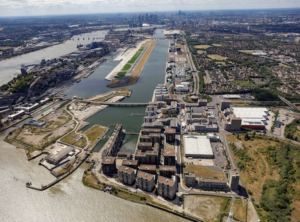
The chosen spot is Albert Island, a 25-acre space owned by the Greater London Authority at the eastern end of the Albert Dock, next to the Thames which has been seeking viable regeneration projects for several years. It follows the collapse of an earlier City plan to move the markets to Dagenham Dock.
It was reported by MyLondon at the start of October that a potential new site in the Albert Dock area was the “preferred location” for a new combined space for market traders.
The City undertook to help the meat and fish traders find a new site within the M25 as part of a deal that will see them vacate their current homes by 2028. It says “conversations will start shortly with potential delivery partners” for creating the buildings and facilities required to incorporate both markets within the available space. The traders have given their backing to a parliamentary Private Bill which needs to become law in order for the change of use of their current sites can go ahead.
The Albert Island site is significantly smaller than the 42-acre space at Dagenham Dock, a former power station site which the City bought in December 2018 with the specific aim of consolidating Smithfield, Billingsgate and the New Spitalfields fruit and vegetable markets there.
In November 2022, it announced that it had “approved plans for a major regeneration programme” that would see nearly £1 billion invested in the Barking & Dagenham borough and ensure “resilience in the food supply of London and the south east”.
However, the Dagenham Dock project was abandoned a year ago, with the City saying it had become too expensive and announcing its intention to close the two markets, which had been in its ownership for centuries.
An in-depth report by On London, published in October, shed light on some of the negotiations that went on within the City’s Guildhall headquarters and between the City and the market traders. Critics argue that the failure to make the Dagenham Dock scheme work reflect badly on the Corporation’s decision-making processes and reveal a lack of commitment to the scheme in an outer London setting that would not immediately generate large financial returns.
The City maintains that freeing up the market sites will enable 4,000 homes to be built on the Billingsgate site in Poplar, Tower Hamlets, and for the 19th Century Smithfield meat market in Farringdon, just inside the Square Mile, to form part of an emerging cultural quarter. Another Smithfield Market building is to be the new home of the London Museum formerly the Museum of London – which is due to open towards the end of next year.
Photograph from Vistry Group.
OnLondon.co.uk provides unique coverage of the capital’s politics, development and culture with no paywall and no ads. It is funded by subscribers to publisher and editor Dave Hill’s twice-weekly newsletter On London Extra. To receive it, become a paying subscriber to Dave’s Substack or followany Support link on this site.
Professor Greg Clark is one of the most distinguished advisors and commentators on cities there is, a man who travels the world helping urban leaders do their jobs better. Speaking with me and London Society chair Leanne Tritton for our latest Talk About London podcast, he revealed that he has visited 400 cities around the globe. In each case, his hosts are excited to discover where he is from.
“They want to talk about London,” he said. “It is a city that almost everyone has an opinion on.” He also described London as being possibly the best-known city in the world, and one that has “some very long-term advantages that people are aware of. It’s been a leading city in the world for almost 500 years.”
He added that foreign observers are extremely interested in how the UK capital recovered its fading fortunes in the second half of the 20th Century and the past 50 years. London has “surprised people,” he said, with its “global leading role” in finance, culture and the creative industries and sports, and with its growing population and cosmopolitanism. “The global view of London is different to the UK view of London,” he said.
The professor went on to describe the buffeting London has taken from three big shocks in a row – the global financial crisis, Brexit and the pandemic – and their consequences. And he noted, I thought very significantly, that international media has taken note that “London has not enjoyed unanimous support from the UK government over the last 15 years…people scratch their heads when they see that and say ‘why is the UK government not supporting its capital city?'”
I was very struck by Greg’s mentioning the recognition elsewhere that UK national governments have seemed to take against London and the puzzlement this causes – surely, it is reasoned, such an impressive and important national asset should be prized rather than derided.
Greg’s observations, I thought, chimed with points made by Kim Darroch, former UK ambassador to the United States and former UK Permanent Representative to the European Union, when he spoke at the annual dinner of the Westminster Property Association. He described London as being “generally admired, even envied around the world, and it is a huge national asset”. Later, he said that London being “a true global capital” was one of Britain’s strengths.
Responding to a question from the audience, he said he’d “never really heard a bad word about London from any of my diplomatic colleagues”. But he added that an exception to the capital’s favourable image abroad was an impression being put around on “the MAGA wing” of US politics about it somehow being a “global centre of knife crime” or being taken over by Sharia law. Such claims, he said, were endlessly replayed on social media and by certain commentators in the States. “This,” he said, “is ridiculous”.
As ridiculous, I suggest, as the same behaviour by the UK equivalent of that “MAGA wing”.
OnLondon.co.uk provides unique coverage of the capital’s politics, development and culture with no paywall and no ads. It is funded by subscribers to publisher and editor Dave Hill’s twice-weekly newsletter On London Extra. To receive it, become a paying subscriber to Dave’s Substack or followany Support link on this site.
Sir Mark Rowley was appointed Metropolitan Police commissioner in July 2022, right at the end of Boris Johnson’s time as Prime Minister. In March 2023, Louise Casey’s scathing review of the Met’s standards and culture, commissioned before Rowley’s appointment, was published.
At the start of this year, the Met was released from the “enhanced monitoring” of inspectors, but Panorama’s investigation of Charing Cross police station showed there was still a lot of work to do.
Meanwhile, despite some encouraging recent statistics, the populist Right continues to portray the capital as “lawless” as a key part of its wider political strategy.
Is the Met improving? Is Rowley’s leadership helping?
In my latest True London podcast, Marina Ahmad, London Assembly member for Lambeth & Southwark and chair of the Assembly’s police and crime committee, gave me some answers to those questions and more.
For more True London podcasts, and the Talk About London shows On London does in partnership with The London Society, subscribe to the Dave Hill On London YouTube channel.
OnLondon.co.uk provides unique coverage of the capital’s politics, development and culture with no paywall and no ads. It is funded by subscribers to publisher and editor Dave Hill’s twice-weekly newsletter On London Extra. To receive it, become a paying subscriber to Dave’s Substack or followany Support link on this site.
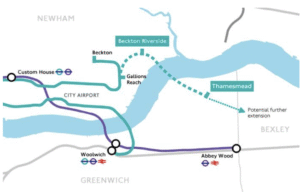
Government backing for the Docklands Light Railway extension to Thamesmead was the capital’s big win in the budget, even though it wasn’t actually mentioned in Rachel Reeves’s speech.
The green light for the £1.7 billion scheme, which will support up to 25,000 new homes, has been welcomed across the city: by London Councils as “essential for accelerating growth…and supporting the delivery of new housing”; by employers’ group BusinessLDN as a budget “high spot” unlocking “billions of private investment”; and by Sir Sadiq Khan, who called it “a massive vote of confidence” in the capital.
Good news, then, for a city that’s become used to being sidelined by Whitehall in recent years. But where’s the money coming from? The detail remains sketchy, though one thing is clear – Whitehall won’t simply be handing over the cash. Budget documents say the scheme will be substantially funded through Transport for London and City Hall borrowing, albeit with the government “also contributing over the long term”.
A government loan seems the likely way forward, though even with favourable rates compared to commercial borrowing this poses challenges for TfL. It hasn’t maxed out on its credit card, but its current debt stands at almost £14 billion, with the £1.2 billion cost of the Silvertown tunnel, though funded by toll charges, an added balance sheet liability nudging it towards its agreed borrowing limits.
Previous loans, for the Elizabeth line and the Northern line extension to Battersea Power Station, are being repaid through a mix of developer contributions and “tax increment financing” (TIF), capturing Business Rate increases as new building comes forward, rather than drawing on fare or Council Tax revenue. But a similar arrangement has not currently come forward for the DLR.
What about that “long term” government contribution? TfL has already secured £2.2 billion in its four-year spending review deal, but that is earmarked mainly for renewals: new signalling, new Piccadilly line and DLR trains and trams, as well as extra Elizabeth line trains. More cash would have to be additional to that agreement. The budget papers are non-committal, saying simply that the government “will continue to work with London to finalise funding details”.
Significant uncertainty then. But if all goes to plan, trains to Thamesmead should be running in 2032. Other important schemes though – the £8 billion Bakerloo line upgrade and extension to Lewisham, and the £700 million West London Orbital rail link, both on Khan’s and TfL’s wish lists – remain on the shelf, while that erstwhile priority, Crossrail 2, looks like a far distant prospect.
There may be just a glimmer of hope in the budget papers in the form of a pledge that the government “will continue to work with the GLA [Greater London Authority] to look at options for innovative financing to support the delivery of infrastructure projects in the capital.” One port of call will be BusinessLDN, which has already developed a model for borrowing against future tax increases from housing development. Meanwhile, we wait for the outcome of those Whitehall and City Hall discussions.
OnLondon.co.uk provides unique coverage of the capital’s politics, development and culture with no paywall and no ads. It is funded by subscribers to publisher and editor Dave Hill’s twice-weekly newsletter On London Extra. To receive it, become a paying subscriber to Dave’s Substack or followany Support link on this site.





You must be logged in to post a comment.