Blog

Julie Hamill: It’s worth living in London…for Selfridges

I used to work for Selfridges & Co’s advertising agency, BBH. I spent a lot of time in the store, just a 15-minute walk from the office, trying to capture what they still refer to as “the spirit of Selfridges”, a phrase that had been used by its American founder, Harry Gordon Selfridge, ever since the store opened in 1909.

When the agency was briefed in 1996, we were told about Harry Selfridge’s flamboyant lifestyle: his gambling, womanising and generous gift-giving. We were also told he was a marketing genius: fond of bold, attention-grabbing ads and stunts in his hot pursuit of having the best department store in London, albeit with a marked disregard for financial restraint.

At his previous job at the Marshall Field’s department store in Chicago, he had been credited with popularising phrases such as “only [x] shopping days until Christmas” and “the customer is always right.” He believed shopping should be enjoyed as a leisure activity rather than endured as a necessity, a philosophy reflected in his London venture’s lavish in-store attractions, such as carnivals, aeroplanes, moving mannequins and its iconic window displays, including a corner “signature” showcase, which would be signed by visiting stars. These were designed to bring the spirit of the store out onto Oxford Street and lure customers inside.

The “Earl of Oxford Street” was, indeed, a revolutionary retailer. The master showman understood that selling was as much about storytelling as it was about goods. Despite his past extravagant spending, the agency was assigned a sensible, modest budget to create a new brand campaign for the approaching millennium. Even so, at BBH on Kingly Street, the Selfridges brief caused considerable excitement.

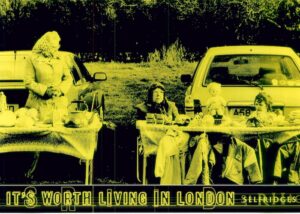
The team had pitched for the business by proposing an approach that directly linked the store to London, positioning it as an integral part of the capital and its history. The tagline was “It’s Worth Living in London”, supported by satirical imagery that offered playful commentary and sometimes pointed reflections on contemporary life in the city and the supposed alternatives in the country.

Unnamed 5

The posters were considered daring and groundbreaking. Apart from being visually striking, they featured no products at all for the first time. The strategy was to keep Selfridges relevant and rooted as a department store for Londoners while differentiating it from its competitors. In doing so, the campaign subtly nudged its rivals into distinct territories: Harrods for the wealthy, Harvey Nichols for the elite/glam, and Selfridges for Londoners.

Two smaller campaigns also ran during the year: Christmas in July and the Mid-Season Designer Sale. Both had been going for decades having been started by Selfridge himself, who delighted in impromptu, spur-of-the-moment events that might have seemed haphazard in the world of retail.

In 1997, during my weekly visits to the marketing team, I watched as the new “central” escalator area was installed to improve customer circulation and a stunning atrium was unveiled as a focal point. The operation became a spectacle in itself, as the store underwent a major refurbishment and prepared to match the standard of a new branch opening in Manchester the following year.

At the end of the wood-panelled corridor on the fourth floor was the managing director’s office, formerly Harry Selfridge’s own. His seat was now filled by Vittorio Radice, one of my favourite clients ever. He was unpredictable, energetic and endlessly inventive. One day, he insisted the agency create lots of little messages for the back of Selfridges receipts, in the style of Baci chocolates’ “love notes”.

When I took the idea back to BBH, it frustrated the creative teams who wanted larger campaigns for their portfolios. Ten-word messages on the backs of bits of paper held little appeal when they could instead be shooting a TV commercial in LA.

The receipt brief became invisible. Everyone knew it existed, but no one touched it, or claimed they had not seen it. Meanwhile, Vittorio called me in for yet another surprise.

Julie. Do you know what’s coming back into fashion right now?”

“Er, no.”

Silence.

“It’s Gucci, of course! Don’t you know? Gucci ties are back! Let’s do something on Gucci ties! Perhaps a half-page press ad?”

Walking back down Oxford Street, I now had two briefs for the creatives to ignore.

One fascinating detail I learned about the store’s layout was that when it opened in 1909, Oxford Street was crowded with horse-drawn carts. The smell of horse manure wafted in every time the revolving doors turned. To counter this, Selfridge positioned the perfume department at the front of the store, offering customers an immediate escape into a more pleasant aroma.

Eventually, Harry Selfridge’s excessive spending caught up with him and in 1941 he was ousted by the board. When he died in 1947, aged 89, his estate was valued at just $6,176, compared with $40 million 20 years earlier. It was a meagre end to an American-in-London rags-to-riches story, but his innovative marketing legacy endured. Despite multiple owners and buyouts, Selfridges has consistently upheld the principles he established.

I was telling my daughter, Sadie, all of this as we walked back from the London Palladium, having just seen the always-hilarious annual pantomime with Julian Clary. We talked about how Selfridges captured the post-World War One celebratory mood of the capital with holiday and picnic imagery, and by embracing Art Deco fashion and  expanding its womenswear department from gloves and hats to dresses, skirts, blouses, shoes, undergarments and more.

Screenshot 2026 01 18 at 09.06.17

She said she would love to see this season’s window displays and suggested went when they were lit up after dark, around 10:30pm. I was expecting to show her the Disney-themed windows I had mentioned in a previous piece for On London. Instead, I was met with something else entirely, and I laughed, thinking that the spirit of Mr Selfridge was still surprising me. The windows, of course, had been blasted with a SALE.

Follow Julie Hamill on Instagram. Posters from It’s Worth Living In London campaign for Selfridges by Hugh Todd and Adam Scholes for BBH (Bartle Bogle Hegarty).

OnLondon.co.uk is funded by sales of publisher and editor Dave Hill’s twice-weekly newsletter On London Extra. To start receiving it, become a paying subscriber to Dave’s personal Substack or follow any Support link on this site. Thanks.

Categories: Culture

Holocaust memorial set to pass parliamentary milestone, but the story won’t end there

Next Monday will MPs once again deliberate the proposal for a national UK Holocaust memorial in Victoria Tower Gardens, next to the Houses of Parliament. The session could see the Holocaust Memorial Bill finally complete its parliamentary journey, a significant step forward for what has been both a long-running and a controversial project.

It has been more than a decade since the government accepted the recommendations of a commission, set up by the then-Prime Minister David Cameron, that a “striking new memorial to serve as the focal point of national commemoration of the Holocaust” should be created in central London. Implementing them has been beset by planning and legal complexities and continuing disagreement over the memorial’s location, its design, its cost, and even its precise purpose.

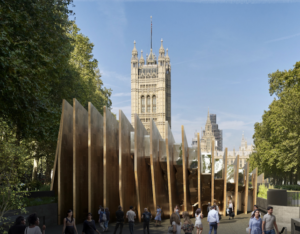
By 2018, the site and a design – 23 bronze fins on a large grass mound coupled with an underground “learning centre” – had been chosen and a planning application submitted to Westminster City Council. Not everyone was happy: concerned that the (then Conservative-run) council might side with objectors, including some local residents who thought the memorial would “profoundly and completely” change the character of the “well-loved” Grade II listed park, the government “called in” the application and gave planning consent itself.

But opponents of the scheme had uncovered an “enduring obligation” under the little-known London County Council (Improvements) Act 1900 to maintain the site as a public garden. The High Court found that this was an “insuperable impediment” and quashed the permission.

Rather than go back to the drawing board, the government decided to legislate – effectively, to pass a new law saying the 1900 Act did not apply to the Holocaust memorial plan. That hasn’t not been straightforward. The Bill almost fell when the 2024 general election was called, and its “hybrid” status – due ot its affecting the private interests of particular individuals and organisations – entailed extra stages of representation and House of Lords committee hearings. And, as that Lords committee reported last year, “the controversy on these issues has not gone away”.

There remain concerns about the memorial’s impact on what is a rare piece of central London open space, including its existing monuments – Rodin’s the Burghers of Calais and memorials to anti-slavery campaigner Richard Buxton and suffragette leader Emmeline Pankhurst. The design is unpopular with some, and the proposed learning centre has been described as both “far too big for the little park” and “far too small” for its purpose. Concerns about security have been raised, and about costs, which are now up to almost £140 million from £90 million in 2019.

There are wider concerns, too, that the project could become a more generalised exhibit about genocides, losing its Holocaust focus, or that it might have too much focus on the past while downplaying uncomfortable aspects of Britain’s history in respect of the Holocaust and contemporary antisemitism. It would “protect the dead but not the living”, one observer memorably told Politico recently.

The memorial nevertheless still retains significant support from major institutions and individuals, including the Board of Deputies of British Jews, the Holocaust Memorial Day Trust, the Holocaust Educational trust and both Houses of Parliament, particularly as memories fade and given the current increase in antisemitism. It will ensure, said former Conservative minister Lord Eric Pickles, co-chair of the foundation overseeing the project with the government, that the Holocaust “narrative” would continue to be “built on truth and honesty and verifiable fact”.

The final issue before MPs is a Lords amendment designed to ensure the memorial will specifically commemorate the mass slaughter of Jews by the Nazis. That bridge crossed, which seems overwhelmingly probable, the Bill will shortly be off for Final Assent.

That won’t be the end of the story, though. The Bill, when passed, will simply remove a legal blockage. The relevant minister will then need to decide on planning permission again, and that will mean, as a new House of Commons library briefing sets out, a fresh look at “the appropriateness of the location, design and other matters”. This could well entail a further public inquiry in front of a planning inspector and argument continuing Will the government meet its target of opening the memorial in 2027? It looks unlikely.

Follow Charles Wright on Bluesky. Image from Adjaye Associates.

OnLondon.co.uk is funded by sales of publisher and editor Dave Hill’s twice-weekly newsletter On London Extra. To start receiving it, become a paying subscriber to Dave’s personal Substack or follow any Support link on this site. Thanks.
Categories: News

Oxford Street transformation – the state of play as 2026 gets underway

Nearly 18 months have passed since Sir Sadiq Khan announced a new plan for making major alterations to Oxford Street. On 17 September 2024, he revealed that the then brand new Labour government was backing his desire to bring “the nation’s high street” under his command.

This would not only entail putting Transport for London in charge of the highway itself, but also setting up a Mayoral Development Corporation (MDC) to annexe some of the area around it too. Control of that area would therefore be removed from Westminster City Council which, in May 2022, had become Labour-run for the first time in its history.

City Hall said that at the heart of the Mayor’s vision was the delivery of “proposals to pedestrianise the road”, an ambition that had been declared by a number of London politicians this century. Liberal Democrat Simon Hughes included the idea in his mayoral manifesto of 2004. Ken Livingstone, who won the election as Labour’s candidate that year, was less enthused: “To pedestrianise Oxford Street would be a disaster,” he said in September 2006.

Khan, though, has always been keen on the idea. In his 2016 manifesto, he promised to “work with Westminster Council, local businesses, Transport for London and taxis to pedestrianise Oxford Street”. He proposed “full pedestrianisation” and “a tree-lined avenue from Tottenham Court Road to Marble Arch”.

An early hope was that this would be delivered in tandem with the completion of Crossrail – what we now call the Elizabeth line – towards the end of 2018. But Crossrail was delayed and Conservative Westminster, which had worked productively with the Labour Mayor to that point, withdrew its support for the Oxford Street scheme shortly before the May 2018 borough elections – a sign of how residents’ groups with big reservations about pedestrianisation have long influenced Oxford Street policy.

The MDC approach nullifies the power of Westminster Council, whichever party holds its reins, to pull the plug. It has not thrilled Westminster’s current administration, which has long opposed pedestrianisation and had its own, painstakingly assembled, plans for improving Oxford Street effectively junked by the Mayor’s September 2024 intervention.

The direction of travel, though, was set. The MDC has been formed under the name of the Oxford Street Development Corporation (OSDC), a red line drawn round the land in its domain, and a board and chief executive appointed. What has been happening lately? And what will happen next?

BOARD POSITIONS

The first meeting of the OSDC board took place last week at City Hall. It wasn’t attended by board members alone. Mayor Khan himself was there. So was Richard Watts, his deputy chief of staff, who has been closely involved with the project. So was Phil Graham, the Greater London Authority’s “good growth” chief. And so was mayoral head of delivery, Jamilla Hinds-Brough.

There was a fitting sense of a baton being passed to board chair Scott Parsons and his colleagues. There was also a sense of messages being sent, both across the table and to audiences elsewhere.

After sharing fond memories of visiting Oxford Street and noting factors he said had led to its decline – the pandemic, the internet and the attractions of modern malls – the Mayor praised board member a fellow Labour politician Adam Hug for “doing a great job” as leader of Westminster. That was politic of him, as was, in its different way, Hug’s candid self-introductory observation that it was “a well-known public fact that we have a different vision for the delivery of transformation on Oxford Street” and that, “obviously, we would rather this body didn’t exist and we weren’t here”.

If that seems a bit stark, bear in mind that Westminster Labour will need to marshal all its resources to prevent a Conservative comeback come May, and the West End ward is a key marginal. Labour won all three seats there in 2022, but two of them have since turned blue – one through a defection and the other because of a by-election that saw the return of experienced Tory councillor Tim Barnes.

Hug has positioned himself as the champion of residents’ interest on the board. He will sit alongside Manisha Patel, the council’s Oxford Street director and, I’m told pending the completion of eligibility formalities, its chief executive Stuart Love. Westminster is pleased to have negotiated its three-seat allocation. Richard Olszewski, the Labour leader of Camden, is on the board too. His borough, it should not be forgotten, contains a significant portion of the West End, and the OSDC’s boundary encompasses a chunk of it and will have impacts beyond it.  Concurring, Graham said the Oxford Street scheme, as well taking in Marble Arch (and the northern tip of Park Lane) “supports a wider vision for the West End”.

The board’s other members are:

  • Howard Dawber, Khan’s Deputy Mayor for Business and Growth.
  • Margaret Casely-Hayward, an illustrious lawyer and businesswoman from an illustrious family. Check her Wikipedia page.
  • Artist and stage designer Es Devlin (it’s short for Esmeralda).
  • Ex-Arsenal managing director and widely-experienced businessman Keith Edelman.
  • Emir Feisal, a chartered accountant and specialist in transformational change (which should be handy).
  • Beamed in for the meeting from India, Soho restaurateur Asma Khan.
  • Caroline Rush, until recently chief executive of the British Fashion Council.
  • Kate Willard, chair of Thames Estuary Growth Board and also, as she informed the meeting, a resident of Berwick Street.
  • Also on the board but in a non-voting capacity is Dee Corsi, dynamic chief executive of the New West End Company business improvement district, which represents many of the area’s big retailers.

As well as making up with Hug, Mayor Khan spelled out just how massively important Oxford Street still is, for all the problems it has had of late. “Every year, the businesses on Oxford Street help generate more than £25 billion towards the national economy,” he said. “And if you look at the Business Rates that all the businesses in Westminster contribute to the national economy, it’s more than all the businesses in Birmingham, Bristol, Newcastle, Nottingham, Leeds, Liverpool, Manchester and Sheffield put together”.

Not just a project for London, then, but for the whole of the UK. “By transforming Oxford Street, we can contribute even more to the national coffers,” said the Mayor. And Watts, after paying his own tribute to Hug and complimenting Olszewski too, stressed that the MDC initiative needed to be seen “in a global context”.

SOME CHALLENGES

Also at the meeting was Nabeel Khan, just announced as the MDC’s incoming chief executive, who told the meeting:

“I come into this role having spent a career delivering large-scale, place-based regeneration in politically complex parts of London. My key takeaway from working on all those schemes is it’s not just about the public realm, it’s not just about the regeneration, it’s not even just about the economic transformation of areas, important as all of those factors are. It’s about stewardship, ultimately – how a place feels, how a place functions, how a place is curated, how it is activated, how it’s managed day-to-day all year round.”

He’s moving on from being corporate director, growth and environment at Lambeth Council, where, in that and other roles, he has worked for the past six years. Previously, he’d done seven-and-a-half at the GLA, so he knows his way around. What challenges lie ahead?

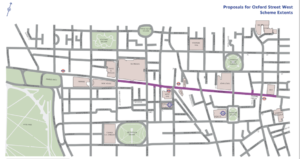
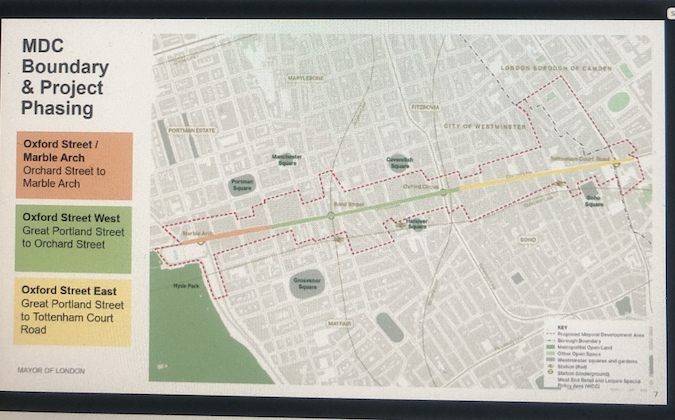
Among the trickier tasks will be getting the transport changes right. A TfL consultation on those will close on Friday, so if you want to contribute, don’t hang about. At this stage, the OSDC, which is expected to have 40 or 50 people in its staff, is looking principally at the section of Oxford Street between Orchard Street, which runs down the west side of Selfridges, and Great Portland Street to the immediate east of Oxford Circus. It calls this Oxford Street West.

Screenshot 2026 01 14 at 19.43.56

Bus services 7, 94, 98, 139 and 390 will be re-routed and bus stop positions changed. In its consultation, TfL says it thinks it pedestrianisation proposals “support the taxi and private hire industries” by providing new or enlarged ranks at some locations and simply by making Oxford Street more of a draw. The board meeting heard that the street’s footfall is currently at just 57 per cent of its level in 2006 (falls on Monopoly board neighbours Bond Street and Regent Street have been far smaller).

The consultation also confirms that the pedestrianised area would not be “compatible with people cycling or using scooters”. Olszewski said thought should be given to “how we can ensure that cyclists understand that pedestrianisation means ‘no bicycles’.” He added, agreeing with Kate Willard, that the space had to be fully inclusive, inviting and available to all.

Hug said some Westminster residents in the immediate vicinity of Oxford Street would have “deep concerns around displacement and the types of activation that will happen”, meaning principally, I think, buses and cabs trundling down their roads and rowdiness spilling into them. Further afield, “we are aware of concerns in Bayswater and Lancaster Gate” among older residents “who have relied on the bus routes, both to access Oxford Street and to go through on other journeys across London”. Hug also emphasised that the Oxford Street vision had to work for disabled people, those pushing baby buggies and so on.

Another area of concern could be the handling of north-south roads traversing this section of Oxford Street, such as Duke Street and the linked Davies Street and Stratford Place, which will – perhaps to the surprise of some – continue to carry traffic across Oxford Street post-pedestrianisation. A list of proposed tweaks to Westminster-controlled streets and junctions is set out in the consultation.

Then there is the day-to-day management of the pedestrianised section to consider. At the board meeting, Dee Corsi took up this theme, noting that Oxford Street is perceived by some to be too busy and not particularly safe. She said that if it is to offer world-class public realm that hosts large crowds and events, such concerns would have to be addressed to world-class standard too.

WHAT NEXT?

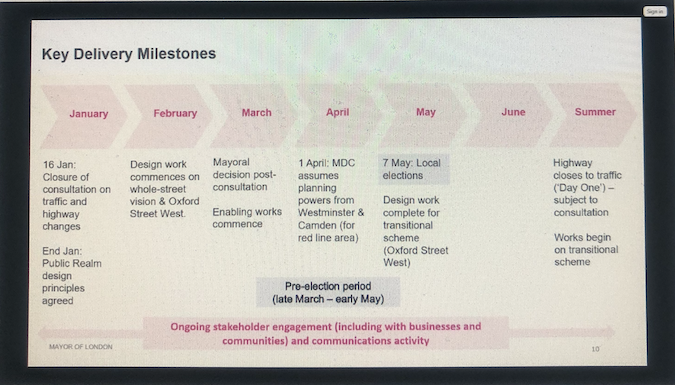
There is a timetable for the next few months. The public realm design principles are to be agreed by the end of this one, with design work on both the Oxford Street West section and the “whole-street vision” to start in February. “Enabling works” are scheduled to commence in March.

On 1 April, the MDC will become the planning authority within its boundary area, taking then from Westminster (nearly all) and Camden (a little bit). The design work for the Oxford Street West “transitional scheme” is reckoned to start in May. Subject to consultation, the highway will close to traffic over the summer and work on the transitional scheme will begin. They don’t intend to hang about.

Schedule

Adam Hug underlined how much community engagement had gone in to Westminster’s scuppered plans and mentioned in passing that the council’s request for the board to include a local resident had not been granted (though he acknowledged that Kate Willard resides in Soho). He asked that the formal structures for resident engagement to be set up speedily. Parsons firmly agreed that “we’ve got to get out there and talk” and that the issue was “top of Nabeel’s list too”. Watts, surely mindful of that local amenity groups have already mobilised – they are, according to one local interested party, “firing off letters” – said it would be vital to hear not only from “the usual loudest voices”.

The board is to provide the members of a three-person planning committee, for which Emir Feisal volunteered. And there’s the question of money. The Mayor struck an upbeat note. “There is so much goodwill towards Oxford Street,” he said. “We’ve had interest from philanthropic contributors, potentially. We’ve had interest from people who want to advertise on Oxford Street, we’ve had interest from the private sector.” He thanked Corsi for her work on that front and added, “we’re going to be contributing towards this transformation as well”.

A positive start. A long way to go. But the Oxford Street transformation journey has begun.

Follow Dave Hill on Bluesky, Facebook, Instagram and LinkedIn. Top image from TfL consultation page. Other images from OSDC board presentation. Watch the meeting here.

OnLondon.co.uk is funded by sales of publisher and editor Dave Hill’s twice-weekly newsletter On London Extra. To start receiving it, become a paying subscriber to Dave’s personal Substack or follow any Support link on this site. Thanks.

Categories: News

Howard Dawber: London’s powerhouse life sciences sector can grow even bigger and better

This week, the world’s business and health leaders are gathered in San Francisco at the JP Morgan Annual Healthcare Conference. It’s a chance for me, as Sir Sadiq Khan’s Deputy Mayor for Business and Growth, to meet industry, emerging fast-growth companies, innovative technology founders and members of the investment community. And as the chair of MedCity, the body shaping and promoting London’s dynamic life sciences sector, I’ve been flying the flag for the capital as a global hub for life sciences and advancing its ambition to become the new world leader in health innovation.

I’m struck by how familiar San Francisco feels to anyone who knows London well. The skylines may be different but the DNA is pretty similar. Both are global trading cities built on openness to international talent, to capital and to ideas. They thrive because brilliant people from everywhere come together to solve the hardest problems – often at the intersection of technology, academia, entrepreneurship and public good. That combination is exactly what defines world-leading life sciences clusters.

Our two cities have long shared the values of innovation and discovery – from finding penicillin, to uncovering the cause of cholera, our cities have been a beacon for research, learning and progress in many sectors. San Francisco Bay Area and London are two of only three trillion dollar tech economies on planet Earth. We are magnets for business, investment and creativity.

What puts London in a unique position – and, right now, even more compelling for investment – is convergence. Life sciences, AI, data, finance, law, insurance and regulation sit closer together in London than anywhere else on earth. That proximity matters. It shortens the distance between discovery and deployment, between innovation and impact. All of this is underpinned by our world-class universities, unrivalled talent and, of course, our brilliant NHS with its unique and diverse data. It’s why investors like JP Morgan have committed to building their new European HQ in London, alongside Google, Salesforce and other leading AI companies.

London has cemented its position as Europe’s powerhouse for life sciences, with the sector attracting over £1.6 billion in venture capital investment in 2025 – nearly double the amount raised in 2024 and more than Paris, Stockholm and Berlin combined.

In November, Sir Sadiq hosted a hugely successful London Life Sciences Week, demonstrating our global leadership in the sector. Our city is home to over 2,700 scaling-up life sciences companies, three of the world’s top 15 universities for health and clinical science, and 19 of the top 20 global pharmaceutical companies. This is a fast-growing ecosystem of innovation that drives commercial growth, with a lot more investment set to come.

With seven growing life sciences districts and clusters in London, we are unlocking new spaces for science, innovation and technology, such as the development planned around the forthcoming HS2 station in Euston. By 2032, London will have an additional 6.2 million square feet of life science lab and office space, accommodating 80,000 direct jobs, which is more than the entire life sciences workforce of Sweden.

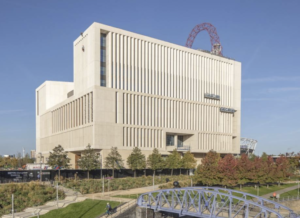
In case you are in any doubt, go to Canary Wharf, where the construction of Europe’s largest and newest lab building is well underway. And of course that growth adds to the world-leading science and space already anchored in the “golden triangle” of London, Oxford and Cambridge and supported by the wealth of activity across the UK. It’s useful to remember that the UK is actually smaller than California, so all our nations, cities and regions should be working as one supercluster.

In the coming decades we are set to face some enormous challenges, from an ageing population to the rising tide of antimicrobial resistance. We all experienced the global pandemic of Covid-19. At the same time, breakthroughs in treatment, diagnostics and therapies are being made literally on a daily basis. Like San Francisco, London believes that innovation should be not just about economic growth but also making better lives for our citizens and tackling society’s biggest challenges.

That’s why I’m banging the drum for more investment in London alongside some of our most exciting start-up and scale-up companies, so that we remain at the forefront of developing the next generation of healthcare ideas that will directly and rapidly improve the lives of Londoners and people across the world.

Howard Dawber is London’s Deputy Mayor for Business and Growth. Follow him on Bluesky. Photo: UCL East Marshgate at the Olympic Park, one of London’s seven life sciences centres.

OnLondon.co.uk is funded by sales of publisher and editor Dave Hill’s twice-weekly newsletter On London Extra. To start receiving it, become a paying subscriber to Dave’s personal Substack or follow any Support link on this site. Thanks.

Categories: Comment

Those new London crime stats: what they tell us, what they don’t, and what they reveal about Nigel Farage

City Hall has released with a fanfare Metropolitan Police Service statistics that tell a good news story for London and its Mayor. Following years of often lurid claims by some of his political opponents that Sir Sadiq Khan has presided over a collapse of law and order in the capital, he is now able to point out that in 2025 there were fewer homicides in London, 97 in total, than in any year since 2014, while at the same time the city’s population has grown.

Writing in the Guardian, he has hailed London reaching “the lowest per capita homicide rate in its recorded history”. Referring by name to Donald Trump and Nigel Farage, two of the more persistent pushers of the “lawless London” narrative, he argues that such people could not be more wrong because “the evidence is clear, in London we’re winning the battle against violent crime”.

The Met figures aren’t only about homicides. They also say violent offences resulting in injury in 2025 were 5.1 per cent lower than in 2024, and that “hospital admissions of young people for knife assault fell by 43%” in the period from 2019, the year the Mayor set up his Violence Reduction Unit.

Its role is to help facilitate projects at local level designed to prevent young people becoming involved with violence and criminal gangs. Speaking to the BBC, the VRU’s director, Lib Peck, noted the striking fall in the number of young homicide victims over time. In 2025, were 18 of them below the age of 25 compared to 69 in 2017.

The Met also claims increased success with “cracking organised crime gangs” including closing so-called county lines drug supply operations, mostly to areas outside London, and with confiscating firearms and knives. This, it says, explains why “NHS data shows the number of people hospitalised after being stabbed or attacked with a sharp weapon has fallen by 29% in London in the past five years, from 1,350 to 955”.

Met Commissioner Sir Mark Rowley praised the VRU and his officers, saying that taking “precise action” relentlessly against the most dangerous gangs and offenders, helped by new technology such as Live Facial Recognition, had helped him honour his pledge to reduce crime.


WHY THE NOISE ABOUT THESE NUMBERS? WHY NOW?

The 2025 figures have been released against the backdrop of an unceasing torrent of media and politician claims that London is a perilous place to live or work in or to visit, and that Mayor Khan is to blame.

Such attacks come from the far-Right in all its forms, ranging from the authoritarian populist wing of the Conservative party, personified by such as Robert Jenrick and former mayoral candidate Susan Hall, to the most extreme social media propagandists, some them overtly ethnonationalist and racist. Khan, remember, is the Muslim son of immigrants from Pakistan.

Such negative accounts of London feed a wider crime-and-decline story which, in its most sinister manifestations, argues that the city has “fallen” due to a takeover by criminal immigrants and calls for the forceful restoration of a “lost” golden age.

A City Hall and Met fightback against depictions of London as “lawless” has been underway for a while, and this is the biggest public pushback yet. They will surely be pleased that almost every Big Media platform has picked up the story.

There have been efforts behind the scenes as well, reflecting concerns that the global ubiquity of the attacks on London is damaging its reputation internationally. I am reliably informed that journalists working for overseas media have been receiving briefings from the Met.

Meanwhile, London and Partners, the organisation that works with City Hall and others to “promote London across the world“, has recently warned its members about “a damaging perception among some of our international audiences that crime in London is rising” and the need to combat it.

As well as highlighting Met stats that tell a different story, it warned of “a deliberate campaign of disinformation on social media to promote false, negative narratives about London”. Rowley and the Met have also been making much of London’s homicide rate being lower than those of many other global cities, not least several in the US.


REFORM UK CLAIMS ABOUT “KNIFE CRIME”

A negative narrative about London crime has long been a centrepiece of campaigning by Reform UK, which hopes to make significant gains in the London borough election on 7 May.

Last summer, the party’s leader, Nigel Farage, claimed that “London is in a state of collapse” and that “crime is out of control” in the city. Unveiled last week by her leader as Reform’s mayoral candidate for May 2028 (and as it’s London “head”), Westminster councillor Laila Cunningham, who was elected as a Conservative in 2022, spoke of “masked gangs roaming our streets”.

At a Reform rally in London on Saturday, party chairman David Bull said “knife crime is up 67 per cent since Sadiq Khan became Mayor in 2016”. By the time Cunningham came to the podium an hour later things had apparently got worse – “knife crime” was up by 68 per cent, according to her.

The Met figures released today do not refer to “knife crime” as a category, though a “knife-enabled crime” section of the Met’s crime dashboard provides monthly statistics for offences meeting its definition of “knife crime” that go back to the financial year 2015/16 (the tables for November 2025, at the top of the list, contain them all)

“Knife crime” is not a specific criminal offence and can be used in different ways by different people and organisations. The Met uses it to cover recorded offences where knives are used to injure or to threaten victims, including when no knife is actually seen by the victim. Such offences include robbery, which last year accounted for nearly 60 per cent of them, and domestic abuse.

The Met’s crime dashboard shows that in May 2016, the year Khan secured the first of his three mayoral election victories, it recorded 906 offences that it categorised as forms of “knife crime” and in Nov 2025, the most recent month shown, it recorded 1,124 such offences in total. That’s 218 more than in May 2016, representing a 24 per cent difference, not 67 or 68 per cent.

Broken down, the May 2016 data shows that of the 906 “knife crime” total, 376 of the recorded offences resulted in the victim being injured. The November 2025 data show 254 “knife crime” injuries – about two-thirds of the number recorded during the month Khan was first elected.

The higher total “knife crime” figure is due to the greater number of offences when a knife was used to threaten the victim and seen by him or her but not used to injure (439 in May 2016, 603 in November 2025) and the higher number of cases when no knife was seen (94 in May 2016, 260 in November 2025).

In between those two monthly periods, the figures have both risen and fallen, with the largest total figure being 1,383 (January 2022) and the smallest, 669 (January 2021). The injury figures by month have ranged from 406 (in August 2023) to 212 (January 2021).

They do not appear to bear out suggestions that “knife crime” has been on a consistent upward path since Khan’s arrival in City Hall – certainly not on the scale claimed by Reform – over a period when the population of Greater London has increased by about 800,000 to around nine million.


DO THE NEW STATS TELL THE WHOLE STORY?

Of course they don’t. Other Met figures show that London has not escaped the national increase in shoplifting and confirm that theft from the person, notably the theft of phones, has gone up a lot in the past five years (On London looked into these upward trends last February). There has been an increase in reported sexual offences against women.

At the same time, there are the usual important caveats about police crime statistics to keep in mind. The Met only records the crimes it witnesses or that Londoners tell it about. There are undoubtedly lots of crimes that go unreported.

Nigel Farage argues – as Boris Johnson did when first seeking election as Mayor in 2008 – that this quantity is huge and reflects Londoners’ belief that there’s no point in telling the Met that they’ve been victims of crime because nothing will be done about it.

Interestingly, Farage has repeatedly rubbished the other primary source of crime data, the Crime Survey of England and Wales. Statisticians tend to regard this as the best available measure of long-term trends in such as violence, theft and fraud precisely because it picks up offences that haven’t been reported to the police. Yet at last week’s Reform press conference Farage dismissed the survey as:

“The old-fashioned way of doing it, where you put a letter through a letterbox and people fill it in and sent it back by post. People my age and older do that sort of thing, the vast majority of the population just chuck it in the bin.”

Farage said this meant the Crime Survey of England and Wales [is] “completely out of date” and doesn’t work. In fact, the survey is compiled for the government from face to face interviews with members of households selected to represent the population as a whole. Summarising its findings, the Office for National Statistics says they show that, with some notable exceptions such as sexual assault, “crime against individuals and households has generally decreased over the last 10 years”. Perhaps that explains why Farage wants to discredit it. At the press conference, he went on to say:

“If you actually look at police crime statistics you will see not only a massive expansion in crime of all kinds. What you’ll also not get is the mass under-reporting of crime.”

Where London is concerned, the Met stats just released plainly contradict Farage’s assertion about “a massive expansion in crime of all kinds”. At the same time, he flatly dismissed the different set of crime stats whose specific value is picking up crime that isn’t reported to the police. As this article goes live, Farage has yet to respond to the new Met figures.

The other thing to keep in mind about fluctuations in crime rates is that they may also be related to factors the police can influence and others that they, at least initially, cannot.

For example, if the police encourage more people to come forward when they have been victims of certain types of offence there might, indeed, be an increase in reports of such offending. It doesn’t necessarily follow that more such offending is actually taking place.

Also, increases in some types of offending can occur because criminals discover new areas of opportunity or because competition in some criminal markets intensifies, resulting in greater violence (the drug market is a good example).

On top of all that is the complicated question of how much difference policing makes to crime levels when various other things also influence them, such as the preventative work of London’s Violence Reduction Unit, which Sir Mark Rowley has made a point of praising.

As for blaming the Mayor, it is important to recognise, as much media reporting does not, that Sir Sadiq Khan, like his two predecessors as Mayor, does not actually run the Met on a day to day basis. Neither does the home secretary. The Met Commissioner is accountable to both of those politicians, but the Met is run by Met.


WHAT DO LONDONERS THINK?

YouGov has revealed a very striking difference between how Londoners and non-Londoners view London’s safety. A new poll by the company has found that nearly two-thirds of Londoners – 63 per cent – consider their city to be either “fairly safe” (48 per cent) or “very safe” (15 per cent) compared to only 34 per cent who think it “very unsafe” (13 per cent) or “fairly unsafe” (21 per cent).

Unnamed 1

People in the rest of the south of England, the Midlands, the North, Scotland and Wales felt pretty much the opposite. Unsurprisingly, at a national level, Reform voters held the most negative views: an extraordinary 58 per cent regard the capital as “very unsafe” and a further 27 per cent think it “fairly unsafe”. Conservatives were the second most likely to think London unsafe.

Given that different recent survey outcomes have put support for Reform in London at only 19 per cent, it might be said that Farage and Cunningham’s depiction of London as being “in a state of collapse” and its streets crawling with “masked gangs” shows them to be out of touch with majority London opinion.

On the other hand, it could be argued that even if portraying the capital as “lawless” ultimately hinders Reform in the capital more than it helps it, monstering “Sadiq Khan’s London” as a symbol of all that Nigel Farage most dislikes has, so far, paid dividends elsewhere in the UK.

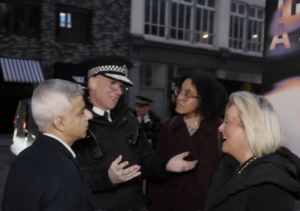
Follow Dave Hill on Bluesky. Image of Mayor Khan and Commissioner Rowley (and others) from Mayor of London X/Twitter feed

OnLondon.co.uk is funded by sales of publisher and editor Dave Hill’s twice-weekly newsletter On London Extra. To start receiving it, become a paying subscriber to Dave’s personal Substack or follow any Support link on this site. Thanks.
Categories: Analysis

John Vane: William Boyd’s Armadillo café

I’m reading Armadillo by William Boyd, one of the many acclaimed novelists I’ve spent decades not quite getting round to. When I started the book I had no idea it was set in London, and this, of course, has helped me warm to it. At the start of Chapter 5 there is a vivid description of the lead character, Lorimer Black, having breakfast at the made-up Café Matisse near his flat in Pimlico.

“He had been coming here for four years, regularly, and had yet to receive even a nod of welcome from the staff. Mind you, he had outlasted them all: the turnover of staff at the Matisse was extraordinary. He saw that the rangy South African girl was still here and the lugubrious Romanian too. He wondered vaguely if the tiny Portuguese one had left, the one who flirted with the bikers, wealthy, middle-aged men, paunchy in their leathers, who descended in a group at pre-arranged times of the week to drink coffee and stare lovingly at their immaculate Harleys, all spangling chrome, parked up on the pavement in full view.”

I admire how the café’s atmosphere has been captured, the insight it gives into Black’s bachelor life – the monitoring and assessing of the waitresses – and, at this point in the chapter, the scene’s familiarity. It doesn’t feel dated even though, given that the book was published in 1998, it might be expected to be showing its age. And then it does:

“Everyone smoked in the Matisse, apart from him; it almost seemed to be a condition of entry. The counter staff and the waitresses smoked during their breaks and every customer, young and old, male or female, fervently followed suit…”

The ban on smoking in enclosed public spaces began in England in 2007, and clearly would have had quite an impact on the vibe of the Matisse. Through the fug, Boyd sketches Black’s fellow customers.

“He looked around him now at the types scattered round the around the big gloomy rectangular room. A middle-aged couple – style: Eastern European intellectual – the man looking uncannily like Bertolt Brecht, both bespectacled, both in drab zip-up waterproof jackets. A table of four consumptive hippies, three men with lank hair and poor beards and a girl (rolling her own), bead-swagged with a flower tattooed on her throat. In one of the booths down the side was the obligatory lost-waif couple, two chalk-faced girls, black-clad, tlaking worriedly in furious whispers – too young, in trouble, pimp-fodder.”

A man puffing on a little pipe is likened to a member of the international Brigade. Two tall women, described as “breastless” and “hipless” with “swan necks and tiny heads”, are assumed by our observer-protagonist to be models – “there must be an agency nearby”. Boyd continues:

“All human life ventured into the smoky interior of the Matisse at some stage; if you sat long enough you would see everyone, every prototype the human species had to offer, every product of the gene pool, rich or poor, blessed or afflicted – which was the key to the place’s strange and enduring allure.”

Sounds a lot like London.

John Vane’s London novel Frightgeist is available here and only here. Read more about Armadillo here. Could the Matisse Café be inspired by the famous Regency?

Categories: Culture, John Vane's London Stories

Reform UK’s London vision – the story so far

Having covered every London Mayor election campaign since 2008, I found much of the vowing and pledging at Wednesday’s unveiling of Reform UK’s entry for the next race for City Hall rather familiar. On transport policy, policing and crime, and in their confident assertions that they are more in touch with the desires of Londoners than is Sir Sadiq Khan, both candidate Laila Cunningham and party leader Nigel Farage sounded a lot like the last two Conservatives to have a go at beating him.

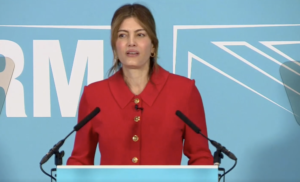
That they failed was attributed by Farage to those Tories being imperfect candidates who received far too little backing from their parties nationally. Reform, he assured the gathered national media, would do better than that. Cunningham (pictured), he said, was now “the head of Reform UK in London” and he explained that her early selection for a ballot that won’t take place until May 2028 demonstrated Reform’s intention to make this May’s borough elections “a referendum” on the direction the capital is taking.

Cunningham herself spoke directly to Reform’s self-image as the true Voice of the People, dismissing the Tories as irrelevant and describing the 7 May votes as “the first step to reclaiming our city” from Mayor Khan and a chance for Londoners to “vote out every councillor who’s propped him up” and end the Labour-Tory “status quo”.

Then she was into the crime-and-decline narrative we’ve been hearing non-stop from all parts of the populist Right in recent years – including, of course, Farage’s friend and ally Donald Trump – and reminiscing about the London of her 1980s and 1990s youth, depicting it as a lost golden age. Statistics were offered to bolster this account – we’ll get back to those another time – along with individual stories of having to tackle street criminals herself. “This is the London Sadiq Khan has created,” she said.

Cunningham raged on this theme at length, claiming incorrectly that the Mayor appoints the Met Commissioner (it’s the home secretary who does that, while “having regard” to the Mayor’s view) and promising that under a Mayor Cunningham there would be “zero, I mean zero, tolerance of crime” thanks to “visible policing” under “a new sheriff in town” who would be “launching an all-out war on crime”. And woe betide anyone in the Met who didn’t get with the project. For them, there would be a “serious reckoning”.

Transport for London, too, would face her wrath – that is to say, the transport unions would. “If that means automating the trains, that is exactly what I’ll do,” she said. She would also liberate motorists, saying she would scrap the entire Ultra-Low Emission Zone (ULEZ), which she called “a tax on driving to work”. As the “war on crime” began, the “war on motorists” would end. She also said she would liberate them from traffic, but not how.

Having further embellished her picture of London as a city consumed by fear, she asked her audience to imagine it being “restored to its former glory” and having “our flag flown proudly” everywhere “as a symbol of our British pride”. Nostalgia for a better London deemed “lost” is a defining characteristic of populist Right narratives.

Cunningham then revealed that she would be compiling “the most serious, detailed plan for London that any party has produced” by going “borough to borough, estate to estate, high street to high street, listening to Londoners” and “young people like my children who feel they’ve been pushed out of their own city”. This would be about “the survival of our city,” she said, and the next mayoral election “a binary choice – Khan v Cunningham”.

SPOT THE DIFFERENCE

Most of this was hard to distinguish from what the Conservatives have been saying year in, year out, except for being slightly more extreme.

In saying she would she would scrap the ULEZ in its entirety because it is “too expensive to drive to go shopping, and that’s why people aren’t going out” she went further than the last Conservative mayoral candidate, Susan Hall, who made abolishing the second expansion of the ULEZ a flagship element of her campaign in 2024, but never advocated doing away with the scheme in its original form – which, though implemented by Khan, was devised under Boris Johnson and covered the central London Congestion Charge zone only. And she dropped her initial opposition to its first expansion, which took the ULEZ boundary out to the North and South Circular roads.

Since her defeat by Khan, Hall has cultivated an even more conspicuous populist Right profile, continuing to use social media to applaud venomous cultural nationalists such as Rupert Lowe MP, whom Reform have disowned, and competing with one of the London Assembly’s two Reform members over who can sport the most ostentatious Union Jack wardrobe accessory. When running for Mayor, though, she did not advocate Union Jacks being flown all over town.

Fully automating London Underground trains on the grounds that this would destroy the power of the tube unions is another ambition Conservatives have been expressing for a long time. And on crime and policing Hall and Cunningham are very hard to distinguish, at least at first glance.

Both of them insist that the capital is being engulfed by a “crime wave” that Khan could get the Met to end but can’t be bothered. Recent falls in Met-recorded crime levels of homicide and in other categories of offending have not impressed them. However, while calling for more police officers on the streets, Hall did not explicitly advocate so-called zero tolerance policing methods.

Farage is as big on this as Cunningham. Interviewed by the Daily Mail over Christmas, he invoked the approach of the New York Police Department when Republican Rudolph Giuliani was Mayor of that city between 1994 and 2001. And at Wednesday’s press conference he expanded on this.

Recalling his years working in New York, he said, “you wouldn’t dare leave a bar or restaurant until you saw the car ready on the side of the road”. And yet, he continued, “after two terms of Rudi Giuliani, New York had become one of the safest cities in America, all done by one man – one man’s drive and determination”.

SPOT THE PROBLEMS

There are three obvious objections to the policy positions Cunningham and Farage set out: one is that the new messenger is delivering old news that not enough Londoners have wanted to buy in the recent past; another is that some of them would be very hard to implement; a third is that there is evidence suggesting some of them might not work.

Hall’s furious opposition to the second ULEZ enlargement always looked disproportionate in a city where nearly half of all households don’t even have a car and where, even two years ago, only a minority of those that did were going to be hit by the daily air quality charge. Nevertheless, she appeared to believe pundits who predicted a massive suburban uprising against it.

In the event, there was a small swing towards Khan in nearly all of the London Assembly areas newly affected, and the number of non-compliant vehicles is reducing all the time. Have Cunningham and Farage noticed how serious Hall’s misjudgement was?

The Tories have been demanding more automated “driverless” trains for years. Consideration of them at TfL has been going on for just as long, as has the large financial cost of bringing them in. In 2020, accountants KPMG put the price of such a change at £7 billion and said it represented poor value for money. A year or so ago, a figure of around £20 billion was put on making the change to just three of the older lines (Bakerloo, Central and Piccadilly). The government’s latest lump of capital funding for TfL totalled £2.2 billion over four years. Where would Cunningham get the money she’d need?

It isn’t just about rolling stock, it’s about new platforms, signalling and more. It’s also about staff. Farage on Wednesday made the classic false comparison with the Docklands Light Railway, which is fully-automated. But it also has Passenger Service Agents on board to manage the doors, operate the train manually if required and help in emergencies – pretty much what tube “drivers” do.

Unlike those of newer metros in other cities, the old, deep level tube tunnels are very narrow, making exiting a stricken train outside a station difficult. Trains on most tube lines are already “driven” by computer software, and much tube-related industrial action is by station staff, not “drivers” anyway. The DLR is also affected by strikes.

Boris Johnson, who would later never cease demanding “driverless trains”, told a Tory AM way back in 2010 that although Underground trains with no one in a cab at the front looked to be a future possibility, that was “a long day’s march from saying there is going to be nobody on the train”. It still is.

There have been numerous studies of what the NYPD did under Giuliani and numerous challenges to the claim that a “zero tolerance” approach to minor street offending and disorder based on “broken windows theory” led to a “crime miracle” in New York.

The term “zero tolerance” has been rejected by Bill Bratton, who was NYPD Commissioner for Giuliani’s first two years, as an accurate description of his philosophy, and a College of Policing review of the evidence found that aggressive order maintenance under the “zero tolerance” banner does not, of itself, reduce crime. Farage either doesn’t know about these things or doesn’t care. Perhaps he should get out of his car more.

WHAT ARE THEIR CHANCES?

A new opinion poll, released today, shows Labour well ahead in the not-yet-started 2028 race for City Hall. The party is backed by 32 per cent of London voters, with the Conservatives second on 20 per cent and Reform on 19. The Greens are fourth on 13 per cent and the Liberal Democrats fifth on 11.

The poll was of party preferences, with no individual candidates named. Cunningham and Farage took it as read that Khan will seek a fourth term in 2028. However, although he stated an “intention” to back in September, this should probably not be taken as a guarantee.

Another factor in the speculation equation is the coming return of the second preference vote, so unscrupulously abolished by the Tory government for 2024. This makes the new poll look even better for Labour, as the centre-and-Left voter bloc (Labour, Green, Lib Dems) commands a 56 per cent share, and the Right bloc (Tories and Reform) just 39.

Who will lead the field on the Right, the Tories or Reform? Will supporters of each give their second preferences to the candidate of the other, or will it be more messy than that? Cunningham’s making Susan Hall look like Roy Jenkins could leave the Tories with an interesting decision. Should they moderate themselves towards the centre or keep on trying to be more Reform than Reform, as they have been to little effect for most of the time since their general election pasting?

What is clear is that Reform has been making up ground on the Conservatives in London: the previous poll by the same company, Savanta, which came out in June, had the Tories eight points ahead of Reform. Other recent surveys have confirmed this shift. Now we wait to see if Cunningham’s selection as mayoral candidate and elevation to “the head of Reform UK in London” further boosts her party’s standing in the capital.

On the one hand, she has obvious attractions as a candidate. She is confident in the spotlight, the daughter of migrants from Egypt, a bit glamorous and mother to seven children (strictly speaking stepmother to two of them according to her Wikipedia page, though that’s neither here nor there). Pre-pandemic (and post-divorce) she ran a network of female-only, home-based co-working groups under her previous surname of Dupuy. Being a former Crown Prosecution Service lawyer can hardly hurt her credentials as a would-be hands-on crime-fighter. As an electoral proposition, she is nothing if not vivid.

On the other, she can come across as both a bit wild and a bit posh. And while her stories of talking to ordinary Londoners  (“I was in Zara the other day…”) deserve a hearing, her “I’m listening” pitch – which is very Susan Hall – will need to include having ears for voters outside of the Reform hardcore if she’s going to have the bit of crossover appeal she’ll need. Hall came nowhere near it. As for rallying Reform activists, it is perhaps worth noting that she appears to have been handpicked by Farage – certainly, there was no mention of any sounding out of members, let alone a contest or a vote. Cunningham’s Muslim background, which wasn’t mentioned on Wednesday, might not be to all of them’s taste.

Proper policy positions will have to be developed and thought through. The seemingly blithe assumption that promising tube train automation, “zero tolerance” and scrapping the ULEZ are surefire winners suggests that process has yet to begin. Farage seemed to think the mayoral election is next year, not more than two years hence. The sole mention of housing – the issue that really presents a danger to London’s future – was Farage saying in passing that London will have to “build tall”. How popular would that be with older Londoners, the age group most likely to vote Right?

An unanswered question so far – On London has inquired – is whether Cunningham will defend her Westminster Council seat in the marginal ward of Lancaster Gate, which she won as a Tory in 2022 as Laila Dupuy.

As for Farage, his charm school touch remains consistent. Pressed further on Wednesday about the (still-growing) number of allegations that he directed antisemitic and other racist taunts at fellow pupils when attending the elite Dulwich College school in south London in the 1970s, he said: “I don’t apologise for things that are complete made-up fantasies…absolute nonsense by people with very obvious, if you looked, political motivation.”

A cynical view about the early launch of Cunningham’s campaign is that it is largely to give fresh impetus to Reform’s national campaign to misrepresent London as the “Third World shit-hole” of Twitter trolls’ unpleasant imaginations. Cunningham insists she loves the place. How much of it will love her back?

Follow Dave Hill on Bluesky. Image from Reform UK X/Twitter feed.

OnLondon.co.uk is funded by sales of publisher and editor Dave Hill’s twice-weekly newsletter On London Extra. To start receiving it, become a paying subscriber to Dave’s personal Substack or follow any Support link on this site. Thanks.
Categories: Analysis

Dave Hill: Labour should get behind all UK cities – including its biggest one

Prepare for further avalanches of untruths about London as the borough elections appear on the horizon and the gangster in the White House tries to shore up his ratings. Even though Metropolitan Police statistics have shown violent crime rates falling across the capital, a soil pipe is gushing with false claims that London is awash with killers and robbers and that a “once proud” city is in chronic decline.

Such claims have, of course, been around for some time, notoriously (and sometimes laughably) made by the Conservatives – including, remarkably, London Conservatives – since the 2024 general and mayoral election campaigns, and before. Nigel Farage is now shamelessly in on the act, self-importantly informing a Sky News reporter last summer that she wouldn’t dare wear jewellery in the West End after dark. She assured him it’s something she does all the time, but that hasn’t deterred “good old Nige”.

King’s College researchers counted more than 250,000 social media posts last year, many of them fake, feeding such falsehoods, which Trump spreads at every opportunity. In November, lickspittle TV channel GB News enabled the World’s Biggest Liar to again recycle his old rubbish about supposed no-go zones in the city (Ofcom is having a jolly good dither about whether to investigate).

Meanwhile, London continues to be derided and disdained by some on the British Left. They too see political advantage to be had from knocking a city whose economy bankrolls the rest of the country while also coping with some of its highest poverty rates. To the point-scoring of the Mayor of Greater Manchester can be added the drive-by snipes of none other than the MP for Holborn & St Pancras and the Lewisham-born Chancellor, each impelled by Fear of Farage and dread of re-losing the “red wall”.

The Guardian, long a pushover platform for “north-south divide” populism, is currently running stuff about students from the north of England complaining about having to share “their” universities with Londoners. (What they’re actually objecting to is rudeness and snobbery, which are never good things, but neither is recourse by the higher educated to low regional identity politics). I have lost count of the liberal-Left national outlets that quail at the idea of publishing anything about the capital unless it’s slagging it off, as if doing so would oppress Blackpool. “We don’t want to look London-centric,” they explain. The BBC is just as bad.

All of this is a symptom of Britain’s Age of Pretending, specifically the daft idea that bashing and sidelining London will somehow make life better for everyone else. In reality, a thriving capital creates jobs and supports businesses all over this land and generates taxes that fund public investment and services too. That doesn’t mean other cities and regions matter less or shouldn’t be helped to grow stronger. Far from it: the UK’s historic, heavy dependence on London robs other cities and regions of talent, driving a cycle of redistribution rather than nurturing self-sufficiency.

The big question is about how best to get from where we are now to where we would sooner be. The search for convincing answers has been thankless for many decades, even centuries. A good way to start gripping the issue today would be dumping the discourse of regional resentment, Sir Keir Starmer’s tiresome exception to his dislike of grievance politics. It gets no one anywhere. Far better would be a warmer, more public embrace of all Britain’s cities, from the smallest to the largest of all. Each has its own strengths to build on, weaknesses to cure and surrounding areas to embrace. All are linked and interdependent, not rivals in sour silos. They are also places where Labour voters live.

London’s distinctiveness is its sheer size and the league in which it competes, which is more global than domestic, more about New York, Hong Kong and Paris than Bristol, Glasgow or Leeds. A confident, outgoing Britain should be backing its biggest city and all its others as places of creativity, freedom and opportunity, both for those who already live in or near them and others who might like to. A government that rejects suspicious, narrow nationalism for being the dead end it is should tell a story of what it wants to achieve that harnesses every one of its cities to the task of national renewal.

Would that be so hard to do? Could it not include embracing its capital as an asset to be cherished rather than a scapegoat to be picked on or a problem to be solved?

Follow Dave Hill on Bluesky.

OnLondon.co.uk is funded by sales of publisher and editor Dave Hill’s twice-weekly newsletter On London Extra. To start receiving it, become a paying subscriber to Dave’s personal Substack or follow any Support link on this site. Thanks.
 

Categories: Comment