Blog

City of London: Residents call for more Square Mile homes

In the depths of a housing crisis and under pressure to deliver some 880,000 new homes in the next 10 years, the focus in London has been on the potential of the Green Belt and on unblocking stalled sites in the Mayor’s earmarked “opportunity areas”. But what about the Square Mile?

That was the topic for the latest session in The London Society’s programme of events exploring ways to meet the capital’s housing need. It took place at New London Architecture’s London Centre behind the Guildhall at the heart of the City of London, and was chaired by On London publisher and editor Dave Hill, who is also a London Society trustee.

While hosting some 650,000 workers, the City houses just 8,600 residents. But in the past, said Dr Jack Brown of King’s College, lecturer in London Studies and City expert who set the scene for the discussion, it had been home to hundreds of thousands. More residential development now, he said, could bring both environmental and economic benefits to the area, as well as contributing to the capital’s overall housing targets.

There was no disagreement from the speakers, who included recently elected City common councillor and Financial Times journalist Leyla Boulton, Steve Goodman, chair of the City Corporation’s housing management sub-committee, architect and Barbican Residents Association chair Jan-Marc Petroschka, and former common councillor, now chair of the Golden Lane Estate Residents Association, Sue Pearson.

The corporation had a “civic responsibility” to London as a whole to provide more housing, said Goodman, speaking in a personal capacity. He cast doubt on the Guildhall’s forecast requirement for an extra 1.2 million square feet of office space by 2040. This forms the centrepiece of its new City Plan blueprint for future development in the Square Mile, expected to be in place next year. “I don’t believe that,” Goodman said. “We don’t know what the City will look like in 2040. But that is the main driver of City policy.”

Other major cities worldwide were already encouraging more homes in their financial centres, he said, highlighting the amount of existing office space that has become unsuitable for modern requirements and could potentially be converted for residential use. “More key worker homes would be a wonderful legacy for the corporation to leave,” he suggested.

Without more homes, Pearson added, “the City will eventually die. It needs to be vibrant. We don’t want another anodyne financial centre.” And pointing out that the area’s population is now growing from its low point of 3,860 residents, Petroschka called for an immediate Guildhall investigation to identify those “stranded” offices suitable for conversion, particularly within the Square Mile’s 28 conservation areas.

He singled out the modernist Bastion House next to the former Museum of London on the southern corner of the Barbican estate, which is now subject, along with the museum building, to replacement with contemporary office space, as “ideal for conversion to residential use”. The Guildhall’s decision to approve the demolition plans is now subject to a pending judicial review brought by the Barbican Quarter Action group.

It’s a nuanced picture, of course. The Guildhall is currently more than meeting its current target of 146 new homes a year as set in Sir Sadiq Khan’s London Plan, and is projecting almost 2,500 new homes by 2039/40, said London Society trustee and experienced town planner Heather Cheesbrough. And as well as the Barbican, Golden Lane and Middlesex Street estates which are within the Square Mile, the corporation also manages some 1,800 tenancies on 11 estates elsewhere in the capital, and is proposing 4,000 new homes on the current Billingsgate fish market site in Poplar.

The corporation itself was not represented at the meeting. But Hill reported that in the course of a recent interview for On London, the City’s leader, Chris Hayward, had said that although in his view the City would “always be a business City” and not “swing towards” being residential, he accepted that most of its housing stock was “in need of substantial regeneration and investment” and that there was a need to “build affordable housing for young City professionals”.

Hayward had added that, lacking sufficient funds in its housing revenue account, the City will “need to look for private partnerships to regenerate those housing estates” and was already in discussion to that end with “a whole number of providers and investors”.

Were there any prospects for a change of emphasis? Modifications to the City Plan agreed with the inspector at its recent examination in public include redefining its new homes target as a “minimum requirement”, with the corporation to “work in collaboration with the Mayor of London” to “identify additional capacity” as Sir Sadiq’s new London Plan comes forward.

Furthermore, the  Mayor’s initial “Towards a New London Plan” document also suggests that areas within the Central Activities Zone, which includes the Square Mile, could “play a greater role in housing delivery” where they already accommodate housing, and that there might also be opportunities for “repurposing lower grade office stock for housing”.

But the City plan, as Cheesbrough pointed out, remained “reactive not proactive”, relying on “windfall” provision of new housing rather than allocating specific sites. And it reiterates that “new housing must not prejudice the primary business function of the City”.

Speakers weren’t optimistic, despite believing that having more people living in the Square Mile would help to make a success of its Destination City growth programme. “The City does not like residents, they get in the way,” said Boulton. “Residents are a nuisance to planners,” said Goodman. “It’s very clear that housing is at the end of line,” added Petroschka. The relationship between the Guildhall and its residents, as one speaker put it, appears to remain fraught.

Update, 2 December 2025: What Chris Hayward said about housing in his On London interview is reproduced in full below:

“Let me say a quick word about new housing, because the Billingsgate site will produce around 4,000 homes [in Tower Hamlets], but in addition to our three housing estates in the City, which are Barbican, predominantly privately owned, Golden Lane and Mansell Steet, we own another 15 housing estates all over London.

Frankly, most of them are in need of substantial regeneration and investment. We do not have within the housing revenue account funds to do that. So we need to look for private partnerships to regenerate those housing estates, and I’m in discussions with a whole number of providers and investors who can help us to do that.

Because whilst we will never be, in my view, a residential City, our biggest challenge is to build affordable housing for young City professionals. Rather than them living on the outskirts of the M25, four to a house share.

I think the estates that we own are the key to unlocking that affordable housing provision. But to do it we need to invest in regeneration. That isn’t going to take place overnight, but I’m well set on that course.” 

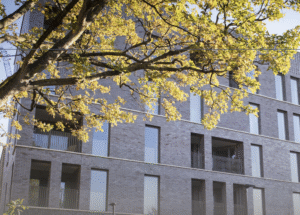
Follow Charles Wright on Bluesky. Photo: Bini Nandra.

OnLondon.co.uk provides unique coverage of the capital’s politics, development and culture with no paywall and no ads. Nearly all its income comes from individual supporters. For £5 a month or £50 a year they receive in-depth newsletters and London event offers. Pay via any Support link on the website or by becoming a paying subscriber to publisher and editor Dave Hill’s Substack.

Categories: News

Richard Lander: Poon’s comes to Somerset House

As is well known, On London is a stickler for accuracy. And when I met Amy Poon 14 months ago to report that she was imminently to bring back the legendary name of Poon’s as a Chinese restaurant brand in a Russell Square hotel in Bloomsbury, she and I were both sure we were right. But we were wrong on both counts. The pain of dealing with a massive hotel group’s snail-like bureaucracy killed the project.

But now Poon’s really is back in town in the splendour of the new wing of Somerset House. The menus are printed, the walls covered in stunning modern takes on Chinese murals, the tables, crockery and cutlery are in place. The kitchens have been retrofitted within the restrictions of a listed building (no external ventilation is allowed, so all the kitchen heat has to be cooled and recirculated internally).

So a dream delayed but a dream come true for Poon to give a proper public face to the family name again after running pop-ups and a wonton, sauce and condiment business from a railway arch in Bermondsey.

For those of a certain age, the Poon’s name will bring back happy memories of her parents’ restaurants across the West End, which were very much The Places To Be Seen in the 1980s. But, as Poon says, you can’t rely on that demographic any longer.

“The people who remember Poon’s are beginning to fade and there’s a whole new generation out there who know nothing about us,” she says. “So it’s how to tell the story without being too much an old fogey going, ‘Oh, do you remember what it was like in my day’?”

She is doing that through a romantic melange of homeliness and fun. You won’t come to Poon’s for Peking Duck, Dim Sum or other Chinese classics. There’s no shortage of places on Gerard Street for those. Instead, it’s all about replicating what a Chinese mother would make at home.

“What I will have here is just very simple, very clean and very seasonal,” she says. “Nothing tastes as good as nostalgia, right? It’s just about wholesome, nourishing food. Stuff that makes you sigh with contentment,” she says. “We’re not going  for a Michelin star. I’m not my father [who did achieve said recognition].”

Nor does Poon feel the weight of any strictures to be 100 per cent faithful to any Chinese cuisine canon. Growing up in a time when fresh Chinese vegetables were hard to come by, she adapts British produce in season into her own recipes. It’s a reflection of her upbringing, scampering around her parents’ restaurant kitchens by night while attending archetypal English private schools by day. “I grew up between two cultures. And I’m sort of equally comfortable in either.”

The fun parts are dotted around the restaurant, on the walls and on the menu. There are “if you know, you know” jokes on the classical murals painted by a prep school friend: a reclining lobster smoking one her father’s beloved cigars. On the menu, there’s a dish called “The hill that Amy didn’t die on”, described as a “hertiage recipe for sesame prawn ‘toast’.”

Screenshot 2025 10 28 at 04.43.37

She had resisted including this culinary trope because, well, it can be found in every bad Chinese restaurant across the land, but backed down following a lecture from her mother  (“Darling, there are things that will pay the bills, pay your rent, pay your staff”) and workshopping an idea with her father to create a heritage version using lardo fat rather than toast. Another dish appearing soon – crispy chilli squid – pays homage to one of London’s most beloved chefs, whose first date with the woman he later married was at Poon’s.

Absent the Chinese classics, the menu brings together the familiar – steamed fish and steamed pork with shrimp paste – along with some intriguing elements of Poon’s  homebrew cuisine, such as Magic Soup  – “a fortifying broth of granny wisdom to soothe, restore and nourish”. I can vouch for this one. There’s also Siu Yeh, a post-theatre light supper of noodles or pot luck rice.

Poon faced opening day with a mixture of excitement and trepidation: “We’ve had so much love, which is incredible and quite humbling, but at the same time it feels like an awful lot of pressure. You just feel like, God, I can’t mess this up. So that’s the challenge. Don’t mess it up, baby.”

Poons is at New Wing, Somerset House, Lancaster Place, London WC2R 1LA. will be open from Tuesday to Saturday, serving lunch 12:00pm-4:00pm and dinner 5:00pm-10.30pm. Bookings can be made at opentable.co.uk. Photo from Poon’s Gallery.

OnLondon.co.uk provides unique coverage of the capital’s politics, development and culture with no paywall and no ads. Nearly all its income comes from individual supporters. For £5 a month or £50 a year they receive in-depth newsletters and London event offers. Pay via any Support link on the website or by becoming a paying subscriber to publisher and editor Dave Hill’s Substack.

Categories: Culture

John Vane: Camden Town grille thrill

The thrill was the more thrilling for having forgotten about it. Reacquaintance occurred due to impatience at Angel, where I was too restless to wait for the Edgware train and took the High Barnet instead. No time was saved, but at least I would be on the move and could switch over at Camden Town, where the branches of the Northern line meet. Thus was the thrill re-lived.

It came when I was changing platforms, striding along a connecting walkway. There’s a grille in the corridor wall. I glanced at it, looked through it, and saw below it the top of a stationary tube train. Passengers entering and exiting it too. It was one of  two southbound platforms (number 3 and 4) , each positioned beneath the two northbound ones (1 and 2) that I was hurrying between. I stopped for long enough to take a photo. Then I remembered that I’d forgotten getting a kick out of this sight before.

The thrill lies partly in the absurd but enjoyable delusion that your vantage point is secret, but mostly in the reminder about why the tracks and platforms are arranged in such a way, and why Camden Town station is a funny shape. Wikipedia explains that it is all to do with the two roads up above – to be precise, the widths of and geometrical relationship between Chalk Farm Road and Kentish Town Road, whose southern ends begin at the same point, forming part of the same teeming junction as Camden High Street and Parkway.

When construction of what was then the Charing Cross, Euston and Hampstead Railway go going, at the start of the 20th Century, it followed the routes of the two roads, thereby avoiding any need for the project’s American financier, Charles Yerkes, and his many foreign investors to pay compensation for disruption to owners of land on either side of them. The shape of the station, one of prolific Underground architect Leslie Green’s designs, fits the “V” the roads form at their shared root.

When the station was opened in 1907 – by future Prime Minister David Lloyd George, at that time President of the Board of Trade – the railway’s dual northern prongs terminated before their current endpoints. They were later connected straight to the West End and the City, entailing yet more ingenious engineering and resulting in multiple junction tunnels beneath Camden High Street. The Northern line name was formally adopted in 1937.

You will have deduced that I don’t pass through Camden Town station that often, and when I do I rarely stop to change trains. But I think about it frequently, largely for nostalgic reasons concerning Camden market, music and the eclectic demographic of wearers of Doctor Martens boots. Frightgeist starlet Mo emerges from it en route to her job at a vintage clothing shop. She and fellow starlet Mo travel from it all the way to Morden in the deepest south, where ocean-going art deco and a landmark mosque await. Next time you are restless at Angel, do what I did.

John Vane’s London novel Frightgeist can be bought here.

OnLondon.co.uk provides unique coverage of the capital’s politics, development and culture with no paywall and no ads. Nearly all its income comes from individual supporters. For £5 a month or £50 a year they receive in-depth newsletters and London event offers. Pay via any Donate link on the website or by becoming a paying subscriber to publisher and editor Dave Hill’s Substack.

Categories: Culture

Richard Derecki: Have Gilbert & George had their time?

Well, here we are again. A bit like meeting your boozed up, aged uncle from the Home Counties – colourful and confrontational as always, but rather stuck in his ways.

I have been to many Gilbert and George exhibitions over the years and watched as “the two people, one artist” became a venerable national institution. They tend to riff on particular topics at particular times – those they believe drive our human activity and interest – sex, money, religion, patriotism, hope, fear, death – but within a distinctively contemporary urban frame, and a uniquely London one.

The latest show has opened at the Hayward Gallery on Waterloo’s South bank to some fanfare and many five-star reviews. It is a retrospective of their art during this century and includes over 60 large-sized pieces, with pictures grouped not in chronological order but rather around certain themes such as “personal identity” and “media”.

The pair’s work is often deliberately provocative, using sexual images, crude words, crass newspaper headlines and scatological humour, typically set within large, brightly coloured panels imitating the stain glass windows in churches.  As the light shifts and changes, these create a sacred and almost worshipful atmosphere. As you gaze up, much as you would at a rose window in a cathedral or abbey, you can’t help but search for some kind of deeper meaning, but the thing remains elusive and perhaps is never really there at all.

Born in the 1940s George (Passmore, in Plymouth) and Gilbert (Prousch, in South Tyrol, northern Italy), met at St Martins school of art where they studied sculpture. Swept up by the spirit of 1967, the embracing and celebrating of the experimental and performative, they became “singing sculptures”.

In their trademark conventional suits and with their heads painted a metallic grey, they would stand on a table, moving in slow motion as they sang Flanagan and Allen’s old-time music-hall hit Underneath the Arches, often for hours on end. Promoted by renowned art dealers, they travelled the world as living sculptures, gaining a widespread following which opened doors for selling their later drawings and paintings.

Yet Gilbert and George like to play the outsiders, claiming they reject the art and the teaching of the time they were students. They sought to create an art that addressed the thoughts and feelings of people from all over the world – work that spoke to people in general, not just those who understood the language of art appreciation. Its purpose was to reflect and trigger an emotional response – to reach out. Art for all, they claimed. They wanted to make audiences go home from their exhibitions feeling a bit different. Hence their attempts at provocation, which even today some find offensive, but can more often seem outdated.

London fascinated them, with all its contrasts and energy. They moved into Fournier Street in Spitalfields in 1968 because it was cheap and unloved. They were among the first to restore an old Huguenot silk weaver’s house. The East End became a formative influence on their practice and, as they wandered, so they collected the detritus of urban life to include in their work – physical things like old bones, sticks and leaves, but also images of graffiti, calling cards of male sex workers, faces of people they met.

With room after room to explore at the Hayward, you are bound to find pieces that will draw you in. My particular favourite was Life After Death Proven, a challenging thought for a humdrum day, which includes two old world means of communicating – a red post box and a red telephone box framing a London bus, its passengers lost in their own worlds, heads down on phones or lost to the sounds coming from their headphones. Together but alone.

Yet the very size of the works, often set side by side with little space between, can be overpowering. Maybe they are making a point about the rush and flurry of images we navigate in our daily lives. But the juxtaposition of so many pieces amplifies the repetitive nature of their format, and the imagery can often seem tired and less urgent than it did in the last century. Perhaps it has become a bit passé and it’s the personalities that keep the machine whirring now.

Follow Richard Derecki on Bluesky. The Gilbert & George 21st Century Pictures exhibition will run until 11 January, 2026. Image: Ha-Ha (2022) from Southbank Centre website.

OnLondon.co.uk provides unique coverage of the capital’s politics, development and culture with no paywall and no ads. Nearly all its income comes from individual supporters. For £5 a month or £50 a year they receive in-depth newsletters and London event offers. Pay via any Support link on the website or by becoming a paying subscriber to publisher and editor Dave Hill’s Substack.

Categories: Culture

Julie Hamill: How Peter Doig taught me to listen to London

I never leave home without my headphones. My soundtrack to London is whatever is playing in my ears, and that’s the film I’m in, usually daydreaming on the Tube. Today, the soundtrack is Yazoo’s Upstairs at Eric’s. “Don’t Go” kicks off the album as I walk to the Jubilee Line, then jump on the front carriage as it glides off to take me partway to Lancaster Gate.

It is only a few weeks since I was in the area with my friends Sharon and Sue to see the Dress Codes exhibition at Kensington Palace. Dress Codes (now in its final weeks) is a display of Royal Family clothing that celebrates the best of its ceremonial dress collection, including pieces worn by a young Queen Elizabeth II, Diana, Princess of Wales, Princess Margaret and Queen Victoria.

I like fashion and dresses. The royals aren’t really my cup of tea, but I do like to try other teas, just to be sure. Apparently, most visitors ask to see more of Diana’s clothes – only three of her dresses are on display. Afterwards, we took a stroll through the gardens and reminisced about our (now grown) children climbing all over the pirate ship in the playground.

Today, I’m back in Kensington Gardens, this time at the Serpentine Galleries to see Peter Doig’s House of Music. If you’ve not heard of him, Doig is an award-winning painter, internationally renowned for his inventive style and tropical palate. He is well-travelled, having lived between Trinidad, Canada, the USA and Germany, and is now settled in London. A bonus is that he’s Scottish, born in Edinburgh in 1959. I’d love to hear that accent now.

Doig blends memory, reality and imagination in a new way that encourages viewers to find the narrative behind the scene. As a fiction writer, this appeals to me. But it’s his love and use of music I’m really interested in, and this is an exhibition of his paintings set to it.

I take my headphones out as I arrive – it’s free entry, by the way – and am offered an exhibition guide. I open it, and the first thing I see is this quote: “Music has often influenced my paintings. Songs can be very visual. I’m interested in what they conjure, and I’ve tried over the years to make paintings that are imagistic and atmospheric in the way music can be. Music, being an invisible art form, is open to interpretation within the mind’s eye.”

According to Doig, he can’t paint without music playing, deeming it “impossible”. I can’t travel without music. I have literally just “starred” in a video with Alison Moyet on the way here. Me and Doig are going to get along great.

I walk through to the main entrance and am greeted by a beautiful multicoloured landscape of a mural of flags he photographed near the Prosperity Club in Port of Spain, Trinidad. The flags are unfinished. I notice there are no stars or stripes on America’s. I think it looks better without the boastful detail.

The warm sound of jazz floats through the corridor, filling the air between the paintings. I see it’s coming from enormous, rare and restored Klangfilm Euronor speakers (pictured below). They are themselves beautiful pieces of art, originally designed for use in cinemas and other large auditoriums in the early and mid-20th Century. There are seats available, and the atmosphere is such that I feel like I’m in in Don Draper’s living room and he’s fixing me an Old Fashioned.

Unnamed 3

With all the lovely colours in the paintings, particularly the childlike shades of pinks and greens, I end up wandering around four times, enjoying Doig’s images of reality blended with imagination. The Lion of Judah is a recurring figure in his Rastafarian mural paintings, representing pride, resistance, and spiritual force.

There’s a “nighttime” room which encourages people to feel a bit more absorbed by the art by shutting out light. In here, almost all the comfy chairs are taken. Nobody is looking at their phones. Everybody is slowing down, allowing their senses to be filled.

The truth is, I don’t like jazz, but I wonder if it’s an added element that’s keeping me here to enjoy the paintings for longer. I see a gallery attendant move from standing by a wall to select another of the 300 pieces of music Doig has chosen – the Joe Harriott and John Mayer Indo Jazz Suite from 1966.

The entire exhibition is wonderful, an illustration of how music can unlock further creativity and add dimension to the senses, creating that extra swirly atmosphere. I see that Brian Eno is playing at one of the  invited guest events, and that disco records are welcome too. Quite the spectrum of tea flavours there.

Heading into the shop at the end, I select three of my favourite Doig paintings as postcards. I decide to pay by cash. The woman at the till notices I have a lot of coins. She instructs me, not unlike a teacher, to empty my purse because she wants my change.

She’s full of elder authority, so I tip the purse upside down onto her shelf. She counts out the coins, flicking them off the edge of the counter like a bank teller, and I’m so ensconced in hearing that coin-scratch noise I haven’t heard in years that I don’t notice how much she chucks in the till. She pushes back the rest of the change towards me and says, “Have a good rest of the afternoon.”

Unnamed 4

Inspired by the Doig experience, (I’ll definitely be back), I remain headphoneless and walk back via the Diana Memorial Fountain, and it seems so much smaller now my children are “big”. As the sound of the water trickles and swooshes around corners, I envision holding little hot hands and paddling in rolled-up trousers many summers ago.

Kensington Gardens is such a lovely part of London, full of wildlife. Swans dunk down, beak deep, bums up. I stand beside two Canada geese as they dig holes in the grass, using their beaks like spades, presumably to find bugs. I later learn it’s called “drilling”, though this doesn’t feel like a good descriptor; these holes were perfectly square.

I end up walking for ages without any music on, all the way under the underpass and into W1, where I find myself in Shepherd Market, not a place I often frequent. The area was originally the site of a fortnight-long “May Fair” (hence the name), which was known for its revelry. The May Fair was eventually banned for being an affront to public decency. Today, it has coffee shops, restaurants, pubs and galleries, and a lot of velvet seats, chatter and clinking cups and cutlery, but who knows what forbidden delights still happen at night.

At the end opening of that lane, I stumble across Trumper, which I’ve passed before but never gone in. I decide to brave it. Would they kick me out for not being a man? On the contrary, I am warmly welcomed. The Victorian curiosity shop and barbers is full of “gentlemen’s items” set out behind polished glass: shaving brushes, herringbone moustache combs, cufflinks shaped like motorbikes or saxophones, fancy soaps, manicure kits, fragrances, and bath salts, and it smells like pencil shavings and pine.

I have to say, I love it. The interior reminds me of an old toy shop in Glasgow, organised beautifully with nooks and crannies for the smaller pieces. In the back, a line of barbers have their own booths, separating every customer with a red velvet curtain. Hairdryers click on and off, intermittently revealing a low hum of hair chat, but the only other noise is my steps on the wooden floor. It is sort of comforting.

I head back to Bond Street (14,607 steps), and as I alight for the final walk home, my feet start to hurt. I pop Yazoo back on for Alison and Vince to take the pain away. For me, music enhances everything, especially imagination and experience (and distraction from sore feet). But London has its own cool soundtrack too. I might enjoy it if I take out my headphones now and then.

Foll0w Julie Hamill on Instagram.

OnLondon.co.uk provides unique coverage of the capital’s politics, development and culture with no paywall and no ads. Nearly all its income comes from individual supporters. For £5 a month or £50 a year they receive in-depth newsletters and London event offers. Pay via any Support link on the website or by becoming a paying subscriber to publisher and editor Dave Hill’s Substack.

Categories: Culture

Charles Wright: London tourism is booming despite enemies’ ‘hellhole’ claims

Sir Sadiq Khan made headlines last week for crediting London’s “open, liberal and diverse” culture for a “major surge” in American tourism – a tribute to “London’s values” making the city increasingly attractive.

Certainly, our American cousins – literally in my family’s case, with a trip booked for Christmas – seem keen to sample the city which this year won Tripadvisor’s top world destination accolade. US visitor numbers were up last year by eight per cent, helping to make London the third most visited city in the world with almost 21 million international visits in 2024.

That alone might disappoint London’s increasingly histrionic haters, across the Atlantic as well as at home. But there’s more. The latest City Hall analysis of visitor accommodation trends in 2024 shows that overall demand for somewhere to stay in the city is now back above pre-pandemic levels – with the recovery driven “entirely by growth in domestic demand”.

It’s a welcome statistic. The city break to London is definitely back. Compared to 2019, the number of nights spent in the capital by people from elswhere in the country has actually risen by a third, to 37 million, boosting London’s total number of visitor nights from around 146 million pre-pandemic to 154 million last year. Plenty of Brits are clearly not convinced by all he “crime-ridden hellhole” rhetoric.

The other side of the coin though is a decline, albeit slight, in the overall number of international visitor nights, from 118 million to 117 million. It’s a picture matched in wider statistics: one of overseas tourists returning, but not yet to 2019 levels, except for those Americans, with Europe close behind. China’s share, along with that of the rest of the world beyond Europe and north America, remains significantly down on its pre-pandemic peak.

Domestic visitors’ £5 billion annual spend last year is more than welcome. But overseas visitor spend, already at £17.3 billion in the capital, underlines how important the wider tourism sector is for the city. London is in a continuing competition with other “world cities” for this lucrative business too. Pushing those numbers back up to 2019 levels and beyond means not only supporting and extending the city’s range of attractions – Ted Lasso location hunting in Richmond, for example – but also ensuring enough rooms are available.

Interestingly, while visitors are getting keener on short-term “unserviced” rentals, the figures show the amount of Airbnb and similar accommodation actually “shrinking rapidly” as regulations get tighter, the City Hall analysis says. Good news for those like Westminster Council leader Adam Hug, who has warned of short-term letting hitting much-needed long-term rental supply in his borough.

It’s the hotel sector which is dominant, and that’s where plan makers and policy makers are focusing their attention, with Khan’s Towards a new London Plan document, the first stage in preparing his next planning and development blueprint for the capital, now acknowledging that boosting “purpose-built visitor accommodation” is essential for supporting tourism.

That’s already happening, according to City Hall’s inward investment and tourism agency London & Partners, including in the more affordable bracket as well as the higher end. One of the capital’s largest budget hotels, a 693-room Premier Inn, is now under construction in a prime spot just off Trafalgar Square.

The historic commercial heart of the city could be a new hotel hub too, with the City of London Corporation now seeking to reimagine the Square Mile as a “vibrant” seven day a week and evening destination. Its new Local Plan envisages 4,000 more hotel rooms by 2037, including as an option for safeguarding historic buildings. The early 19th Century Grade 1 listed Custom House, on the Thames near the Tower of London, is a case in point, now to be repurposed as a 179-room hotel with opened up public access to the riverbank.

But hotels should also be encouraged more widely in the next London Plan, Khan says, both to help “spread the benefits of tourism across London and revitalise commercial areas”. Wherever you live, more hotels could be coming your way.

While that’s a medium to long-term ambition, London retailers will be watching next month’s budget closely to see if their plea for short-term help, reinstating VAT-free shopping for international visitors, has been heeded. The scheme, previously applying to non-EU residents, which the government ended after Brexit, has cost West End retailers nearly £1.4 billion in sales since the beginning of 2023 alone, with tourist shoppers taking their spending to Paris or Milan instead, according to central London businesses.

And City Hall continues to press the case for a tourism levy, to “raise vital funds, improve services for residents and strengthen London’s global appeal”, according to London Assembly oversight committee chair Bassam Mahfouz. Such a levy could raise up to £240 million a year for the city, a new assembly report says.

Follow Charles Wright on Bluesky.

OnLondon.co.uk provides unique coverage of the capital’s politics, development and culture with no paywall and no ads. Nearly all its income comes from individual supporters. For £5 a month or £50 a year they receive in-depth newsletters and London event offers. Pay via any Support link on the website or by becoming a paying subscriber to publisher and editor Dave Hill’s Substack.

Categories: News

Dave Hill: Will Labour’s London housing boost plan work?

First things first. On London reported last month that Sir Sadiq Khan looked like making a big adjustment to a key planning policy by lowering the percentage of “affordable” homes he wants included in property developers’ proposals for residential schemes.

As Charles Wright wrote, the expectation in the sector was that the Mayor’s “threshold” would be lowered from its current 35 per cent, with some smart money being on a drop to 20 per cent. Then, last week, a leak confirmed this, along with a few more details about plans that City Hall, developers themselves and the government have been discussing for months.

It seems the drop will be for a limited period – a temporary, emergency measure of about two years – and might be accompanied by letting developers off other “planning gain” contributions, such as the Community Infrastructure Levy (as is already the case in Greater Manchester). Certain London Plan policies are likely to be relaxed too.

There’s been a lot of highly polarised political media commentary about this news. Unsurprisingly, populist Left voices have been raised in outrage, because for them “the developers” can only ever be greedy and bad and must always be fought and thwarted as a matter of principle. Also unsurprisingly, voices on the Right are saying “about time too” and reasserting their own core belief that lowering the threshold will enable housebuilding in London to pick up.

Meanwhile, those who work in the planning, development and construction world are giving a measured welcome to what has emerged so far and are waiting for the full, official announcement. As this article goes live, that is intended to be made later this week.

What useful difference might the forthcoming changes make? Please note my use of that word “useful”.

Let’s start with Mayor Khan’s hopes for housing supply when he was first elected, back in 2016. His goal was for 50 per cent of all new homes in London to meet his definition of “genuinely affordable”, a term that encompassed everything from homes for social rent to low-cost home ownership dwellings, typically shared ownership. Hitting that target – a percentage, not an absolute number – would be achieved through three avenues of housing supply.

  • A minimum of 50 per cent of all homes built on publicly-owned land meeting the Mayor’s “genuinely affordable” description.
  • Significantly more than 50 per cent coming from housing associations (and, later, boroughs) with the help of government funding Mayors distribute through their affordable homes programmes on terms negotiated with the government.
  • And 35 per cent of “affordable” homes built by private developers secured through agreements under Section 106 of the Housing Act (1985). These are deals done at borough level as a condition of planning consents being granted.

It’s that last part that is about to change. Importantly, what is sometimes termed the “35 per cent rule” isn’t actually a rule at all. It isn’t something the Mayor has been imposing on private sector developers by force, a diktat they must obey. He doesn’t have the ability to do that. Rather, it was introduced as an incentive, one codified in a piece of supplementary planning guidance (SPG).

Mayors of London have a limited and uneven set of powers. Among the stronger ones is the freedom to block or even take control of the determination of some planning applications. These are initially submitted by developers to the relevant local councils, whose officers then decide whether or not those plans conform with that council’s planning policies. They then recommended them, or otherwise, for approval by the council’s planning committee of elected councillors.

But if the scheme is above a certain size, the applicant’s plans also need to adhere to the planning policies of the Mayor, to whom they must be referred by the council in question. Developers and, indeed, boroughs are mindful of this and devise and assess development plans accordingly, knowing that City Hall can intervene if it isn’t happy with them.

Khan’s SPG – guidance, not a “rule”, remember – advised developers that plans which proposed new homes of which 35 per cent (or more) were “genuinely affordable” would be looked on favourably and dealt with quickly – put on a “fast track” to a likely green light and no mayoral intervention.

Those that didn’t would be subjected to a detailed City Hall scrutiny of their viability calculations. Was it really not possible for 35 per cent of the homes specified in the scheme to be “genuinely affordable” without its finances failing to stack up? If City Hall’s assessors thought the developer could do better, it would be sent away to think again. Failure to meet the threshold didn’t necessarily mean the scheme biting the dust, but would entail it being later subjected to “viability review mechanisms”, which could result in the amount of affordable housing accepted being increased if its profitability was found to have improved.

Broadly speaking, developers thought they could live with all this. Yes, they’d have preferred a 30 per cent threshold, better still a 25 per cent. Yes, they were unhappy about late stage viability reviews. But there were also upsides to the SPG. Under Boris Johnson or, to be precise, his deputies for planning, first Sir Simon Milton and then Sir Eddie Lister, negotiations with City Hall were on an individual, case by case basis. That could have advantages. But so could the Khan approach.

For one thing, a fixed threshold provided certainty. Developers knew, from the start, exactly what the Mayor wanted from them. There was no ambiguity about the carrots and sticks. They tailored their plans accordingly.

For another, the threshold approach was designed to hold down the price of land. In London, land is scarce. As a chap called Mark once said of land in general, they’re not making it any more. The more expensive it is – and in London it can be very expensive – the more profit developers need to make to cover that high cost and, therefore, the less room they are likely to have in their projected margins for “affordable” homes they can’t sell for as much.

However, the creation of the SPG also influenced the calculations of those with land to sell. Knowing that developers had an incentive to meet the Mayor’s 35 per cent “affordable” threshold gave them an incentive to lower their asking prices to levels developers could realistically afford.

Thus, the SPG sought to create a virtuous, self-perpetuating circle of downward pressure on land prices, making it easier for developers to meet the 35 per cent threshold, leading to greater percentages of “affordable” homes within larger residential schemes than would otherwise have been the case.

Of course, the SPG’s value has long been debated and contested, notably from the free-market Right, whose proponents have argued that it is a form of over-regulation that has hampered the overall supply of homes, “affordable” ones included.

For them, a lower threshold, though resulting in smaller affordable percentages, would have yielded a higher number for Londoners unable to afford full market rents or buying prices. As the mantra goes, 35 per cent of nothing is nothing. But 20 per cent of something is something. And if overall supply accelerates, so will the 20 per cent portions and the number of “affordable” homes.

Planning lawyer Simon Ricketts has pointed out that the press has portrayed such a threshold cut as a “spectre” that would amount to “an actual reduction in the amount of affordable (and particularly socially rented) housing that will be developed”. In fact, he continues, “very few schemes are currently proceeding with 35% or more affordable housing”. Far from it.

The reasoned sort of counter argument – as distinct from the ideological, junior common room variety – has been that market forces in this area do not operate as beneficially as their advocates claim, because developers will continue to build homes only at a speed and of a type that maximises profits. In other words, mindful of “absorption rates”, they can, depending on other factors, often have an interest in limiting supply, because that increases prices.

Whatever view you take, “affordable” homes delivered through Section 106 agreements with private developers have, until very recently, been accounting for between 41 and 52 per cent of “affordable” homes completed every year since Khan’s election (see page six of the London Assembly housing committee’s most recent affordable housing monitor).

Now, the whole economic terrain has changed – and with it the complex and sometimes fragile algebra of development finance. Construction costs – for energy, materials and labour – have soared. The high cost of living and general economic anxiety have dampened demand, further inhibiting supply. By the time of the general election, planning consents existed for around 300,000 homes of various kinds to be built across Greater London. The problem was, they weren’t being turned into homes.

Why? Because developers had concluded that the finances of these projects simply did not stack up; that if they started them, they might end up going bust. Funding these schemes often depended on the backing of investors who, seeing no prospect of a return, looked at other options elsewhere in the world. With the painful slowness of the new, post-Grenfell, building safety regulations process making matters even worse, the private sector has been building next to nothing. The latest report from analysts Molior says construction numbers are set to slump to just one quarter of their normal levels.

Populist Left narratives perpetually proclaim there is a choice between enabling the delivery of market priced homes – what they habitually and mostly inaccurately deride as “luxury flats” – and providing “affordable” homes, the most important being for social rent. They demand that politicians “get tough with developers”, as if caning them as profiteers will send them simpering back to their corporate abacuses to re-do their maths.

Real life doesn’t work that way. In fact, the amount of affordability in a housing scheme is increased, not decreased, by potential profitability of the private market homes. Also in real life, a vital stream of “affordable” supply – one that has provided a large proportion of the new homes built for low and middle-income Londoners for at least ten years – has come close to drying up.

Such is the intensity of the supply crisis, that no one believes lowering the threshold to 20 per cent will solve the problem on its own. But the hope is that it will least help prepare the ground for some sort of recovery, some sort of progress towards the government’s already-heroic target of 88,000 new homes in London a year and, most importantly, the alleviation of the plight of more Londoners of limited financial means stuck in unsatisfactory or downright desperate housing situations than is currently the case.

Maybe it will. Maybe it won’t. One thing, though, is clear – the politicians and policy makers who count have concluded that things can no longer stay as they are.

Follow Dave Hill on Bluesky. Photo from London Assembly/GLA.

OnLondon.co.uk provides unique coverage of the capital’s politics, development and culture with no paywall and no ads. Nearly all its income comes from individual supporters. For £5 a month or £50 a year they receive in-depth newsletters and London event offers. Pay via any Support link on the website or by becoming a paying subscriber to publisher and editor Dave Hill’s Substack.
Categories: Analysis

John Vane: Horse hunt

They are easy to spot, hanging around on street corners, showing unusually close interest in their surroundings. Their clothing suggests hard experience of weather turning nasty. They take pictures. They consult notes. I know about such people. Sometimes, I am one of them.

I saw such a soul other day, loitering near the Barbican: staring long and hard at a wayfinder totem; looking Aldersgate Street up and down. Finding what I was looking for, I took out my phone, lined it up and snapped. I looked round, and he was at my side.

“Are you filming?” he asked.

No, just photos. Why did he ask?

“I was wondering,” he said, “because of Slow Horses. They’ve done some scenes round here.”

He looked at me a bit uncertainly. In his head, he was wondering, ‘does this bloke know what I’m on about?'”

This bloke did. In fact, he’d watched the latest episode the night before, and done so in his usual state of frustration and delight: frustration at being unable to identify the mews, alley or avenue in which scenes from the show had been filmed, even when they looked familiar; delight when he was able to. Sad, but true.

We agreed that the current series has been quite silly. “They’ve run out of ideas,” said my fellow seeker of locations. But we also agreed that, even so, the show captures qualities of London streets with empathy and skill. And, it so happened, we were adjacent to the building that serves as the Slow Horses’ HQ, the place where core characters from Mick Herron‘s novels most often act out their small screen lives.

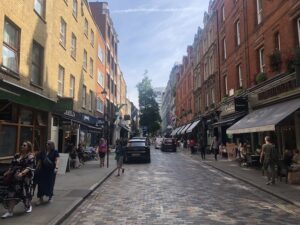
My interlocutor left in search of other featured spots: a restaurant, a café. I turned back to my subject, a yellow-fronted 1950s tower block. Returning home, I did some research. Londonist informed me that A Slow Horses character had been filmed passing before it. I knew I’d seen it somewhere before.

John Vane’s London novel Frightgeist can be bought here.

OnLondon.co.uk provides unique coverage of the capital’s politics, development and culture with no paywall and no ads. Nearly all its income comes from individual supporters. For £5 a month or £50 a year they receive in-depth newsletters and London event offers. Pay via any Donate link on the website or by becoming a paying subscriber to publisher and editor Dave Hill’s Substack.
Categories: Culture, John Vane's London Stories