Blog

John Vane: Farringdon chuggers

I had almost made it over Cowcross Street before being chased and hailed.

“Good morning, young man, you’re looking great today, I know you’re rushing off to a meeting with Bill Gates, but…”

A bit of what he said was true. I was, indeed, in a rush. I mentioned this over my shoulder as I completed my scuttle from the brand new Elizabeth line Farringdon station into the one opposite. It is old. Even older than me.

Addressing gentlemen in their sixties as “young man” is an interesting ploy. What is the thinking behind it? That we’ll be flattered? Amused? Charmed? How often, I wonder, does it work?

It didn’t work with me. I hastened to the barrier, Freedom Pass in hand, hoping I had conveyed some sense of good humour and well-wishing to my artful pursuer, whose line of work, after all, isn’t one I need to consider.

Guys like him, young, usually black, buzzing with ersatz affability, pouncing evangelically on passers-by, have become a regular feature of this pedestrianised link in a rail chain now used by up to 150,000 people daily.

You’ve seen them there. You’ve seen them elsewhere. You’ve seen the exposes. The complaints. Maybe you’ve made one. If so, it didn’t work.

There’s no escaping them. Your only option is to observe them while rebuffing them and wonder how they come up with their lines. Why Bill Gates? Why me?

An old favourite is “Could I be cheeky…?” Well, you can try. But I’ve got what I wanted from the encounter: a scan of your wares (a magazine full of nothing); a look into your eyes (less empty, more hopeful and more hopeless at the same time). You, on the other hand, have not.

This high-pressure chugging for an opaquely social mission is a modern London thing, but it is also an adjunct to a Farringdon tradition.

For centuries, long before the influx of creatives and tech, this mosaic tile of London, a subset of Clerkenwell and a spit from Smithfield, was a labyrinth of hustlers and hoods.

During the reign of the first Elizabeth, Turnmill Street, which leads off Cowcross, was notorious for crime and vulgarity, which is why playwrights of the era loved it.

The neighbourhood’s narrow streets were nicknamed Jack Ketch’s Warren, because so many who lived round there ended up being dispatched by Charle II’s executioner.

Under Victoria, Charles Dickens fashioned the Oliver Twist pickpocketing scene on Clerkenwell Green, which is a two-minute walk from the station.

The Farringdon chuggers aren’t robbers or thieves, but their methods can make you feel cornered and wary of being fleeced. Presumably, it works – at least well enough for enough of them to keep on trying, picking their targets, zooming in, referring to old blokes as “young man”.

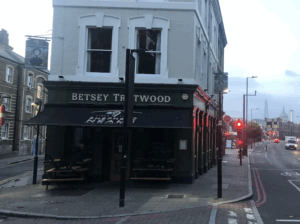
And you have to feel for them. But Betsey Trotwood would not have approved, and even were I Bill Gates himself I doubt I would give them a bean.

OnLondon.co.uk provides unique coverage of the capital’s politics, development and culture with no paywall and no ads. Nearly all its income comes from individual supporters. For £5 a month or £50 a year they receive in-depth newsletters and London event offers. Pay via any Donate link on the website or by becoming a paying subscriber to publisher and editor Dave Hill’s Substack.

Categories: Culture, John Vane's London Stories

Protecting Workers on the Track: An encounter and a dispute

It is easy to take for granted the scale and complexity of keeping the London Underground working, providing up to four million passenger journeys a day. And it is easy to forget, perhaps especially so with strikes by some Tube workers on the near horizon, that many people essential to keeping the network running are little known of and rarely seen.

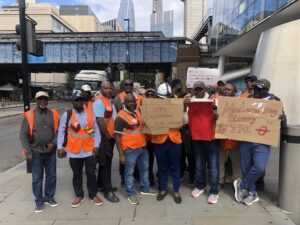
I encountered some of those, entirely by chance, during a visit to Blackfriars the other day. Emerging from Southwark station, I spotted them across the road outside the Palestra building, where Transport for London has office space – a group of maybe 20, most (but not all) of them men, most wearing hi-vis jackets, some carrying placards, and all of them with armbands bearing the initials PWT.

That stands for Protecting Workers on the Track. Essentially, PWT personnel on the London Underground are responsible for the safety of others working on or around Tube rails, be that supervising the movement of trains or having full control or “possession” of a designated section of track. “If one of us is not there, people doing maintenance or whatever it is, cannot do their job,” is how one of those outside Palestra put it.

What is their beef with TfL? They aren’t TfL employees, but agency-supplied. TfL has recently entered into the latest of a number of contracts with Morson, a large recruitment firm that bills itself as the UK leader for placing people in transport and rail jobs.

The PWT demonstrators claimed that this new deal, due to come into effect from Monday, will weaken their job security and have the effect of reducing their incomes. Morson disputes this, saying in a statement that “terms have not been reduced” and that payment rates “remain on a like-for-like basis with the previous contract” at levels “well above the London Living Wage”.

The detail is complex, but in an email to Sir Sadiq Khan, sent last Monday, Ibrahim Shittu, writing on behalf of “protection services personnel” who work for Network Rail within London and TfL subsidiaries as well as on the Tube, says that a move to a form of PAYE taxation system will entail a reduction in net income and, at the same time, no enhanced employment rights or security. “Workers will still face a disguised form of zero-hour contracting, with no guaranteed shifts,” the letter says.

Agency work, of course, is often less reliably available than permanent employment, but also allows a flexibility appreciated by some. However, the PWT protesters feel that their positions have been made unacceptably more precarious.

Usually, they work at night, when track maintenance is routinely done. They describe not knowing if they are to be needed until four and five in the afternoon or even as late as eight in the evening, receiving the information by text. The unsocial hours and qualifications required mean, according to one I spoke to, that a five-shift week can yield an income of around £1,000 a week, which above the London median of around £850. But a two-shift week means only £400 or so.

In his letter, Shittu says that under the previous framework, PWT workers’ pay rates corresponded to their qualifications, so that those with higher level certificates were paid better accordingly, regardless of the specific tasks they were asked to perform, but that from now on, the highest qualified will only be paid the highest rates if the work undertaken requires that degree of expertise.

Moreover, he contends to the Mayor that workers will no longer be able to go to an alternative agency due to “Morson now monopolising the contract”. Previously, another agency also supplied this type of temporary staff. Shittu also points out, as did his colleagues outside Palestra, that some of them have been doing this work for more than 20 years.

A number of the roughly 200 PWT personnel in London are individually members of the RMT union – which has long called for their roles to be brought in-house – but it is not in a position to negotiate for them. The Mayor, who chairs the TfL board, has been asked to halt the contract.

Below is Morson’s statement in full:

“Terms have not been reduced; payment rates under the new PAYE model were developed in collaboration with our expert accountancy partners and umbrella company suppliers. These remain on a like-for-like basis with the previous contract. Workers continue to receive fair, transparent pay that is well above the London Living Wage, while their rights and job security remain unchanged. This PAYE model also brings track protection workers in line with other TfL contracts and other government bodies, ensuring consistency, compliance, and fairness across the board.

 Morson Group takes pride in maintaining the highest standards of compliance and worker protection across all contracts. These principles remain at the heart of how we operate and reflect our ongoing commitment to the workforce who are essential to the capital’s transport infrastructure. Looking ahead, we will continue working with TfL and trade unions to safeguard fair standards and ensure the voices of our workforce remain central as we support London’s future transport needs.”

I’ve asked for more detail about some specific points and will update when this arrives. TfL said:

” We encourage Morson to continue engaging with their workforce on the concerns raised.”

It will be interesting to see what happens next.

OnLondon.co.uk provides unique coverage of the capital’s politics, development and culture with no paywall and no ads. Nearly all its income comes from individual supporters. For £5 a month or £50 a year they receive in-depth newsletters and London event offers. Pay via any Donate link on the website or by becoming a paying subscriber to publisher and editor Dave Hill’s Substack.

Categories: News

Lewis Baston: Lib Dems bury Labour in West Hampstead landslide

The Liberal Democrats won an impressive victory in a by-election in the West Hampstead ward of Camden on Thursday, gaining the seat with a high swing. But the question of which party they gained the seat from is a little more complicated than usual.

Both Labour and the Conservatives had cause for embarrassment thanks to the trajectory of former councillor Shiva Tiwari. A managing director at the private equity firm Peak Rock, Tiwari had been a valued recruit to Labour’s slate in 2018, but he became disenchanted with the party and resigned from it in March 2025 to join the Conservatives.

In doing so, he criticised Labour both nationally and locally, arguing that “I just don’t think the Labour Party stands any more for the values that I strongly believe in around supporting hard-working families and small and medium-sized businesses to drive economic growth”. He accused Camden Labour of “pursuing a minority leftist agenda”.

The depleted Conservative contingent on Camden Council, reduced to just three councillors in the 2022 elections, welcomed Tiwari with open arms and made him deputy leader of their group. He was selected as a candidate for the Frognal ward, Camden’s only Tory stronghold, for the borough elections in May 2026 and seemed set fair for a significant role in his new party home.

However, Tiwari’s period as an asset to the Conservatives proved short. On 12 July, he went to pick up a package at the Costcutter supermarket on Finchley Road and got involved in a dispute with the staff there about whether he had a correct form of identification. Tempers rose and Tiwani shouted, “Don’t annoy me, I’m a councillor for this area, I will shut down your bloody shop, ok? Call your boss, this is a joke,” and went on to use foul language. The incident was recorded on the shop’s CCTV. Tiwari expressed regret for his part in the altercation and resigned his seat on the council.

It was not an election Camden Labour wanted to fight. West Hampstead’s electoral history is interesting. Its predecessor ward, West End, elected one Conservative and one Labour councillor in 1978, but then voted Labour across the board in the next three sets of local elections. In 1986, the Alliance (precursors to the Lib Dems) won neighbouring Fortune Green and some of the local activism spread next-door: the Lib Dems won their first seat in West End in 1994, mopped up the other in 1998, and then dominated three-member West Hampstead from its creation in 2002 until 2014, when Labour gained all three seats. But the Lib Dem vote did not fade away, and even at their 2018 low point they still had a quarter of the vote. West Hampstead has been a vigorously contested Labour-Lib Dem battlefield for over 30 years.

It is a compact ward, well-served by public transport. The three West Hampstead stations (Jubilee Line, Mildmay Line, Thameslink), lined up along West End Lane, are the focus of the ward, although the railway lines divide the residential areas from each other. In the east, the ward extends to Finchley Road, the eponymous stations (including Finchley Road & Frognal) and the O2 Centre, a 1998 shopping centre which was very trendy when it first opened but has aged poorly.

In the east, West Hampstead touches the borough boundary just opposite Kilburn station at the end of Maygrove Road and under the railway arches. The southern boundary is the southernmost railway line, except for several streets around Sherriff Road opposite the West Hampstead Jubilee Line station. To the north, it is divided from Fortune Green at Mill Lane and the northernmost part of West End Lane that runs east-west. Fortune Green and West Hampstead are closely linked and effectively form a single urban community of West Hampstead.

Demographically, West Hampstead is the sort of ward found only in the big cities. It is dominated by flats (89 per cent of households), and 39 per cent of people live alone (29 per cent do in London as a whole). The population is disproportionately drawn from people aged between 20 and 50, and a staggering 66 per cent are educated to degree level, nearly twice the national proportion.

It is skewed towards professional and managerial workers (55 per cent, compared to 38 per cent in London). West Hampstead is ethnically mixed but fairly white for London (62 per cent compared to 54 per cent) and by faith it is plurality non-religious (37 per cent) with a significant (six per cent) Jewish community. The politics of the ward can be read off from these figures – it is a metropolitan liberal stronghold and proud of it, with a small but persistent wealthy Conservative element.

The residential areas forming West Hampstead ward are mostly late Victorian terraces, with subtle social gradations between subdivided villas overlooked by railway lines to the larger family houses up towards the centre of Hampstead. There is also the 1970s Lymington Road council estate, also known as the Potteries because its streets and walks are named, apparently randomly, after pottery firms and the city of Dresden.

Admirers of quirky street names, fresh from last week’s chinchilla-inflected contest in Hounslow, will also be happy with West Hampstead. There is a path named after rock and roller Billy Fury and a road named in Victorian times after a large Indonesian island for reasons nobody seems to know. There is a complete gazetteer of Camden street names with explanations (when they exist) and a little history of street-naming to be found online. Sumatra Road, incidentally, was crowned in 2015 as the UK’s most canvassed street, being in a key three-way marginal (Hampstead & Kilburn) within easy reach of Westminster on the Jubilee line.

The West Hampstead landscape is in the process of changing because of the development of the O2 site, which extends nearly all the way from Finchley Road to West Hampstead stations on a stretch of land originally earmarked for the Ringway motorway scheme that was cancelled in the mid-1970s. Camden Council approved the masterplan for the site in 2023, and it will eventually yield 1,800 new dwellings, 600 of them graded affordable. The development is intended to be car-free. Work on the first phase has already begun with the demolition of the Homebase store at the far end of the O2 car park.

The O2 development was a campaign issue. Labour supported the scheme for its new housing and argued that existing local residents would get benefits, including new parks and £10 million in improvements to West Hampstead station. The Lib Dems were more equivocal, arguing that the housing was good but improved local infrastructure should precede it, but it was not a major theme of their campaign. The Conservatives complained about the 15-storey “high rise” buildings in the development – the developers argue that density is needed to allow more green space – and Reform UK alleged that “uncontrolled development is reshaping West Hampstead behind closed doors”.

The issue of fly tipping was prominent in the campaign, as it was in Cranford last week. It seems a ubiquitous problem regardless of whether the ward is urban, suburban or semi-rural, although the very central boroughs are perhaps less affected. It rankles with voters who see it as a sign of creeping squalor in their neighbourhood and an example of the state’s inability to control antisocial behaviour.

Looking into the economics of why the tippers do it and enforcing the regulations that exist would be good investments by central and local government. Labour pointed out that Camden was doing this, funding an enforcement officer focused on West End Lane and prosecuting several local businesses for violations, but the opposition argued that there was a lot of room for improvement.

Liberal Democrat leaflets targeted left-liberal voters who had supported Labour in the 2024 general election and subsequently felt disappointed. They criticised the Starmer government over welfare cuts, Europe and potential cuts to central government funding of London boroughs. Gaza came up frequently on the doorstep. Labour’s campaign majored on the record of Camden Council, one of London’s more effective and popular borough administrations, although it is rare even in those circumstances for people to feel all that grateful for improved schools and libraries.

The candidates were an interesting bunch. The Lib Dems selected Janet Grauberg, a significant personality in the local party and Camden’s political history. Camden is, despite having more wealthy and Conservative areas than other inner north London boroughs, generally loyal to  Labour, and Labour control has only lapsed on two occasions – the Conservative sweep of 1968 and Labour’s recent nadir of 2006. The result in that year was a hung council, with the Lib Dems the largest single party. The administration was formed from a coalition between the Lib Dems and the Conservatives.

Elected for Kilburn ward, Grauberg became the borough’s cabinet member for finance. Labour regained control in 2010, unseating her in Kilburn. She stood there again in 2014 and 2018 with diminishing returns and was redeployed to the more hopeful ward of West Hampstead in 2022, achieving a strong result – the Labour version of Tiwari finished only 38 votes ahead of her, and she led her Lib Dem colleagues by around 200 votes, indicating an effective personal campaign.

Her personal qualities formed a major part of the Lib Dem by-election campaign – she had been awarded an OBE for services to education and the community. Labour criticised her record in power in 2006-10. If there is a non-Labour administration to be formed after the 2026 elections, Grauberg will form an important part of it.

Labour’s candidate was Francesca Reynolds, a young parliamentary staffer and management consultant. The Conservatives nominated Ian Cohen, who had contested West Hampstead in 2022 and Fortune Green in both 2014 and a 2021 by-election. Cohen runs a dry-cleaning business in West End Lane and is a long-standing local resident. Thomas Sterling stood for Reform and Matthew Hull represented the Greens.

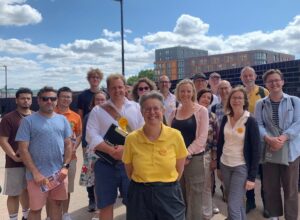
Despite a vigorous campaign, the electorate had not shaken off its summer torpor and turnout was poor (26.4 per cent). As the Lib Dem bar charts claimed, it was a two-horse race – their campaigners were impressed by the Labour effort and pushed back against predictions of a big win. But when the votes were counted Grauberg (pictured, centre) had won in a landslide. She polled 1,176 votes – eight more than in the higher turnout 2022 borough elections  – which amounted to 54.4 per cent of the vote (up from 38.9 per cent in 2022).

Reynolds fought a good fight, but was miles behind on 21.2 per cent (a steep drop from the Labour team’s 44.5 per cent in 2022). Cohen polled 222 votes (10.3 per cent), a poor showing, although the Tory vote was buffeted by Lib Dem squeeze tactics and the arrival on the ballot of Reform (155 votes, 7.2 per cent). The Greens brought up the rear with 152 votes (7.0 per cent).

It is not a good sign for Labour that they ran a decent campaign yet only just scraped over the 20 per cent barrier, even considering the factors making for a good Lib Dem result. It is enough to make one revise down the estimates of Labour performance in the 2026 borough elections, and those predictions were not looking too rosy to start with. But the question with challenges to Labour’s inner London hegemony is always from which direction they might come, and whether the opposition merely split the vote and enable Labour to survive despite reduced support.

In West Hampstead it was always clear that the Lib Dems were the main contenders, but in many wards it is far from clear – Conservatives, Reform, Lib Dems, Greens, local parties, Independents and Corbynites will all have ambitions. Three Camden by-elections last year painted a confused picture. To lose Camden, for example, Labour needs to lose 20 seats compared to 2022. It is easy to see six going to the Lib Dems and two more going to the Greens, but after that it gets harder. The bedraggled Camden Tories would have to pick up seats in their targets such as South Hampstead and Primrose Hill and the Greens would need to expand into Kentish Town. That’s still only 19 seats, so somewhere unexpected would have to flip as well.

Camden, for the first time since 2010, will be one of the headline contests in London, as local voters weigh the merits of the council and their verdict on Sir Keir Starmer’s government on the Prime Minister’s home turf.

Follow Lewis Baston on Bluesky. Photo from Janet Grauberg’s X/Twitter feed.

OnLondon.co.uk provides unique coverage of the capital’s politics, development and culture with no paywall and no ads. Nearly all its income comes from individual supporters. For £5 a month or £50 a year they receive in-depth newsletters and London event offers. Pay via any Donate link on the website or by becoming a paying subscriber to publisher and editor Dave Hill’s Substack.

Categories: Analysis

Nick Cuff: Why London stopped building

This is a very lightly edited version of an article originally published last month at Prop Views. Its author is managing director of real estate advisers Urban Sketch Ltd and has long and varied experience in London local politics, planning and housing supply.

***

Two weeks ago, London focused furniture company David Phillips went into administration.  The business, roughly 25 years old, cited the ongoing downturn in the housing and construction market. I had worked successfully with David Phillips on mobilising several build to rent schemes. It was a great business and an important part of the complex ecosystem of companies that aid the delivery of good quality homes for sale and rent.

That ecosystem, once so bright, is being rapidly dissembled, the victim of a series of poorly thought through policy interventions and perhaps well-intentioned but politically motivated attempts to spur affordable housing that have backfired.

Only 3,950 new homes were sold in the first half of 2025, according to housing data company Molior – just nine per cent of the government’s half year delivery target for London.

Molior predicts that by 2028 the industry can expect just £90 million of completion funds to flow through per week rather than the £1 billion it should expect. This is not the bottom. It is likely to get worse. High density brownfield sites for residential flatted schemes, once the bedrock of the London market, are no longer viable. There appears as yet to be no meaningful attempt in government to address the issues.

Why has London stopped building? The first thing to say is that it is not because of NIMBYs and defective planning committees alone, although neither are very helpful.

The system was always precarious – a delicate balance of pragmatic trade-offs by local authorities and developers accepting risk of discretionary decisions because the returns were there.    Sometimes they did well, sometimes they did not, but there was always an opportunity to recover returns during the elongated development process.

Those returns have been whittled away over the last five years. On the demand side, erosion has come in the form of Stamp Duty, soaring mortgage rates, tax changes on overseas investors and Buy To Lets, the loss of Help to Buy and the impact of higher risk free rates on Build To Rent yields.

On the supply side, more taxes mean more costs to carry. Two forms of Community Infrastructure Levy (CIL), Section 106 contributions, carbon offset levies, biodiversity net gain and now the soon to be adopted Building Safety Levy (BSL). It doesn’t end there: a landfill tax hike is also being mooted to firmly nail the coffin of brownfield housing development.

Then you have new regulatory requirements around fire safety. Buildings have lost around three to five percent of net saleable floor area from the addition of secondary cores and evacuation lifts. Less revenue, more cost and on an appraisal the impact is around 20 per cent on land value (or if you had already bought your site before the changes, your entire profit).

That’s a big ouch made worse by the fact you still have to pay CIL and the BSL on all that extra space. The newly implemented Gateway system, rather than facilitating safer developments, has merely become a check post causing serious delays to delivery, exacerbating the shortage of housing.

It’s been five years since James Murray left the role of London’s deputy mayor for housing to sit sits on the green benches. He departed with a legacy of additional planning requirements which now cannot work alongside the tax and building safety changes of the last three years.

“Genuinely affordable” housing was good party politics for Murray and adopted by the Sadiq Khan mayoralty when he came to office. It suggested previous administrations had somehow got a bad deal from developers. With limited grant available to pay for social housing, City Hall decided to put further onus onto the private sector by introducing a set of profit capture mechanisms, or late stage reviews, for all development proposals which didn’t hit 35 per cent both in terms of tenure and mix.

This meant the Mayor proposed to take the majority of profit over a certain percentage. His upside is unlimited and difficult to price. He has no downside and he has no capital at risk. That sits squarely on the developer: to assemble, fund and project manage a development where profit is fixed for all time but you are exposed to catastrophic losses. The result? Investors  required far higher returns because the London planning system is so obscure. Such complexity has also disempowered local politicians and planners from making judgement calls.

Is there much distinction between a local politician who opposes new housing and a local politician who supports new housing as long as it is social housing? If the state is not willing to pay for it and the private sector cannot afford it, there is actually little difference between the two positions. Both end up at the same place – nothing gets built. That is what is happening across London.

A mistaken belief that the private sector could and should pay for everything and anything has led to an exodus from the capital and to other, less politicised, asset classes. The housebuilders were the first to go, then the investors, both foreign and domestic. The housing assoications have consolidated and looked to their own estates for improvements rather than take development risk.

Multifamily Build To Rent, which should be motoring in a rental crisis, now creates negative land values, unable to provide anywhere near 35 per cent affordable due to higher debt costs. The sector that is functioning is single family housing – much less risk and far, far away from London.

Co-living and student development are still there. But London cannot rely on this alone and even these tenures are under huge pressure due to the building safety regulations and the risks around the Renters Rights Bill. There is no golden goose to be found in them, just an avoidance of negative land value.

The simple truth is that housing development is not a bonanza of goodies, yet successive governments and the mayoralty have mistakenly thought otherwise. It can offer something, but if the planning system is too demanding the consequence is that we all get nothing.

Urban renewal, housing agglomeration and regeneration yield long term benefits to society and the economy, but they are often not immediate cash cows and many times they need state subsidy or at least co-investment. Limited government resources have meant the default position is that the private sector is always there. But it has turned out to have alternative options.

There are huge tracts of land in London, much of it brownfield. You look at the bigger cities and the land is there. A “brownfield first” approach can carry a very significant part of the housing numbers where people want to live.

Unlocking it requires a move away from a discretionary, poorly resourced and land tax heavy broken system. Simpler rules, which are based on zones to which developers and investors are enticed and encouraged to put their capital at risk to improve the built environment is now the only way back. Politicians, both national and regional, need to get real about the viabilities of sites in London and elsewhere. Over the course of the past decade, governments and Mayors have extracted more and more value to the point where there is little to none left.

The public sector does not have the cash to build, so it must find ways to encourage others to take the risk.  That means simpler, fairer rules and an end to the war on profit that has stopped this great city from building.

OnLondon.co.uk provides unique coverage of the capital’s politics, development and culture with no paywall and no ads. Nearly all its income comes from individual supporters. For £5 a month or £50 a year they receive in-depth newsletters and London event offers. Pay via any Donate link on the website or by becoming a paying subscriber to publisher and editor Dave Hill’s Substack.

Categories: Comment

Enfield: Should the council build homes on the Green Belt?

Local plan examinations are long, complex and – let’s be honest – often pretty dull to sit through.

A council will draw up hundreds of pages of evidence and analysis to justify how and where it intends to provide new homes and employment space to meet its targets for the next two decades or more. News interest is usually limited to a few concerns here and there over the odd plot of land. But in Enfield – the borough I cover for my paper Enfield Dispatchthe council’s proposals for 9,651 homes on the Green Belt have provided endless controversy to write about, going back several years.

My first story on the topic was a splash in December 2018 carrying the headline: “Council set for showdown with mayor over new homes”. The opposition Conservatives had failed to win Labour backing for a motion calling on the council to ban housebuilding on the Green Belt. The next day, Sadiq Khan was asked about it at Mayor’s Question Time. He said he would object to any plan in breach of his planning policies and that it was “important to protect the Green Belt”.

Two public consultations on the Enfield Local Plan, one in 2021 and the other in 2024, generated huge levels of opposition. Going into the start of the public examination this year, therefore, I was sure these were going to be a very newsworthy set of hearings.

***

I was not wrong. On day one, in January, the “showdown” with the Mayor I had predicted six years earlier came to pass – but not exactly in the way expected. Khan sent his top planning official, Lisa Fairmaner, to speak on his behalf. She announced the Mayor had concluded that building on Green Belt was now necessary since the new national government’s target of 88,000 homes per year in the capital could not be “achieved wholly within London’s urban extent” and that “the Green Belt should be reviewed and alterations proposed”.

This statement came with a caveat, however. Even with the U-turn, the Enfield Local Plan was proposing homes on Green Belt sites that City Hall deemed “unsustainable”, thanks to their lack of existing public transport links. For that reason, the Mayor would still be objecting to them.

Reacting to that news at the hearing, council barrister Matthew Reed KC tried to seize the initiative. “There was much in that statement that was supportive of the approach we have taken,” he insisted. “I take the point about [the need for] sustainable development, but it [the U-turn] does alter the landscape in which the local authority will need to consider things. It does suggest our approach is aligned with the future.”

Long-time local campaigner Carol Fisk countered: “Given the Mayor has announced a London-wide Green Belt review, is it not jumping the gun to be including the Green Belt in Enfield when the review could find sites [elsewhere in London] without the need for Enfield?”

Vicarage farm (1)

This exchange essentially set the tone for the rest of the hearings. On the one hand, the council wanted to show it was being progressive by proposing to build on the Green Belt and was ahead of the curve – as both the new Labour government and Mayor of London were now open to the idea. On the other hand, local campaigners and opposition Conservatives maintained the council was rushing to build on Green Belt and had still not done its homework properly, such that, even now, it had failed to win City Hall support.

Later during the first stage of hearings, the council admitted there would be “high harm” caused to some of the Green Belt sites chosen for new housing. Government-appointed inspector Steven Lee pressed the council on whether it had taken “all reasonable steps” to find alternative locations for the number of new homes needed, which it insisted it had.

But local community groups disputed this, mentioning examples of brownfield sites omitted from the plan and pointing out the borough’s flagship housing site on ex-industrial land – Meridian Water in Edmonton – was supposed to be accommodating 10,000 homes, but had instead been earmarked in the Local Plan for only 6,700.

This led Richard Knox-Johnston, chair of the London Green Belt Council, to speculate. He told the hearing: “I think, frankly, they [the council] weren’t keeping their brownfield register up to date. We might say that was on purpose – the Green Belt housing will help them make up a financial shortfall.” The claim was robustly denied by Reed.

***

Stage one of the Enfield Local Plan examination concluded at the end of January. Stage two – looking more closely at individual sites – began in June and concluded earlier this month. Stage three is now scheduled for October, with several modifications likely to be discussed.

Might these include reductions to the number of homes proposed for Green Belt land? It seems a distinct possibility, given the flaws in the council’s plans highlighted during the second stage of hearings over the summer.

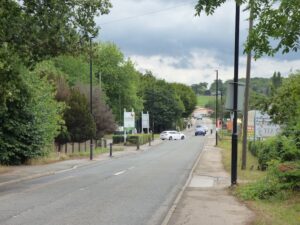
First up for debate was Crews Hill, the largest Green Belt housing area proposed, with 5,500 homes. The area has a railway station, but only a single, twice-hourly bus service, and very few people live there at present. Instead, Crews Hill (top photo) is largely commercial, known primarily for its horticultural businesses, including several garden centres and plant nurseries. As well as many such sites along the main road, the council also wants housing on some of the surrounding farmland, plus a golf course, which it owns.

Several affected businesses have already sold up to developers in anticipation of this change, but many more have not, and fragmented ownership remains a big obstacle. Asked by Lee how the civic centre would enable new housing on land where businesses refuse to leave, Reed admitted: “The council will consider the exercise of CPO powers as necessary.” Later on, Lee asked if such an approach was “justifiable”, to which Reed responded: “It is a process of last resort […] but it is exactly what the government wants to see happen to facilitate the delivery of sites and enable the scale of delivery.”

The council was also asked if its plans for Crews Hill would lead to a net loss of jobs, but was unable to give a straight answer. In terms of public transport, a new bus service is proposed, but Transport for London’s position remains that Crews Hill is unsustainable as a location.

The second biggest Green Belt housing site proposed is a number of adjoining greenfield sites used predominantly for farming and grazing which the council has collectively named “Chase Park”. It has proposed 3,700 homes being built there.

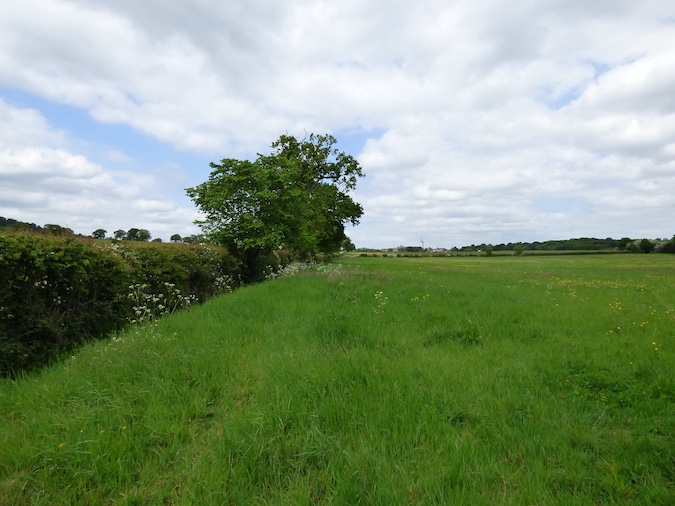
Although situated between two stations – Oakwood, on the Piccadilly Line, and Enfield Chase, operated by Great Northern – Chase Park (above) is within walking distance of neither and is again opposed by TfL as a housing site for this reason.

During the debate on the proposals, another rift emerged between the council and one of the major landowners. Comer Homes, owner of Vicarage Farm, was previously supportive and offered up part of its land for an extension of neighbouring Trent Country Park, which would be used to offset the loss of Green Belt.

But the developer has since U-turned – the farm is now making money, and it wants to maintain it for agriculture after all. This revelation irritated Lee, who said: “The policy as a whole keeps coming back to the country park. It is a crucial part of the vision. If it can’t be delivered in the way the council envisage it, it will have an affect on the planning balance.”

On the issue of “high harm” being caused to the Green Belt at Chase Park, Philip Russell-Vick, a chartered landscape architect commissioned by The Enfield Society to study the impact of new housing on the area’s undulating farmland, told the hearing: “It’s not the foothills of the Lake District or the Yorkshire Dales, but in terms of a London context it is a recognisable and highly valuable piece of landscape, and it should be considered as such.”

***

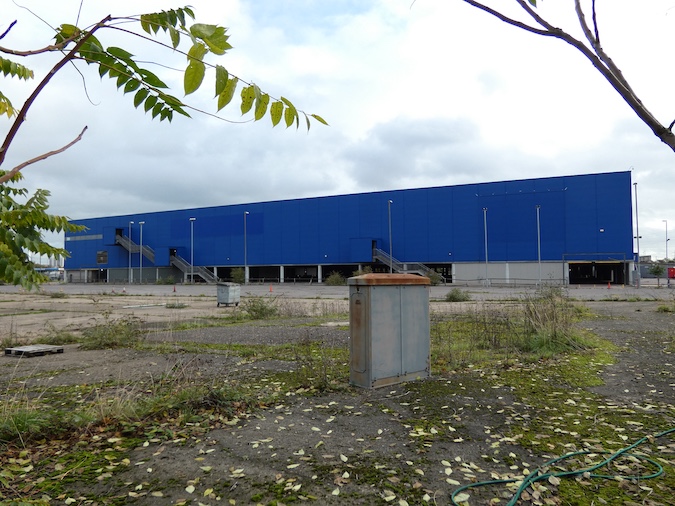
Curiously, the subject of the Green Belt also arose during a later debate on Meridian Water. Ikea – whose Edmonton store opposite Meridian Water Station closed in 2022 – wants to build 3,000 homes on the site. But the council disagrees, allocating 1,750 instead (below).

Closed ikea

Rebecca Burnhams, representing the Swedish furniture giant, questioned why the council was advocating thousands of homes on the Green Belt in the west of the borough, when brownfield sites in the east could accommodate more. “There is a brownfield site here that is ripe for development,” she said. “While you have pressure being put on Green Belt sites, it is unclear to us why this site is not being maximised.”

Later on, during the same debate, the council again appeared to frustrate Lee by admitting it had neglected to include around 700 extra homes on another site within Meridian Water. The council denied, however, that adding these extra homes would have any bearing on the rest of the plan – such as the exceptional circumstances needed to justify Green Belt development. Whether the inspector agrees remains to be seen.

A discussion event about the Enfield Local Plan, the Green Belt, and the borough’s housing crisis will take place at Dugdale Arts Centre in Enfield Town on the evening of 15 September. It has been organised by The London Society and the Enfield Dispatch. On London editor Dave Hill will chair it. Buy tickets here.

Categories: Analysis

News: Headphones on please, says Transport for London

Posters will appear on the Elizabeth line from today, asking passengers to wear headphones when listening to music, watching videos or having phone conversations during journeys.

Backed by Sir Sadiq Khan, the Transport for London initiative, which will be extended to the Underground, Overground, Docklands Light Railway, London Tram services and buses from October, follows TfL research conducted in June suggesting that 70 per cent of public transport users in the capital dislike being exposed to other peoples’ phone speaker noise while travelling.

The issue has become more prominent as the availability of 4G and 5G has increased across the rail networks and since April, when the Liberal Democrats proposed an amendment to the Bus Services Bill to ban people playing music and video out loud on public transport or in stations or while waiting for buses.

A YouGov poll at the time found that 65 per cent of Londoners “strongly” or “somewhat” supported the Lib Dem idea, which included fines of up to £1,000 for transgressors. The Conservatives have now suggested a similar measure in relation to Labour’s forthcoming railway reforms.

It is already a breach of national railway by-laws to create such noise or play musical instruments in a way that can annoy people, and TfL has adopted these, but the rules are infrequently enforced. The rail service posters will appear on trains themselves, not at stations.

The poster campaign is described as an addition to TfL’s long-running Travel Kind campaign, which encourages considerate behaviour on public transport.

Emma Strain, TfL’s Customer Director, said, “Most people use headphones, but even just a small number of people not doing so can create an unpleasant or even stressful environment for others. That’s why we’re reminding people to put their headphones on if they don’t already, to give others the stress-free journey they’d expect for themselves.”

Seb Dance, Deputy Mayor for Transport, said, “The vast majority of Londoners use headphones when travelling on public transport in the capital, but the small minority who play music or videos out loud can be a real nuisance to other passengers and directly disturb their journeys. TfL’s new campaign will remind and encourage Londoners to always be considerate of other passengers.”

Updated at 07:51 on 26/8/2025.

OnLondon.co.uk provides unique coverage of the capital’s politics, development and culture with no paywall and no ads. Nearly all its income comes from individual supporters. For £5 a month or £50 a year they receive in-depth newsletters and London event offers. Pay via any Donate link on the website or by becoming a paying subscriber to publisher and editor Dave Hill’s Substack.

Categories: News

Julie Hamill: Return of Arthur the parrot – a story of modern London

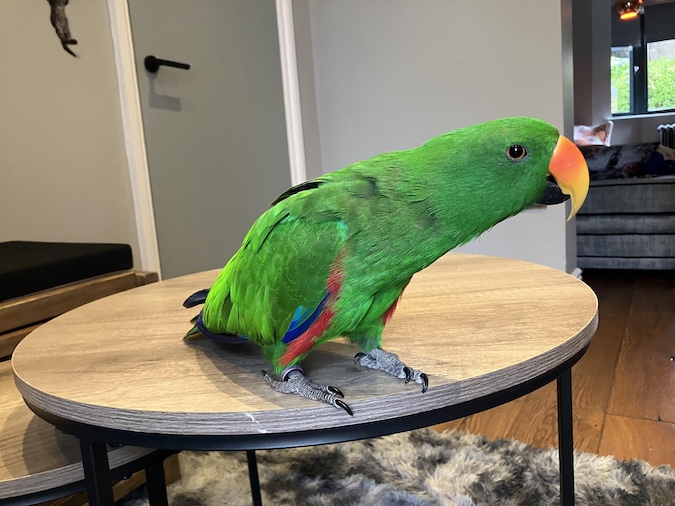
Posters of a striking, emerald-green, missing parrot with beautiful round eyes began appearing on my feed. His name was Arthur, and something about him seemed to radiate personality. I am always sad when I see a pet is lost, and immediately felt for Arthur’s owners, who I was sure must have been frantic.

I was transported to the time when our family dog, Sandy, went missing in Bellshill, Scotland, during my early childhood. Sandy had soft white curly fur (probably part poodle), pointy pink ears and a sandy-coloured stripe down his back. Our street neighbours joined in the search, calling his name, checking gardens, knocking on doors. In the end, it was my sister, Louise, who trusted her instinct, knocked on the right door and found our beloved pet (he’d been stolen).

Arthur the parrot’s story unfolded decades later in London. He wasn’t stolen, he was startled. One afternoon, a cat jumped on top of his outdoor cage, bending the netting just enough to open a small gap. Terrified, the four-year-old parrot launched himself skyward over the top of the cat and vanished beyond the rooftops.

Christy Zetta King, his owner, was at home at the time. “I was working on my laptop when Arthur was in his outer cage, getting his vitamin D,” she says, when I visit. “It was all over so fast. Before I could react or yell, it was too late. Arthur flew off. I knew he’d be disoriented. Parrots don’t have a homing instinct, like pigeons. He wouldn’t know how to get back. Immediately we went into rescue mode, calling for him loudly, even with a megaphone, as the first thing we taught him was to come to us when called.”

Christy and her partner, Michael Zmahar, like her a successful author from Slovenia, moved to London only two years ago with Arthur and Lexi, their incredibly elderly and wonderfully sprightly 19-year-old “golden something” rescue dog. What happened next surprised them.

“London is nothing like Slovenia,” Christy explains. “There, if you lose a pet it’s just: good luck! But here, everyone helped. People put out seeds and water, texted us, called his name in the streets. Kids rode off on bikes to look for him. We were shocked, in the best way.”

Michael agrees: “Our neighbours on this street are Ukrainian, French, Lebanese, Chinese, Indian — everyone came out. First, they thought, who’s yelling with a megaphone? But then they joined in.”

While the couple scoured the streets and posted online, neighbours spread the word on WhatsApp and Nextdoor. Christy notified parrot-alert groups, and posted flyers on trees. “We received about 100 calls that day,” says Christy. “Arthur was spotted up a tree in the park, then over on Willesden Lane, a mile away.”

Unnamed 15

After nearly 48 hours, salvation came from a young Brazilian couple, Liz and Rafa, who lived in a flat five storeys up beside a towering tree. They heard squawking at their window and saw a vivid green bird with red feathers perched about a foot away. They offered him a banana, which he ate. The ever-sociable Arthur eventually climbed on to an arm and was brought inside.

“Rafa and Liz don’t speak a lot of English, so didn’t even know he was missing,” Christy adds. “Arthur is an Eclectus parrot from the Solomon Islands, a special bird, not something you usually see in Willesden! He’s vulnerable to cats, foxes and other birds. Liz had done so much research on parrots, what to feed them, how to behave around them. She contacted the parrot society that I had previously notified. They told her to identify the ring around his leg and ask me for the ID number. Once she knew we were the owners,  she sent a video of him eating the banana. We were so happy our boy was with good people.”

Arthur was soon returned. “He got lost on Saturday afternoon, he was at their flat by 8pm that night, and we were reunited Monday,” Christy says. Meeting Arthur in person, I understand the attachment. He’s great with me, very playful, just as Christy and Michael trained him to be – familiar and friendly with people.

At one point he tries to nibble my earrings before giving me a kiss and sticking his tongue out. He even poses for photos by bending his head from side to side. As well as an ear-splitting loud squawk, he boasts a wide vocabulary in both Slovenian and English, and happily shouts phrases like “Good bird!”, “What’s up?”, “How are you?” and of course, his own name. “He’s such a goof,” Christy laughs.

Michael points out that although people meet him, love him and then want to own a parrot as a pet, they don’t realise the commitment required. “It’s like caring for a five-year-old who could live for 40 years. They’re super smart, demanding and full of personality. People don’t realise the level of work, expense and responsibility.”

I am touched to hear that the search for Arthur also involved one very special neighbour, who was the first to hear him after his escape. “A woman four doors down, who is blind, spends her days listening to birdsong in her garden,” Michael says. “She heard a strange-voiced bird and contacted us. ‘Does your bird call his own name?’ she asked. ‘Yes,’ we replied, ‘that’s him, that’s King Arthur!’”

The ordeal left Christy and Michael with more than relief. “It was stressful, of course,” says Christy, “but also uplifting. We’ve never felt this kind of support anywhere we’ve lived before. London gave us kindness, good energy, protection, and we got Arthur back.”

After another parrot kiss goodbye, I head home. I think of the day Louise brought Sandy home in her arms. I visualised him jogging up our hallway to greet me, his tail wagging, my fingers in his furry curls.

Foll0w Julie Hamill on Instagram. Enjoy Christy and Michael rejoicing in Arthur’s return here. It’s just as well that Arthur wasn’t stolen: very few pets reported stolen in the capital are recovered.

OnLondon.co.uk provides unique coverage of the capital’s politics, development and culture with no paywall and no ads. Nearly all its income comes from individual supporters. For £5 a month or £50 a year they receive in-depth newsletters and London event offers. Pay via any Donate link on the website or by becoming a paying subscriber to publisher and editor Dave Hill’s Substack.

Categories: Culture

Lewis Baston: Hounslow by-election hold gives Labour little to cheer about

Labour successfully defended Hounslow Council’s Cranford ward in a by-election on Thursday, but looking beyond the headline there is little for the party to celebrate – it was one of the Conservatives’ best results in London since the general election.

The by-election was caused by the death in June of Labour councillor Sukhbir Singh Dhaliwal. He served as a councillor for the Cranford or Heston West wards in two periods, from 1994 to 2010 and then again from 2016 until his death. Dhaliwal worked on the buses, first as a conductor and then as a driver, and had an encyclopaedic knowledge of London’s bus network, which his friends would test him on. Transport was one of his top political interests. He was a proud trade unionist. The leaders of both of the main Hounslow Council parties praised Dhaliwal’s dedication and personal warmth, and commented on the respect in which he was held in the Cranford community and the borough more widely.

Cranford’s name indicates that the old village was a ford over the River Crane, which flows from Yeading into the Thames near Twickenham. The Crane is a boundary river, demarcating the line between Hounslow and Hillingdon and, further downstream, between Hounslow and Richmond-upon-Thames. It also separates Feltham from Heston. Cranford Park and the parish church of St Dunstan’s are in Hillingdon, but the centre of the village and modern residential development are in Hounslow. The ward lies between Hounslow West and Hatton Cross on the Heathrow branch of the Piccadilly line, and contains the triangle of roads at the meeting point of the A4, A30 and A312.

Heathrow’s proximity is impossible to escape in Cranford. Planes fly low overhead on their way in, and many local residents work at the airport or in jobs that supply it or the airlines that use it. Like much of the Heathrow hinterland, Cranford has a large Asian population (57 per cent of residents according to the 2021 Census). It is a working-class community, with few professionals or managers resident in the area, and very religious – only eight per cent claimed no religious affiliation in 2021 (37 per cent did so in England as a whole). The plurality religion is Christian (38 per cent), with significant Muslim (20 per cent), Sikh (18 per cent) and Hindu (10 per cent) presences too. The Sikh community seems particularly prominent in local politics.

Cranford’s housing is a mix of owner occupied (37 per cent), privately rented (35 per cent) and socially rented (28 per cent). Much of it consists of family houses built in the inter-war period, though one will see the occasional older house left over from when this was market gardening country. The major roads physically divide the community, and the residential areas are slightly bleak, with treeless avenues and front gardens converted into parking.

The ward is host to some of London’s quirkiest street names, thanks to the presence of the council-built estate known variously as Beaver, Beavers or Beaver Farm – the official renaming to “Meadows” in the 2000s never caught on. The main loop through the estate is called Chinchilla Drive and the other roads are also named after rodents and small mammals – Raccoon Way, Opossum Way, Marmot Road and so on. The estate has had a troubled history, with problems arising from the system building techniques used in the late 1960s and, in the 1990s, from antisocial behaviour. It remains a rather insular community.

Candidates for the by-election came forward from the five main parties. Labour’s Hira Dhillon (pictured) was in the tradition of Sukhbir Dhaliwal in being a long-standing local resident and a transport worker – in his case on the London Underground and railways rather than the buses. There have been ructions within Hounslow Labour, and currently Labour candidates within the borough are being selected by a panel of the National Executive Committee. The Conservatives contrasted this with their own more local methods, and selected young activist Gurpreet Singh Siddhu. Businessman Khushwant Singh stood for Reform UK and Miruna Leitoiu stood for the Liberal Democrats. Neither party fought the seat in 2022.

The Green Party nominated Gurpal Virdi, who has an important place in the history of London policing. He was the first recruit to the Met from the Hounslow Asian community when he joined in 1982, and became a high-flying detective sergeant in the 1990s. Then, in 1998, he and other ethnic minority officers received racist messages. Instead of conducting a proper investigation, the Met falsely alleged that Virdi himself had sent the notes, and in 2000 he was dismissed.

The Virdi affair was the subject of an official inquiry. This reported in 2002, when Virdi was reinstated, and again in 2004. After retiring in 2012, Virdi aspired to a political career and in 2014 was selected as a Labour candidate for Cranford ward, only to suffer further injustice. He was accused of a historic sexual offence during the campaign, suspended from Labour, elected anyway and eventually acquitted of all charges in 2015. The Labour whip was then granted, but Virdi left the party in 2017 and stood down from the council in 2018. He ran for election in Cranford as an Independent in 2022, polling a respectable 489 votes but still coming last, just behind the Green.

Cranford has long been a safe Labour ward. The Labour slate won well over half the vote in 2022 (the usual method of calculation of percentages rather understates how dominant Labour was) and the party has won consistently large majorities for decades, lapsing only in the Tory annus mirabilis of 1968. One of the Cranford Labour winners in 1982 was Harbans Kanwal, one of the first two Asian councillors in Hounslow.

The issues of the by-election were familiar ones to the observer of local politics – standards of street cleaning, fly tipping, antisocial behaviour and the feeling of neglect which sometimes takes hold in communities such as Cranford due to their lying at the outer edges of their boroughs. The August polling day made for a torpid campaign and a low turnout, which at 21.6 per cent was well down on the itself unimpressive 30.6 per cent participation in Cranford in the 2022 full borough elections.

Hira Dhillon retained the seat for Labour, with 951 votes (40.7 per cent). This was by past comparison a very poor result in Cranford – the Labour vote share was down 12.6 points on where it was in 2022 on the standard basis of calculation, and this arguably understates how big the fall in support really was. Calculated on an alternative basis, the Labour share collapsed by 25 points.

The Conservatives finished a good second, with 679 votes (29.1 per cent). That was up by 10 percentage points on 2022, making the Cranford result their third-best in London since the general election on that metric. The meaty 11.3 per cent swing from Labour to Conservative was the highest since Fulham’s Lillie ward in February.

The Tories achieved this despite the arrival of competition on the right from Reform UK, whose 405 votes (17.3 per cent) was not a bad showing for a ward with Cranford’s demographics. The Greens (156 votes) and Lib Dems (145 votes) were far behind. Overall, there was a large swing from Left to Right.

One should not read too much into a low-turnout summer local by-election, but some conclusions can be drawn from Cranford. One is that there is a bit of a malaise about Hounslow Labour. This is indicated not only by the NEC involvement in selections but also internal rumblings becoming public and poor by-election results earlier in the year, in Brentford.

The swing in Cranford would, if replicated across the borough next May, be enough to switch perhaps 10 or more seats to the Conservatives, though the tide would have to rise higher to threaten Labour’s control of Hounslow, as its majority in 2022 was an enormous 52 seats to the Tories’ ten.

Cranford is another piece of evidence that the Conservatives are picking up support among Hindu and Sikh voters, on top of the 2022 elections in Harrow and Brent and several results in the 2024 general election, including Harrow East and the isolated Conservative gain in Leicester East. If this is indeed a general trend, the Conservatives could make significant gains in Hounslow, Ealing and Brent and perhaps on rather high swings, even if they struggle elsewhere.

Follow Lewis Baston on Bluesky

OnLondon.co.uk provides unique coverage of the capital’s politics, development and culture with no paywall and no ads. Nearly all its income comes from individual supporters. For £5 a month or £50 a year they receive in-depth newsletters and London event offers. Pay via any Donate link on the website or by becoming a paying subscriber to publisher and editor Dave Hill’s Substack.
Categories: Analysis