
There were three by-elections in London on Thursday 9 July, one of them in Camden and two of them in Lambeth. Camden’s Regent’s Park election has been given special treatment in a separate piece but the Lambeth polls had interesting results that conflict with the mild encouragement for Labour in Camden.
The 7 May elections left Lambeth under no overall control with 29 Green, 26 Labour and eight Liberal Democrat candidates elected following 20 years of Labour majorities. While the Regent’s Park contest was caused by an ineligible Green candidate being elected the previous month, the two Green defences in Lambeth arose from councillors who could have validly served but chose to stand down almost immediately: Saiqa Ali for Streatham St Leonard’s and Joanna Eaves for Clapham Park.
Ali was arrested during the campaign on suspicion of stirring up racial hatred as a result of social media posts. The law prevents extensive discussion of the matter, but the political implication was that Ali offered an apology at the time which proved not to be good enough for the local Greens, nor indeed for many of the electors of Streatham St Leonard’s: her two running mates polled over 2,000 votes while she received only 1,437, though that was still 353 more than the highest-placed Labour candidate.
Following her election, Ali was not admitted to the Green group on the council and her brief term of office was as an Independent. Many of those who voted for her would have been unaware of her posts or the arrest they led to and by-election campaigners encountered expressions of regret from some voters.
Streatham St Leonard’s is a ward with an interesting social and electoral history. It runs along the western boundary of Lambeth where it meets Wandsworth around Tooting Bec Common. Before the reorganisation of London government in 1965, Streatham had been part of the old Wandsworth borough. St Leonard’s voters live in residential avenues, mostly to the west of the A23 Streatham High Road, running from Streatham Hill station down to the edge of Streatham Common.
All three Streatham stations are on the corners of this irregularly-shaped ward. In the interwar years, the High Road flourished as a shopping and entertainment centre and the architectural heritage remains, although it has fallen on harder times. It has the lowest proportion of social housing of any ward in Lambeth (14 per cent) with the rest divided evenly between owner-occupation and private renting.
St Leonard’s is a microcosm of how certain parts of inner suburban London have evolved politically. It used to be extremely Conservative back in the days when Cynthia Payne became famous for running a brothel on Ambleside Avenue, voting 61 per cent for the Tory slate in 1982. But the Conservative vote, weakening for a while, collapsed to third place in 1998, when the Lib Dems won St Leonard’s.
The coalition era then saw Lib Dems crash to defeat in 2014, when they lost all of their Lambeth seats. Two Labour councillors one Green were elected in St Leonard’s in that year, and the Greens won all three seats in 2018, but it was split two Green and one Labour in 2022. That councillor was Martin Abrams, who defected to the Greens in August 2025 and is now leader of the council, though he now represents a different ward (Streatham Hill East).
Despite Alli doing less well than her two fellow Green candidates in May, the party finished with a 24-point lead over Labour there, making it the biggest Green majority in Lambeth. The Conservative share shrank to seven per cent.
By contrast, the Lib Dems saw a bit of a revival of their pre-2014 strength. Streatham as a whole was the best part of Lambeth for the Lib Dems in 2026. They polled 28 per cent of the vote across the five wards, a healthy increase of nine points since 2022, and gained Streatham Wells from Labour.
St Leonard’s was their weakest ward in the area, although their lead candidate finished only 107 votes behind Labour’s third-placed hopeful and they had local campaigning resources and street knowledge. Their candidate, Alex Davies, had been a Streatham Wells councillor in 2010-14. Lib Dem activists enjoy leafleting and canvassing, and this ward was easy for helpers from across London to reach.
The Greens’ by-election defence was put in the hands of Dario Goodwin, a climate campaigner and author who missed out on a seat in the neighbouring Brixton Acre Lane ward by 17 votes in May. Labour’s candidate Jade Albás contested St Leonard’s in May. Candidates also came forward from the Conservatives, Reform and the Christian People’s Alliance.
The Green campaign basically reprised the themes of May, criticising the Labour government and the previous Labour administration in Lambeth and warning – inaccurately – that Labour could be back in charge if the by-elections went the wrong way. The Lib Dems took a different tack, emphasising very local issues.
The result was the most startling in London since the full elections in May: the Lib Dems came from third to win a seat where the Greens seemed to have a strong grip. Davies was elected with 1,161 votes (42 per cent, up 26 percentage points on May), and Goodwin came second with 972 (35 per cent, down 13 points on May). Labour slid further to 421 votes (15 per cent) as did the Conservatives (119 votes, four per cent) and the others polled 109 votes between them. Turnout was 26 per cent (down from 39 per cent in May).
Never underestimate the Lib Dems in a local by-election where they have some sort of base and the folk memory of previously representing the seat. But the result is also a caution for the Greens: they have been winning seats in this ward since 2014, but much as it looked as if they had in May, they have not quite nailed it down.
Lib Dems are able to see off opposition once they have established a ward as a beachhead in a local authority, but the Greens have been oddly inconsistent in Lambeth and elsewhere. This comes despite the importance of a very local focus in Green political thinking and the undoubted qualities of many of their elected representatives.
***
Clapham Park ward, where the other by-election took place, is a transitional area between Clapham Common and Brixton Hill. It is centred on the Clapham Park estate, an area originally called Bleak Hall Farm but laid out in the 1820s by the architect Thomas Cubitt as a high-class suburb.
The plan never really worked. The Clapham Park site became Lambeth’s largest single council estate, which was built in two stages in the 1920s (east) and the 1950s (west). It is a mixture of houses and blocks of flats and accommodates around 2,400 households. Residents of the estate voted for a stock transfer in 2005, so management and ownership are no longer directly with Lambeth. A regeneration project is providing new homes at higher densities, although all the political parties have criticised the management company.
The ward extends in a somewhat jagged fashion south of the South Circular and west to the Wandsworth border, not far from Clapham South station and just south of the wealthy “Abbeville Village” area. This is the most stereotypically Clapham part of the ward. There are also Victorian and Edwardian terraces in the streets south of Brixton prison. It is densely populated and the largest open space is Agnes Riley Gardens. The ward is 38 per cent social rented, 35 per cent white British and 27 per cent black. In terms of socio-economic classification, it is almost as middle-class as Streatham St Leonard’s: 42 per cent of people working in managerial and professional roles compared to 45 per cent.
Clapham Park ward was created by the boundary changes introduced before the 2022 elections. Like a lot of south and east London, it voted Labour in 2022 by a large margin with the Greens a clear second, and swung so heavily to the Greens in 2026 that a 36-point cushion was not quite enough for Labour to retain all three seats. The two incumbent Labour councillors were re-elected, but the Green Party’s Joanna Eaves beat a new Labour candidate Louie Somerville-Sutherland by 37 votes.
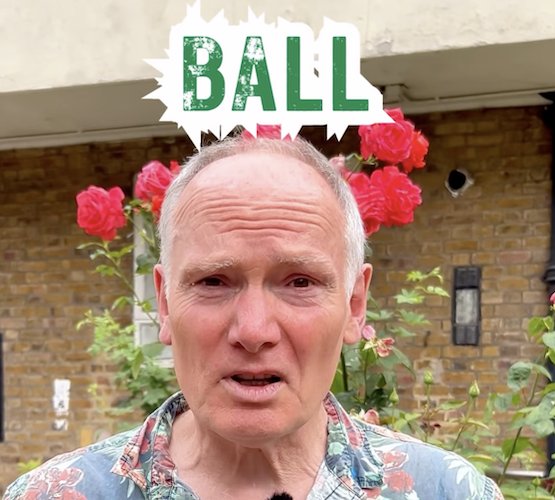
Soon after winning, Eaves stood down on health grounds. Somerville-Sutherland, a support worker for SEND children, was renominated as the Labour candidate. Replacement Green candidate Michael Ball (pictured) runs a charity in the north of Lambeth and had stood in Kennington in May and in the 2022 elections. Clapham Park was virtually a straight fight between Labour and the Greens, with Labour trying hard to regain what looked like a promising seat. Lambeth Labour has a record of being a strong campaigning force ever since regained the borough against the trend in 2006 under the leadership of Steve Reed, now a government minister.
All five main English parties stood candidates. They were joined by representatives of the Christian People’s Alliance (CPA) and the Socialist Party of Great Britain (SPGB), which is unkindly sometimes called the Socialist Party of Clapham because its electoral bids tend to be confined to that locality.
The SPGB is a venerable organisation, founded in 1904 by Marxists who objected to their party (the Social Democratic Federation) helping to found the Labour Party, but it has found the electoral route to socialism difficult and received only six votes in Clapham Park this time. The CPA did little better, with twelve, though of the “others” only the Lib Dems struggled above a hundred votes. Somerville-Sutherland, surprisingly, was denied again, losing out this time by 43 votes this as he polled 799 (42 per cent). Ball was elected with 842 (44 per cent). Turnout was 20 per cent.
While Streatham St Leonard’s was a bad result for the Greens, Clapham Park was something of a triumph, even though their majority was narrow. In May, Labour’s share of the vote in the ward was four points ahead of them. But for the by-election, the Green share rose by 12 percentage points, and Labour’s by Six, meaning there was a three per cent swing from Labour to Green. It was their most impressive result in any of the by-elections since May.
***
In wards like these two, where the political Right is electorally irrelevant, there are still multiple dimensions to tactical voting. Labour’s vote held up best in May 2026 among its more comfortable liberal professional supporters, and there is a trace of anti-Green sentiment in this quarter. The Lib Dems can appeal to this if they can establish themselves, as in St Leonard’s, as the main alternative.
In Clapham Park and the two Haringey wards the anti-Green vote consolidated around Labour, but the – usually larger – anti-Labour vote consolidated around the Greens. There has not been sufficient time, nor enough visible change, for voters to have come to firm conclusions about the new Green administrations. There is not much sign of a wish to revisit the verdict reached in May despite the impending changes at national government level. On average the Greens are down 0.2 per cent and Labour up 4.5 per cent in the nine London by-elections since May.
Green council seat defences have been unusual in the past, with only one happening (Camden Highgate in November 2023) during the previous council term. But the party’s increased representation has already brought with it far greater exposure to by-elections, with eight of the nine seats contested since May being Green defences. Their three losses have been Streatham St Leonard’s, where Ali’s situation was unique, and in two of the three cases of nominating disqualified candidates (Haringey Northumberland Park and Camden Regent’s Park).
There could be more to come: Green councillors may find that their personal values and their commitments to their ward electors conflict with the disillusioning choices of running local authorities under financial pressure and with limited autonomy. But there won’t be any for several summer weeks. The one current London council seat vacancy, a Labour-held seat in the Trinity ward in Wandsworth, should be a high-pressure contest between what we used to call the two big parties.
Follow Lewis Baston on Bluesky. Image from Lambeth Greens Instagram.
OnLondon.co.uk is funded by sales of publisher and editor Dave Hill’s twice-weekly newsletter On London Extra. If you don’t already receive it, become a paying subscriber to Dave’s personal Substack or follow any Support link on this website.