Blog

Dave Hill: Ending the Brexit state of mind

Below is the start of the lead piece from the latest edition of the On London Extra newsletter, published on Substack. It links to the rest at the end. Sales of On London Extra finance the whole of this website. A free trial is available.

***

An opinion poll has found that 58 per cent of likely British voters would favour rejoining the European Union if offered the chance, while only 37 per cent would oppose it. The London sub-group of the Ipsos survey points to 66 per cent of Londoners wanting to rejoin. Yes, the regional sample size was small. Yet that two-thirds majority feels plausible given that 60 per cent of Londoners voted to Remain ten years ago and that national backing for Brexit has fallen.

The nation, it seems, has been coming round to London’s way of thinking, as have some Londoners who voted Leave. At the same time, though, the capital has continued to be treated by politicians of different kinds as a useful enemy, as a suitable case for neglect and as a problem for the rest of the country.

These strategies have been informed by an enduring Brexit-related state of mind. The EU Referendum outcome has been persuasively described as an expression of anti-London feeling, often directed not against the capital as such but at a London – make that a “London” – of the imagination symbolising things Leave-voters disliked, such as the indifference (perceived or otherwise) of Parliament and Whitehall, cultural and ethnic human variety, and a rich and out-of-touch “metropolitan elite”.

Read the rest of this edition of On London Extra here.

Categories: Comment

Transport for London opens new consultation on DLR extension to Thamesmead

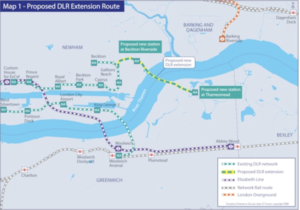
Transport for London has opened a new public consultation on its plans for extending the Docklands Light Railway (DLR) from the south of Newham beneath the Thames into Greenwich and creating two new stations, one on each side of the river.

The scheme would see a new branch of DLR track begin between the existing Gallions Reach and Beckton stations, connecting to a Beckton Riverside station opposite Gallions Reach Shopping Park and a Thamesmead station on the south bank of the Thames via a tunnel under the river.

The extension would facilitate the development of the two areas with housing and amenities, which TfL is describing as being “among the largest remaining brownfield sites in London” and between them potentially able to “support up to 30,000 homes” .

The owners of Gallions Reach Shopping Park, the Edinburgh-based Aberdeen Standard Investments, have in the past expressed a wish to enlarge the site into fully-formed town centre, adding housing and commercial premises. It was subsequently announced by TfL, in December 2020, that the company would contribute to the £1 million cost of a feasibility study for the DLR scheme.

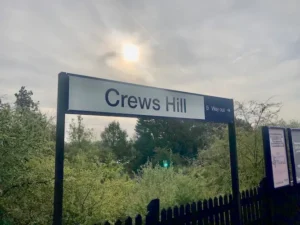
The Thamesmead station would be built on a 100 hectare (247 acre) site called Thames Waterfront owned by Peabody, the leading housing association already undertaking a major regeneration of the 1960s Thamesmead Brutalist housing estate through a combination of renovation, demolition and new homes. Thames Waterfront has also been shortlisted by the government for one of its two London New Towns, alongside Crews Hill and Chase Park in Enfield.

The new consultation will be open until 16 July and TfL says construction work “could begin in 2029, subject to funding and approvals” with a “final scheme” to be designed ahead of an intended application for a Transport and Works Act Order early next year. TfL hopes that the extension will open “in the early 2030s”.

In November, the government confirmed its support for the scheme in its autumn budget following chancellor Rachel Reeves not mentioning it in her Spending Review speech the previous June. However, soon after the speech transport secretary Heidi Alexander told TfL that the government recognised “the potential housing and economic growth that could be stimulated by extending the DLR” and acknowledged the “substantial work” already undertaken.

The total cost of the extension has been estimated at £1.5 billion, with the bulk of the money coming from loans raised by TfL and the Greater London Authority and the government contributing as well, thoiugh how much is not yet known.

OnLondon.co.uk is funded by sales of publisher and editor Dave Hill’s twice-weekly newsletter On London Extra. To start receiving it, become a paying subscriber to Dave’s personal Substack. Thanks.

Categories: News

Richard Derecki: Henry Moore’s Monumental Nature

You could bump into one in any of a dozen public spaces across London: in a park, a college courtyard, in front of a hospital or on an estate. There’s even one in a church in the City. Henry Moore’s monumental sculptures, typically of reclining figures, interlocking shapes or standing groups have long intrigued, inspired and provoked controversy.

And now there are more than 30 of Moore’s works gathered together in Kew Gardens, which is showcasing a once-in-a-generation presentation of his practice. Set against Kew’s historic landscapes and broad sweeping vistas are large forms and semi-abstract figures, but also, in Shirley Sherwood Gallery of Botanical Art at Kew, smaller wood and stone carvings, prints and drawings.

Moore was born in 1898 in Castleford near Leeds and was one of eight children. His father was a coal miner and ambitious for his children. He was particularly keen that they became teachers. Moore’s drawing abilities were quickly noticed at school, and he was encouraged to try painting and pottery. Sent to France during World War One, in November 1917 he suffered a mustard gas attack at Bourlon Wood during the Battle of Cambrai. He later studied at Leeds School of Art and then, on a scholarship, at the Royal College of Art (RCA) in London.

Already fascinated by the shapes he saw in landscape and formations he found in fossils and stones, Moore focused on working with clay and on carving. He would spend his free time wandering the British Museum, captivated by the African and Mexican sculptures on display. A part-time teaching role at the RCA gave him some financial security to produce pieces for sale.

Between 1924 and 1928, Moore lived and worked in Hammersmith, specifically 3 Grove Studios, Adie Road. A local heritage plaque marks the building. After his marriage to Irina Radetzky, a Ukrainian refugee from the chaos of the Russian revolution and herself a talented artist, they moved to a larger space on Parkhill Road, Belsize Park.

In 1928, Moore secured his first public commission. He and five other avant-garde artists were tasked with carving giant reliefs symbolising the four winds to adorn the new headquarters of the Underground Electric Railways Company of London – principal forerunner of the London Underground – at 55 Broadway, near St James’s Park. The pieces were to sit on a band of stone 80 feet high but had to be visible from street level.

Moore was given the West Wind, which he carved out of Portland stone in three sections. The central section of the figure weighed over two tons and the three together were more than two metres long and one metre high. Once finished, they were hoisted into place and fixed. But there was a problem with the naval area, so Moore was forced to go up in a cradle, winching himself from side to side, and hammer out a belly button as the cradle zigzagged all over the place.

While Moore’s work had admirers, many commentators were hostile. His more abstract pieces were deemed inaccessible and his human forms, lumpy and lacking beauty. Taking his niece to see West Wind, Moore asked a stranger who was gazing up at the sculpture what he thought of it, the stranger replied: “Who did it? Bloody awful isn’t it!”

Moore rejected the idea that his work should, as with classical sculpture, seek anatomical perfection and be purely representational. He spoke of universal shapes to which everybody is subconsciously conditioned, so his artwork was not aimed at reproducing natural appearances but to inspire feelings that have a spiritual dimension.

His reclining figures, a dominant theme of his career, with their fluent and rhythmic forms, reflect an ancient rolling landscape. His more abstract pieces create a tension between the forms natural to the material and the concepts of the imagination. “An artwork should be an expression of the significance of life,” Moore said, “a stimulation to a greater effort in living.”

In September 1931, Moore was appointed to run the sculpture department at Chelsea School of Art, where he taught for two days a week. He had a small number of dedicated students, and some of the painters would come by to try their hand too. He was remembered as a thoughtful and supportive teacher, but Moore’s commitment was always to his own practice, though he did enjoy the pub lunches down the King’s Road.

Following the start of the Blitz in September 1940, the school was moved out to Northampton, but Moore refused to follow. One evening, returning home by Tube, he noticed people bedding down along the platforms to take shelter from the overnight bombing raids. Conscious of the need to preserve the privacy of the sleepers, Moore would commit to memory their positions and expressions and spend the next days sketching.

His Tube shelter drawings captured the stoic suffering of people at a time of great danger. They resonate with the experience of so many today who face potential destruction delivered from above in an arbitrary, senseless fashion. The drawings and others he did at the time showing the damage wrought on London were displayed along the works of other war artists at the National Gallery and proved hugely popular. They became his most famous works.

Moore’s own house and studio suffered bomb damage, so he and Irina moved to a dilapidated farmhouse in Hertfordshire, which they restored and where they lived and worked for the rest of their lives. Moore achieved international recognition when a collection of his works won him the International Sculpture Prize at the 1948 Venice Biennale.

Controversy and criticism continued to dog his career, yet his work became the go-to for many international corporations looking to project a modernist, progressive cultural awareness. Banks, insurance companies, art galleries and UNESCO commissioned and bought his creations.

For Moore, sculpture was an art of the open air. “Daylight, sunlight is necessary to it and for me it’s best setting and complement is nature,” he said, in 1951. “I would rather have a piece of my sculpture put in a landscape, almost any landscape, than in or on the most beautiful building I know.”

Now there’s an opportunity to see his work in Kew’s majestic grounds. Make up your own mind and hopefully find something that speaks to you. The Henry Moore: Monumental Nature exhibition is at Kew Gardens until January, 2027.

Follow Richard Derecki on Bluesky.

OnLondon.co.uk is funded by sales of publisher and editor Dave Hill’s twice-weekly newsletter On London Extra. To start receiving it, become a paying subscriber to Dave’s personal Substack. Thanks. 
Categories: Culture

Dave Hill: Crews Hill New Town tests

Below is the start of the lead piece from the latest edition of the On London Extra newsletter, published on Substack. It links to the rest at the end. Sales of On London Extra finance the whole of this website. A free trial is available.

***

Downing Street has said it will back city Mayors with building big housing schemes and has named Enfield Council as a blocker. That borough is now led by a very right-wing Tory thanks to a handful of Greens enabling it. Those theoretical progressives share the right-wing Tory’s view that a New Town should not be permitted on Green Belt land. But it looks as if this blue-green conservationist alliance is out of luck.

Tools already exist for over-riding the objections of local London politicians to large development schemes. They are in Sadiq Khan’s hands, and the Prime Minister has signalled that he wants them used. The key one is the creation of a fourth Mayoral Development Corporation, following those set up for the Olympic Park, Old Oak and Park Royal and, most recently, the Oxford Street district. The local rail service would come under the control of TfL, including Crews Hill station which serves the earmarked area.

The stage is therefore set for a major test of London government’s vision, values and know-how. What will be required to construct the New Town and do it well?

Read the whole thing here.

Categories: Comment

John Vane: The Etcetera Theatre (and so on)

The no-cars part of Camden High Street is like a set for a Wild West movie inspired by psilocybin. Dragons and giant footwear burst from walls above shopfronts. Pop art and tattooists vie for your attention with candy shops and Colonel Sanders, like some parodic, peak Haight-Asbury montage.

It’s all perfectly in keeping with a London neighbourhood where, half a century ago and more, potheads could purchase bongs and mystery herbs of borderline legality without much fear of the constabulary. Maybe they still can.

Being there the other day was quite a trip, and wilder still for the smell of fresh rain on streets lately parched by blazing heat. If you didn’t know better, the foursquare Oxford Arms, which has commanded the junction with Jamestown Road since late Victorian times, might have been a hallucination.

It wasn’t, though the strands of London tradition it pleasingly combines do include a form of mind-expansion. That’s intended as a compliment to the Etcetera Theatre, which has been nestling in its darkened niche upstairs and putting bums on its 42 narrow bench seats since 1986.

Most of those seats were taken for the opening night of Ghosts of West Hollywood, a solo show by Tino Orsini. Many were filled by a party of around a dozen, whose members leaned back or forward as required so that one of them could capture a group selfie. The dark compactness of the scene enhanced the impact of Orsini’s entrance, making him seem vast in his check shirt and dungarees.

The performance, which runs until Sunday, is billed as exploring “the pursuit of an acting career in Hollywood and the personal cost of reinvention”, blending “confessional storytelling with dark humour and theatrical flair”.

Its story starts in Italy, then moves on to reminiscences of a childhood in Fulham that evoked, at least in my subjective and perhaps mistaken imagination, a time when that part of town was not quite as smart as it is now. Encounters with addiction and HIV ensue, along with chasing that LA dream, a return to London and a recovery.

Theatre on this scale feels minutely intimate, with no hiding place for the lone deliverer of 45 or so minutes of self-penned lines, each one of them memorised and rehearsed. To me, watching alone from near the back, that fragility seemed to nurture a kind of solidarity with those who’d picked this entertainment offer for their night out. Each time a quip or wry observation got a laugh it came as relief, as if a tightrope walker had taken and completed a risky step without falling.

At the end, Orsini bowed, acknowledged the slide projectionist in his tiny annex and thanked his audience for its kindness. He also asked it to spread the word about Ghosts of West Hollywood (and so, in my small way, I have).

Then it was back to the Wild West movie set, past the Underground station becalmed by the RMT, a sprint for a Number 59 and the steady journey home, thinking about what a jewel the Etcetera Theatre is and how they don’t have a bus service like London’s in West Hollywood.

John Vane’s London novel, a political satire called Frightgeist, can be purchased here.


Categories: Culture, John Vane's London Stories

Dave Hill: Lambeth. Green leader. And Green fudge?

On Monday night, 1 June, 24 long days after the borough elections, Martin Abrams became the new leader of Lambeth Council, the first Green Party councillor to secure the role. His elevation to the head of a minority administration followed intense negotiations with the Liberal Democrat group which, though smaller in number than both its Green and Labour counterparts, holds the balance of power between the two.

Much of the discussion was not about who had the strongest case for leading the council: the Lib Dems were clear that although the Greens had fallen short of a majority and have already lost two of their original 29 councillors to resignations – by-elections to replace them will follow later this month – they were still the largest party with 27 members compared with Labour’s 26 and the Lib Dems’ eight, and were therefore are entitled to take the helm.

Rather, it centred on the conditions the Lib Dems would demand were met in return for enabling a Green-led council to happen. These concerned the very fundamentals of how the council takes decisions and the distribution of power and responsibility among its 63 elected members. That matter too was decided on Monday night. How it happened is quite a tale.

Let’s begin with Lambeth Greens’ manifesto which, on page 23, said that one of its “aims” was to:

“Move Lambeth from the cabinet model to the committee model, giving councillors and residents more accountability and collective power.”

Dumping one local government decision-making structure (more formally known as “executive arrangements“) for a completely different one is a major undertaking. There are specific rules to follow and considerable re-organisations of local authority bureaucracy – its “democratic services” – are entailed.

On top of that, changing from the Leader and Cabinet model (to give it its full title) to the Committee System model, which is what the Greens had in mind, has recently become legally problematic because of the English Devolution and Community Empowerment Act. One of the Act’s objectives is to completely do away with the Committee System, which is currently used by very few local authorities in England and by only one in London (Richmond).

As for the Lib Dems, they had a manifesto pledge of their own about local decision-making. This was a much more general promise to “ensure residents shape decisions that affect them”, including by ending what it called a “‘Town Hall knows best’ culture”. However, it enabled discussion with the Greens on the common ground of seeking to move Lambeth away from Leader and Cabinet governance to something both parties regarded as better for democracy, transparency and scrutiny.

Supporters of the Leader and Cabinet arrangement believe it leads to stronger, speedier and more decisive local government. Opponents think it concentrates too much power at the top, marginalises most councillors and excludes residents. The Lib Dems and the Greens moved forward together on the basis of their shared opposition, but there were lots of issues to consider.

Would moving to a Committee System even be legal? Although it had received royal assent on 29 April, the provisions of the English Devolution and Community Empowerment Act had not yet come into effect. And although th Act sought to replace the few remaining Committee Systems with Leader and Cabinet set-ups, certain restraints had been introduced when the legislation passed through the House of Lords.

Summarising the new Act, the UK Constitutional Law Association has explained that if a Committee System became a local authority’s governance arrangement “by virtue of a resolution” it would be “protected” for five years. A local government resolution is an official statement by that authority of its position on an issue. And the Local Government Act 2000 (Section 9KC) states that “a resolution of a local authority is required in order for the authority to make a change in governance arrangements”.

This meant that any governance arrangement change in Lambeth could not be adopted by the council until the necessary resolution had been made. Furthermore, the making of that resolution would have to take place both in time for the governance change it referred to be voted on at the council’s Annual Meeting and before the provisions of new Act came into effect. There was very little time available and the Annual Meeting was already scheduled for 27 May.

A procedural ploy was devised to enable the calendar choreography. Legal advice was that there were risks with this, but the Lib Dems thought these manageable. A quintet of Green councillors deployed their right to have an Extraordinary Meeting held at which the necessary resolution could be made. This was set for 1 June. And to ensure that councillors could vote on the resolution at this year’s Annual Meeting – next year’s would, of course, be far too late – the Greens and Lib Dems saw to it that although the Annual Meeting would begin, as required, on 27 May, it would be adjourned and not completed until after – indeed, directly after – the Extraordinary Meeting had taken place.

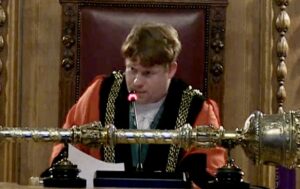
That was the plan for switching Lambeth Council to a Committee System just before doing so became illegal, and for retaining it for as long a the law allowed. But the the plan never came to fruition. That was because the Greens had second thoughts. The Extraordinary Meeting was declared closed within 30 seconds of beginning because, in the words of the borough’s ceremonial mayor (pictured) who chaired the meeting, “the five councillors who requisitioned the meeting have since withdrawn their request”. According to some interested parties, the decision to do this had been made several days earlier.

Exactly why the Greens changed their minds about adopting the Committee System is hard to know. In a press release, they said “the move became untenable due to central’s government’s move to effectively ban the model” but there has been no response to my request for elaboration. Sources in the other party groups variously speculate that the legal advice had “spooked” the Greens or, more cynically, that the prospect of leading the council had caused them to take a slightly warmer view of the Leader and Cabinet arrangement.

Whatever the reason or reasons, when the Annual Meeting resumed on Monday evening the Greens brought forward a different idea for changing how council’s decisions would be made. This took the form of an emergency motion to tweak the council’s constitution. Rather than seeking a complete change of governance model, they proposed instead an adjustment of the Leader and Cabinet arrangement to create what they later called “a hybrid Cabinet Committee model under the existing system”.

What, exactly, is that? A 2020 paper from the Centre for Governance and Scrutiny says this:

“A hybrid model is one that combines the features of more than one governance model. So there are some councils operating under the leader/cabinet model where scrutiny committees carry out detailed debate and discussion on forthcoming Cabinet decisions, and where Cabinet essentially rubber stamps what they decide.”

Under this set-up, council committees, though legally their role is limited to scrutiny, effectively act as de facto decision-making bodies. So, was the hybrid route a different way of achieving essentially the same thing as a Committee System, or was it, as both the Lib Dems and the Labour group have said, a Green U-turn made even before Abrams had been appointed council leader? If not a U-turn, then a timorous Green fudge?

The Greens, naturally, protest otherwise. And the “hybrid” system does seem to meet two of what the Lib Dems call the “three key tests” they set for the Greens to pass before the would enable them to form an administration: changing the council’s constitution “so that opposition parties can properly scrutinise and influence council decisions” and involving “local councillors more in decisions impacting on their ward”. (The third, significantly, given the Greens’ anti-establishment aspirations, was that they “commit to a legal, balanced budget”).

At the resumed Annual Meeting, the Lib Dems also amended the Green motion in ways they say will bring decisions back to the council if the leader and his cabinet members “depart from the recommendations of committees” and also ensure that committee chairs are elected by the full council, rather than being picked by the leader and cabinet. The amended motion was passed with Labour backing.

Will the new way work? Labour’s view of the original plan was that it would create cost and confusion, and in her valedictory speech outgoing council leader Claire Holland accused the Greens of causing “chaos”. Certainly, the hybrid model, which will take some time to put in place and adjust to, is being introduced at very short notice.

Another possible problem is raised in that Centre for Governance and Scrutiny paper. It argues that hybrid governance forms “can be made to work” but also that although “structures are important…culture – how people are predisposed to behave and think, depending on their roles – is arguably more critical”. Will Lambeth’s new Green leader and cabinet behave and think in the way the hybrid model supposes? What if they don’t?

All of that is for the future and judgements will be made over time. That said, potential for disruption and dysfunction in the way Lambeth works surely already exists, what with a tyro minority administration finding its feet and major changes in the way the council functions to be brought in.

Then there are those two by-elections to consider, both of them set for 9 July. Should Labour win them both – perhaps unlikely, but not impossible – it will replace the Greens as the largest party. Would that prompt a Lib Dem re-think? The group does not consider itself to have entered a coalition with the Greens. What might happen if and when the Lib Dems decide the Greens have begun failing one or more of their “key tests”? Lambeth Council is one to keep on watching.

OnLondon.co.uk is funded by sales of publisher and editor Dave Hill’s twice-weekly newsletter On London Extra. To start receiving it, become a paying subscriber to Dave’s personal Substack. Thanks.
Categories: Analysis

John Vane: Arsenal FC and the changing London crowd

The penalty shoot-out is an instrument of torture best escaped from by finding a reason to walk to a corner shop and letting the London street break the bad news.

During my outward journey, the evening ticking towards eight but the sun still Mediterranean, roars and groans from the pub across the road suggested things were in the balance in Budapest. But as the checkout registered my milk and bread, there was no chorus of car horns outside. The pavement drinkers were subdued as I walked home. Back indoors, confirmation on the screen – Arsenal were not champions of Europe.

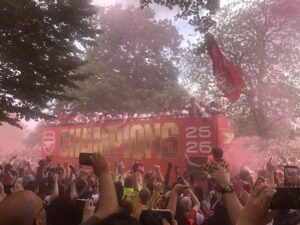
So much for Saturday. Sunday, though, still felt sweet. The route of the Premier League victory parade was lined with fans from soon after noon, descending from all parts of Islington, pouring across the border from Hackney. On Blackstock Road, the Gunner’s Fish Bar was open as I’d hoped, still going after more than 40 years.

Img 8602

Congregants gathered on Clissold Park and the verges of Highbury New Park opposite, where a drum ensemble struck up as the excitement grew with the open-top coaches, making their way from Seven Sisters Road, drawing near.

Img 8616

There were kids on bus shelters, a few fireworks, lots of flares, many songs and the full range of modern day, north London citizenry, including numerous small children.

Img 8605

The coaches emerged to raptures through red mist, followed by a fan entourage that was still filing past 15 minutes later.

Img 8643

To look at that that crowd, to feel its mood, was to almost touch half a century of London change.

Img 8632

The lovely home movie below of the Premier League and FA Cup double winners’ slow drive of 2002 ends up at the old Arsenal stadium, a site since redeveloped as housing, though with the 1930s East Stand still intact, as the club moved to a newer, larger home nearby.


Step further back in time to 1971 and a London in decline. The news coverage of Arsenal’s first ever domestic double triumph – in those days, the FA Cup and the the Football League, Division One – conveys a poorer, paler, more male and more municipal air, with team captain Frank McLintock greeted by Islington’s municipal mayor on the steps of the town hall.


Back then, McLintock, a Glaswegian, was about as foreign as an Arsenal player got. The English football business, even at its richest and most prestigious, was not yet trading on global markets. The Premier League was yet to come. The London crowd Arsenal FC pulls today would have seemed a world away.

OnLondon.co.uk is funded by sales of publisher and editor Dave Hill’s twice-weekly newsletter On London Extra. To start receiving it, become a paying subscriber to Dave’s personal Substack. Thanks.

Categories: Culture, John Vane's London Stories

Dave Hill: The capital’s contribution

Below is the start of the lead piece from the edition of the On London Extra newsletter sent out on Tuesday. It links to the rest at the end. Sales of On London Extra finance the whole of this website. A free trial is available.

***

You’ve heard the one about how flash Londoners live the high life at the expense of honest northern folk, feasting on their taxes and getting the Elizabeth line while the rest of the country has to make do with handfuls of warm gravel and trains that are almost as old as the ones on the Bakerloo?

You might have also heard the one about how London gets far less public money spent on it than it generates in taxes, and that were this not the case Andy Burnham’s telly would be a a monochrome eye in Bakelite and Blackpool wouldn’t have an NHS.

As regular readers know, the second story is the true one – poetic licence aside – and has been for years. What is more, it seems to be getting even truer.

Continues on Substack here.

Categories: Comment