Blog

Enfield: Greens enable formation of minority Conservative rule

Four newly-elected Green party councillors last night installed Conservative councillor Alessandro Georgiou as leader of Enfield Council and head of a new minority Conservative administration – all without raising a hand in favour either of Georgiou or his Labour rival Ergin Erbil at the council’s annual meeting.

The council had been left under No Overall Control after the 7 May elections saw the Tories win 31 seats, one short of a majority, with Labour retaining 27, down 11, and the Greens holding the balance of power with five, one of whom did not attend last night’s meeting.

The Greens’ decision to abstain from last night’s vote for council leader guaranteed Georgiou’s win, putting an end to 16 years of Labour control of the borough.

The change has already enabled two key policy shifts, with Georgiou withdrawing support for the government’s 21,000 home New Town scheme for the Crews Hill area, and pulling out of the previous administration’s controversial plan to lease separate Green Belt land to Tottenham Hotspur FC for a women’s football training centre.

The now former council leader Erbil wasn’t impressed, accusing the Green group of entering a “cynical backroom deal” to “gift” power to the Conservatives. “Those who voted Green have every right to feel betrayed,” he said.

Labour’s own attempts since the election to woo the Greens had included offering of a number of “meaningful” roles, such as chairing the powerful backbench scrutiny committee. But ormer cabinet member Alev Cazimoglu said on X/Twitter that those overtures had been rebuffed. “They still chose the Tories,” she wrote.

The Green group did not explain their position at the meeting, but a party statement said the abstention did not signal a coalition or other formal arrangement with the Conservatives. The party would not endorse the programme of any other party, and votes would be decided “case by case”, with no other party given “a free pass” it said.

As early as election night itself, Green winners had suggested that would be their approach and giving the nod to the Conservatives was unsurprising, given the two parties’ shared commitment to protecting the Green Belt and opposing the Crews Hill and Whitewebbs developments, which the Labour administration had backed.

With the Conservatives now given a free hand on the council’s executive though, the extent to which the Greens’ independent stance can secure its pledges to “oppose Conservative cuts” and “stand firm” on issues such as active travel remains to be seen.

A key point of contention will be the pledge in the Tory manifesto to end the “war on the driver” by removing bus and cycle lanes, cancelling plans for a boroughwide 20 mph speed limit, scrapping the borough’s two Low Traffic Neighbourhoods (LTNs), allowing 30 minutes of free parking on high streets and making it easier for residents to instal front garden parking spaces.

The Green manifesto, by contrast, pledged more “low-traffic and low-speed neighbourhoods” alongside a focus on “preventing” rather than policing anti-social behaviour. The Greens teaming up with Labour could blunt the Tories’ pro-car stance, but it may be what some are already calling a “NIMBY alliance” between the Greens and the Conservatives will have the widest repercussions, particularly by putting the Crews Hill New Town scheme  – a government flagship proposal – under challenge.

This week, Sir Sadiq Khan declared his hand firmly in favour of new homes, going over the head of Barnet Council to approve some 1,700 on schemes in Finchley and at High Barnet station car park. He retains the option of taking over the New Town development via a mayoral development corporation, but the election outcome in favour of parties opposing the project may suggest a compromise – perhaps a reversion to previous Local Plan proposals for some 5,000 homes on the site.

Meanwhile Enfield’s new Tory administration is pledging to “utilise every legal instrument at our disposal to vigorously oppose any mandates from the Mayor of London or the Government that threaten the character or wellbeing of our borough” and the Greens have set the Tories a test of delivery, meaning “genuinely affordable homes in sustainable locations, especially social-rent housing”. Difficult choices lie ahead, with a lot at stake for those in housing need in the borough.

Follow Charles Wright on Bluesky. Photo from Enfield Council

OnLondon.co.uk is funded by sales of publisher and editor Dave Hill’s twice-weekly newsletter On London Extra. If you don’t already receive it, become a paying subscriber to Dave’s personal Substack or follow any Support link on this website.

Categories: News

Lambeth: Greens and Lib Dems take next step towards governance change amid Labour charge of ‘chaos’

Lambeth Council remains on course to radically change its decision-making processes thanks to an agreement between the Green and Liberal Democrat groups on the No Overall Control authority, which also involves the Lib Dems supporting a Green becoming the next council leader.

Wednesday night’s post-borough elections Annual Meeting was adjourned to enable proposals – the details of which aren’t yet known – for switching to a different governance model, to be formally adopted early next week and subsequently voted on.

The Lib Dems and Greens have argued that replacing the current Leader and Cabinet arrangement with a Committee System, a form that used to be commonplace in local government, would ensure that council decision-making better reflects the spread of political opinion expressed at the elections, allowing ward councillors to have greater input and improving transparency and public scrutiny.

However, a Labour spokesperson has described the Lambeth situation as “absolute chaos”, accused the other two groups of changing their minds about the prospective reforms in the course of the day and claiming they are now “panicking about what they can and can’t agree on by Monday”. Labour members also believe the rushed change would entail a major re-organisation and enlargement of council officer resources for which no preparations have been made and result in cuts to council services.

The Green Party won the largest number of seats at the 7 May full council elections, outscoring Labour by 29 to 26, with the Lib Dems winning eight, though the Green group has since been depleted by two resignations. By-elections will have to take place as result, though whatever their outcomes there will still be no party with a majority.

The adjournment, proposed at the Annual Meeting by a Lib Dem councillor and supported by the Greens, was a procedural device to enable an Extraordinary Meeting, instigated by the Greens, to take place before the Annual Meeting resumes. Changes to a local authority’s governance models can only be passed at its Annual Meetings and have to have been backed by councillors separately beforehand.

The Extraordinary Meeting is scheduled to take place next Monday, 1 June. The council’s calendar states that it will “consider a resolution to change the governance arrangements currently in operation from one of Leader and Cabinet to a Committee system” under the Local Government Act 2000.

The speed with which the Green and Lib Dem allies have moved to bring in the change is due to the new English Devolution and Communities Act 2026 making switching to a committee system illegal. The Act received royal assent on 29 April, but its provisions have not come into immediate effect.

In a statement issued on Sunday, the Lib Dems said the Extraordinary Meeting would “make constitutional changes that would turn our principles into reality”. They claimed that the Leader and Cabinet model, used by a large majority of London boroughs, had led to Labour in Lambeth “imposing decisions in the face of local opinion”.

Of the 32 boroughs, only Richmond uses a Committee System. Barnet did so until 2023, when it moved to the Leader and Cabinet alternative following a 12-month transition period. Five boroughs have a directly elected Mayor and Cabinet system.

Labour was scathing about the Lib Dems and Greens, pointing out that the Lib Dems did not specifically advocate going back to a Committee System in their election manifesto and claiming that although the Greens had done so, they had at one point on Wednesday backed away from the idea then thought better of it when the Lib Dems threatened to withdraw their support for making Green group leader Martin Abrams leader of a minority administration.

The Annual Meeting, much of which was difficult to follow on the council’s webcast due to the sound disappearing or being of poor quality, elected a Green councillor as Lambeth’s new mayor. He went on to chair the meeting. A deputy mayor was elected from the Lib Dem group.

Most of the rest of the meeting was taken up with procedures and speeches relating to the adjournment. This meant a new leader was not appointed, leaving Labour’s Claire Holland in place for the time being. Abrams was elected to the council as a Labour candidate in 2022, but defected to the Greens last autumn, having been suspended by Labour in 2024 for refusing to vote against a Green councillor’s motion calling for a ceasefire in Gaza. Prior to his defection he had reportedly been deselected by Labour.

Labour says it is not unsympathetic to the committee system in principle but it is understood that members of the group regard switching to it so quickly as irresponsible, complaining that no concrete proposals have yet been supplied and claiming that considerable extra financial costs would accrue due to more councillors needing to be briefed and guided by officers, which would have to be met from cuts to services.

Advocates of the Leader and Cabinet system consider it more efficient at making decisions and using resources. Lambeth’s finances are presently subject to medium term financial strategy devised to enable in-year savings and has lately been granted “exceptional financial support” by the government to help it balance its books.

Getting the governance change made before it becomes illegal also entails completing it within 21 working days of the full borough elections taking place.

It had been thought by some involved in behind-the-scenes discussions at the Town Hall that the deadline was 21 calendar days, raising the question of whether it was allowable for an Annual Meeting begun within 21 days to be adjourned and not resumed and completed until after that period. However, it is understood that Lambeth’s constitution excludes weekends and Bank Holidays when setting the deadline.

Photo: Lambeth Town Hall interior from Lambeth Council website.

OnLondon.co.uk is funded by sales of publisher and editor Dave Hill’s twice-weekly newsletter On London Extra. To start receiving it, become a paying subscriber to Dave’s personal Substack. Thanks.

Categories: News

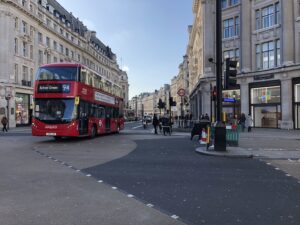
Westminster: Conservatives drop plan for Oxford Street judicial review

Straight after the Conservatives gained control of Westminster Council from Labour on 7 May, their leader, Paul Swaddle, made a point of repeating his intention to challenge Sir Sadiq Khan’s plans for transforming Oxford Street through the courts.

He immediately told the media a legal fund would promptly be set up for that purpose, and on the 11 May, appearing on the Political Business podcast, he said that earlier that day he had instructed the council’s chief executive to “look at all legal avenues” for thwarting the Mayor.

But now he has revealed that the judicial review avenue, which might have challenged the lawfulness of Khan and Transport for London’s decisions, will not be followed. The reason? The answer seems to be straightforward – there wasn’t enough time.

Swaddle disclosed the problem on X/Twitter yesterday, saying “the advice is that a successful Judicial Review is simply impossible at this late stage”. However, in the same post he repeated his vow to “explore every legal avenue” that might remain, and a statement on the Westminster Conservatives’ website insists that “this administration will use every legal lever available to it” and that “Every option remains open”.

Labour has responded with some derision, claiming the Tories have “dropped plans for legal action” following “months” of campaigning on the issue and describing Swaddle as having “backed down from his earlier threats”.

The party had mounted its own opposition to the Mayor’s plan, which was announced with little notice given in September 2024, rendering redundant the then-Labour Westminster administration’s own programme for improving the the Oxford Street area, which did not involved pedestrianisation.

Rather than looking to legal action, Labour negotiated what it regards as significant recognitions of its concerns, including the council continuing to keep contributions from property developers who build within the area now governed by a mayoral development corporation.

Swaddle blamed his need to abandon seeking a judicial review on Labour, claiming it should have taken legal action when it ran the council. Khan signed off the development of “detailed pedestrianisation proposals” for the section of Oxford Street between Great Portland Street and Orchard Street on 26 February, leaving little time after the borough elections for the Conservatives to act, as judicial review applications must be filed within three months of the decision to be challenged being made.

However, Geoff Barraclough, Labour’s spokesperson for economic development, said the Tories had “misled voters” with a “spurious promise” of a legal challenge they knew was unlikely to be made. “The new leadership of Westminster City Council now needs to stop grandstanding and start working constructively with all parties,” he said.

Khan intends to have the part of Oxford Street covered by his February decision operating without traffic by the end of the summer.

OnLondon.co.uk is funded by sales of publisher and editor Dave Hill’s twice-weekly newsletter On London Extra. To start receiving it, become a paying subscriber to Dave’s personal Substack. Thanks.

Categories: News

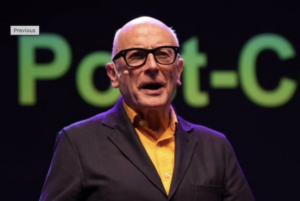
Talk About London Podcast: Peter Murray – the man who would be Mayor

Anyone who knows anything about the many aspects of London’s built environment knows who Peter Murray is. Born in 1944, he studied at the Royal West of England Academy in Bristol and the Architectural Association School of Architecture in London, and went on to become editor of Building Design magazine and the RIBA Journal before, in 1983, he launched the innovative Blueprint magazine with Deyan Sudjic. In 2005, Murray co-founded New London Architecture, a hugely influential membership organisation for the built environment sector, and he later led the revival of The London Society.

How fitting, then, that he should be a recent guest of The London Society’s Talk About London podcast to discuss the latest of his many ventures – making a bid to become Mayor of London in 2028, running as an Independent candidate with the mission of bringing the built environment sector together to deal the city’s acute housing problems, improve its transport systems, strengthen the city’s economy and equip it for the future. He gave my co-host Leanne Tritton and I a taste of his evolving policy programme and the passions and experience that lie behind it.


More Talk About London podcasts can be found on my YouTube channel, along with my separate True London series. All London Society podcasts can be found here. Photo from Peter Murray’s website.

OnLondon.co.uk is funded by sales of publisher and editor Dave Hill’s twice-weekly newsletter On London Extra. To start receiving it, become a paying subscriber to Dave’s personal Substack. Thanks.

Categories: Analysis

Ann Campbell: Choosing between London’s two legendary cricket grounds

Two of the great cricket stadiums of the world are right here in London: Lords, located in St John’s Wood, known as the “home of cricket” and the base of the Marylebone Cricket Club (MCC), custodian of the laws of the game; and The Oval in Kennington where, in 1882, the “death of English cricket” was satirically proclaimed after Australia beat the home side on its own soil for the first time, giving rise to the “The Ashes“, the winners’ trophy in Test Match series between the two countries ever since.

During international matches, these two iconic old grounds are packed. Tickets are expensive and hard to come by. But in the earlier part of the cricket season, it’s a different story. My companion and I visited both to compare the cost, facilities and entertainment value at a couple of early season County Championship matches.

First up, a Saturday visit to the Oval, where home team Surrey hosted Essex on day two of four-day match. Tickets were just £15 for an adult and easy to obtain online. Getting in was easy too, with the ground just a few minutes’ walk from Oval tube station and nothing too tedious about the ticket inspection, the security check or finding seats. In fact, we could to sit anywhere we wanted except in the club members’ areas, and were free to move around, following the sunshine, during the day.

We enjoyed being able to spread out our belongings, a luxury unheard of in the packed environment of a Test, when space is at a premium and much time can be spent tucking in your knees as spectators come and go (too often these days while an over is underway). We were glad to have brought our own picnics, though, as there were few options for buying food and drink inside.

The closed outlets gave the Oval walkways a bit of a pre-season feeling.  There was only one bar, where a large glass of rose cost an eye-watering £13.70, a food outlet called The Crispy Wicket and an ice cream van. My companion said we shouldn’t complain – no one had checked whether we’d exceeded our drink limit of four cans of beer or a plastic bottle of wine per person – and service was friendly and prompt when we did need it.

So often, towards the end of a long day at a Test, the crowd is more than a little the worse for wear and the stands are littered with empties. But here there was less drinking, and a patient, appreciative crowd took its rubbish when it left. Our sense was that people were there because they followed Surrey and knew the traditional game. A few were even keen enough to fill in the outcome of every ball bowled in their scorebooks.

At Lords, it was day one of Middlesex versus Durham. Tickets, at £20 for adults, were easily available if a slight tussle with app was required. Lords isn’t quite so handy for public transport as the Oval and half the stands were closed off, but there was a good crowd in, with plenty of members in the pavilion in their distinctive red and yellow ties (perhaps they don’t use the tube) and several school groups enthusiastically demanding – and getting – autographs from a very patient and perhaps slightly bemused Durham stalwart Graham Clark, fielding in the deep.

As with the Surrey match, there was less drinking than at a Test, a very pleasant atmosphere and knowledgeable fans. The wine was £8.50 for a 187 ml tin, but there too you could bring your own food and drink – two cans of beer or one bottle of wine in this case – and you needed to, as even less was on sale at Lords than at the Oval.

Both venues offered the same extra treat – the chance to walk on the ground during the lunch break. It’s a lovely bonus to stroll on the velvety grass, get close enough to inspect the wicket and take a selfie in front of the pavilion. At Surrey’s ground, kids could even have a quick game on the outfield and later say they’d played at the Oval. You could picnic there too – or, like one spectator, lie down reading Brideshead Revisited – whereas at Lords it’s hard to find a bit of lawn that you are allowed to even sit on.

A visit to Lords is a big day out. Emerging onto the pitch, with its famous views and sense of history, is a moment in any sports fan’s life. The strict dress code for members makes for a smart crowd and there’s something special about the mix of tradition and sporting prowess. The Oval can’t quite compete with this (though perhaps as it has its own heritage, a solid body of county support and the club’s winning ways, it doesn’t really want to).

As for the games themselves, much has been written about batting-friendly wickets that make high-scoring draws the most likely outcome. The runs piled up on both days, but boundaries and wickets were scarce. There was entertainment nevertheless from seeing Test stars and hopefuls trying to catch the eye of the selectors. Plenty of them were there too: Sam Cook, Ollie Pope, Jamie Smith, Dan Lawrence, Gus Atkinson and Dom Sibley at the Oval; Emilio Gay, Ben McKinney and Matthew Potts at Lords. At Lords, there was also a glimpse of the great man himself, Durham’s Ben Stokes, captain of the England Test team, albeit in the practice nets, not on the pitch.

Choosing between them, I went for Lords, with its sense of theatre and occasion, and my companion went for the Oval, iconic in its own less formal way, with its fans appreciating the nuances of the four-day game in the sunshine. He was not alone – that match was watched by more than 15,000, a record Championship attendance at the Oval this century. No wonder. Not T20-style exciting for sure, but the teams’ commitment, the buzz of seeing big-name players showing off their skills, the politely absorbed crowds – these make for great value days out.

Photo of Oval crowd from Kim B X/Twitter feed.

OnLondon.co.uk is funded by sales of publisher and editor Dave Hill’s twice-weekly newsletter On London Extra. To receive it, become a paying subscriber to Dave’s personal Substack. Thanks.

Categories: Culture

Lambeth: Green-Lib Dem deal set to end Labour rule and bring back committee system

Green and Liberal Democrats councillors in Lambeth have struck a surprise political deal that looks set to end Labour control of the borough and see the re-introduction of running the local authority through councillor committees, which the parties say would lead to more scrutiny and better decision-making.

The deal appears to have brought to an end two weeks of intense behind-the-scenes discussions about who should run the council, after no party secured a majority at the elections of 7 May. The Greens formed the largest party group with 29 councillors, Labour finished second with 26 and the Lib Dems won eight seats.

The Greens have since lost two of their councillors, meaning by-elections must be held to replace them, but their combined total with the Lib Dems still outnumbers Labour’s and would continue to even if Labour won both by-elections, which won’t be held until after the decision about the new arrangements has been taken at a special Extraordinary Meeting of the council on 1 June.

The council’s Annual Meeting is currently due to take place before that, on 27 May, and scheduled to elect the next council leader, though it is understood that this might change with the meeting being adjourned and agenda business conducted on 1 June instead.

As part of the Green-Lib Dem agreement, there will be a Green leader and deputy leader of the council after two decades of Labour control. The Greens and Lib Dems have also agreed to rotate the mayoralty position – which carries a potential casting vote – between them over the next four years.

The current leader and cabinet set-up concentrates more power at the top of local councils and is designed to produce faster decision making. The Labour government recently passed a law – English Devolution and Communities Act 2026 – preventing councils from reverting to the committee system, but the Greens and Lib Dems have taken legal advice and say they can make the change before the Act comes into force on 29 June. The legislation was pushed through by housing, communities and local government secretary Steve Reed, a former Labour leader of Lambeth.

The Lib Dems had been talking to both the Greens and Labour about the possibility of going into coalition under the existing system, but found instead a basis to move forward with the Greens around their shared desire to bring the committee system back. The membership and chairing of committees would be shared out on a proportionate basis, leading to what the two parties say is more effective form of governance that gives more sway to opposition councillors.

As well as running the council, Labour’s dominance meant its own members also chaired the important overview and scrutiny committee, meaning Labour council policies were interrogated by Labour councillors. The Greens and Lib Dems  have agreed that from now on this work should be led by an opposition councillor. As part of the deal, the Lib Dems demanded an assurance that the Greens would set a legal, balanced budget.

The Green-Lib Dem deal looks set to bring to an end Claire Holland’s five years as Labour leader of the borough, as well as her role as chair of London Councils, which represents the capital’s 33 local authorities.

Apart from Richmond, which adopted it in 2019, Lambeth would be the only London council run through the committee system – a standout surprising outcome in what was already a multi-faceted set of election results

Green group leader Martin Abrams said moving to a committee system was in his party’s manifesto and could now be voted on: “A committee system has the potential to open up decision making, give all councillors a meaningful role, and restore proper accountability to residents across Lambeth. Done properly, it can be a more democratic and transparent way to run the council.”

He added: “We hope we can work constructively with the other parties over the coming days to make sure this new structure is designed in a way that genuinely works for Lambeth residents and allows us collectively to deliver on the commitments made to people across the borough. The detail of how this system is implemented will matter enormously, and we’ll be engaging carefully with that process.”

Lib Dem group leader Matthew Bryant said there was a unique opportunity to change the council for the better: “People voted for change on 7 May, but as in many parts of the country no single party has an overall majority in Lambeth. The committee system is the best way to navigate this multi-party reality. Our proposals will give councillors a real say over decisions affecting their ward. We are determined that local people have a greater voice and that councillors are involved in council decisions that impact their wards.”

This article was corrected on 25 May 2026 to recognise that Richmond Council uses the committee system of decision-making.

Tim Donovan is the former political editor of BBC London and now a trustee of Centre for London. Follow him at LinkedIn.

OnLondon.co.uk is funded by sales of publisher and editor Dave Hill’s twice-weekly newsletter On London Extra. To receive it, become a paying subscriber to Dave’s personal Substack. Thanks.
Categories: News

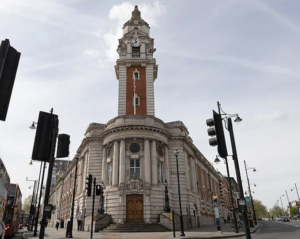
Barnet Council has a Labour leader again. How did it happen?

Many recent London local election outcomes were close, but none were closer than Barnet’s. Labour, which had been in control since 2022, ended up with 31 seats. The Conservatives, who had previously been in control of Barnet throughout its entire history, ended up with 31 seats too. Barnet has 63 council seats in total. A single Green completed the Town Hall line-up. Who would end up being in charge? How would that be determined?

Decision day would be the council’s Annual Meeting to be held on at Hendon Town Hall on Tuesday 19 May, when the next leader was due to be appointed. All concerned pondered and projected.

Both Labour and Conservative sides had candidates for leadership to nominate: the former wanted Barry Rawlings, leader of the previous, majority administration, to continue at the head of a new, minority one; the latter wanted their group leader, Peter Zinkin to take the helm.

Barnet Council leaders are, as is usual, elected by a simple majority vote. However, it can take more than one round of voting to find a winner. That is because at the Annual Meeting each nominee is voted on individually, one at a time. If a majority of councillors vote in favour the first nominee they consider, that nominee becomes the leader and that is that. But if a majority votes against that first contender, the next nominated person is voted on.

Plainly, much would depend on what the sole Green councillor chose to do. Charli Thompson, Barnet’s first ever Green councillor, held the balance of power between the two large party groups.

If all 63 councillors turned up with the 62 who were Labour or Conservative line-up to vote in favour of their respective party nominees for the leadership, Thompson would be in a position to use her single vote to get either Rawlings or Zinkin across the finish line by 32 votes to 31, or thwart either, or thwart both. That last possibility would, if it occurred, leave the council unable to elect a leader on the night and an impasse ensuing.

Thompson also a had further option – to abstain from voting on the leadership. Doing that would bring about a 31-all draw. In such situation, a different tie-break scenario would come into play. Full meetings of the council are chaired by the borough’s civic mayor, a councillor elected by his or her peers. The mayor’s duty is to chair impartially. However, if a voting deadlock occurs, they can use their casting vote – effectively, a second personal vote – to break it. The incumbent mayor was Labour councillor Danny Rich.

You do the maths. Barnet’s councillors certainly did. And here is how the events of Tuesday evening’s Annual Meeting unfolded.

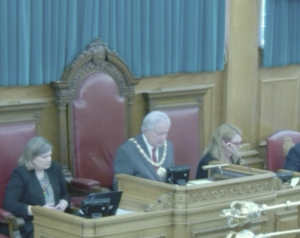
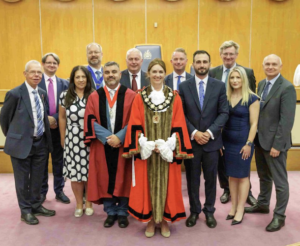
Nominations were made and seconded from the floor, with Rich presiding (pictured, centre). The first nominee to be voted on was Zinkin, the Conservative. All 31 Conservative councillors voted for him. All 31 Labour councillors voted against him. The Green councillor did the same. And so, Zinkin was rejected by 32 votes to 31. The mayor’s casting vote was therefore not required.

Then came the vote for Labour’s Rawlings. All 31 Labour councillors voted for him. The Green councillor Thompson voted against him. And the 31 Conservative councillors? All of them abstained, leaving Rawlings the clear winner by 31 votes to one and appointed leader of Barnet Council again.

Why did the Conservatives do that? What had happened behind the scenes?

Two ways of looking at it have been offered. One way, articulated and held in common by Tory and Labour councillors, is that they had an obligation to minimise the risk of instability and disruption created by the exceptionally close result of the recent council elections.

At the meeting, Labour’s Ross Houston, proposing Rawlings, said he had “always supported collaborative working when it’s possible”. (He also, seemingly anticipating how Rich might act if 31-all votes occurred, maintained that a principle behind mayors’ use of casting votes is ensuring continuity of council business). For the Conservatives, Richard Cornelius referred to “collaborative working, which will be very new for Barnet” and described as “quite something” an “administrative agreement in order to deal with what has happened” that had been made.

The agreement, already hammered out, included the unsuccessful party group leader (who would turn out to be Zinkin) being allowed to attend the leader’s cabinet meetings and have input into discussions, and the opposition group (which would turn out to be the Tories) having better opportunities to scrutinise decisions before they were taken.

Unsaid at the meeting but understood to be the case was a keen awareness of the power the lone Green councillor possessed to bring about instability and disruption if so minded, not only in the matter of the leadership appointment, but also thereafter for as long as she held the balance of power.

Barnet Conservatives said as much in a statement they released after the Annual Meeting: “We were not prepared to enter any arrangement that would hand the single Green councillor disproportionate influence over the borough’s future and leave the administration of the borough in complete chaos.”

The order in which the leadership votes took place can perhaps best be understood in the context of the Tory-Labour agreement.

The Conservatives had been very keen for the Zinkin vote to take place before the Rawlings vote, believing this was the only way they could be certain they could make the case for Zinkin at the meeting. Their calculation was that had the Rawlings vote happened first, he would probably have secured a majority, either because Thompson voted in his favour, judging him the lesser of two evils, or because Rich’s casting vote would have got Rawlings over the line if Thompson abstained.

There was also the possibility of Thompson voting against Rawlings, leading to his rejection and a vote on Zinkin then taking place anyway. Far better, though, from the Tories’ point of view, to pre-empt all vicissitudes by getting the Zinkin vote at the front of the queue of two. Victory would only be secured in the unlikely event of Thompson voting in Zinkin’s favour, but at least the argument for a Conservative leader would definitely get a hearing.

I’m told the order of voting was settled on not by Rich, but by officers and party group negotiators. For Labour’s, this appears to entailed a degree of risk. What if Thompson did indeed voted for Zinkin, thereby handing the leadership to him?

As it turned out, the way Thompson actually voted on Zinkin reinforced the Conservatives’ rationale for facilitating the appointment of Rawlings if and when Zinkin was unsuccessful. It was not a guarantee that she would also vote against Rawlings, potentially creating a no-leader impasse. But it made no difference that she did so, because the Tory bloc abstention pre-empted such an impasse ensuing.

This brings us to the other way of looking at what transpired on Tuesday evening – Thompson’s way. In a speech from the floor she argued that “across Barnet residents feel deeply disconnected from how decisions are made and increasingly frustrated by a political culture that too often manages the status quo rather than confronting the scale of the challenges we face”.

She referred to “constitutional changes” being made in Barnet that, in her view, would exclude the public and her from participating in democratic processes and scrutiny, and she claimed to have approached, without success, both party groups “constructively and in good faith to discuss how we might work differently in a council with no overall control”. She described Labour and the Tories as “teaming up” to maintain the status quo.

There is, though, a deeper backdrop to Labour and Tory Barnet’s reluctance to engage with Thompson and her party. Thompson was, until quite recently, a Labour party member in Barnet. Jewish News has reported her acknowledging being an admirer of Jeremy Corbyn, whose leadership of Labour caused a fall in support for that party in much of Barnet due to his views about Israel and his, in some eyes, poor attitude to Jews.

Barnet has more Jewish residents than any other local authority area in England and many of its councillors are Jews. The Annual Meeting’s opening prayers were delivered by a rabbi. Mayor Rich, himself a rabbi, spoke about the recent spate of antisemitic attacks that have taken place in the borough (noting also that Barnet has the largest Iranian community in the country and that it has come under attack too). Houston, in his speech, mentioned that an antisemitic attack had taken place in his ward. Zinkin represents Golders Green, where some of the most shocking have taken place. “All of us need to maintain our vigilance against hate in all its forms,” Rich said.

Green politicians in other parts of London have been accused of expressing, endorsing and spreading antisemitic attitudes. Prior to the 7 May elections, two Green candidates in Lambeth were arrested on suspicion of doing so. Both were eventually suspended by the party. But if Thompson wants to persuade her Barnet colleagues to engage with her ideas for changing how the council operates, she might have a bit of work to do.

As for the Labour and Tory groups, they regard themselves as having acknowledged the implications of the exceptional closeness of the election result, in which the Tories got a larger share of the popular vote than Labour and missed out on a seat in one ward by just eight votes. There seems to be a healthy amount of goodwill and trust behind the Labour-Tory agreement. “We have to make it work,” said Cornelius, before quipping: “Until the first by-election.”

Watch the webcast of Barnet Council Annual Meeting here. Follow Dave Hill on Bluesky and at LinkedIn.

OnLondon.co.uk is funded by sales of publisher and editor Dave Hill’s twice-weekly newsletter On London Extra. To receive it, become a paying subscriber to Dave’s personal Substack. Thanks.
Categories: Analysis

Dave Hill: Burnhamism means Londonism

Below is the start of the lead piece from the edition of the On London Extra newsletter sent out on Tuesday. It links to the rest at the end. Sales of On London Extra finance the whole of this website. A free trial is available.

***

Andy Burnham’s coronation as “King of the North” and his veneration by some as Labour’s plain-spoken socialist prince across the water has owed a lot to his complaining about “London”.

I put the name in quotes because the Mayor of Greater Manchester’s deployment of it has been intended to evoke a stereotype about the city and its people as uniformly prosperous and given preferential treatment in the allocation of public funds at the expense of other cities and regions, such as his.

Knocking this straw man “London” has been good for Burnham’s electoral business, appealing to the resentments of his base by identifying not just a city but a set of values and associations in the populist imagination to fuel a politics of northern grievance.

Nigel Farage does the same thing in a different way, in his case wooing Middle England by pointing a finger at a capital it suits him to misrepresent as “fallen” because of immigration and crime, which he indirectly seeks to link.

Continues on Substack here.

Categories: Comment