Blog

Barking & Dagenham: The great fragmenting Right show

It’s been a while since Barking & Dagenham received a media mention as a Reform UK target for 7 May. But the party is surely hoping to make an impact there, even if it can’t knock down Labour’s big red wall. One of its top targets is Eastbrook & Rush Green ward in the east of the borough, which bumps up against its border with Havering. Nigel Farage’s vehicle might, though, find itself in a race for votes there it hadn’t bargained for.

Until a week or so ago, a man called Lewis Holmes was Reform’s local guiding light, busy on X/Twitter and Instagram accusing the council of all of sorts of wickedness. Last summer, he was Reform’s candidate for a by-election in Thames View ward. He finished third behind Labour, which held the contested seat, and, perhaps surprisingly, the Greens. He did, though, beat the experienced and well-known local Conservative Andrew Boff of the London Assembly.

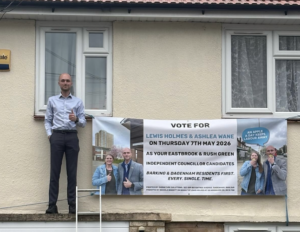
However, Holmes has now left Reform in a blaze of bad blood and announced his intention to run in Eastbrook & Rush Green as an Independent. He has pledged on a banner to put “Barking & Dagenham Residents First”. He even has a running mate for the two-seat ward, whose name is Ashlea Wane.

What happened? Perhaps Holmes’s fracture with Reform began shortly before that Thames View by-election, when HOPE Not Hate dug up his sharing of X/Twitter posts by Stephen Yaxley-Lennon, better known as Tommy Robinson, and other very far-Right nationalists. Holmes had also, in June 2025, replied to ex-Reform MP Rupert Lowe’s assertion that “we need a credible alternative to the utter shambles that is Reform UK” with the word “Amen”. Lowe has since set up a party called Restore Britain, which is even further to the Right than Reform.

The exposure of Holmes’s very public display of disloyalty to Reform did not deter Reform London Assembly member Alex Wilson praising his Thames View candidacy a few days later. A week before that, the X/Twitter handle Reform Party UK Exposed highlighted a tweet by Holmes in which he described Barking as “a nasty, disgusting place surrounded by Pakistani rape gangs”.


Screenshot 2026 04 02 at 18.46.10

Holmes’s X/Twitter account abruptly disappeared, but the recording of some of its output for posterity has provided a weapon for opponents. He used to describe himself as the chairman of Barking & Dagenham Reform. But these days that role belongs to Ben Suter, a former Conservative who was the party’s by-election candidate for Barking & Dagenham’s Village ward as recently as November 2024.

Suter is now down to be one of Reform’s challengers for Eastbrook & Rush Green with Holmes set to be among the competition. The other is Ron Emin, who finished fifth there as an Independent four years ago and describes himself as “the voice of the public and the champion for the community in Rush Green”. There will also be a brace of candidates representing Kemi Badenoch’s stubbornly Right-populist Tories in the field. All this suggests some potential for the ward’s right-wing vote to split three different ways, which wouldn’t hurt Labour’s survival hopes.

As for Holmes, he has been hailed by a Facebook page entitled Restore UK – Romford as the “chairman of Restore in Barking & Dagenham”. There’s a photo of him standing next to a street poster of Lowe. On Wednesday, Lowe said Restore won’t be standing local election candidates anywhere except in Great Yarmouth. But after that, he revealed, the plan is to “take it national”. For Lewis Holmes, it appears, when one far-Right door closes, another opens.

Follow Dave Hill on Bluesky and at LinkedIn. Photograph from Lewis Holmes’s Instagram.

OnLondon.co.uk is funded by sales of publisher and editor Dave Hill’s twice-weekly newsletter On London Extra. To start receiving it, become a paying subscriber to Dave’s personal Substack. Thanks.
Categories: News

Talk About London podcast: V&A, Olympic Park and the importance of culture

I’ve had a lot of interesting and enjoyable conversations in recent years with Tim Reeve, deputy director and chief operating officer of the Victoria & Albert Museum since 2013. That’s because he has been centrally involved in the V&A setting up two exciting new branches on the Olympic Park.

The first, V&A East Storehouse, opened on 31 May last year at Hackney Wick. It is the revolutionary new home of the museum’s vast reserve collection, open to the public with lots to see and the opportunity through the “order an object” service to make an appointment to be shown items that are stored out of view.

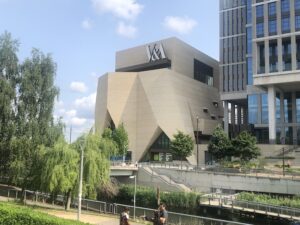
The second, the V&A East Museum is on the Stratford side of the park forming part of the the waterfront section of East Bank, the still emerging culture and education hub near Westfield and the London Stadium. The distinctive building, deigned by Dublin-based architects O’Donnell and Tuomey will open to the public on 18 April and is already being beckoned towards it by a very tall sculpture of young woman by Thomas J Price.

In our latest Talk About London podcast, I and London Society chair Leanne Tritton asked Tim about V&A East and also the vital importance of culture in the life of the capital city. Watch below.

You can every edition of Talk About London and also every edition of my own separate podcast series, True London, here.

Follow Dave Hill on Bluesky and at LinkedIn.

OnLondon.co.uk is funded by sales of publisher and editor Dave Hill’s twice-weekly newsletter On London Extra. To start receiving it, become a paying subscriber to Dave’s personal Substack. Thanks.

Categories: Analysis

In The Print at the King’s Head

I had a friend who lived on the 21st floor of a tower block on Cable Street. From that unnerving height above a London street famous for a political battle in 1936, you could see the location of another E1 conflict. It was 50 years later and one year after the miners’ strike had ended in defeat. That had taken place in other parts of the country, of course. Now, London had its own epochal stand-off between workers seeking to defend jobs in an old-school industry against a force hellbent on imposing change.

That force was Rupert Murdoch, newspaper man. The workers were led by Brenda Dean, the first woman to head a major British trade union – SOGAT, acronym for the Society of Graphical and Allied Trades (as almost no one knew). Their combat zone was Murdoch’s new print site in Wapping, historically a maritime area on the north bank of the Thames but, for 54 weeks, shorthand for an industrial relations war in the second term of Margaret Thatcher’s Britain amid a regenerating London Docklands.

The conflict and the motivations of its key protagonists are the subjects of In The Print, a new play at the King’s Head Theatre in Islington. Co-written by King’s Head board chair Robert Khan and his long-time creative partner Tom Salinsky, it pays its audience the compliment of declining to reduce the Wapping dispute of 1986 and early 1987 to a monochrome tale of Wicked Boss v Noble Proles. Instead, it takes on the stiffer challenge of exploring an often morally tangled tale of inter-union rivalries, media industry powers and responsibilities, and the tensions between employees’ rights and technological innovation.

Murdoch’s ruthlessness is conveyed as cunning yet almost civil by Alan Cox. “I just want want to print newspapers,” he insists, practically pleadingly, in the play. A distinction was once made between him and the criminal ex-publisher of the Telegraph, Conrad Black. The latter was described as an ideologue while Murdoch, for all that he was behind The Sun at its most vindictive and extreme, as first and foremost a mogul.

Claudia Jolly, who plays Dean, doesn’t recreate the appearance of the public figure Dean so memorably was, with her Lady Di-era blonde bouffant, but captures her persuasive public presence, a novel feature of news bulletins of the time. She and the script also illuminate a combination of high principle and necessary compromise that guided her actions behind the scenes in a losing situation that unfolded on the streets of Wapping outside the Murdoch plant – where protestors tried to disrupt its products’ distribution – and through the courts.

The play also shows us, through her relationships with colleagues and competitor “brothers”, how novel it was that a woman from Salford was leading the defence of a male-dominated London workforce, characterised by ingrained Spanish practices and a nepotistic closed shop. When Cox’s Murdoch says at one point that he, not the union, is the combatant on the side of progress, a part of you reluctantly agrees. Much of the skill of In The Print is that it re-tells this messy, angry piece of the capital’s and the country’s history without concealing what might be inconvenient. Dean’s SOGAT right-hand man Bill Sargeant, played by Jonathan Jaynes, opens a window onto a world which, seen in a certain light, was controlled by crafty geezers protecting a well-paid skive.

There’s lots of fun in there, too. Members of the excellent six-strong cast, some of them playing more than one part, serve up winning parodies of others involved in the dispute: Norman Willis, general secretary of the Trade Union Congress at a traumatic time, is mocked for taking refuge in writing poems; the playboy aspirations of then-Sunday Times editor Andrew Neil are nicely teased. I attended Saturday’s matinee. On Monday night, the press gang will roll up. I hope the hacks behave and give In The Print good reviews.

The King’s Head theatre setting enhanced the sense of being taken back in time, partly because the audience indicated the resilience of Islington’s grey pound. Also, although the theatre building, just off Upper Street, is very new having opened in January 2024, it is the descendent of and literally just round the corner from the pub of the same name which, for 50 years, doubled as one of the most illustrious small theatre venues in town.

The old King’s Head theatre put on a vast array of shows, nurturing new talent and generally providing a watering hole for what was once sometimes called “the alternative society” (or, more geographically specifically, “Islington trendies”). A feature of that culture was that it could be as sentimental as it sought to be subversive. The King’s Head’s long-time manager opposed decimalisation, so bar staff were still charging in pounds, shillings and pence up to and beyond the Wapping dispute. Parallels, paradoxes, competing views of progress. We could be here all day.

In The Print runs until 3 May. Buy tickets here. Follow Dave Hill on Bluesky and at LinkedIn.

OnLondon.co.uk is funded by sales of publisher and editor Dave Hill’s twice-weekly newsletter On London Extra. To start receiving it, become a paying subscriber to Dave’s personal Substack. Thanks.
Categories: Culture

Tony Travers: How Margaret Thatcher paved the way for Sadiq Khan

The Greater London Council (GLC) was abolished 40 years ago.  At midnight on 31 March 1986, following an epic struggle with Margaret Thatcher’s government, London’s city-wide authority, led at that time by Ken Livingstone, ceased to exist. Its functions were scattered between Whitehall departments, borough-run joint committees, a new, directly elected, Inner London Education Authority and the ominously named London Residuary Body (LRB).

County Hall, the home of London government since it had been opened in 1922 by the GLC’s predecessor, the London County Council, remained in use by successor bodies until it was sold by the LRB to a corporation which developed the site into an eccentric leisure and recreation campus, including hotels, restaurants, an aquarium and a theatre. It is hard to imagine governments in France or the US treating Paris’s Hotel de Ville or New York’s City Hall with such disdain.

The GLC had started life in 1965 as a solution to the problem of how to provide consistent government across one of the world’s largest urban agglomerations. Pressure had existed since the 1920s to provide metropolitan scale co-ordination and planning to address policy challenges such as the need for more road building (yes, really!) and to move people out of life-expired properties in inner London.

A Royal Commission had been appointed in 1957 to review the situation. It made proposals which have profoundly shaped London’s government ever since. Indeed, they became the model for other major cities across England.  There were to be two tiers of government – a “Council for Greater London” and 51 “Greater London Boroughs”. The City of London, local authority of the Square Mile, would not be reformed beyond having the powers of a borough added to its wider historic functions. There would thus be 52 councils in total.

The proposed Council for Greater London would have responsibility for major roads, strategic planning, traffic management, the ambulance service, refuse disposal, some housing and elements of education provision such as teacher training. The boroughs were to be the primary unit of government for education, social services, planning decisions, local roads and environmental services.

The Conservative government reduced the number of boroughs to 32 (plus the City) and retained a single education authority for Inner London, but otherwise enacted the Royal Commission’s proposals. After fierce lobbying, Esher, Walton, Weybridge, Banstead, Epsom and Ewell, which the Commission would have placed within the new London, all escaped the metropolis’s expansion.

The 1965 reform created the “bottom heavy two-tier” system which has survived to this day. There were unintended consequences: central London, where previously all road, planning and traffic management provision was delivered by the LCC, was split between 10 boroughs.  Thus, Sir Sadiq Khan’s decision to create the Oxford Street Development Corporation has its origins in the political fallout from the 1965 reforms.

But back to abolition. In the 1981 GLC elections, Labour won the council from the Conservatives but immediately after the election Livingstone – nicknamed “Red Ken” – replaced the moderate Andrew McIntosh as Labour’s, and thus the GLC’s leader. The Livingstone regime set about delivering an array of policies tailor-made to antagonise Thatcher’s Conservative government across the river.

Some policies were mainstream, notably “Fares Fair”, which reduced public transport fares by increasing the subsidy from local taxation.  This policy was struck down by the courts after a legal challenge by Bromley Council. But the Livingstone GLC also majored on policies about Northern Ireland, the nuclear deterrent, gay rights, race, women’s rights, Palestine and more besides. On industrial policy, it was very conservative: it wanted to protect traditional industries such as the docks and manufacturing from further decline.

This being Britain, with no constitutional protection for sub-national institutions, the Thatcher government’s eventual response to political taunting from Livingstone & Co – famously including a banner on County Hall proclaiming the number of people unemployed in London – was to announce that the GLC and its six metropolitan county cousins would be abolished.

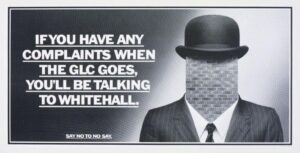
From 1983, the threat of abolition saw Livingstone move from being portrayed as a pantomime left-wing populist to being viewed as a democratic martyr. The GLC mounted a spirited campaign against its own demise, using brilliant advertising campaigns with slogans such as “Say No to No Say”. Many Conservatives had misgivings about leaving a city of seven million with no metropolitan government. Labour and the Liberals promised to restore it. But in the end, majority UK governments get what they want – or at least they used to. The GLC ended its 21-year existence with a programme of events on the South Bank culminating in a massive late-night fireworks display on 31 March 1986.

Abolishing the GLC created a vacuum which its successor, the Greater London Authority (GLA), filled. Just 11 years after abolition, the newly elected Labour government of Tony Blair published proposals to introduce a Mayor of London and a London Assembly. In a 1998 referendum, voters in all 32 boroughs and the City of London voted to create today’s City Hall machinery. Ironically, the authority of the massive mandate given to the Mayor, coupled with powers to deliver a wide range of transport provision, fire and emergency services, spatial planning, economic policy, housing and the Metropolitan Police have made the GLA a more powerful institution than its predecessor.

Unlike the GLC, the GLA is under no serious threat of abolition. The evolution of similar government models in other major English cities has embedded the mayoral city region as a consensual element in British politics.

The boroughs are now UK government’s great survivors, reaching their 61st birthday on 1 April.  Despite occasional alarms and excursions about whether, for example, there might be a combined authority to allow the boroughs more say over mayoral policies, or whether the Mayor should have more control over licensing, the GLA and the boroughs coexist reasonably happily. GLC abolition in 1986 seemed reckless and undemocratic at the time, but it accidentally led us where we are today. At its most deliciously ironic, Margaret Thatcher paved the way for Sir Sadiq Khan.

Tony Travers is Professor of Government at the London School of Economics.

OnLondon.co.uk is funded by sales of publisher and editor Dave Hill’s twice-weekly newsletter On London Extra. To start receiving it, become a paying subscriber to Dave’s personal Substack. Thanks.

Categories: Analysis

True London Podcast: Antisemitism and other hatreds in the city

I had already hoped Daniel Sugarman, deputy editor of Jewish News, would agree to be a True London podcast guest before the antisemitic hate attack on the ambulances of a Jewish charity in Golders Green. That was because I, like many others, had been impressed by a Jewish News editorial that had strongly defended Muslims following the distorting, vicious and chilling attack by the Right on the recent open iftar event in Trafalgar Square led by, disgracefully, the shadow justice secretary Nick Timothy.

Daniel wrote that editorial, and since the Golders Green attack, he has also written a strong personal piece about growing up in the area and a necessary, precise rebuttal of the ridiculous but disturbingly pervasive conspiracy theories that always flourish in the wake of such incidents.

We covered all of the above in our podcast conversation and explored more broadly what I would call the roles assigned to Jews and antisemitism in various parts of the political spectrum, including in their different ways both the far-Left and the far-Right. Referring to US podcasters, Daniel warned that they, having spent years attacking Muslims, have lately begun directing their hate at Jews. “If people think that can’t happen here,” he said, “they are absolutely kidding themselves.” He also set out his view on what he sees as the shortcomings of the laws governing protest marches.

Watch the podcast below or just listen to it here.

PS: If we’d had more time, Daniel would have told us more about Hatzola, the Jewish charity that, for years, has provided its ambulance service for anyone who needs it in north London. Perhaps, once a little time has passed, On London can do that job.

Follow Dave Hill on Bluesky and at LinkedIn. Image from BBC News.

OnLondon.co.uk is funded by sales of publisher and editor Dave Hill’s twice-weekly newsletter On London Extra. To start receiving it, become a paying subscriber to Dave’s personal Substack. Thanks.
Categories: Analysis

‘Robocars’ will have to obey London rules, says TfL chief Andy Lord

Driverless cars are already out and about in London, doing their own version of the The Knowledge ahead of a launch of commercial “robotaxi” services which could come as soon as September if the powerful companies behind the new technology have their way.

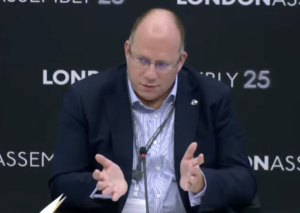
But to start plying for hire, they will need the consent of Transport for London. And that’s not a done deal, the London Assembly’s transport committee heard yesterday. The opportunities presented by autonomous vehicles (AVs) remained “unproven”, said Sir Sadiq Khan’s transport deputy Seb Dance, while TfL chief Andy Lord (pictured) told assembly members (AMs) that AVs “would have to meet our current private hire regulatory requirements, and no driverless vehicle would comply as it stands.”

AV companies with their eyes on the capital, including London-based Wayve, backed by Microsoft and Uber, and Californian heavyweight Waymo, owned by Google parent Alphabet, have made much of how safe their product is; – it doesn’t drink, sticks to the speed limits, never gets tired. But an “awful lot of work” needed to be done, said Dance, to determine whether AV technology would offer a “a net benefit on safety”.

There are wider fears too. AVs might be an alternative to private car use, but a proliferation of robotaxis could also increase congestion and pollution levels, the committee heard. Private hire numbers were already heading towards “unsustainable” levels, Lord said, with some 130,000 minicabs registered and no government action to cap numbers or curb “cross-border hiring”, whereby drivers and vehicles licensed elsewhere are currently allowed to operate in London without necessarily meeting the capital’s regulatory standards.

Concerns were also raised around accessibility, security and safeguarding as well the impact on the livelihoods of current taxi and private hire drivers. These are under “massive threat” according to Liberal Democrat AM Hina Bokhari. The Mayor’s recently-launched AI taskforce would be considering those implications for the city, Dance confirmed. He also promised continued support for London’s “iconic” black cab fleet. “The black cab is a strong symbol of the city and we are very, very keen that it remains so,” he said.

The chief executive of private hire company Addison Lee, Liam Griffin, has this week warned in the Financial Times that current drivers’ livelihoods could be “on the line”. He called for a minimum price to be fixed to prevent “predatory pricing” and for the number of permits for AV taxis to be limited “in the first instance”.

Green AM Caroline Russell asked if TfL could actually block AV passenger services. In his reply, Lord seemed confident: “My understanding is that they will have to meet the current regulatory requirements. We do have the powers, if they do not meet those standards, to refuse them a licence,” he said.

It’s not straightforward, though. The Automated Vehicles Act 2024 provides the broad legal framework for AVs to operate within, but also contains provisions to “disapply” current licensing rules enforced by local licensing authorities. Robotaxi permits would effectively be issued by the government, through the national Driver and Vehicle Standards Agency, albeit requiring the consent of the local authority – TfL in the case of London.

With the details of the new AV licensing scheme yet to be set out in secondary legislation and the government keen to embrace the new technology, the way that TfL veto might actually work in practice is still in contention, with some hard-talking clearly going on behind the scenes. “It’s going to need a lot of interaction between us and central government,” said Dance, while Lord warned that stronger regulatory powers at Whitehall level risked “cutting across” the capital’s existing devolved responsibilities.

Mayor Khan made his own position clear in December: “While we want London to be the global capital of innovation, enterprise and creativity, this must not be at the expense of jobs and livelihoods, and I am committed to working with industry and unions to ensure this technology is introduced in a way that works for all Londoners. TfL must consent before APS [automated passenger service] permits can be issued in London and this consent would be based on APS permit applications supporting the objectives of my transport strategy.”

Whether that requirement can be satisfied, given the strategy’s focus on “active travel” – on foot, by cycle or on public transport – and more efficient use of the capital’s road space, remains an open question, according to a recent intervention by Glenn Lyons, Professor of Future Mobility at the University of the West of England.

It shouldn’t “just be about safety…but the wider question of how to ensure driverless vehicles deliver societal impact that is acceptable and beneficial”, he said, suggesting that safety improvements might rely on “constraining pedestrian behaviour” through US-style “jaywalking” rules, or corralling cyclists. “Perish the thought that we look back and realise we were asking what London can do for robotaxis rather than asking what robotaxis can do for London,” he concluded.

Follow Charles Wright on Bluesky. Watch the transport committee meeting in full here.

OnLondon.co.uk is funded by sales of publisher and editor Dave Hill’s twice-weekly newsletter On London Extra. If you don’t already receive it, become a paying subscriber to Dave’s personal Substack or follow any Support link on this website.

Categories: News

Reform UK seeking ‘paper candidates’ for London borough elections

Further insights into Reform UK’s approach to the borough elections on 7 May are provided by an email message to supporters, in which the party announces that it has created an “application portal” for “paper candidates”. A “paper candidate” is one who puts their name forward for election despite having no hope of winning in order that local people nonetheless have the option of voting for the party he or she represents.

In the email, which is headed “Stand Up to Sadiq” and been seen by On London, Richard Bingley (pictured, from 2022), the former Conservative leader of Plymouth City Council who is now Reform’s regional director for London, says “we still need local council candidates in Hackney and Islington” (below) and claims that “If we do not have these candidates, Sadiq Khan’s colleagues on Hackney and Islington councils will win on May 7th without having to lift a finger”.

This understates the task facing Khan’s fellow Labour politicians to stay in power in those two boroughs, where the Green Party, in alliance with hard-Left Independents, is mounting strong challenges. Hackney Labour in particular appears vulnerable, with both the borough’s mayoralty and a council majority potentially within the Greens’ grasp.

Bingley urges anyone interested to “contact me now, if you can help us by being a ‘paper candidate’. The application form literally takes 60 seconds to complete”. His email also says “every seat needs to be filled” – slightly confusing wording, given that Reform has previously committed only to having a candidate in every London ward, most of which return three candidates to sit as councillors.

It seems likely, though not known by On London at this stage, that similar emails have been sent to Reform supporters in other boroughs where the party has negligible support, which is the case in many inner London areas. Soliciting paper candidates is not unusual among political parties and in London is unlikely to be confined to Reform.

Screenshot 2026 03 25 at 11.36.17

The striking thing about Bingley’s message is that it directly targets Sir Sadiq Khan, who, as Mayor of London, is not a borough elections candidate.

This in keeping with Reform leader Nigel Farage saying in January that his party intended to make the borough elections a “referendum” on the direction he claims the capital is taking and Westminster ex-Tory councillor Laila Cunningham, announced as Reform’s mayoral candidate for 2028, saying at the same event that 7 May would be a chance for Londoners to “vote out every councillor who’s propped him [Khan] up”. The Mayor does not depend on borough councillors to stay in office.

This latest Reform appeal for candidates follows the party taking out a full-page ad in the Metro newspaper earlier this month appealing for people to “stand and represent their local community on May 7th” and a previous email from Bingley tailored for residents of particular boroughs. The deadline for borough candidate nominations is 4pm on 9 April.

Follow Dave Hill on Bluesky and at LinkedIn. Photo of Richard Bingley from his Facebook page taken when he was a Plymouth Conservative.

OnLondon.co.uk is funded by sales of publisher and editor Dave Hill’s twice-weekly newsletter On London Extra. To start receiving it, become a paying subscriber to Dave’s personal Substack. Thanks.

Categories: News

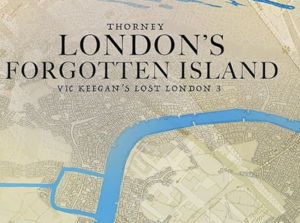
Book Review: Thorney – London’s Forgotten Island, by Victor Keegan

If I conjure up an image of Westminster, I think of politicians filing in and out of Parliament, of TV crews conducting interviews on College Green while the Palace of Westminster keeps watch over the Thames. I think of the Gothic towers of Westminster Abbey and the tombs of the great and good held within its ancient walls. I think of campaigners in Parliament Square jostling with tourists seeking that perfect snap of Big Ben. There’s an undeniable sense of history about the place, though most people wouldn’t know it was once the site of several notorious prisons, a Victorian school for pickpockets, or where a vibrant medieval brewing trade laid the foundations for one of the world’s largest drinks companies.

That’s something former Guardian journalist and illustrious On London contributor Victor Keegan aims to change with the third of his Lost London series of books. The first two focused on fairly broad swathes of central London, as illustrated by maps that are included at the end of this volume. A review of his first book, Victor Keegan’s Lost London, notes that “Keegan’s curiosity for London’s story is indeed burning; beyond deeply held, and genuinely felt.”

That’s also apparent in Thorney-London’s Forgotten Island, in which the author has assembled a vast amount of information about a much more concentrated part of the capital, one which many will never have heard of.

Thorney Island was an eyot – an island within the Thames – bordered in this case by its lost tributary the Tyburn, which became buried as the city developed.

It was an area of around 30 acres that is little memorialised now except, as the author tells us, on a sign on St Margaret’s Church (where Sir Walter Raleigh is buried) and by the Thorney Island Society, of which Keegan is a member, having first spotted a sign for their building on his daily walk to work at the offices of The Guardian, where he worked for some decades.

Today, we know this small piece of London as home to major public institutions including the Houses of Parliament, the Supreme Court and Westminster Abbey and while – as various chapters detail – these institutions have deep roots here, there are many other stories to uncover, which Keegan does with great enthusiasm.

While the claim made on the book’s cover that Thorney Island contains “The densest concentration of history in Europe” is something some areas of Rome, Istanbul or any number of cities might take issue with, Keegan makes a compelling case for his island. The range of topics he covers in 164 pages is immense, embracing culture, politics, royalty, religion and class among others, over a period from the first century AD up to the present day.

He takes care to remember voices often excluded from historical narratives, dedicating chapters to women who might have been candidates for burial in Poet’s Corner at the Abbey (none are buried there, though some have memorial plaques), and to the 18th Century Black writers and abolitionists Ignatius Sancho, Olaudah Equiano and Ottobah Cugoano, all of whom had links to Thorney Island.

I was particularly interested to learn about Margaret Cavendish, a 17th century writer, philosopher, scientist and proto-feminist who is buried in Westminster Abbey, and about the hospitals on Thorney Island that could be viewed as precursors of today’s National Health Service – two very diverse topics you might be surprised to find within the pages of one book, but not, it seems, if that book is about this very distinctive place.

For me, some of the most effective chapters come when Keegan zones in on one street or location and unpicks the various layers of history within it, as he does with Canon Row, which might easily be wandered past unnoticed. Yet, having been a home for aristocrats in the 16th Century and Sancho in the 18th, it later bore the roots of the V&A museum, a major catering college and the company that became British Gas.

Keegan’s tone throughout is warm and clubbable – as if you’ve pulled up a stool next to the history buff at the pub and settled in to listen. He’s clear in his introduction that this is “a journalist’s book following avenues that took my fancy rather than a historical narrative”. Nonetheless, I would have liked to have more sense of his authority on the topics – not least as a member of the Thorney Island Society, which works to preserve the history of the area – and more on his sources, beyond the two books cited at the end, along with Wikipedia, the limitations of which as an accurate source are well known. The acknowledgements mention various historians, archivists and librarians who helped in creating the book and I would have liked to know more about how he worked with them to bring the stories within it to light.

It is apparent from the repetitions that sometimes occur across chapters that the book was in part developed from stand-alone articles. That the 17th Century Czech artist Wenceslas Hollar (several of whose engravings appear in the book), died in poverty, is mentioned more than once. The reader’s interest in this relatively unknown character piqued, it might have benefited from a fuller development of his story across the various places he crops up. I read the book from beginning to end, but the repetitions could be overlooked if the book was picked up and read by individual chapter according to topics of most interest to the reader.

The page layouts in this hard-backed volume are slightly idiosyncratic, with text size that sometimes varies between chapters, though I got used to that as I dug into the book.

By the end, I had a new sense of the immense amount of history that happened in that 30-acre space and it was hard not to find infectious Keegan’s undying passion for relaying it. Next time I find myself emerging from Westminster tube station, I know I’ll be on the hunt for signs of Thorney’s buried history.

Buy Thorney: London’s Forgotten Island here. Elin Morgan is a writer and communications professional from east London. Follow her on Bluesky

OnLondon.co.uk is funded by sales of publisher and editor Dave Hill’s twice-weekly newsletter On London Extra. To start receiving it, become a paying subscriber to Dave’s personal Substack. Thanks.

Categories: Books, Culture