Blog

London borough elections 2026: Predictions, half-predictions and cries for help

I had decided not to make predictions – certainly not in public – about the outcomes of this year’s votes in the capital’s 32 boroughs. Lewis Baston and I, as we embarked on compiling our epic guide to the elections, London Decides, made a decision ourselves. It was that we would not make predictions, because doing so would only end in tears. We have instead concluded each borough profile with a section called What To Watch For, which sets out a balance of probabilities and identified factors on which results will hinge.

And so, here I am, on borough elections day, making a full set of predictions. Well, sort of.

I should make clear that these are my predictions, half-predictions and cries for help (see headline) and mine alone. Though obviously informed by the wisdom of Lewis, which is far greater than mine, they are entirely my work in all their rash, self-harming foolishness. But, in the end, feeling a bit light-headed after several weeks of very intensive work, the temptation was too much. Who knows, perhaps as many as half of them will turn out to be right.

SECTION ONE: VERY CONFIDENT

In the case of six boroughs, I am very confident about what will happen. I am completely sure that the Liberal Democrats will retain control of Richmond upon Thames and Kingston upon Thames and almost completely sure they will do the same in Sutton, with the right wing vote there splitting to their advantage. I am very confident that the Conservatives will, as always, win Kensington & Chelsea and also Harrow, even though it is a borough that can surprise. Finally, in a year where we could see around a dozen boroughs ending up under No Overall Control (NoC), I am certain that Redbridge will be one of them.

SECTION TWO: PRETTY CONFIDENT 

Labour is on course for heavy losses. I am, though, pretty confident that the party will secure majorities, if reduced, in Hammersmith & Fulham, Ealing, Hounslow, Brent, Barking & Dagenham (despite the challenge of Reform UK) and Merton (despite the challenge of the Lib Dems, which I think will come up just short). I am almost Very Confident that Reform will gain Bexley from the Tories, but have succumbed to a small bout of cowardice. That said, if Reform don’t win there I will be very surprised. The same applies to Havering. Will Tower Hamlets stay in the hands of Aspire? I think so. And here are two NoC punts: Camden, even though a friend of a friend who lives there thinks Labour will hang on, and Croydon, where I got the feeling while visiting there on Monday that Labour might win the mayoralty while the council will be something of a salad.

SECTION THREE: PROBABLY, BUT

Here I enter in the realm of half-predictions, the terrain of the tentative, the valley of uncertainty. I think the Conservatives are going to hold Hillingdon, but NoC can’t be ruled out. I think Enfield, Waltham Forest and Bromley will go NoC, but majority outcomes are achievable. I think the Greens will probably win the Hackney mayoralty, but the council make-up? Too close to call. Another NoC? If forced to place a bet, I would put it on the Tories recapturing Westminster, but it wouldn’t be a big bet. Greenwich will probably just about stay Labour. So will Islington, I just about think. And then there’s Newham, where a defeat of Labour would be historic. I think it probably won’t happen. But there again…

SECTION FOUR: HELP!

These are little more than guesses. In Southwark, it seems possible that Labour will survive, but a red, yellow and green NoC could happen too. In Lewisham, it seems possible that both the mayoralty and the council will stay in Labour hands, but if the Green tide rises high enough, they won’t. Lambeth is a cliff-edge in that regard – Labour could lose a lot of votes there and still retain a lot of seats, but also lose enough to lose a lot. Haringey? See above, but throw the Lib Dems into the mix. Wandsworth? The Greens will hurt Labour more than Reform will hurt the Tories, but the signals from the ground are inconsistent. And finally, Barnet. Will Labour hold on or will the Tories make a comeback? Help!

CONCLUSION

My firm prediction is that almost anything could have happened by the time London’s polling stations close. See you on the other side.

Follow Dave Hill on Bluesky and at LinkedIn. Read London Decides here.

OnLondon.co.uk is funded by sales of publisher and editor Dave Hill’s twice-weekly newsletter On London Extra. To start receiving it, become a paying subscriber to Dave’s personal Substack. Thanks.

Categories: Analysis

Newham 2026: Greens acknowledge ‘error’ in candidate’s home address statement (but say they don’t know how it happened)

Six days have passed since I reported that the home address information of a Green Party candidate in Newham published by Newham Council on its website was both inaccurate and of a type that appears not to be in line with election law.

The official Statement of Persons Nominated for Royal Victoria ward (pictured below) says in its “home address” column that Green candidate Rob Callender lives at an “address in Royal Victoria”. However, according to Newham’s electoral register, Callender does not live in the electoral ward of that name, as his home address is in the Royal Albert ward next door.


Screenshot 2026 04 27 at 10.27.00

Furthermore, the rules governing what information may be published as a candidate’s home address for local elections in London state that there are only two options available: the candidate’s full home address or, if that candidate wishes to keep that private and lives in Greater London, the name of the London borough (or other local authority area) in which he or she resides must be submitted on the nomination papers. This is known as the “relevant area”.

Callender’s home address information, which is repeated on ballot papers for tomorrow’s vote in Royal Victoria ward, does not conform to either description. Newham councillor Steve Brayshaw, who is defending his Royal Victoria ward seat for Labour, has asked the police to intervene.

Brayshaw’s displeasure stems from his widely-shared view that some voters favour candidates who stress that they  live in the ward they are contesting. His argument is that Callender having the words “address in Royal Victoria” next to his name gives him an unfair advantage in what has been a closely contested ward, because he, Brayshaw – who, unlike Callender, does live in Royal Victoria ward – has “address in Newham” next to his.

What has happened since? To Brayshaw’s frustration, not much. The police have declined to act. The council has repeated its view that it wasn’t allowed to challenge what was written. And the Greens have provided me with a statement, which said: “We are aware of the inconsistency and have been in contact with the council. At this stage, it’s unclear where the error occurred, as documents pass through many hands.” It added: “As an experienced candidate, Rob is familiar with correctly completing nomination papers and there is no evidence that he submitted anything false.”

All of this raises a few questions. How did what the Greens call an “error” occur? Is Newham Council correct to say to Brayshaw, as it has to me, that it must accept nomination papers “on face value”, even if they plainly don’t abide by the home address rules? And why have I yet to find any examples from other boroughs of home address rules being broken while in Newham’s case I’ve found 16?

My reading of the Greens’ statement is that Callender himself is not responsible for the “error” and that it could have made by a variety of other people, though the Greens don’t specify who. Are they implying that someone at the council has been at fault? If so, the council seems unlikely to accept this, given its insistence, which is consist with what the Electoral Commission told me, that nomination papers must be accepted as submitted.

Who else might have put “address in Royal Victoria” in the home address box of Callender’s nomination papers? In his first letter to the police, Brayshaw informed them that his election agent had – as agents are entitled to in the presence of a relevant council officer – “reviewed Mr Callender’s nomination paperwork” and that this review had shown that the name of Newham had originally and correctly appeared in the home address section of Callender’s nomination paperwork, but later been, in Brayshaw’s words, “crossed out and replaced with ‘Royal Victoria’.”

I am told that it is usual practice for nomination papers to be filled in online, with the full home address or allowed “relevant area” typed in. The form is then printed out and delivered to the Returning Officer by hand. So if “address in Newham” was indeed crossed out and replaced with “address in Royal Victoria”, as I am assured it was, who did it? Somebody knows. Probably, more than one person knows. But none of them are saying.

The “face value” question is interesting. Although the Electoral Commission has told me, in line with Newham, that Returning Officers “must accept nominations at face value”, its guidance for candidates completing nomination papers, which appears on its website, says as follows:

“The RO [Returning Officer] can hold your nomination paper invalid if the particulars of your nomination are not as required by law. The RO can also reject your nomination if they conclude it is clearly a sham, for example an obviously fictitious name is provided.”

Callender’s nomination was clearly not a sham, but its particulars, it seems to me, were not “as required by law”. Leaving aside the fact that Callender doesn’t actually live in Royal Victoria ward, wouldn’t “address in Royal Victoria” immediately be spotted as being not the “relevant area” to submit as a home address, and of itself be sufficient grounds for the Returning Officer to hold the nomination paper invalid? According to Newham Council, it would not.

As for my third question, I haven’t had time to look through the Statement of Persons Nominated lists of all 31 other boroughs – there are elections on, you know – but I picked a varied group of six – Bromley, Enfield, Hackney, Hillingdon, Sutton and Westminster – and scrolled through every candidate’s details.

I didn’t find a single one whose home address box didn’t contain either a full home address – for example, 6 Cherry Orchard Close or 12 Oaklands Way, plus postcodes – or an approved “relevant area”, almost always stated as an address in the London borough in question, or else that of a different London borough or a local authority outside the capital (for example, Broxbourne and Surrey), as appropriate.

Perhaps if I kept looking I would find boroughs other than Newham where numerous invalid home address details have appeared on Statements of Persons Nominated as candidates. Perhaps this isn’t a mystery at all and the “face value” approach has been followed everywhere, with Newham just happening to have a bunch of candidates who filled in the form wrongly while other boroughs didn’t. Perhaps I’m missing something really obvious here. But if I am, no one has mentioned it so far.

I can see perfectly well that “error” might be the right word for describing what has happened with Rob Callender, his Royal Victoria ward Green Party running mate – whose statement also says “address in Royal Victoria”, though at least she actually lives there – and 14 others in Newham, most of them not members of major political parties and therefore perhaps inexperienced in these matters. But, if so, whose “error” was it? Was more than one error involved? I think we should be told.

The Electoral Commission has confirmed to me that candidate nominations once accepted by a Returning Officer cannot be challenged during an election, but can be afterwards by means of an election petition. Right now, though, that is of little consolation to Steve Brayshaw.

Follow Dave Hill on Bluesky and at LinkedIn. Dave and elections expert Lewis Baston have compiled the definitive guide to the 2026 borough elections in partnership with public affairs specialist Lowick Hedry. Read it here.

OnLondon.co.uk is funded by sales of publisher and editor Dave Hill’s twice-weekly newsletter On London Extra. To start receiving it, become a paying subscriber to Dave’s personal Substack. Thanks.

Categories: News

Croydon 2026: Labour’s best and only hope?

The area around East Croydon station, which serves the town from which the borough takes its name, can be tricky for visitors to get a fix on even if, like me, you’ve been there many times before. It feels, all at once, a bit old, a bit new, a bit temporary, a bit unfinished and, here and there, a bit uneasy.

There is a London Tram stop (very progressive) and there are wide, fast roads (thought very progressive when built). There is a Boxpark, a “pop-up” venture that’s been there for ten years, and a cluster of new tall buildings that have a box-fresh air. More iconic (as they say) is the One Croydon office building, nicknamed the Threepenny Bit when completed in 1970 – to a design by Richard Seifert’s architecture practice, previously responsible for Centre Point – and then, post-decimalisation, the 50p Building.

Img 8408

Venture further and find the Whitgift Centre, a shopping complex name that’s been synonymous with Croydon since its foundation in the late 1960s. It made a cameo appearance in the title sequence of Terry and June, a popular BBC sitcom of the 1980s. Set in Purley, the show portrayed the suburban side of Croydon, a borough that reaches all the way from its interface with inner London Lambeth to wary Surrey fringe redoubts.

Croydon Council had Conservative majorities from 1968 until 1994, when Labour at long last got a go and stayed in power for three terms. This century, borough control has oscillated between the two big old parties before attaining a novel state of No Overall Control in 2022, with a Conservative directly elected Mayor heading a deeply split councillor intake.

A lot has changed since the days of Terry and June, which, when its long run ended in 1987, was described by a critic as “Macmillanite”. Today’s Whitgift, for example, modernised as part of an unfinished regeneration, is pretty much a retailer-free zone. The word “Croydon” has become more associated in the public mind with destruction and violence than with patio deckchairs, thanks to the burning down of a family furniture store during the 2011 London Riots and, these, days with terrible and tragic youth violence.

Meanwhile, the council has been mired in financial problems that emerged during the pandemic when Labour was in control. These were inherited by Tory Jason Perry, narrow winner of the borough’s first mayoral race, and have continued. The electoral upshot is difficult to divine. In London Decides, our guide to this year’s borough elections, Lewis Baston and I conclude our Croydon section as follows:

“Croydon’s Conservatives must hope that the electorate will be patient with them, rather than reversing 2022’s swing in their favour. Their path to a council majority looks tricky, but so does Labour’s, given the likelihood of losses to the Lib Dems, Greens and Reform and the limited scope for gains from the Conservatives. It might be easier for Labour to win the poisoned financial chalice of the mayoralty.”

***

Fighting for that chalice is Rowenna Davis, former schoolteacher, current Croydon councillor, journalist, author, associate partner of the think tank Global Future Foundation and Labour’s mayoral candidate.

Yesterday, we met at East Croydon, her choice of location. The town centre is a prime focus of her campaign. “Croydon’s becoming a ghost town,” she declares in her resolutely upbeat social media output, striding and pointing at dead shells of buildings that once were full of life: “Grants cinema, over there, closed*, Waitrose gone, the Nestlé tower decaying“. Then there’s the “hole in ground” to which she led me, a site surrounded by black-painted hoardings. “It’s been there so long,” she said, “that no one can remember what was there before.”

The problem, Davis argued, has been lack of political will. If “the market says no,” she said, the Town Hall response has been that “there’s no point even trying”. And trying, she continued, means a Mayor who will try everything. “I’ve said to people over and over again, ‘I don’t own the land. The council does not have money. But if you want a Mayor who is going to fight the big fights and have the courage to fight them, and to narrate the story and tell you everything that can be done, then you choose me’.” For the “hole in the ground” even a good “meanwhile” use would do for now. The ex-Nestlé pile has been a grievous eyesore since the company upped sticks and moved to Gatwick way back in 2012,

Davis said carrots and sticks would be deployed to deal with all empty or neglected sites around the place: “Step one, day one, is a land commission.” She’s identified 50 sites around Croydon that are “derelict and decaying” and proposes that a “bespoke action plan” would be drawn up for each one. Then, “a big, open, welcoming conversation” with landowners and potential developers, exploring all the options, grants that could be applied for, introductions that could be made to help to get things moving. Lack of initiative would be rewarded with visits from health and safety inspectors and the suggestion that “maybe you need a fine”. Compulsory purchase, though laborious, is there as a last resort.

Img 8419

The rest of Davis’s top five pledges centre on crime, fly-tipping, nurturing “a beautiful Croydon” involving better links between parks, stations and shops, and measures to help with the cost of living.

On crime, she was optimistic that the Met can be persuaded to take fewer officers from Croydon to help deal with central London protest marches, she praised the efforts of local youth work partners and she highlighted Sir Sadiq Khan’s recent announcement about late-night youth club funding.

She also made a point about violence in the home: “Croydon has a huge problem of domestic abuse. More knife crime happens in the home than on the street, but we don’t hear about the bit behind closed doors.” Davis attributes this to the combination of “a very high level of deprivation with a very transient population”. She concludes: “If you grow up in a violent household, you are going to take that outside.”

Davis has promised to levy less Council Tax than has Perry, who received Conservative government permission to hike it by 15 per cent for the financial year 2023/24. It was a decision made in the context of the council’s financial predicament, with Perry insisting there were no other viable options. How would a Mayor Davis handle the issue better?

The key, she said, would be a good relationship with the current national government. “I think I’m best placed because I’ve got the most trusted relationships, and I’ve already been having those conversations,” she said. “Keir [Starmer] came here this year, Rachel [Reeves] came here this year. I’ve spoken to the Chief Secretary of the Treasury, I’m making the case all the time, because it’s grim. But what I hear, and what is fair, is that to get a deal, you need to do something else, which is get your council in order. Why would anyone help you if you haven’t helped yourself?”

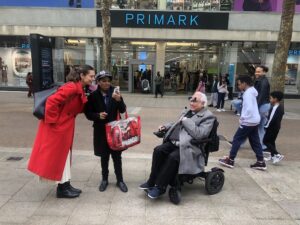
That’s the hard reality part. But Davis’s campaign is can-do positive, stressing her belief in “visionary leadership” and the cultural strengths of Croydon, home of the BRIT school. Unaccompanied when we met, she wore a bright Labour-red coat and was twice spotted by admirers who came over to wish her well. Her slogan is “people first”, and people in Croydon seem to like her. Will the borough swing her way against the London tide?

***

This year’s elections in Croydon are distinctive for two big political reasons: one is that all five national parties are competitive there at least in some wards; the other is that the borough could provide a crumb of comfort for Labour, possibly its only one, if Davis becomes Mayor.

It is a powerful position. Executive Mayors have the whip hand in a centralising local government model, and major policy decisions can only be impeded by a two-thirds councillor majority. Labour, which won the largest number of the council’s 70 seats last time – 34 compared to the the Tories’ 33, the Greens’ two and the Liberal Democrats’ one – might end up with fewer this time, but Davis is confident “that we can get a third” which would see her through. Mayors also get a vote in full council decisions.

As for the mayoral race, which will be a First Past The Post affair this time, London Decides points out that “much may depend on whether Perry loses more votes to Reform in the south of the borough than Davis does to the Greens in the north”.

In 2022, the two Greens won their seats in three-seat Fairfield ward, with Labour taking the third. They will be looking for a clean sweep there this time. Davis’s Waddon ward is in the same “downtown Croydon” territory and was also split last time, with the Conservatives winning one seat to Labour’s two. Davis topped the poll, but the possibility exists of her becoming Mayor and losing her council seat on the same day (though if she wins both, she will have to resign as a councillor, just as Perry had to four years ago).

Img 8437

The Lib Dems’ single seat is in the very north, Crystal Palace & Upper Norwood ward, where Croydon meets the junction of boroughs around Crystal Palace Park. Reform’s ambitions lie in the far south and far east of the borough. In the former, they will hope to at least erode Conservative dominance in an area associated in the minds of political historians with a breed of 1970s right-wing Tory Harold Wilson dubbed “Selsdon man”. In the latter, at the far end of a tram line, New Addington (pictured above), a large and largely local authority-built estate created either side of World War II, is described in London Decides as one of Reform’s “more obvious targets in all of London”.

I paid a flying visit, enjoying the smooth tram ride through fields and villages that seem a million miles away from the urban ambience around East Croydon station. The New Addington vibe still feels informed by the “outer estates” ideal of modern homes for working class people in a countryside idyll. The London Borough of Croydon is nothing if not varied. “It’s a very special place,” candidate Davis said, in full revivalist mode. “I think it’s ready to be the capital of south London again.”

PS: *It has been reported today that the owner of the Grants centre has said that a major cinema chain could move into the empty space. And in other news, one of my brothers-in-law, Sean Fitzsimons, a long-serving Labour councillor in Croydon, is defending his Addiscombe West seat this year. If I lived there, he’d definitely get my vote.

Follow Dave Hill on Bluesky and at LinkedIn. Dave and elections expert Lewis Baston have compiled the definitive guide to the 2026 borough elections in partnership with public affairs specialist Lowick Hedry. Read it here.

OnLondon.co.uk is funded by sales of publisher and editor Dave Hill’s twice-weekly newsletter On London Extra. To start receiving it, become a paying subscriber to Dave’s personal Substack. Thanks.

Categories: Analysis

Hillingdon 2026: Can the Conservatives hang on?

Nothing will eclipse the impending Labour collapse in Thursday’s borough elections, but the Conservatives aren’t on course for ending up over the moon either.

If all their wildest hopes come true, they will hold on to the five councils they currently control, regain Barnet, Wandsworth and Westminster from Labour – all three of them lost in 2022 – and overhaul Labour in Enfield. That would make nine boroughs out of 32 and not a bad final score, given the sorry state of the party in the capital.

More likely, though, they will emerge from this year’s utterly unpredictable elections breaking even or thereabouts. None of the boroughs they hope to gain look like done deals, with the possible exception of Westminster. By contrast, Bexley is, by some accounts, as good as conquered by Reform UK and although the Tories might remain the biggest party in Bromley they could lose their majority, with Reform making inroads at their expense there too.

Only Kensington & Chelsea and Harrow appear safe (despite the latter being capricious), which brings us to Hillingdon and the importance to the Tories of hanging on to it. Fortunately for them, hanging on to Hillingdon is something the Conservatives are good at.

Here’s a passage from London Decides, the in-depth borough elections guide compiled by me and Lewis Baston. It follows a section about the borough’s Uxbridge & South Ruislip parliamentary seat, famous as the final parliamentary resting place of Boris Johnson and the ULEZ-related bye-election of July 2023 that followed his resignation. This saw a Tory hold against the odds:

“Labour later captured the seat at the general election, though not by a big margin, perhaps reflecting the resilience of Conservative support among voters in much of this part of outer London. Demographic changes that would normally be expected to help Labour haven’t really moved the dial. In the 2021 Census, slightly fewer than half of Hillingdon residents described themselves as white, a drop from 60 per cent in 2011, while those saying they were Asian reached one third of the total. During the same period, the proportion of homes that were privately rented grew a lot too, rising to over a quarter.

In other ways, though, Hillingdon has retained what might be termed a Conservative character: over half of its homes are owner-occupied and it has the highest level of car ownership of all the boroughs, with almost 80 per cent of households having access to at least one car or van.”

Sometimes in recent years it has looked at first glance as if Labour might win Hillingdon, as it has the past, though not since 1994. Such impressions have been mistaken in part because that “Conservative character” has absorbed demographic change rather than being politically altered by it, and in part because several wards in the borough have long been beyond Labour’s reach. For its part, Labour is stronger in the south, while the marginal areas are in the geographical middle, where two wards, Uxbridge and Charville, produced split verdicts last time.

That territory is still very much in play but, this being 2026, the electoral geography and permutations have been transformed. Reform is a new contender, and presents a challenge to both Labour and the Tories. The Greens will be looking to gnaw at Labours margins, and a group of former Labour councillors are seeking to rain on their old party’s parade in and around the town of Hayes, running as the Hayes Independent Party.

I spoke on a background basis to two shrewd readers of local electoral runes, one a very active Conservative, the other with Labour leanings. Both of them reckon the Tories are going to be OK. The Tory was confident that their party would win between 28 and 32 of Hillingdon’s 53 council seats, which would get them across the majority line in much the same shape as last time (when they won 30). The two split wards are looking good for them, I was told, as is Colham & Cowley, where Labour wasn’t far behind four years ago.

Yes, Reform could go some damage, but mostly only at the blue margins with Labour sinking everywhere. The isolated Harefield Village ward in the very north west of the borough at the edge of Greater London could very well turn turquoise, but it only returns one councillor.

London Decides thinks Reform might stand a chance in wards in the Ruislip area, noting that UKIP did quite well round there in 2014. South Ruislip ward in particular is singled out. My Tory contact, though, reckons its safe. And both of my sources think Reform could inflict more damage on Labour in the West Drayton and Yiewsley wards they currently hold, due to the presence in them of hotels accommodating asylum-seekers.

Add to that the Hayes Independents focusing on Labour’s Hillingdon heartland, and my Labour-ish sage thinks the party faces “a disaster” even if none of the rebels get elected. Standalone Independents appealing to Somali voters could weaken Labour’s support too. I’m told.

Complicated, isn’t it? But though it still appears wise not to rule out No Overall Control with the Conservatives the largest party, an overall no change result is what both of my local whisperers expect.

Hillingdon is an exceptionally varied borough, containing – among much else – a huge lido in Ruislip, with an actual sandy beach, and Heathrow airport. Uxbridge, with its Battle of Britain Bunker and Charles Holden Underground station at the end of the Piccadilly and Metropolitan lines, is its administrative headquarter.

We find Hayes in the middle, with its impressive industrial past and multi-ethnic present. I twice spent time there last autumn and paid a flying visit on Sunday to refresh my memory and top up my photo bank. I ate an excellent chicken jalfrezi there too. London is such an extraordinary place.

Follow Dave Hill on Bluesky and at LinkedIn. Dave and elections expert Lewis Baston have compiled the definitive guide to the 2026 borough elections in partnership with public affairs specialist Lowick Hedry. Read it here.

OnLondon.co.uk is funded by sales of publisher and editor Dave Hill’s twice-weekly newsletter On London Extra. To start receiving it, become a paying subscriber to Dave’s personal Substack. Thanks.

Categories: Analysis

Dave Hill: Why I will be voting Labour in the 2026 London borough elections

Yes, I’ve noticed. I have spotted what a disappointment the Labour government has been. Clumsy, over-cautious and confused, it has squandered a fortune in political capital trying to please or appease groups of voters, especially in the Midlands and the North, who will never be pleased or appeased because they simply aren’t that way inclined.

In the process, it has alienated far larger numbers of other types of voters who had hoped Sir Keir Starmer would lead a focused, capable and shrewdly radical administration with goals aligned with their desires, only to be left fed up and let down.

London is a place with high levels of poverty while at the same time being the mighty engine of the UK economy, without which everywhere else, from Redruth to Redcar, would be worse off. Yet too often in its words and sometimes in its deeds, the Labour government has slighted and sidelined the capital despite its being very much a Labour city since 2010.

Why, then, have I decided that, despite all of the above, I will be voting for Labour on Thursday 7 May rather than “sending a message” that I am displeased with the PM and co so far? I have a few reasons. Hear me out.


One: My local Labour councillors are good.

Back in March, walking past the historic ornamental pond near where I live, I bumped into one of my ward councillors “doing his rounds” as he described it. Phone in hand, he was following up issues raised by local residents, mostly the latest outbreaks of fly-tipping.

At that moment though, he was noting with frustration that some people insisted on throwing bread to the ducks that live on the pond, even though it’s bad for them, and even though there was a sign up listing the sorts of food that do not do ducks harm. Something needed to be done. And by the middle of April, the local neighbourhood action group was reporting that it had.

This is the stuff good local councillors do. It’s not the only thing they do, but it’s the basic business of the job. This particular councillor has served the ward in Hackney where I live in since 2002, engaging with local campaigns, attending school ceremonies, making sure neighbourhood voices are heard and action taken over neighbourhood concerns. One of his ward colleagues, who has been doing the job since 2010, is a lawyer who sits on important council committees with responsibilities that include children’s safety. Both have excellent attendance records. Both are Labour councillors.

Back in January, I attending a ward community meeting at which residents who often get around by car protested about a local road traffic reduction scheme. They filled the Salvation Army meeting space down the road to capacity. Almost as many couldn’t get in, so they squeezed into the reception area. The two Labour councillors were there, taking questions, noting complaints, promising to look into points raised. The Labour Mayor of Hackney, Caroline Woodley, attended too. She stayed late, getting it in the neck from displeased people, not losing her cool. That is part of the job too.

Labour is in some danger of losing control of Hackney to the Greens (no other party stands a chance). Those two Labour candidates are seeking re-election (a third Labour councillor for the ward is standing down this time). Would the Green candidates hoping to unseat them be better at the job?

I’m not claiming they’d be negligent or useless – Greens take pride in being community-minded, after all. But I did see one of them on television a while back saying things about Hackney that were remarkably naive for someone aspiring to public office in the borough. By contrast, the two Labour councillors seeking re-election have tremendous experience and knowledge, all of which they can share with the new third Labour candidate for my ward. Why would I want to get rid of them?


Two: I don’t believe a different party would run my borough better 

Labour politicians have run Hackney for most its existence. They haven’t always done it well. But throughout this century, they have stewarded the borough through some very difficult times and made or enabled many improvements. I’ve lived in the borough since the early 1980s and raised my six children here. I’ve seen a lot things get better.

The past four years have been bumpy at times, and not everything has been perfect: the Care Quality Commission said in February that the council’s adult social care services, while not wholly bad, require improvement; in August 2024, the Regulator of Social Housing found “serious failings” in the council’s service to its tenants, and in May 2025 the Housing Ombudsman produced a report that criticised its “structures and systems” and its culture.

On the other hand, also in August 2024, the council’s children’s services, another core responsibility, were judged “good” and “greatly improved” by Ofsted and a January 2025 Local Government Association review of the council’s performance as a whole was largely positive, recognising that it has a vast array of duties and pressures to cope with. Would having the Greens – or any other political party – in charge at Hackney Town Hall make the council’s delivery of such absolutely fundamental services better? What about bin collections or street-cleaning?

I have my doubts. I say that as someone who knows and has interviewed Zoë Garbett, the Greens’ mayoral candidate for Hackney. I found her likeable, purposeful and, in the best Green traditions, eager to understand how everyday lives are led and to harness creative grassroots energy.

But the problem with the Greens is that in the past few years they have become a completely different party. Zack Polanski’s election as their national leader was just the culmination of an embrace of the worst elements of the Left that was already underway.

In 2024, I privately warned another senior London Green about the general election candidate the party had selected for a seat in east London, a lieutenant of an ally of Jeremy Corbyn who the Greens should have had nothing to do with. Today, the Greens are indistinguishable from Momentum, the Corbnyite activist network that had many good intentions but couldn’t run a bath and tolerated people with intolerable opinions and ideas. In Hackney, Greens have made electoral pacts with such individuals. In Lambeth, Green candidates have expressed such opinions and ideas themselves.

More broadly, Greens across the capital have hitched their wagon to a range of what I call Protest Left narratives, notably about housing and development, that are at best misleading and at worst, dishonest. They’ve also placed a foreign policy issue, Gaza, front and centre of their campaigning. Forgive the statement of the obvious, but no London local authority, no matter what adjustments it might make to its pension funds, is in any position to end the horrors of the Middle East.


Three: Populism is no solution

Populist politics are risky. They speak to emotions, not realities, to fantasies, not facts. Feeding off disillusion, they offer solutions that would be difficult to put into practice and could have unforeseen, harmful effects.

Reform UK is a nationalist, populist far-Right party. Its leaders don’t like being called far-Right and, fair enough, they are different from other British far-Right parties, such as the National Front and the British National Party. It is their nationalist populism that defines them. That is why Nigel Farage and his home affairs spokesman Zia Yusuf put about the falsehood that foreigners are hogging London’s social housing. That’s why their candidate for Mayor of London is obsessed with flags.

Otherwise, Reform’s approach to London local government is hard to differentiate from that of the Conservatives, certainly in the outer boroughs to which its London popularity is confined. Even so, it isn’t hard to imagine Reform administrations in London boroughs wasting time on stunts and gestures, taking far too long to face hard financial truths, and making nasty remarks in public. If I lived in Havering, Bexley or Hillingdon, I would be voting for whichever candidates stood the best chance of thwarting Reform, including if they were Tories.

The Greens are now a populist party. Their leader defines them as “eco-populist” but the “eco” bit has been forgotten. Rather, as we have seen, the Greens have become populists of the hard or far-Left (we can discuss terminology another day). Their goal is to hammer Labour, and Thursday’s elections could see them win control of Labour boroughs: Hackney, Lambeth and Lewisham look their best bets.

It’s easy to understand the Greens’ appeal. They have energy, optimism and youth. Leaving aside some of their more niche or outré national policies, their calls for private sector rent controls will strike a chord with many private renters in London, a city where such rents are punishingly high (this, it should be said, is something Sir Sadiq Khan has long recognised too).

There are, though, two big problems with this: one, local authorities do not have the power to introduce such rent controls and are vanishingly unlikely to be given it by national government; two, independent studies going back many years, not to mention the experiences of cities elsewhere in the world, have found that such measures can make matters worse rather than better, perhaps especially for those in the most acute housing need.

The Greens either do not know this or do not care to recognise it. Populists often place what sounds good to its supporters above what they could or would do if placed in positions of responsibility and power. Which brings me to…


Four: London has a housing emergency

It’s an emergency of many dimensions and it threatens London’s future, economically, socially and culturally. Part of the solution is to build new homes, including as many as possible that are affordable to Londoners on low and middle incomes. National Labour’s housing targets for London are, shall we say, ambitious and nowhere near being hit. But at least it has policies designed to maximise supply. All the others don’t.

Let’s look at the Greens again. In recent years, 40 per cent or so of the new affordable homes built in London have been supplied by private developers thanks to agreements reached with London councils. Nobody thinks this model is ideal, and the recent collapse in overall supply has shattered it, at least for the time being. Even so, it remains vital to maintaining affordable supply where possible. Polanski describes councillors he opposes as being “in the pockets of property developers”. That is shallow, unfair and immature.

In March, Labour-run Lambeth approved a planning application to build 288 new homes in Brixton, of which 98 would be for social rent – a rare result in the capital these days. The Greens, though, have vowed to overturn the decision if they take power in the borough. Leaving aside the small matter of how that would be achieved, what would they have to say to the nearly 100 Brixton households who would have to go without a social rented home as a result?

Similar fighting talk is coming from the Green mayoral candidate in Lewisham, who says that if elected he would “stand up to” developers. If that means he would tell them to push off if they won’t do what he wants, that’s what they’ll do. Only yesterday, the Labour candidate for Mayor of Croydon told me that if future Green inner London council leaders want to antagonise developers, they would be welcome to give her a call.

Liberal Democrats too are talking about getting more “affordable” homes built, as are local parties in Ealing, Redbridge and elsewhere that are essentially proxies for Your Party. At the same time, the latter can be found protesting about schemes they say don’t supply enough of it and represent “overdevelopment”. Everyone committed to increasing the supply of the types of homes London most needs wishes they had more public money to spend. But they still have a duty to do the best they can with the situation as things stand. Placard policies don’t put roofs over heads.

Meanwhile, the right-wing parties are just as obdurate in their own ways. In Bexley, where Reform hopes to defeat the Tories, its campaign is peddling scare stories about the Green Belt – ironically, one of those local government postures Nigel Farage’s party has in common with the one it aspires to replacing. Like the Tories, too, Reform opposes housing intensification in the outer boroughs, railing against tall buildings, warning of threats to local built environment character and so on.

London has a housing emergency. Yet parties in London across the ideological spectrum seem determined to make it worse. Labour is the sole exception.


Five: Chaos imperils change for the better 

Labour in London needs much better opposition. The massive majorities it has come to expect in some parts of the capital are not conducive to lively, responsive and productive local government democracy and debate. Let’s look on the bright side. If, say, Labour keeps hold of Hackney but has to face a stronger but also competent, knowledgeable and constructive Green opposition for the next four years, that could be a good outcome for the borough. The same might be true if, for example, Reform becomes a substantial opposition in a Labour-retained Barking & Dagenham and ends up behaving like reasonable Tories.

Sadly, there seems to be a bigger chance that several boroughs will end up in the hands of inexperienced and sometimes incompetent, fractious and foolish councillors who’ve risen to elected office on bubbles of hubris that will be very quickly burst. A third or more of the 32 boroughs could end up under No Overall Control. That doesn’t have to be a recipe for chaos and disaster, but a lot can go wrong, and the bad feeling between the parties that have some objectives in common – the Greens and stronger local groups and Labour, the Conservatives and Reform – could make coalitions unworkable.

Those are not clinching arguments for no change, because parties that stay in power for too long can and do become stale, complacent and tainted. But the troubling thing about the London borough elections of 2026 is that the parties most likely to bring about changes in council control do not appear well-equipped for taking on the difficult and important tasks they will have to perform – or to have what I think are the right priorities.

Thank you for reading all the way to the end. And whichever candidates you favour, don’t forget to vote!

Follow Dave Hill on Bluesky and at LinkedIn. Dave and elections expert Lewis Baston have compiled the definitive guide to the 2026 borough elections in partnership with public affairs specialist Lowick Hedry. Read it here.

OnLondon.co.uk is funded by sales of publisher and editor Dave Hill’s twice-weekly newsletter On London Extra. To start receiving it, become a paying subscriber to Dave’s personal Substack. Thanks.

Categories: Comment

Southwark 2026: Shades of red, yellow and green

A pleasing thing about the London Borough of Southwark is that it stretches all the way from the south side of Tower Bridge to the faraway north side of Crystal Palace Park. Its 6.5 mile length covers everything from regenerated, ex-industrial central London enclaves, to working-class inner city neighbourhoods, to village suburbia.

I didn’t walk the full distance when I went there on Saturday afternoon – my legs got tired and, anyway, it started raining – but I went as far as Rye Lane in Peckham before taking the Overground home. En route, I visited other places of personal interest and reflected on the many layers of London history Southwark contains.

Part of that history is Labour Party history. From 1980 until the mid-1990s it had its headquarters there in a building on Walworth Road that became named John Smith House in memory of the party’s late leader. The borough has been Labour-run ever since it was created apart from two four-year terms early this century when it came under No Overall Control and the Liberal Democrats formed minority administrations.

In 2010, Labour regained command and have maintained it ever since, winning 52 out of 63 seats in 2022 and leaving the Libs Dems with just 11. But the latter still enjoy significant support in the borough, and in 2026 the wider stage is set for perhaps the biggest political upheaval Southwark has ever known. Here are the concluding words of the Southwark section of my and Lewis Baston’s London Decides borough elections guide:

“Having a decent-sized group on the council already is advantageous for the Lib Dems, but they may find progress confined to the north of the borough. If Labour can hold steady in the centre – Peckham, Camberwell and Walworth – and lose only Nunhead & Queen’s Road, the party will have 26 seats and need only a further six from Dulwich and the north to retain a majority. Notwithstanding the challenge of the Greens, such a final result seems possible. But there are a lot of “ifs” in there.”

There really are. The Lib Dems are strongest in the north of borough. The seats they presently hold are clustered at Southwark’s long Thames waterfront, in wards in Bankside, Bermondsey and Borough. Wandering through these neighbourhoods, the signs of rapid development and accompanying social change were evident in the shops, bars and cafés where thirtysomething young professionals communed and grazed.

Along with modern and done-up housing, these neighbourhoods are dotted with ancient churches, pleasant parks and social housing, of which Southwark has a great deal. Labour too has seats in these parts, and the Greens got significant portions of support in several in 2022. A ward to watch might be Chaucer – solidly Labour since 2014, it could be a three-way battle this time. Again, consult the guide.

Img 8372

Meandering south, I soon entered core Labour country and wards where the party racked up vote shares of around 60 per cent four years ago. The Greens were distant runners-up, the Lib Dems not far behind. Which way will voters disillusioned with Labour turn and in what numbers?

The transformation of Elephant and Castle continues. Much has changed in recent times, most notably the demolition of the huge Heygate estate followed more recently by the destruction of the 1960s shopping centre, an architectural eyesore for some, an antiheroic icon for others, in part because others rubbished it.

At the rear of the station, a cluster of Latin American shops and cafés were still in business (main photo), belying dire predictions that regeneration would extinguish them. I bought a tasty arepa and ate it in Elephant Park, opened in 2021, which was alive with picnickers and and sunbathers.

Screenshot 2026 05 03 at 18.41.20

Then it was on to Walworth Road, past the refurbished Walworth Town Hall, the enticing East Street market and the monumental Red Lion pub, before, on a whim, I turned right down John Ruskin Street. Quite a guy, that Ruskin, born in Brunswick Square and raised in Herne Hill. Then I turned left on to Camberwell New Road, where stands the Golden Goose theatre pub, and thence to Camberwell itself.

Img 8385

From there, Peckham Road leads you to where it says it will. At the junction of Peckham High Street and Rye Lane I took shelter beneath the Peckham Arch as a Christian preacher held forth across the way, undeterred by the sudden shower.

Back at Walworth, I had feigned interest in a poster on a wall in order to eavesdrop on three people, a woman and two men, discussing the pace and style of local change. The woman declared: “I’ve lived in Peckham for 20 years, and it is nothing like Brixton. In Brixton, they’ve got everything now, the nightlife too. But Peckham. No. Peckham is so dry.”

She knows better than I, although, as a visitor, I find much to interest me in Rye Lane – perhaps the very things that she derides. Its look and feel seem little different from when I first spent serious time there there, taking part in a Future of London field trip. A local man upbraided the group at the site of the then still new Peckham library, telling us we knew nothing because we all were middle-class.

I later joked that it had taken longer than usual on an inner London retail street to spot a café boasting that its bread was sourdough, but that I’d found one in the end. My assumption was that more would soon follow. Yet more than ten years later, the lane is much as I recall it, as it has been on subsequent visits.

it, as it has been on subsequent short visits. Plans for enhancements around Peckham Rye station are underway, though it is ten years since planning consent was secured.

Img 8388

The usual suspects warned that the charming Rye Lane movie, released in 2023, would unleash ruinous gentrification – the sort of thing the local woman I had earlier overhead appeared to crave – but its shops still speak of low incomes and hard lives. More from the Southwark section of London Decides:

“Peckham is part of a belt of exceptionally strong Labour territory stretching across south London between Brixton and Lewisham. Its Labour loyalties have rested on what have been secure foundations of social tenants, black voters and a sprinkling of precarious young graduate professionals in private rented flats.”

Mind you, the Rye Lane ward is, as a whole, less badly off than some. A by-election there on general election day saw the Greens come second to Labour with an impressive 32 per cent of the vote in what is Peckham’s whitest ward. They will be daring to dream of making inroads in all those in Peckham and Camberwell.

That was the end of my walking tour of Southwark, but there is plenty to say about the parts of it I didn’t reach, its southernmost and poshest. There are 13 council seats to be filled in and around prosperous, higher-educated Dulwich. The Conservatives used to be strong here, but the two seats they won in Dulwich Village way back in 2014 were the beginning of the end of their representation on the council, so steep has been London Tories’ decline.

In 2022, Labour won everything, with the Greens in clear second places in four wards, including Champion Hill, which is represent by council leader Sarah King. The Lib Dems were runners-up in one, and one tenth of a point separated the two challenger parties in another, Goose Green, where James McAsh, probably the most senior figure in London to defect from Labour to the Greens, will defend his seat under his new colours.

King became leader last summer after her predecessor resigned. McAsh had thought he’d won the contest for the succession, only for the close outcome to be declared void because invalid votes were cast. McAsh was just the last of Labour 2022 intake to cross the floor. In all, seven have left the group, four to join the Greens and three to sit as Independents

To what extent will their disenchantment be replicated by the voters of Southwark? Lib Dem group leader Victor Chamberlain set out his stall for me in a True London podcast, emphasising his party’s historical strength in Southwark, its focus on the local and making promises on affordable housing supply, addressing crime and antisocial behaviour and more. He think the Lib Dems could end up being the largest party and perhaps doing better still.


Southwark Labour’s manifesto, which you can read here, foregrounds similar themes. The Greens’ promises are here. How many seats will Labour lose? And to whom?

Follow Dave Hill on Bluesky and at LinkedIn. Dave and elections expert Lewis Baston have compiled the definitive guide to the 2026 borough elections in partnership with public affairs specialist Lowick Hedry. Read it here.

OnLondon.co.uk is funded by sales of publisher and editor Dave Hill’s twice-weekly newsletter On London Extra. To start receiving it, become a paying subscriber to Dave’s personal Substack. Thanks.


Categories: Analysis

Enfield 2026: ‘How all this plays out is anyone’s guess’

Enfield has for many years, politically speaking, been a relatively predictable borough of roughly two halves: Labour to the east of the A10, the Tories to the west. In the borough’s entire history, only three council seats have ever been won by anyone other than candidates of those two parties. With its southernmost wards trending redder, Labour has run the council since 2010 and took 38 seats to the Tories’ 25 in 2022.

The tectonic plates have been shifting though. Four years ago the Tories gained eight seats at the expense of Labour, recording the second-highest swing in their favour of any London council election that year. And now an earthquake could be imminent, with the latest YouGov projection putting Labour, the Conservatives and the Greens all within five percentage points of each other.

Continuing momentum may see the Conservatives getting over the majority line, but “plenty could go wrong”, according to the comprehensive London Decides analysis put together by On London’s Dave Hill and Lewis Baston with public affairs specialists Lowick Hedry. In Enfield, they say, the Tories are “still running up a down escalator in terms of demographics” and facing tough competition from Reform in the north-east of the borough.

Adding the Greens into the mix, says James Cracknell, who as editor of the local Enfield Dispatch newspaper has his finger very much on the pulse of the local political scene, makes the outcome of this year’s vote ”more difficult to predict than at any time in the borough’s history”. It won’t take much to push the borough into uncharted No Overall Control territory, with one or other small party perhaps holding the balance of power.

That could mean some “unusual alliances”, Cracknell says, particularly over the vexed issue of where to build more much-needed housing or, more accurately, where not to build it. Labour has doubled down on plans for some 9,000 homes on the Green Belt around Crews Hill, and the government, as well as relaxing Green Belt planning restrictions more generally, has now earmarked the same area for a 21,000-home New Town. Opposing that is a perhaps unlikely but potentially powerful coalition of Green and Reform, Lib Dem and Conservative.

It’s not just about building on the Green Belt either. A hustings in the key battleground ward of Southbury saw the Greens, Reform and the Tories lined up against a proposed 1,150 home scheme on an underused brownfield site – too tall, not a “good fit” for the area, not affordable enough, potentially damaging to “community cohesion” – even, according to Green candidate Mueez Abdurrahman, short on parking space.

The once-fierce debate over the borough’s two Low Traffic Neighbourhoods (LTNs) in Palmers Green and Bowes Park, both of them Green target areas, could reignite too, with the Conservatives maintaining a pledge to “rip them out”.

Full disclosure: I live in one of them. There was undoubtedly some overblown rhetoric around “active travel” benefits and reduced car use when the LTN was introduced, plus some poor early decisions on access. Both with those now rectified,  I’m not sure residents would welcome the Tory plan, which would reopen a rat-run through our narrow terraced streets for the benefit of North Circular Road commuters.

That’s certainly on the cards though, and could even be facilitated if Green wins squeeze the Labour vote to the extent that a Conservative administration, perhaps “with the permission of Reform”, takes control – a plausible outcome according to Hill and Baston. Or perhaps LTN residents’ current freedom from daily congestion could be up for grabs in post-election horse-trading?

With a legal battle likely, as has already occurred in Tower Hamlets, the Tories may not see LTNs as a hill worth dying on if the wider prize is a common front over the Green Belt. But that could also see costly conflicts with City Hall and the government, with the Crews Hill scheme possibly removed from borough purview via a Mayoral Development Corporation. “If the government and Sadiq Khan want to play silly buggers we will see them in court all along the way,” Tory group leader Alessandro Georgiou has warned.

At the very least, there could be delays over the council’s own Local Plan, with Labour’s proposals unpicked if they are no longer in power. The party’s controversial deal with Spurs allowing a new women’s squad training facility on disused golf course in the Green Belt, now facing judicial review, might be unwound too.

And, as former Khan aide Nick Bowes has forecast for London as a whole post May 7, City Hall’s new draft London Plan, due soon after the elections and setting challenging new housing targets for the boroughs, “could well be a political tinderbox just waiting to explode”. In our connected city, council election decisions inevitably have implications beyond borough boundaries.

Big decisions for voters in Enfield then. And as Cracknell concludes, “how this all plays out is anyone’s guess.”

The latest Enfield Dispatch election coverage is here and there will be regular updates from the count, which will takes place on Friday 8 May on the paper’s website. A full list of Enfield candidates can be seen on the council website here.

For in-depth coverage the elections in all 32 boroughs, read London Decides, written by Lewis Baston and On London publisher and editor Dave Hill in collaboration with public affairs specialists Lowick Hedry.

Categories: News

Tower Hamlets 2026: Siege politics

Last July, a demonstration took place outside Tower Hamlets Town Hall on Whitechapel Road. It was a type of event familiar in this part of the East End: familiar for its theme; familiar for its fervour; familiar for its theatre and farce.

The demonstrators’ displeasure was directed at the plans of the Truman Brewery company, a prominent and successful local business, to put up some new buildings within its leisure, culture and workspace complex on nearby Brick Lane, convert some existing structures and add housing.

The council’s strategic development committee was due to consider the Truman application that evening, although the power to approve or reject it had already been taken out of its members’ hands. That was because Tower Hamlets had taken too long to get round to dealing with the matter. As a result, rather than elected councillors taking the decision, government planning inspectors would do the job.

This information was in the documents on the council’s website pertaining to the meeting for anyone to see. That did not deter the demonstrators, with their Save Brick Lane banners and their fiery denunciations of Truman, from gathering on the pavement outside Tower Hamlets Town Hall, a new council headquarters built behind the preserved facade of the Grade II-listed Royal London Hospital.

I approached one of the more prominent speech-makers, an amiable young man in a suit, and pointed out to him that the strategic development committee could now do precisely nothing to prevent the Truman scheme going ahead. He warmly assured me he had knowledge to the contrary.

Img 6248

Inside, the public gallery was well-populated. There was an expectant and almost holiday atmosphere, with old people and children present and snacks being devoured as those councillors who attended, regardless of party allegiance, went through their reasons why they would have rejected the Truman application had they been in a position to do so.

The conclusion of each speech was greeted with applause. And then everyone went home, having confirmed to each other that they were not fans of the Truman plans and having underlined for me that Tower Hamlets does local politics in its own distinctive way, and that nothing seems able to stop it.

***

That local politics has, of course, been of keen and often disapproving interest to influential greater powers throughout this century – and, for that matter, previous ones – most particularly the Labour Party, more than one national government and the vast battalions of the right-wing media.

Since 2010, the primary focus of those powers has been the borough’s directly elected Mayor, Lutfur Rahman, who is, like it or not, one of the most remarkable politicians in the country. Let’s recap:

Born in 1965 in a village in what was then East Pakistan and has since 1971 been Bangladesh, Mohammed Lutfur Rahman (to give him his full name) came to London as a young child. He attended Tower Hamlets state schools and grew up to become a solicitor, a Labour councillor in Tower Hamlets and, in 2008, the borough’s leader.

At a local referendum in May 2010 – held on the same day as the local and general elections of that year – the borough chose to adopt the mayoral system of local government, as Hackney, Newham and Lewisham already had. Shortly before those local elections, which saw Labour increase its majority, Rahman was the subject of a rather breathless, conspiratorial Channel 4 programme. It claimed he had “links” to a locally-based Muslim organisation which was portrayed as “fundamentalist”.

The programme’s allegations played a part in persuading the Tower Hamlets Labour councillor group to replace Rahman as its leader shortly after the elections. Undeterred, Rahman sought to become Labour’s candidate for the inaugural election for a Tower Hamlets Mayor, set for October 2010.

Despite the Channel 4 programme and his rejection by the majority of his councillor peers, Rahman was the choice of local party members. But their preference was overruled by Labour’s National Executive Committee after it received a dossier of allegations about Rahman and a different candidate was imposed.

Shunned by his party, Rahman decided to run as an Independent instead. He won with ease. In 2014, he won again, this time representing a local party of his creation called Tower Hamlets First. But this time the outcome prompted a legal challenge in the form of an election petition, which led to an election court hearing the following year.

The judgement of the presiding barrister Richard Mawrey is a riveting and persuasive read. He clobbered Rahman good and proper, concluding that his re-election had been secured with the help of “corrupt and illegal practices” conducted by him or his “agents”, meaning people who had acted on his behalf.

Mawrey found that false statements had been made about Rahman’s Labour opponent John Biggs, depicting him as racist, that people were paid to canvass for Rahman, that Bengali media were bought and paid for, that community organisations were bribed, that invalid votes had been cast and “undue influence” brought to bear on electors in the form of harassment at polling stations and pressure applied to Muslim voters to the effect that it was their religious duty to vote for Rahman.

The 2014 election was declared void and Rahman was banned from seeking political office for five years. A fresh mayoral election was held in 2015, which Biggs won. Biggs won again in 2018. But in 2022, his ban spent, Rahman made a comeback, winning the mayoralty again and knocking some shine off Labour’s three big early borough gains in Westminster, Wandsworth and Barnet. His latest local party, Aspire, won a small majority of council seats.

That time, there was no election petition. Neither were there complaints about intimidation at polling booths or improper behaviour at the count, as was so glaringly the case in 2014. No ifs, no buts: Rahman and Aspire won fair and square, leaving a vanquished Labour to work out how to beat him next time.

***   

That next time is upon us, and the omens for Labour are not good. The party’s national unpopularity is, of course, an obvious reason for that, with certain aspects of its record of particular dislike in the East End. And then there’s the large truth that even Rahman’s more vituperative critics might have to accept – for all his failings and malfeasance, the Mayor of Tower Hamlets has always been genuinely popular with a large number of Tower Hamlets voters.

The Mawrey judgement is instructive on this point. Damning though it was of Rahman himself, along with one of his key lieutenants and the political culture they fostered, it did not corroborate some of the larger claims about Rahman that were (and, to some extent, remain) in circulation.

For example, a foreground narrative had it that Rahman only won the 2014 election because of voter fraud on a very large scale. But at one point (page 110) Mawrey wrote:

“Even if voter fraud is established, neither the parties nor the court have any idea whether it is the tip of a large iceberg or the few rogue items in an otherwise impeccable poll – or somewhere in between.”

What about those alleged “links” with Islamic fundamentalists or extremists? Mawrey had something to say about that too (page 61):

“It should…be stressed that this court has not heard a shred of credible evidence linking Mr Rahman with any extreme or fundamentalist Islamist movement, something he himself has always denied.”

And Mawrey was scathing (page 77) about Labour’s treatment of Rahman, focussing on the NEC’s decision to dump him as its mayoral candidate.

“The upshot of the meeting was thus that Mr Rahman, completely unaware of the accusations [made against him in the dossier] and given no opportunity to counter them, was summarily sacked as candidate.”

He continued:

“Although this judgment will have to be critical of Mr Rahman in many respects, in the matter of his deselection the court cannot but sympathise with him. His treatment by the NEC was, by any standards, utterly shameful and wholly unworthy of the Party which, rightly, prides itself on having passed the Human Rights Act 1998.”

What accusations did the dossier contain? I got hold of a copy at the time. If I still have it, I can’t find it. But my coverage of it for the Guardian survives. The document was striking for its spelling of “Lutfur” as “Luthfur”, its replication of allegations made in the Channel 4 programme, and its claim that 16 people who voted in the Labour members’ ballot that resulted in the selection of Rahman as the party’s mayoral candidate for 2010 weren’t eligible to vote.

The figure of 16 is significant in the context of the ballot’s outcome, because Rahman won it by a margin of 182 votes. In other words, even if did benefit from 16 member votes that shouldn’t have counted, he would still have won with room to spare. In this instance too, assertions that fake votes and malpractice explain why Rahman won an election do not stack up numerically.

   ***

The facts set out above do not absolve Lutfur Rahman of every charge and criticism he has faced. Alongside its bruising conclusions about the 2014 mayoral election (that now officially never was), Richard Mawrey’s election court judgement observed of him that, during the proceedings, “faced with a straight question, he proved himself almost pathologically incapable of giving a straight answer” (page 96) and as having been “caught out in what were quite blatant lies.” (page 97).

Other parts of the judgement align with claims long made by enemies and opponents that Rahman’s entire approach to running his home borough involves surrounding himself with a tight group of loyalists, shutting out everyone else, and focussing tightly and improperly on nurturing and maintaining the support of his fellow Bangladeshi Londoners, who make up 35 per cent of the borough’s population and are the bedrock of Aspire.

Overwhelmingly, they, like Rahman, are of Muslim background, culture or faith, as are other, smaller population groups in the borough. Forty per cent of Tower Hamlets residents describe themselves as Muslim, the largest proportion of any local authority area in England and Wales.

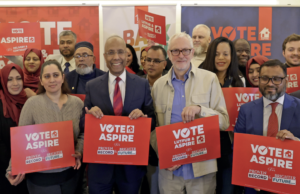
Not every Bangladeshi or other Muslim Londoner in Tower Hamlets supports Lutfur Rahman: Labour enjoys support from them too, and there are still Labour politicians from those communities on the council, including Rahman’s Labour opponent in this year’s mayoral race, his former deputy as council leader and current Labour group leader Sirajul Islam. Neither is Rahman voted for only by Bangladeshi and other Muslim residents: some others regard him as being desirably to the left of Labour and of having been unfairly picked on (significantly, Jeremy Corbyn has endorsed Rahman and Aspire for the coming elections. See main photo, which appears on the Aspire manifesto).

It is, however, Bangladeshi East Enders who form the foundation of an electoral base that looks strong enough to carry Rahman and Aspire to victory again next week, despite the growing attraction for some of the Greens and the arrival on the scene this year of a new local option on ballot papers, the Tower Hamlets Independents.

Rahman’s relationship with the Bangladeshi community of which he is a product troubles his various critics in various ways. Some years ago, a Labour political rival, caught in a dark mood, characterised his approach as one of “tending little dungheaps”, a reference to mutterings of the time about the nature of some of the community projects he chose to back.

It was not an isolated view. Much the same perspective informed the decision in late 2014 of a Conservative government to appoint commissioners to take over the grant-giving and property transactions of the council following a critical report by financial services firm PWC. That report was entitled a “Best Value Inspection”, a reference to local authorities’ legal duty to carry out its functions well and to improve them.

These issues haven’t gone away. Early last year, Labour announced its own “best value” intervention, citing poor governance, lack of accountability and the need for change in the political culture of the Town Hall. Ministerial “envoys” have been working with the council at many levels and think they are seeing some improvement, though both they and the minister, Steve Reed, a former leader of Lambeth, want to see more.

***

What is the heart of the Tower Hamlets problem? What has led to its elected leaders, representatives and many local activists displaying what so often seems like a closed-in, mistrustful, defensive attitude that extends even to council staff – a kind of siege politics that perpetuates itself and its own shortcomings?

Some clues may reside in the backstory above: Rahman’s ways of doing things has often been poor and inexcusable but also, in view of Labour’s and the media’s treatment of him, perhaps explicable. And, of course, there is the longer, deeper context of the history of racist hostility to Bangladeshi Londoners in the East End, which in the 1970s meant violent harassment, even murder, and a resolute community response whose legacy endures.

Tower Hamlets today is a prime target for Muslim-haters, as most recently seen by the thwarted attempt of the UK Independence Party to hold an anti-Islam protest in Whitechapel in January. Significantly, when the same thing happened in October, Reform UK leader Nigel Farage felt moved to contrive a defence of the party he once led. Rahman, who grew up in the borough in the 1970s, has long presented himself as the defender of Tower Hamlets Muslims against those who hate them. Is it any wonder that lots of them vote for him?

A siege mindset seems also to inform Rahman and Aspire’s approach to the physical development of the borough. Shortly after his win in May 2022, Rahman himself attacked an earlier Truman Brewery plan to build shops and offices on a car park, vowing to “protect important cultural sites in our borough from predatory developers” (the legality of the consent for the scheme granted under the previous, Labour, administration was eventually upheld by the Supreme Court after a local conservationist group challenged it).

In February 2023, the strategic development committee considered an application for continuing the regeneration of the 1970s-built Aberfeldy housing estate in Poplar. The council’s planning officers had recommend its approval as it conformed to the borough’s local plan, and warned that its rejection would be “difficult to defend” if challenged. Previously, more than 90 per cent of the estate’s residents had voted in favour of the plans in a high turnout ballot.

But there were fiery denunciations. There was a protest petition. The committee voted against. Fervour. Theatre. Farce. It was obvious what would happen next. A few months later, Sir Sadiq Khan’s Deputy Mayor for Planning, Jules Pipe, used City Hall powers to “call in” the application, taking it out of the council’s hands and then, in January 2024, giving it the go-ahead.

And then there is the mood on the streets. I had visited Aberfeldy the previous October. It was there that I saw for the first time in Tower Hamlets a flag of Palestine hung from a lamp post following the outbreak of the war between Israel and Gaza. The borough became festooned with them. They lined Whitechapel Road and stayed there for a long time.

I asked Tower Hamlets if it intended to remove them, given that municipal infrastructure is not supposed to be used for displays of political sentiment of whatever kind. I was told that the problem was that many local people felt very strongly about the issue. Be that as it may, unfriendly eyes were once more turned towards Tower Hamlets, its Bangladeshi Londoners, its Muslim East Enders and its embattled but defiant Mayor.

It probably won’t hurt his re-election chances. Back in 2011, a Labour strategist, with rueful candour, acknowledged that Rahman was an adept exponent of what he called “political jujitsu” – the art of drawing strength from his enemies’ attacks. It is a skill that has yet to desert him.

Follow Dave Hill on Bluesky and at LinkedIn. Dave and elections expert Lewis Baston have compiled the definitive guide to the 2026 borough elections in partnership with public affairs specialist Lowick Hedry. Read it here.

OnLondon.co.uk is funded by sales of publisher and editor Dave Hill’s twice-weekly newsletter On London Extra. To start receiving it, become a paying subscriber to Dave’s personal Substack. Thanks.

Categories: Analysis