Blog

Newham 2026: Green candidate accused of giving ‘false address’ amid confusion over borough elections rules

A Labour councillor seeking re-election to his local ward in Newham has reported a Green Party challenger to the police, claiming there has been “a potential case of election fraud” due to the Green candidate providing the council with incorrect information about where he lives.

In an email to the Met’s designated officer dealing with electoral law, Steve Brayshaw, who is defending his seat in Royal Victoria ward for Labour, claims that the Greens’ Rob Callender “submitted a false address in his nomination papers”.

Brayshaw points out to the Met officer that although Callender’s nomination statement – which is published on the council’s website (reproduced below) and has already appeared on ballot papers to postal vote applicants – lists him as residing at an “address in Royal Victoria”, the electoral register shows that he lives in a block of flats in North Woolwich within the neighbouring Royal Albert ward.

Brayshaw informs the Met officer that he regards the situation as “a criminal matter” relating to the Section 65A of the Representation of the People Act.

Providing a false statement on a nomination paper in England or Wales can result in an election win being invalidated, an unlimited fine, up to one year in prison or both.


Screenshot 2026 04 27 at 10.27.00

Callender, who was the Greens’ candidate for Mayor of Newham in 2022 and fought the local West Ham & Beckton parliamentary seat for his party in the 2024 general election, has previously described himself as living in North Woolwich. A campaign video for his Royal Victoria campaign this year, uploaded to Instagram on 16 April (pictured above), states only that he lives “in the Royal Docks” area rather than specifying the Royal Victoria ward.

He also contested Royal Victoria ward in 2022 alongside running for Mayor. In that year his nomination statement home address information was “address in Newham”.

Speaking to On London, Brayshaw called on Callender to “immediately publicly acknowledge that he has provided voters in Royal Victoria with misleading information, correct the record with Newham Council and stand down”. He reiterated his view that “the police need to take action”.

The London Green Party has been approached for comment. Meanwhile, another Newham Green candidate, Rajeev Kumar, debating Brayshaw on the private Royal Victoria Docks Residents Facebook page, has acknowledged that Callender lives in Royal Albert ward but added: “As I know for a fact, this is a simple mistake made when someone else finalised the form. It happened due to that person’s confusion.”

Screenshot 2026 05 01 at 06.57.27

Brayshaw’s initiative over Callender is taking place amid confusion and dispute about Newham Council’s stewardship of the candidate nomination process and the rules governing information to be provided in the “home address” section of the papers candidates must submit.

Local elections rules for England and Wales state that if a local government candidate prefers his or her full home address to not be published they may instead make known the name of the “relevant area” in which they live, and that for London council elections the “relevant area” is the the borough in which the candidate resides. No other type of area is mentioned as being acceptable.

The same definition of a “relevant area” is used in the homes address guidance for candidates published on the website of the Electoral Commission, the independent agency whose duties include setting standards for how elections are run (below).

Ec address guidance

In Newham’s case, therefore, the “relevant area” for council candidates would normally be Newham itself and the words “address in Newham” appear on the “homes address” column of the vast majority of nomination statements for the borough’s 24 electoral wards, all of which are on the council’s website (under Statutory Notices).

However, On London has found 16 examples spread across eight wards where neither a candidate’s full home address nor “address in Newham” – or, legitimately, another London borough, where relevant – is listed in the “home address” box.

As well as Callender, these include Shabd Pyari, his Green Party running mate in Royal Victoria. Like Callender, Pyari’s nomination statement specifies “address in Royal Victoria” in the home address section, although On London understands that, unlike Callender, the electoral register lists her as residing in the ward of that name. Every other Green candidate for a Newham Council seat has given their home address as Newham.

Nine of the 16 deviations from the borough name rule are by standalone Independent candidates, raising the possibility that they didn’t know about the “relevant area” rule when filling in their nomination papers. Three are by the small Christian People’s Alliance party, one is by a candidate running under the banner of “Communities United” and one, in Boleyn ward, is by the local Newham Independents’ Party, which is posing a major challenge to Labour’s dominance in much of the borough this year.

In 2023, the Newham Independents Party gained one of Boleyn’s three seats from Labour in a by-election and will hope to win all three on 7 May. The other two Newham Independents Party candidates for Boleyn have “address in Newham” in their nomination statements.

In most of the 16 cases, the home address entry is the name of the ward the candidate is contesting, though three of the standalone Independents have provided the names of other Newham wards and two of them have said they live in areas of London whose names are not those of wards – respectively, “Plaistow”, a suburban part of Newham, and “Ilford”, which is a town in the neighbouring borough of Redbridge.

Brayshaw has represented Royal Victoria ward for Labour since its creation in 2022, its predecessor ward, Royal Docks, since 2009, and has lived in the Royal Victoria ward area throughout that entire period. He argues that Callender and Pyari presenting themselves as residents of Royal Victoria ward gives them an advantage they shouldn’t have, because candidates thought to be unequivocally local can be favoured by some voters over others whose home address information is less specific about where they live.

As well as running for Mayor, Callender contested Royal Victoria ward in 2022, finishing third in the two-seat ward behind Brayshaw and another Labour candidate. The recent increase in the popularity of the Greens means that this year the ward is being seen as a marginal the Greens have a chance of winning.

Two candidates running as Independents in the Labour-held three-seat East Ham South ward, Suhel Rob and Kamal Hussain, whose published home address information is the name of the ward, have jointly posted on TikTok: “Why would you vote [for] a candidate that may not be from your local area. Larger parties send candidates to different areas all the time, so it’s possible they don’t understand East Ham South as much as we do.” Every other candidate for the ward has given their home address as Newham, in line with the rules.

A number of other Labour candidates in Newham are unhappy that opponents’ address details other than their full addresses or the alternative borough address have been accepted by the council and will appear on ballot papers for 7 May.

They include Rohit Dasgupta, an incumbent candidate for Canning Town South who lives in the ward and said he believes “the rules are clear: candidates should only publish the local authority area, not a specific ward. How has this been allowed to happen, and what checks or questions were raised during the nomination process?”

However, when approached by On London for comment about the Newham situation, the Electoral Commission said that Returning Officers, the local government officers who administer elections, “must accept nominations at face value” – wording that suggests Returning Officers are not required or able to correct or block home address information that doesn’t adhere to the rules or is demonstrably untrue.

Newham Council responded in a similar way when asked about its stewardship of this year’s elections. A spokesman said: “Nomination papers are accepted on face value, and an incorrect ‘relevant area’ does not invalidate a nomination paper under law.”

Brayshaw told On London that taking this approach “opens the system to confusion and abuse before a vote is cast. Candidates who follow the rules can get penalised by others taking advantage of the fact that no one will stop them from putting literally anywhere as their home address if they think it will help them get more votes. That cannot be fair, and challenging the outcome later is not easy.”

The Electoral Commission told On London, “Returning Officers are responsible for the conduct of the election for their electoral area, ensuring that it is administered effectively and in accordance with the law” and that “This includes administering the nominations process.”

But it added, “Candidates are responsible for ensuring they are eligible to stand and their nomination papers are submitted correctly” and it pointed out that “once a nomination has been accepted by the RO [Returning Officer], it cannot be challenged during the election, though it may be challenged after the election through an election petition”.

Follow Dave Hill on Bluesky and at LinkedIn. This article was update at 21:38 on 30 April 2026 to include Rajeev Kumar’s remarks on Facebook.

OnLondon.co.uk is funded by sales of publisher and editor Dave Hill’s twice-weekly newsletter On London Extra. To start receiving it, become a paying subscriber to Dave’s personal Substack. Thanks.
Categories: News

Still struggling with the housing emergency: views from the Centre for London summit

Sir Sadiq Khan’s reduced affordable home requirements on major housing schemes are taking effect, with the quotas allowing access to City Hall’s “fast track” through the planning process now down from 35 per cent affordable to 20 per cent.

The shift is part of the package of emergency “build baby, build” measures designed to kick-start housebuilding in the capital which was confirmed by the government and City Hall in March. It’s already proved controversial with the boroughs and housing campaigners, and think tank Centre for London’s annual housing summit last week heard further criticism, this time from a senior figure with major housebuilder Barratt London.

The “quick fix” intervention wouldn’t “necessarily help” boost numbers, the company’s head of affordable housing, Syreeta Robinson-Gayle, told the session. With private demand softening, housing associations and councils, with enough support, could take up the slack, providing the “counter-cyclical” impetus needed to get schemes underway, she said, while reducing affordable percentages in itself “won’t get more building”.

What, then, was the solution to the capital’s housing crisis, underlined for attendees by the now familiar grim litany – record numbers of homeless families in temporary accommodation provided by the boroughs, record numbers sleeping rough, unprecedented numbers too on council home waiting lists and officially in poverty after housing costs?

“For many of us,” the centre’s research director Rob Anderson said, “we’ve spent our whole careers talking about this, but it just keeps getting worse, on every measure. Something isn’t working.” Ongoing centre research previewed at the session added another twist to the debate. That “something” said Anderson, was actually too much focus on new build targets, rather than on how those homes are allocated.

“The core of the problem is not that we don’t have enough homes to go round. It’s a crisis of distribution, resulting in a harshly unequal city”, he said. More private market homes were required, but questions of matching housing supply to housing need had to be addressed as well.

Floorspace statistics highlighted the mismatch, said Anderson: 30 per cent more space per person since 2002, but most of that accruing to “affluent owner-occupiers”, while private rented and social housing remained often overcrowded. Meanwhile, house prices had nearly doubled over that period, resulting in the private rented share of London’s homes rising from 14 per cent to 30 per cent, with the social housing share reducing from 30 per cent to 22 per cent.

The perhaps surprising fact that 22 per cent of homes in London had two or more spare bedrooms suggested part of the solution: more incentives to downsize, including reviewing Stamp Duty costs and providing the sort of homes “empty nesters” actually wanted to move to. Wider demand support measures could also be considered.

But the key point was succinctly put by Fiona Fletcher-Smith, the think tank’s outgoing chair and chief executive of major London housing association L&Q. “What we really need is a massive public building programme of social and affordable homes,” she said. “We don’t have anywhere near enough.”

Mayor Khan’s deputy for housing, Tom Copley, nevertheless remained optimistic, highlighting the £1.8 billion now available in City Hall’s new Developer Investment Fund, primarily for low-cost loans to boost social and affordable housebuilding, streamlined London Plan requirements on the way, and more mayoral intervention to push schemes through, including on Green Belt land. With the prospect of less consensus on the mix of solutions required though, next week’s borough elections could prove critical.

Follow Charles Wright on Bluesky.

OnLondon.co.uk is funded by sales of publisher and editor Dave Hill’s twice-weekly newsletter On London Extra. If you don’t already receive it, become a paying subscriber to Dave’s personal Substack or follow any Support link on this website.

Categories: News

London Decides: The Podcast

If you haven’t yet discovered, explored and adored London Decides, the definitive guide to the 2026 borough elections compiled by me and ace political analyst Lewis Baston, I hope you have a jolly good excuse. Cleanse yourself of any shameful prior failings by immersing yourself in the guide here.

And if you want to savour me and Lewis, together with Kevin McKeever and Nathan Parsad-Wyatt of public affairs specialists Lowick Hedry, our collaborators on this epic project, talking about it, making rash predictions about Merton and Barking & Dagenham and gossiping about what might be happening on the ground, watch our joyful, 40-minute Political Business podcast discussion below.

OnLondon.co.uk is funded by sales of publisher and editor Dave Hill’s twice-weekly newsletter On London Extra. To start receiving it, become a paying subscriber to Dave’s personal Substack. Thanks.
Categories: Analysis

Julie Hamill: Artist Jill White on capturing the ‘zing’ of London

I recently started a podcast called Postcards from London, half-hour conversations (or “postcards”!) with creative people who don’t live in the city but work here from time to time and love it. My most recent guest was award-winning illustrator Jill White, who draws, paints and digitally enhances London scenes for art prints, cards, postcards and notebooks for her company Rocket 68, which she runs from a studio in Somerset.

I discovered Jill’s art at the company’s website. It leapt off the screen. Many depictions of London lean into stereotypical red, white and blue tourist imagery, but Jill had taken a different approach. Yes, there were classic visitor destinations such as Big Ben, Tower Bridge and Downing Street, but also the National Theatre, Battersea Power Station, Spitalfields, the Sky Garden at 20 Fenchurch Street (at the top of the “Walkie-Talkie” building), a street in Primrose Hill, local markets and an East End pie and mash shop.

Her London Calling series features over 65 pieces that also include lesser-seen corners of the capital as well as landmarks. For me, her designs offer a more authentic and personal take on London life, and I’m delighted that Rocket 68 has become Postcards from London’s sponsor.

Jill was born in Trinidad, where her English art teacher mother had taken a job and met her husband, Jill’s father. In our podcast conversation, she describes arriving in London from Trinidad on visits during the 1970s and staying with an aunt in Southgate. “The thing that strikes me the most in Southgate is the lovely art deco Underground station there,” she says, but goes on to describe loving “the contrast between those clean modern buildings” and older, more tradition ones.

“Zing” is the word Jill uses a lot when describing her goal of capturing the vibrancy and vibe of the city, drawing on the lush emeralds, azure blues, terracotta and pastel-colours of the Caribbean that have captured her heart and her art. “I don’t do subtle,” she says, which is probably why her designs have won two awards and stand out so brightly in stockists Harrods and Waterstones, as well as many art and greetings card shops around the UK.

Of the London scenes she has illustrated these are her top five:

1, Spitalfields Market
“This is my latest design. Loved Spitalfields, loved having a mooch around there. I tried to capture the vibrancy of it and the hustle and bustle.”

Spitalfields

2. The Sky Garden
“I went there just after lockdown with my daughter. Fantastic views. Just a favourite modern building.”

Screenshot 2026 04 26 at 09.56.53

3. Camden Market
“Lots and lots of fun. I used to go there with my husband back in the 1990s.”

Screenshot 2026 04 26 at 09.58.50

4. The West End
“Illuminated loveliness. Many customers buy it, put theatre tickets in it and send it to their friends.”


Screenshot 2026 04 26 at 10.00.21


5. National Theatre
“I love the contrast of that Brutalist architecture and the punchiness of the design.”

Screenshot 2026 04 26 at 10.01.32

My personal favourite is Abbey Road, shown at the top of this piece. Jill says she considers requests. Mine would be Queen Mary’s rose gardens in Regent’s Park. I hope she does it, in sumptuous and colourful bloom, Rocket68 style.

The Postcards from London podcast is available on Apple, Spotify and Amazon. Other guests so far have included, from New York, Sopranos actor Steve Schirripa and, from Sunderland, Stranglers vocalist Baz Warne. 

Categories: Culture

Tim Donovan: Labour might not lose as badly in London as expected

The predictions are of seismic change and unprecedented turmoil. The keywords: fragmentation; patchwork; loss of control. But, whisper it very quietly. This may not go nearly as badly for Labour as people are saying.

Of course, it will be quite bad. As in bad for the dozens of those individual Labour councillors – many long-time servants to the cause and dedicated community activists – who will suddenly have more time on their hands.

As in bad when you look at the headline numbers of councillors lost and that minus figure in the box next to the red Labour emblem on TV screen ticks steadily higher.

But in London it’s very possible that it will not be really, really bad for Labour.

In fact, it could well be a story about something that is different, as well as just bad. Something that may prove to be fine for Labour as well as for the health of the capital’s local communities. An opportunity for renewal for Labour. A boost for local democracy and accountability. More on all that in a moment.

The first thing to remember is that Labour has a very dominant hold on the capital’s town halls at the moment – more than 1,000 out of 1,817 councillors spread across the capital and with a stake in the game in all but one or two boroughs. Their opponents are nowhere by comparison. From this absurd apex – and two years into a Labour government – fairly substantial losses were almost a given.

But it is also now clear that Labour is so far ahead that it can afford to haemorrhage large numbers of councillors and still get up before the referee’s count, still be the boss in the ring. It is reasonable to assume Labour could drop 15 to 20 percentage points and still be winning.

This is partly because of the inchoate nature of the enemies ranged against them. One insurgent here, another over there. Rushes and charges at the Labour citadel. Lots of energy and lots of things being chucked at the ramparts – but neither of the new tribes on the block yet ready to deliver the knockout blow. Of course, that may come later though there will be doubts.

It is also because of the condition of the traditional enemies. This will not and cannot be just about the tribulations of Labour, without it also being about the starkly rapid decline and poor recovery in opposition of the Conservatives in London, and a flat-lining of the Liberal Democrats who are still some way off bouncing back from the self-harm of coalition government a decade ago.

That some are suggesting that Labour could hold at least one of the “jewels” – Barnet, Wandsworth and Westminster – which they took from the Tories in 2022, tells you why this is complicated.

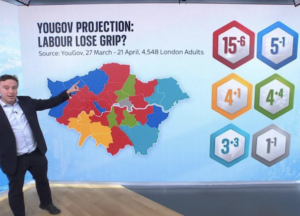
Even this week’s ostensibly, for Labour, gloomy poll by YouGov for Sky News (see photo) – using a technique taking responses from big numbers of people across London then extrapolating for local conditions and indices – had as its most likely the scenario Labour would lose control of six of its 21 councils but remain in charge in 15.

That would be a far superior outcome to that of the 2006 post-Iraq Tony Blair local elections in the capital, which saw Labour lose eight and ended running just seven. Of course, that this is happening just two years into a Labour government with a record majority is pretty extraordinary – but Armageddon it may not prove to be.

The fact is, Labour will lose some councils to the Greens. The Tories will lose some to Reform. Yes, it is interesting that we will have morphed to a multi-party situation. But will it be sustained and lead to a genuine loosening of Labour’s stranglehold long-term? That is far from a given.

The pollsters know their own limitations and do not claim to be able to capture the hyper-local dynamics operating in different boroughs. Reflecting how independent candidates will do is a particular problem. And that is what provides the biggest clue to Labour’s potential emergence from these elections less battered than imagined. Their opponents may be much weaker and fragmented in these areas than the surveys can reflect.

There are two or three predictions in the YouGov poll that prompted wider thoughts about just how resilient, entrenched and hard-to-budge Labour has become. It is suggested that in Haringey and Barking & Dagenham, Labour will not get the highest vote share and implicitly could lose majority control.

Genuinely it is only pollsters who have told me that Labour is in serious danger of being ousted in these places. Those on the ground accept there will be losses, mainly to the Greens in Haringey, and to Reform in Barking & Dagenham, but they say the picture from the air does not reflect the doorstep.

In Barking & Dagenham, the reality is of a more cohesive and harmonious inter-communal borough than the pollsters’ methods are picking up. In Haringey, there has been a growth of the young professional and student population looking for a cheaper place to live, but that is also the demographic least likely to vote in local elections.

This is the fundamental point: the Greens and Reform are respectively creating a bit of a vibe in these areas, but it is not likely to be enough. And even if it is and wins materialise, this would, in any case, serve to underline another harsh reality that the reaches of the Greens and Reform are confined to distinctive geographic and demographic areas – the Greens in parts of metropolitan inner London, Reform on the Essex and Kent borders, with both still falling some way short of holding universal appeal. Labour may take some comfort from that in the long run.

The other obvious point to make is that in inner London opposition to Labour could splinter. So, in places like Lambeth, Lewisham, Southwark, Camden and Islington, Labour might retain the whip hand, emerging as the largest party as the Greens and Lib Dems win in different parts of those boroughs but not quite enough seats between them.

Given the likely tally and location of Labour’s losses, the real story of the night is likely to be the return of something currently missing from many town halls: genuine opposition. For too long, a good number of Labour-run councils have been literally or almost one-party fiefdoms. Now it looks like proper local politics could be back, offering the possibility of scrutiny, accountability and revived debate in council chambers.

Greater numbers entitle opposition groups to more resources and research help, and enable them to share out the workload. It enhances their ability to dissect those granular committee papers, spot when officers are trying to pull a fast one and call out the rationale of the ruling administration. It should lead to better decisions for local communities.

So let’s not fret over the possibility of instability in some parts of the capital, as parties negotiate in No Overall Control councils over who is going to be in charge, and haggle over who chairs which committee. Let’s not worry about the chaos and uncertainty, but anticipate a welcome return to plurality in local democracy. All we would need on top of that is a revived local press to go with it.

Tim Donovan is the former political editor of BBC London and now a trustee of Centre for London. Follow him at LinkedIn. To understand in depth and hyper-local detail how the story of the 2026 borough elections might unfold, see London Decides, the definite guide compiled by On London editor Dave Hill and elections expert Lewis Baston in collaboration with Lowick Hedry. 

OnLondon.co.uk is funded by sales of publisher and editor Dave Hill’s twice-weekly newsletter On London Extra. To start receiving it, become a paying subscriber to Dave’s personal Substack. Thanks.

Categories: Comment

Harrow 2026: Maybe not as serene as it seems

The ten-minute walk from Harrow town centre to Wealdstone is rewarding for its parade of Asian shops, its opportunities for long looks down inter-war housing avenues, cars parked on hard standing spaces at the front, and for the sudden shock of seeing the monumental 1970s Harrow Civic Centre building hemmed in by builders’ hoardings, its entrance signage fading, peeling and mildewed.

This spectacle prompts questions. Why has the titanic structure been abandoned? Where does Harrow Council go about its business? Is the local government scene in this outer London borough as stable and serene as it may seem?

Some answers are easy to find. The Civic Centre pile, designed by architect Eric G. Broughton, was earmarked for destruction way back in October 2014 by a newly re-elected Labour administration as part of its regeneration strategy.

Things did not move fast. Five years later and one set of borough elections later, the council, still Labour-controlled, said its plans for a new, replacement home would not be realised soon. Broughton’s grand creation wasn’t closed for business until 2023 by what by then was a Conservative administration. And for the past few years, Harrow’s municipal business has been variously conducted at a council service hub, an arts centre in Pinner and, most recently, a former Plymouth Brethren church hall.

Img 8328

This may feel hapless, untidy, even a bit cheap, though the Conservatives, led by Councillor Paul Osborn, have received praise from neutral quarters. A Local Government Association “peer challenge” report in 2023 judged the council to have found “fresh impetus and energy” and to have worked well with local police and the care system as well as making progress with a “customer first” approach to residents.

That said, Labour objects that Harrow was served with a government “improvement notice” last year after Ofsted reported that its children’s social care services were “inadequate”, and that in 2024 the Care Quality Commission said its adult care “requires improvement” – an important issue for a borough where more than 15 per cent of people are over 65 years old. As election day draws near, Labour is promising to freeze Council Tax next year and retain a Tory policy of providing an hour of free parking in a borough where three-quarters of households have at least one car.

Even so, in a borough elections year that is exceptional for its unpredictability, Harrow looks like one of those least likely to see power change hands: Labour is in the doldrums nationally and although the Conservatives are hardly flying high either, their support in Harrow – unlike in some other outer boroughs – does not seem obviously susceptible to incursions by Reform UK. Only Kensington & Chelsea looks safer. But even if the Harrow outcome could be fairly nailed-on, the borough’s politics do not lack interest. Neither do they want for turbulence, controversy or reasons for disquiet.

***

First, let us consider some of the Conservative candidates. At Byline Times, Adam Bienkov has unearthed unpleasant items from the social media back catalogues of two of them.

Exhibit one is William Jackson, selected by the Tories to stand in the extremely marginal Tory-held ward of North Harrow. In recent months, Jackson has taken to his X/Twitter feed to, for example, tell Shadwell-born Poplar & Limehouse MP Apsana Begum to “go back to Bangladesh” and Birmingham-born Coventry South MP Zarah Sultana to “go back to Pakistan”. Even the MP Rupert Lowe, with his “re-migration” dream, might stop short of using language such as that.

Exhibit two is Nathan Smith, standing for the Tories in the Labour-held West Harrow ward. Last summer, a photograph emerged on X/Twitter of far-Right agitator Stephen Yaxley-Lennon – the man who calls himself “Tommy Robinson” – standing close to a man lying injured on a platform at St Pancras station. After being arrested in connection with the matter, Yaxley-Lennon faced no charge. However, Smith’s X/Twitter response to the photo was: “Good on Tommy. No doubt this wanker deserved it.” He added an emoji of a flag of St George.

Jackson has been suspended by his party, but he is already listed on ballot papers as a Conservative candidate for North Harrow. If elected to the council, he will sit as an Independent. I understand that the Tories have yet to say if they will take action against Smith, who on his X/Twitter feed has also called former Tory Prime Minister Boris Johnson a “traitor” and a “scumbag” for his pandemic safety measures and immigration policies when at Number 10.

It cannot be asserted on the strength of these two examples that the Conservatives in Harrow are rotten to the core with members who make Nigel Farage look like a Liberal Democrat. However, they do have a bit of form in this regard. The best-known Harrow Tory is, of course, Susan Hall, the party’s candidate for Mayor of London in 2024, leader of the Conservative group on the London Assembly, a Harrow councillor of long standing and, indeed, for a short period from September 2013, the leader of Harrow Council after the previously ascendant Labour group split.

Hall, who is defending her seat in Hatch End ward, attracted much criticism during her mayoral campaign for her own activities on X/Twitter, which had already included expressing sympathy for Enoch Powell and egging on the far-Right provocateur Katie Hopkins in her abusive attacks on Sadiq Khan. Undeterred, Hall has carried on in much the same way to this day, sticking up for Lowe in his row with Farage and endorsing the views of other extreme right-wingers on the Elon Musk-owned platform.

The extraordinary indulgence of Hall by Conservatives in London and at national level is the number one reason I think the capital’s Tories have lost their minds. The selections of Small and Jackson as council candidates hardly contradict that view, particularly given that Jackson had previously been put up as a London Assembly candidate for the 2024 elections.

I’m told that Small and Jackson are friends as well as party colleagues and that their social circle also includes Matthew Goodwin-Freeman, Hall’s fellow Hatch End ward councillor. Goodwin-Freeman, who, like Hall, is defending his seat, is an energetic self-publicist and guest on the Right-populist Talk TV. His X/Twitter output has included mocking Sir Sadiq Khan’s needing to travel in an armoured police vehicle as a result to the frequent death threats he receives.

In the last full borough elections the Tories won only 404 seats out of 1,817, their lowest total ever. They will be lucky to cross the 400 threshold this time. If they don’t, will they at long last do something to save themselves from yet further disrepute and decline?

Img 8324

***

Another diverting dimension of campaigning in Harrow is provided by the involvement of Arise Harrow, a local group whose leading light is former Labour Harrow councillor Pamela Fitzpatrick. She was also Labour’s defeated candidate for the Harrow East parliamentary constituency in the 2019 general election.

The founder of a local law centre, Fitzpatrick is a loyal and close supporter of Jeremy Corbyn. As On London reported at the time, her Harrow East campaign was marked by what critics saw as the noxiousness of Corbynism, including its attitudes to Jews. (Harrow has a long-established Jewish community, notably in Stanmore).

Fitzpatrick was expelled by Labour after Corbyn’s replacement as party leader. According to her, this happened because she gave an interview to the (now defunct) Socialist Appeal newspaper, organ of the International Marxist Tendency, which was formed by erstwhile members of the Militant Tendency, an entryist group Labour fought a long battle to expel in the 1980s. Fitzpatrick claimed that Labour members like her had been subjected to years of “abuse and harassment” by the party. Locally, some Labour members described Fitzpatrick and her supporters in not dissimilar terms. According to one, her departure has not been missed and party meetings have become a lot more pleasant.

Fitzpatrick is now one of Corbyn’s co-directors of the Peace and Justice Project he set up. In the 2024 general election she ran as an Independent in Harrow West, hoping to unseat Labour’s Gareth Thomas. Publicly backed by Corbyn, she finished third with nine per cent of the vote. Fitzpatrick registered Arise as a political party last summer, apparently taking the name from one of Corbyn’s favourite poems. It was launched in Harrow in December with Corbyn’s support. Now, Arise is fielding 11 candidates, most of them in wards in and around Wealdstone and Harrow town centre, where seven of them are contesting every seat in three wards won by Labour in 2022.

Arises’s focus on these wards is unsurprising. They have substantial Hindu populations, but these are smaller than in other parts of Harrow, and in two of the wards – Marlborough and Wealdstone North – the Muslim populations are larger. Fitzpatrick’s X/Twitter feed contains frequent “pro-Palestine” references – including defences of the Palestine Action group, which the government has proscribed as a terrorist organisation – and attacks on Labour, except for its surviving Corbynites in the House of Commons, who are praised.

Labour’s margins of victory in these three wards in 2022 were in two cases not enormous. Arise’s presence on the ballot papers increases the chances of the Left vote getting split to the Tories’ benefit. That seems unlikely to perturb Arise, given that damaging Labour is a more prominent priority for them than opposing the Tories. Fitzpatrick herself is standing in Marlborough ward, where Harrow’s Labour opposition group leader David Perry is defending his seat.

Arise is one of a number of local parties Corbyn has thrown his weight behind in London. Collectively, they might be seen as, in effect, proxies for Your Party, the outfit Corbyn formed with Zarah Sultana that quickly crumbled into rancour and division. Arise’s hopes in the borough elections depend heavily on attracting Harrow Muslims’ votes.

***

One of the reasons Reform probably won’t be a big problem for Harrow’s Tories – at least, not as big as the Greens and, in certain wards, Arise, might be for Labour – may be that its large proportion of Hindu residents, more than 25 per cent according to the 2021 Census, have become increasingly loyal to them. That’s part of a nationwide phenomenon that’s been around for a few years (preceding, by the way, Rishi Sunak’s time as Prime Minister).

The success of Harrow East MP Bob Blackman’s in making his constituency a Tory fortress is seen locally as being largely down to his nurturing of Hindu voters. This has sometimes been in ways that have angered political opponents and others. Critics have accused him of contributing to or tolerating anti-Muslim attitudes and of being sympathetic to Hindu nationalism in India, which is seen as inherently threatening to Muslims.

It has been noticeable that Harrow voters as a whole have been less keen to support Labour mayoral candidate Khan than Labour London Assembly candidates, for whom they vote on the same day. The 2016 Tory mayoral campaign notoriously sought to stir fears about the Muslim Khan among Hindu Londoners.

All of this is part of a Harrow political mix that belies any impression of uniform stability. One of the smaller novelties of this year’s unusually unpredictable London local elections is that boroughs whose democratic outcomes have been hard to call in the past are among the minority where power seems unlikely to change hands. Harrow is one of them. But could the borough, once again, confound expectations?

Four years ago, its return to a Conservative majority after three Labour wins in a row was not widely foreseen. Along with capturing the Croydon mayoralty, this gave the Tories in London some consolation for losing the star prizes of Westminster, Wandsworth and Barnet to Labour. In 2010, the surprise was the other way round as Labour gained Harrow from the Tories on the same day as it lost power nationally.

Img 8312

Labour is realistic about its chances this time round, concentrating on cost of living, quality of life and bread-and-butter service delivery issues – keeping it local, as elsewhere. Along with those vows about Council Tax and free parking, Labour’s pledges include doubling the frequency of residential street cleaning, “tougher action” on fly-tipping, the introduction of “a private alleyway clearance scheme” and a crackdown on rogue landlords, all of these listed on a leaflet with a corner splash of Union Jack.

In Harrow town centre, the pedestrianised St Ann’s Road contains a string of purple retail kiosks that have gone unused since their arrival last November. Public realm works around them are ongoing. This, too, is a matter Labour is seizing on as it concentrates its efforts on its more promising wards, which tend to be in Gareth Thomas’s constituency. Tory candidate Jackson’s suspension might have helped their candidates’ chances of winning North Harrow ward against the likely trend. Harrow looks pretty safe for the Tories. But in 2026, who can be entirely sure?

Update, 26 April, 2026: Now, meet a Reform UK candidate in Harrow.

To understand in depth and hyper-local detail how the story of the 2026 borough elections might unfold, see London Decides, the definite guide compiled by On London editor Dave Hill and elections expert Lewis Baston in collaboration with Lowick Hedry. 

OnLondon.co.uk is funded by sales of publisher and editor Dave Hill’s twice-weekly newsletter On London Extra. To start receiving it, become a paying subscriber to Dave’s personal Substack. Thanks.

Categories: Analysis

Haringey 2026: There’s all to play for in the north London borough

Could Haringey Council, Labour controlled since its inception in 1965 except for a short period in Conservative hands between 1968 and 1971, go Green on 7 May? At first glance it seems unlikely: in the 2022 election Labour won 50 seats, the Liberal Democrats took seven and the Greens, none.

However, predictions so far have varied from a more or less narrow Labour hold to Professor Tony Travers’s view in his forecast for BBC London that it’s “hard to judge which party will be biggest”. With less then three weeks to go until polling day, findings by JL Partners have upped the ante, suggesting the Greens will attract the largest share of the Haringey vote, with 30.4 per cent against 28.2 per cent for Labour.

That doesn’t necessarily translate into the party winning the council, of course, as the company’s founder James Johnson pointed out in an  explanatory tweet. It’s an MRP poll, too, extrapolating from a national one rather than being a borough-by-borough survey. Furthermore, the local elections outcome will be determined by seats won, not by borough-wide vote share. But it’s fair to say there’s all to play for in Haringey, as I discovered at the weekend when I joined around 20 Labour activists door-knocking in a ward the party retained in 2022 with some 66 per cent of the vote.

Canvassing can feel like a fairly thankless task: multiple unlabelled door bells, steep steps down to basement flats with no letterbox in sight, not even one of the all-too-common tiny ones that seem designed to not accommodate your “sorry we missed you” cards. Larger blocks often seems impregnable and so many people are either not at home or are unwilling to answer an unexpected knock. And all that’s before the rain starts.

But those who did come to the door were polite, aware the election was happening (not always the case), generally happy to be asked their opinion – plenty of “undecideds” still –  and interested in engaging with the local candidate, who will often already be deep in conversation on another doorstep down the road.

Down my street at least, the man who told my fellow canvasser that Labour was “not welcome here after you supported the genocide” was an outlier (and already flagged on the party’s slick campaign app as “against” from a previous canvass). His wasn’t the only mention of the Middle East though. “I’m 50:50, I’m really upset about Gaza,” said another. Younger voters in particular were undoubtedly “Green-curious” – “Labour’s not been great” – although older residents, perhaps predictably perhaps, were much less so: “We’re going with Labour again…we’ve done our reading.”

How to deter those potential defectors? “Keep it local” was the message of the pre-canvass pep talk. The approach was to emphasise, again and again, that these are council elections not a referendum on the government, and to remind voters of the Labour administration’s track record – having one of the largest council housebuilding programmes in the country, for example – the importance of experience and continuity and the risks of an untried alternative.

Perhaps optimistically, my gut sense is that those arguments may be persuasive. Green positions are coming under increasing scrutiny, too. In Haringey, their deal with the Independent Socialist Alliance group, which entails giving way in three Tottenham wards to a slate that includes Socialist Workers Party members, might give some voters pause for thought.

Haringey Labour has been here before though. In 2005, it ceded its 10,000 majority in the Hornsey & Wood Green, a Labour-held since 1992, to the Liberal Democrats. The party itself acknowledged that it “could be attributed directly to Iraq”.  The Lib Dems remain a perhaps underestimated force to be reckoned with, not fighting to win control, but squeezing the Labour vote in the west of the borough as the Greens take votes elsewhere, attracting former non-voters too. No Overall Control seems a distinct possibility, with its attendant horse-trading or even trench warfare. “That’s what scares me the most,” said one senior Labour council figure.

Will that prospect scare enough voters? As one experienced campaign veteran told me, it’s currently “very close”. Labour has a formidable campaign armoury and the last “get out the vote” days before the polling stations open will be critical.

Full details of all candidates standing in Haringey are on the council’s website. Learn more from the Haringey section of the comprehensive London Decides guide, written by Lewis Baston and Dave Hill.

OnLondon.co.uk is funded by sales of publisher and editor Dave Hill’s twice-weekly newsletter On London Extra. To start receiving it, become a paying subscriber to Dave’s personal Substack. Thanks.

Categories: News

LONDON DECIDES: The ultimate guide to the 2026 borough elections is live

First things first. The London Decides guide to the 2026 borough elections is available for free from public affairs specialists Lowick Hedry, who invited Lewis Baston and I to do the job. Link to the guide HERE.

Lewis, as On London readers (and many others) know, is one of the country’s foremost elections analysts. I, as the founder, publisher and editor of On London, try very hard to publish the best writing about the capital’s politics, development and culture (including by Lewis). From time to time, other organisations like to draw on On London‘s pool of expertise. London Decides is an example of that.

The guide will take you through every seat of every ward in all 32 of the capital’s boroughs, whose residents, if they haven’t already cast a postal vote, will go to their polling stations on 7 May. These borough elections are likely to see major changes in the political map of the capital. The city’s local government has been dominated by Labour for years, with the party gathering enormous strength from the 2010 election onwards.

This time, things look sure to be very different, thanks to the unpopularity of the national government and the rise of an array of challengers to Labour, notably the Greens but also an array of local parties and groups in many places. Meanwhile, on the right of the political spectrum, the Conservatives too face a new threat, in their case from Reform UK. Amid this earthquake, the Liberal Democrats, traditionally of the centre ground, will be hoping to make gains as well.

Lewis and I have largely avoided making firm predictions about outcomes – these, after all, are the most unpredictable borough elections for a very long time, vividly reflecting the fragmentation of political loyalties the whole of Britain has been seeing of late. It does, though, seem safe to anticipate control of perhaps a third of the boroughs changing hands and around another third ending up under No Overall Control.

Realignment on such a scale would have major implications for how much of London local government is run, and alter the city’s relationship with national government more broadly. All of that is for the near future. But it’s a future that will be shaped by the decisions a likely two million London voters make in the coming days.

If you want to to understand, in depth and in detail, how the story of the 2026 borough elections might unfold, the London Decides guide is for you.

OnLondon.co.uk is funded by sales of publisher and editor Dave Hill’s twice-weekly newsletter On London Extra. To start receiving it, become a paying subscriber to Dave’s personal Substack. Thanks.

Categories: News